


You're sitting in a Scottsdale clinic parking lot with a growing list of symptoms, several specialist opinions, and no single explanation that accounts for everything. Fatigue persists, oral supplements haven't corrected a suspected deficiency, or cancer treatment has left you considering supportive options. An IV sounds appealing because it seems direct, but direct delivery also demands better clinical judgment.
IV therapy in Scottsdale should begin with a medical question, not a cocktail menu. The relevant questions are what problem the infusion is intended to address, whether intravenous treatment is necessary, what risks your history creates, and how the response will be measured. Scottsdale's resident population provides a substantial local healthcare market, with 241,361 residents recorded in the 2020 census and a July 1, 2024 estimate of 246,170, according to the U.S. Census Bureau's Scottsdale population data. Population size doesn't prove IV therapy utilization, but it does place infusion care within a mature and expanding outpatient medical setting.
Table of Contents
- When IV Therapy Becomes Part of the Conversation
- What Physician-Directed IV Therapy Actually Involves
- Common IV Options and What They Are Designed to Do
- Clinical Situations Where IV Care May Be Considered
- Safety, Screening, and What Patients Should Ask First
- How an Integrative Clinic Approach Differs From a Hydration Bar
- What a First Visit Looks Like From Intake to Follow-up
- Travel Logistics, FAQs, and How to Begin
When IV Therapy Becomes Part of the Conversation
IV treatment usually enters an integrative care plan after a clinician has clarified the diagnosis, treatment goals, and safety baseline. It may be considered when persistent fatigue, poor gastrointestinal absorption, complex treatment schedules, or incomplete oral nutrient repletion make another delivery route reasonable. It isn't automatically the next step, and it shouldn't replace treatment that addresses the underlying disease.
The first decision is to identify the problem. “Low energy” can reflect anemia, infection, medication effects, sleep disorders, endocrine disease, inflammation, inadequate nutrition, or a condition that requires urgent conventional care. An infusion may support a carefully defined problem, but it can't compensate for an incomplete evaluation.
The second decision is to determine whether oral treatment is practical. Oral nutrients are often simpler, less invasive, and easier to discontinue. IV delivery becomes more relevant when absorption is impaired, a clinician needs a controlled route of administration, or an individual's medical circumstances make oral repletion inadequate or poorly tolerated.
Clinical rule: An IV should have a purpose that can be stated in one clear sentence, along with a plan for deciding whether it helped.
Patients considering an integrative approach should also evaluate the clinician, not only the formula. A useful guide to finding a credible alternative medicine practitioner can help you assess credentials, communication, coordination with conventional care, and the quality of the proposed evaluation.
For someone in Scottsdale, Phoenix, Paradise Valley, Tempe, Mesa, or Chandler, the practical sequence is straightforward:
- Define the clinical goal. Is the objective hydration, nutrient repletion, treatment support, or evaluation of a complex illness?
- Review alternatives. Ask whether oral therapy, dietary treatment, medication adjustment, or conventional specialty care is safer or more appropriate.
- Establish a baseline. Relevant laboratory results, medical history, medications, allergies, pregnancy status, kidney function, and cardiovascular history can change the decision.
- Set a reassessment point. A responsible plan explains what will be monitored and when the protocol will be stopped, adjusted, or continued.
What Physician-Directed IV Therapy Actually Involves
Intravenous therapy delivers fluid, electrolytes, vitamins, minerals, antioxidants, or selected pharmaceutical agents directly into a vein. This route can create systemic exposure without relying on gastrointestinal absorption, but it also bypasses some of the body's normal absorption controls. A substance that appears harmless in an oral supplement can require different precautions when delivered directly into circulation.
That distinction separates physician-directed infusion care from an elective hydration service. A medical clinic should connect the protocol to a patient's history, examination, diagnosis, laboratory findings, current therapies, and treatment objective. The clinician should also determine whether the formulation is appropriate for the patient's kidney function, cardiac status, fluid tolerance, and medication profile.
The formula is not the treatment plan
Common categories may include water-soluble vitamins, minerals such as magnesium or zinc, glutathione, amino acids, and selected adjunctive medications. Those categories don't establish that every patient needs them, and they don't make a standard formula suitable for everyone. Dosing, sequence, concentration, and infusion rate should be individualized rather than selected solely from a printed menu.
The route creates several practical consequences. Fluids and electrolytes can affect volume status. Minerals can influence neuromuscular and cardiac function. Antioxidant protocols may interact with a patient's broader treatment plan. A clinician must also consider allergies, prior infusion reactions, pregnancy, renal disease, heart disease, and concurrent oncology or immunomodulatory treatment.
Patients often ask whether an IV works “faster.” Direct delivery can produce rapid systemic exposure, but speed isn't the same as appropriateness. The clinically useful question is whether the desired exposure is necessary and whether the patient can tolerate it.
For patients exploring glutathione, an explanation of how IV glutathione is used is more useful than a promise of generalized detoxification. The relevant discussion includes the proposed purpose, evidence limitations, treatment interactions, and monitoring plan.
What oversight should look like
Physician direction means more than having a clinician's name attached to a service. It should include a patient-specific order, traceable ingredients, appropriate preparation controls, trained staff, vital-sign monitoring, IV-site assessment, and a documented response plan if symptoms develop. The prescriber should know what was administered and why.
An infusion service may be outpatient and comfortable, but it remains a medical procedure. A clean-looking room can't demonstrate sterile preparation, correct labeling, or safe injection practice. Those controls need to exist in the workflow and records.
Common IV Options and What They Are Designed to Do
An infusion should be selected for a defined clinical purpose, not chosen from a menu because it sounds restorative. Nutritional infusions may have a place when a clinician identifies a plausible need for repletion, limited oral tolerance, or supportive care. A Myers-style formulation can contain several vitamins and minerals, but its name does not establish the diagnosis, dose, expected benefit, or suitability for a particular patient. Ingredient traceability, preparation controls, and the patient's medication and laboratory history matter as much as the formula.
Higher-dose intravenous vitamin C requires a more deliberate process. The National Cancer Institute reports that IV vitamin C has been administered safely at doses up to 1.5 g/kg in appropriately screened patients, while also noting that it is not FDA-approved as a cancer treatment in the vitamin C PDQ. Screening should address G6PD deficiency, renal disease, kidney-stone or oxalate history, and relevant iron-storage disorders. In oncology, the reasonable framing is a possible adjunctive approach, with the full protocol shared with the treating team, never a replacement for cancer treatment.
Glutathione appears in some integrative protocols when a clinician is evaluating oxidative stress, medication burden, hepatic stress, or selected neurologic and inflammatory patterns. The evidence base for glutathione IV varies substantially by condition, so the clinician should state the specific indication before starting. The discussion should also cover the proposed benefit, alternatives, interactions, and how response or adverse effects will be assessed.
Chelation has a narrower role. Agents such as EDTA or DMPS may be considered after a documented heavy-metal exposure has been evaluated and the potential benefit has been weighed against the risks. Exposure history, the basis for the diagnosis, renal function, electrolytes, and concurrent medications should be reviewed before an order is written.
| IV Option | Intended Clinical Purpose | Evidence Position | Required Pre-Screening |
|---|---|---|---|
| Nutritional infusion or Myers-style formulation | Targeted nutrient or hydration support when clinically indicated | Depends on the deficiency, diagnosis, and formulation. Evidence is not uniform across wellness uses | Medication and allergy review, kidney and cardiac history, relevant laboratory testing |
| High-dose vitamin C | Investigational adjunctive support in selected complex cases, including oncology care | Human evidence remains limited and does not establish vitamin C as a cancer treatment. The NCCIH cancer guidance describes findings as mixed and inconclusive | G6PD status where relevant, renal function, kidney-stone or oxalate history, iron-storage disorders, cancer treatment review |
| Glutathione IV | A selected antioxidant-support protocol based on the patient's clinical context | Use is complementary and condition-dependent, not a universal treatment | Medication review, treatment goals, allergy history, liver and kidney considerations |
| EDTA or DMPS chelation adjunct | Management of documented heavy-metal exposure under medical supervision | Selective and diagnosis-dependent | Exposure assessment, renal function, electrolytes, medication review |
| Other adjunctive agents | A specific physician-defined treatment objective | Varies by agent and indication | Agent-specific consent, contraindication review, and monitoring plan |
Patients may also ask about oxidative approaches such as ozone IV therapy in Scottsdale. Before treatment, the clinician should explain the proposed mechanism, evidence position, alternatives, risks, compounding controls, and coordination requirements for existing care.
Clinical Situations Where IV Care May Be Considered
Complex illness changes the question from “Which infusion feels best?” to “Which intervention fits the patient's physiology and treatment plan?” IV care may be considered as supportive treatment in oncology, chronic multi-system illness, selected tick-borne disease protocols, autoimmune disease management, or environmental medicine. In each setting, the infusion is only one component of a broader evaluation.
Oncology support
Patients receiving chemotherapy or recovering from treatment may need careful attention to hydration, nutrition, medication effects, and symptom burden. An integrative clinician may consider nutrient repletion or glutathione within a plan coordinated with the treating oncologist. That coordination is essential because an unreviewed infusion can introduce interactions, complicate symptom interpretation, or distract from evidence-based cancer treatment.
High-dose vitamin C belongs in the investigational or complementary category. The National Cancer Institute notes the need for screening, and human evidence has not established it as a replacement for standard oncology care. Patients should share the full protocol with their oncologist, including ingredients, doses, timing, and the reason for treatment.
Chronic multi-system illness
People with overlapping gastrointestinal, neurologic, inflammatory, and metabolic complaints may have difficulty tolerating oral supplements or may need a more structured assessment before adding treatment. An infusion can sometimes provide supportive care while the team continues investigating causes, but it won't resolve an unclear diagnosis by itself.
Lyme and tick-borne disease
IV therapy may be considered in selected protocols involving antibiotic delivery or supportive care. Claims about biofilm disruption or hepatic support require individualized clinical reasoning rather than a blanket promise. The patient's diagnosis, previous treatment, organ function, medication risks, and response should guide the decision.
Autoimmune and environmental conditions
For autoimmune disease, infusion care is generally adjunctive to disease-directed treatment and monitoring. A clinical guide to IV therapy for autoimmune disease can help patients understand why immune-modulating therapy and supportive interventions need to be considered together.
| Condition Category | Typical IV Therapy Role | Adjunctive or Stand-alone |
|---|---|---|
| Cancer care | Hydration, selected nutrient support, or investigational adjunctive protocols | Adjunctive |
| Chronic multi-system illness | Support during evaluation when oral treatment is inadequate or poorly tolerated | Usually adjunctive |
| Lyme and tick-borne disease | Selected antimicrobial or supportive protocols based on diagnosis and monitoring | Adjunctive, diagnosis-dependent |
| Autoimmune disease | Support alongside immunomodulatory and conventional care | Adjunctive |
| Documented heavy-metal exposure | Chelation when testing and clinical history support it | Diagnosis-directed, not general wellness |
| Nonspecific fatigue | Evaluation for underlying causes before considering an infusion | Not a stand-alone answer |
Safety, Screening, and What Patients Should Ask First
A patient may arrive seeking hydration after travel and still have a history that changes the risk calculation. Kidney disease, reduced cardiac function, active cancer treatment, medication sensitivity, or an unrecognized electrolyte abnormality can make a standard “wellness” drip inappropriate. IV therapy should therefore be selected as a clinical intervention, with a defined purpose and documented reason for using it.
IV administration bypasses normal absorption controls, so a higher concentration is not automatically better. Mayo Clinic reports limited evidence for IV vitamin benefits in otherwise healthy people and describes potential harms from high doses, including kidney injury, abnormal heart rhythms, blood-pressure changes, gastrointestinal symptoms, and peripheral-nerve damage. Its review of IV vitamin therapy benefits and risks also addresses trauma, bleeding, and infection related to IV placement.
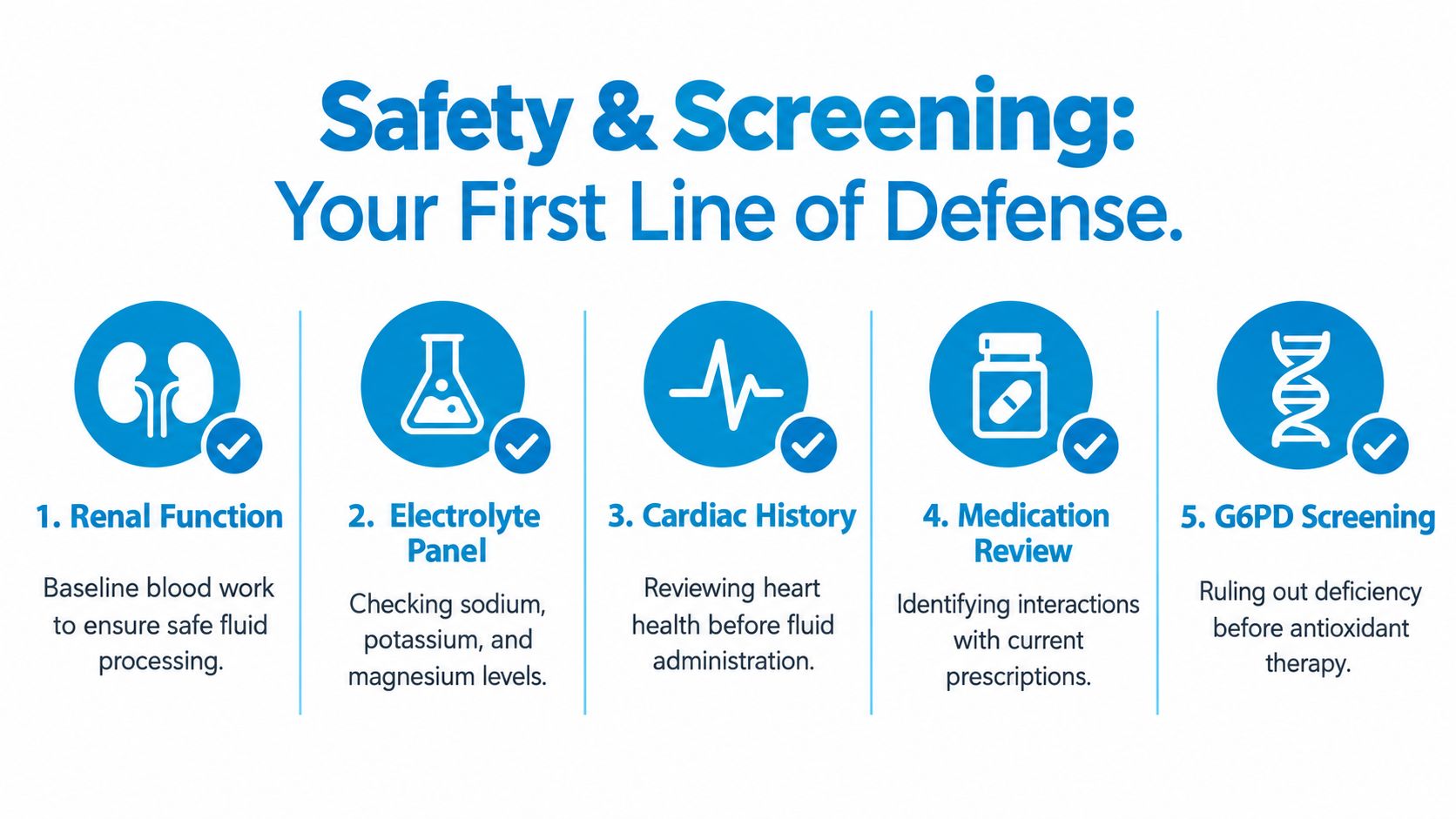
Before prescribing, the clinician should establish a baseline suited to the proposed ingredients and fluid volume. The review may include:
- Renal function: Kidney impairment can alter the handling of fluids, minerals, and metabolites.
- Electrolytes: Abnormal sodium, potassium, or magnesium levels may worsen during treatment.
- Cardiac history: Heart disease, low cardiac output, and fluid sensitivity can affect whether outpatient hydration is appropriate.
- Medication review: Prescriptions, chemotherapy, supplements, and allergies may require a different formula or a decision to defer treatment.
- G6PD screening: This matters before high-dose vitamin C and other protocols that may create oxidative hemolysis risk.
High-dose IV vitamin C requires a separate level of review. Because the screening criteria were outlined earlier, the practical question here is who verifies them. The prescriber should document G6PD status and renal review in the chart before the first dose, then select the dose and monitoring plan according to the patient's condition. Higher-dose protocols warrant particular caution in patients with impaired renal clearance, fluid-management problems, or other relevant risk factors.
Sterility is part of the prescription
The FDA has identified IV hydration clinics and medical spas among settings where compounded products may be prepared under insanitary conditions in its drug-compounding regulatory response. A responsible facility should explain who authorizes the prescription, where each ingredient comes from, and how it records lot numbers, expiration dates, storage conditions, aseptic preparation, and beyond-use dates.
CDC guidance covers hand hygiene, protective equipment, injection practices, and the handling of contaminated equipment and surfaces. The CDC outpatient infection-control guidance addresses needles, syringes, IV tubing, medication vials, and parenteral solutions. The CDC core infection-control practices also support dedicating administration sets to one patient and using single-dose vials where possible.
Ask the provider:
- Who evaluates and prescribes the infusion?
- Who supplies or compounds each ingredient?
- Are lot, expiration, and beyond-use records retained?
- Which vital signs and symptoms are monitored?
- What is the response to an allergic reaction, faintness, chest symptoms, or an IV-site complication?
- How will the clinic coordinate with your oncologist, rheumatologist, or primary clinician?
For comparison across jurisdictions, Dubai IV treatment regulations illustrates why licensing, clinical oversight, and accountability matter wherever infusion care is provided.
How an Integrative Clinic Approach Differs From a Hydration Bar
A walk-in hydration bar is designed around convenience and elective use. An integrative medical clinic approaches IV treatment as one decision within a longitudinal care plan. The distinction isn't that every hydration bar is unsafe or that every medical infusion is necessary. The distinction is the level of clinical reasoning applied before, during, and after the infusion.
A complex case may involve an oncologist, rheumatologist, primary care physician, gastroenterologist, or infectious-disease specialist. The infusion clinician needs to understand those diagnoses and treatments before adding a new intervention. A patient with kidney disease, heart disease, pregnancy, medication sensitivity, or an active cancer protocol shouldn't be treated as a standard hydration customer.
The practical differences
The integrative model starts with intake, records, relevant testing, and a defined objective. It can incorporate nutrition, lifestyle measures, conventional treatment, and complementary therapies while tracking whether the patient is tolerating the plan. A formula may be changed or discontinued when laboratory findings or symptoms change.
A standalone service may offer a fixed set of named drips. That can be easy to understand, but a familiar name doesn't tell you whether the ingredients, concentration, infusion rate, or monitoring fit your medical history.
| Feature | Integrative Clinic | Standalone Infusion Bar |
|---|---|---|
| Initial decision | Based on history, goals, records, and clinical assessment | Often based on a selected service or symptom |
| Formula | Individualized to the proposed purpose and safety findings | May be organized around standardized menus |
| Conventional care | Coordination can be built into the plan | Coordination may be limited or patient-managed |
| Monitoring | Includes protocol-specific observation and reassessment | May focus on the infusion encounter |
| Follow-up | Response and tolerability can inform later decisions | Repeat visits may be based on preference |
| Accountability | Prescriber, administering clinician, and product source should be identifiable | Oversight structure varies by service |
For patients with complex chronic disease, a single infusion can't replace diagnostic work, medication management, or specialty care. It may be useful only when it fits those pieces.
What a First Visit Looks Like From Intake to Follow-up
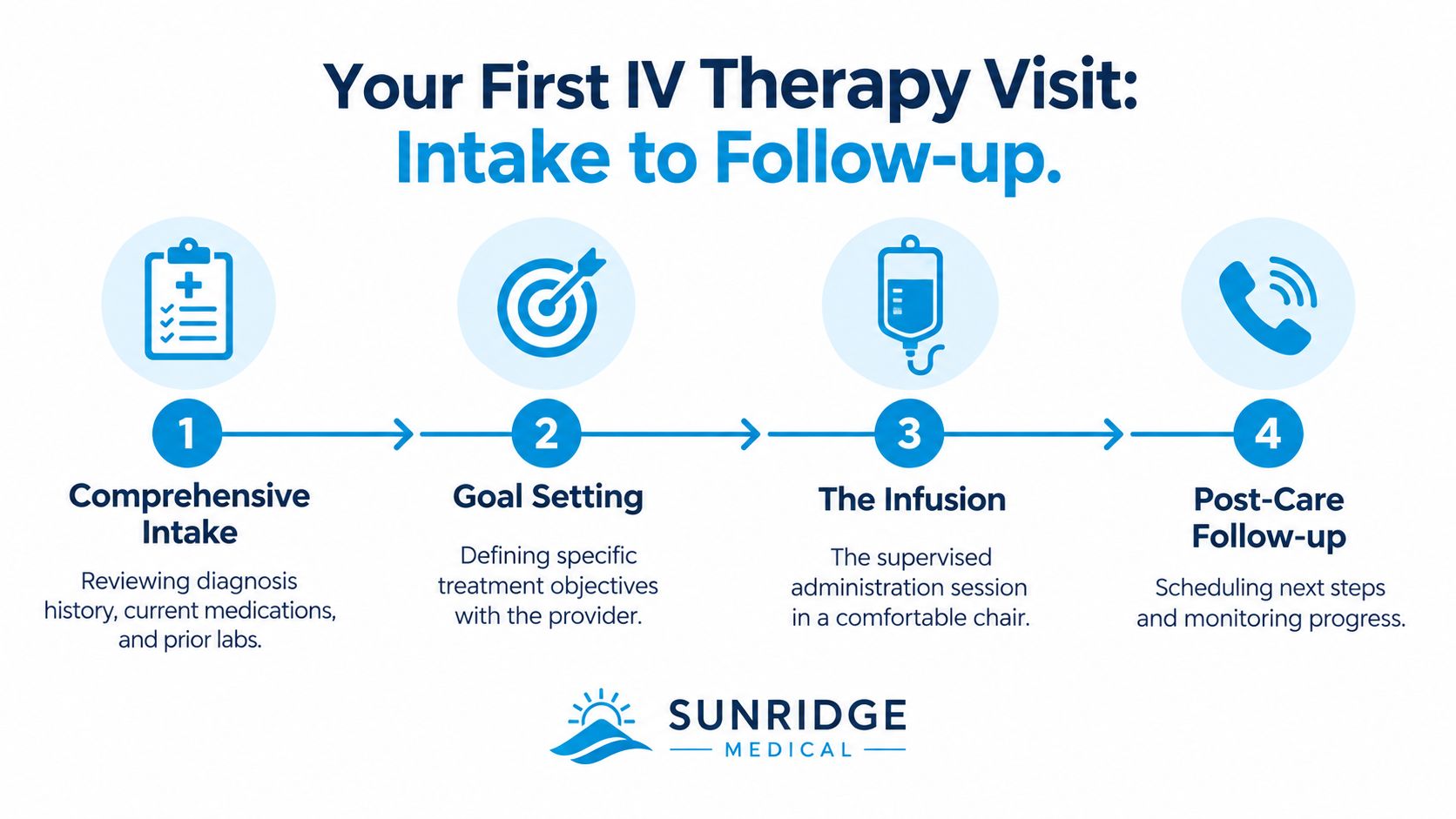
The first appointment should feel more like a medical consultation than a transaction. The intake reviews your diagnosis history, current medications, prior laboratory work, allergies, previous infusion reactions, treatment goals, and the clinicians already involved in your care.
The provider then identifies the testing needed for the proposed protocol. That may include renal function, electrolytes, and a review of cardiac history. High-dose vitamin C requires particular attention to G6PD status and renal or oxalate-related risk. The results should shape the formula, concentration, infusion rate, and decision to proceed.
During the infusion
After the order is reviewed, staff should confirm the patient, ingredients, route, and intended protocol. A trained clinician places the catheter using aseptic technique, checks the IV site, records baseline vital signs, and observes the patient during administration. The session length depends on the formulation, dose, fluid volume, and tolerance.
Patients may notice warmth, a change in taste, an urge to urinate, or discomfort at the IV site with some formulations. Those symptoms should be reported rather than dismissed. Slowing or stopping the infusion, checking the site, reassessing vital signs, or activating an emergency response may be appropriate depending on the reaction.
After the appointment
Observation doesn't end when the bag is empty. Staff should assess the IV site, symptoms, and vital signs before discharge and explain what requires prompt medical attention. Follow-up laboratory testing should be tied to the treatment objective rather than ordered automatically.
A practical facility checklist includes:
- Before treatment: Confirm who reviewed your medical history and who authorized the infusion.
- Before insertion: Ask how staff prepare the room, supplies, access points, and medication.
- During treatment: Confirm that a qualified clinician remains available and monitors your response.
- After treatment: Request written instructions, the administered ingredients, and the follow-up plan.
- Between visits: Ask what measurable findings would justify repeating, changing, or stopping the protocol.
The most useful outcome is not a subjective promise that you'll feel different immediately. It's a documented clinical response that makes sense in relation to the original goal and remains acceptable in terms of safety and tolerability.
Travel Logistics, FAQs, and How to Begin
Patients traveling to Scottsdale from Phoenix, Paradise Valley, Tempe, Mesa, Chandler, Gilbert, or elsewhere in the greater Phoenix metropolitan area can usually plan care around an initial consultation rather than an unscheduled infusion. Out-of-town patients should allow enough flexibility for records review, laboratory testing, the clinical assessment, and any follow-up that the protocol requires. The right schedule depends on the diagnosis, the proposed treatment, and whether testing is available before arrival.
Bring a current medication and supplement list, relevant imaging and laboratory reports, pathology or oncology records when applicable, and contact information for the clinicians coordinating your care. With permission, the care team can share records and post-visit summaries with your local oncologist, rheumatologist, primary care clinician, or other specialist.
Common questions
Does insurance cover integrative IV care? Coverage depends on the service, diagnosis, plan, and insurer. Ask for a written explanation of fees and what is included before scheduling treatment.
Can I bring outside records? Yes. Complete records are more useful than a symptom list alone, especially when cancer treatment, kidney disease, autoimmune medication, or prior infusion reactions are involved.
Will the protocol be adjusted? It should be adjusted when new laboratory data, medication changes, symptoms, or treatment responses alter the risk-benefit assessment. Established patients may be able to coordinate some follow-up remotely, but that doesn't eliminate the need for appropriate clinical review.
Can I book a same-day drip? A same-day appointment may not be medically appropriate if the clinician hasn't reviewed your history, medications, laboratory needs, and treatment goals. A consultation is the safer starting point for complex illness.
What should I expect from cost discussions? Ask which evaluation, laboratory work, infusion ingredients, monitoring, follow-up, and coordination services are included. Transparent pricing should accompany a clear explanation of the clinical purpose.
For patients considering IV therapy in Scottsdale, Sunridge Medical offers physician-directed integrative evaluation and infusion options for cancer care and complex chronic conditions. Contact the clinic to discuss your records, treatment goals, and whether a consultation is appropriate before scheduling any infusion.