


Ozone IV therapy is an off-label adjunctive treatment that requires strict medical supervision and careful patient selection. Direct intravenous gas administration must be avoided because rare but serious complications, including gas embolism, can occur.
You may be searching for ozone IV therapy in Scottsdale after conventional treatment hasn't fully addressed a chronic or complex health problem. Perhaps you've read local wellness pages describing energy, immune, inflammation, or recovery benefits, then encountered regulatory warnings that sound far more concerning. Both perspectives matter, but neither is enough on its own to guide a safe decision.
The clinically relevant question is not just whether ozone therapy is “good” or “bad.” It's whether the proposed route, protocol, screening process, medical oversight, and treatment goal make sense for your health history. Ozone therapy is an investigational or adjunctive modality, not a replacement for urgent care, cancer treatment, antibiotics, antivirals, or evaluation of serious symptoms.
Table of Contents
- Understanding Ozone IV Therapy in Scottsdale
- The Science Behind Ozone IV Therapy
- Evaluating Benefits and Clinical Evidence
- Safety Protocols and Contraindications
- The Patient Experience at Sunridge Medical
- Why Choose an Integrative Clinic for Complex Care
Understanding Ozone IV Therapy in Scottsdale
People in Scottsdale, Phoenix, Paradise Valley, Tempe, Mesa, Chandler, Gilbert, and the wider Phoenix metropolitan area often look for integrative options after standard care has produced limited relief. That search can be especially difficult when symptoms involve several systems at once, such as fatigue with inflammatory complaints, persistent symptoms after infection, autoimmune activity, or a complex cancer-care plan.
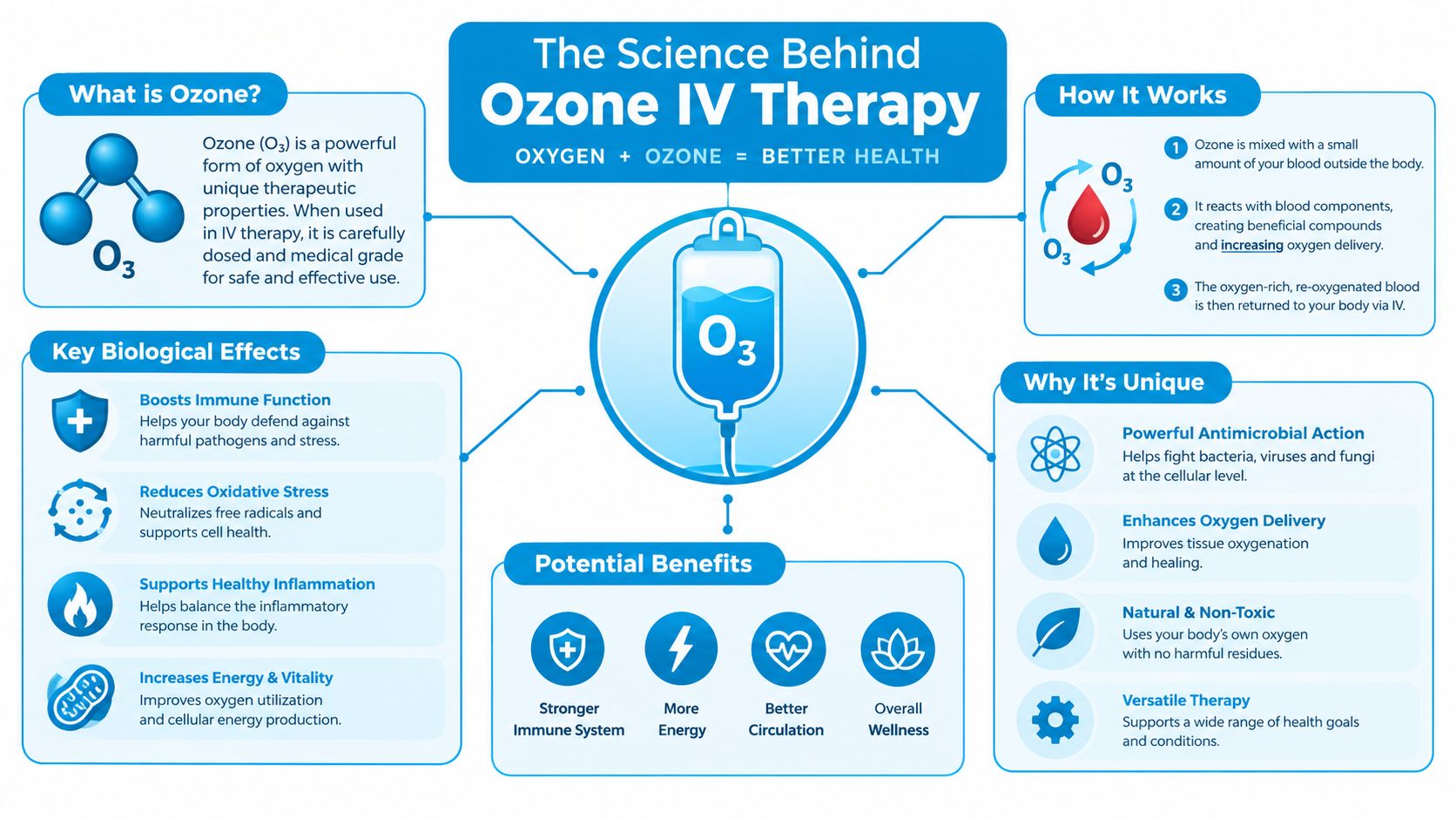
The first step is separating a clinical procedure from broad “wellness” language. The method most often discussed as systemic ozone autohemotherapy involves your own blood:
- A clinician draws blood into a sterile, closed collection system.
- A measured ozone and oxygen mixture contacts the blood outside your body.
- The treated blood is returned through an IV.
The exposure occurs in the collection system, not by injecting ozone gas directly into a vein. That distinction is fundamental. A patient considering treatment should be able to ask exactly how blood is handled, how the system prevents gas from entering the circulation, and who is responsible for monitoring the procedure.
Why the terminology matters
Ozone is often associated with disinfection because it can react strongly with biological materials. In systemic therapy, however, the proposed mechanism isn't that ozone travels through the bloodstream to sterilize the body. The relevant reaction occurs when ozone contacts blood, producing short-lived signaling compounds that may influence cellular responses.
This is a medical intervention involving venous access, blood handling, an external gas exposure, and reinfusion. It therefore deserves the same seriousness as any other procedure, including review of medications, medical conditions, laboratory information, allergies, prior reactions, and treatment goals.
Practical rule: If a provider presents ozone IV therapy as risk-free, universally appropriate, or a substitute for established treatment, ask for a more careful explanation before proceeding.
Ozone has a long history outside modern Scottsdale integrative clinics. It was first noted in 1785, named in 1840, and used for water purification in 1857. Medical applications were reported in Europe by the mid-1800s, Russia formally recognized ozone therapy at the state level for dermatology by 2005, and the 2010 Madrid Declaration on Ozone Therapy became a major standardization milestone. These historical facts show that the modality has an older global tradition, but history alone doesn't establish effectiveness for a particular disease. A review of ozone therapy's history and development helps place the treatment in context.
The Science Behind Ozone IV Therapy
The biological rationale for ozone autohemotherapy is more nuanced than the phrase “oxygen therapy” suggests. Ozone does not merely add oxygen to every tissue, and the proposed benefit isn't based on flooding the body with a disinfectant. Instead, controlled contact with blood creates a brief chemical signal that may prompt the body to adjust its own protective responses.
A controlled signal, not direct tissue oxidation
When ozone contacts blood outside the body, it generates transient reactive oxygen species and lipid ozonation products. These compounds act as signaling mediators. Their proposed role is to communicate with cells and influence pathways involved in antioxidant defense and adaptation.
One important pathway is Nrf2, a cellular control system involved in the expression of endogenous antioxidant defenses. In plain language, the treatment is intended to give the body a measured signal that may encourage its own protective machinery to respond. This concept resembles hormesis, where a controlled, limited stressor can stimulate an adaptive response. The dose must remain controlled because a larger or poorly delivered oxidative exposure can cause harm rather than adaptation.
The literature also discusses modulation of hypoxia-response signaling, including HIF-1. HIF-1 helps cells respond when oxygen availability changes. That doesn't mean ozone therapy automatically improves oxygen delivery or corrects every circulation problem. It means researchers are examining whether carefully managed blood exposure can influence signaling related to oxygen use and cellular stress.
Why dose and route change the discussion
The biological response depends strongly on dose, concentration, and route. A protocol that treats blood externally is not equivalent to placing gas directly into a vein. Short-term safety has been reported in some controlled settings, while long-term safety remains insufficiently characterized. Those limits should shape how a clinician describes potential benefits.
The treatment also isn't best understood as directly “killing pathogens in the blood.” The proposed systemic effect is indirect and signaling-based. That distinction matters for anyone considering ozone as part of care for chronic infection, cancer, autoimmune disease, or another serious condition. A patient still needs disease-specific diagnosis and treatment, and ozone shouldn't be presented as a proven antimicrobial or anticancer cure. For a more detailed discussion of clinical context, review this clinical guide to ozone therapy for chronic infections.
Evaluating Benefits and Clinical Evidence
Ozone therapy is often discussed in integrative medicine for goals such as inflammation modulation, immune signaling, oxygen utilization, and support during complex care. Those are proposed or investigational applications, not guaranteed outcomes. The evidence remains inconsistent and low-certainty overall, particularly for major claims involving cancer or infectious diseases.
The U.S. regulatory position is important. The FDA classifies ozone as a toxic gas with no proven medical utility in specific, adjunctive, or preventive therapy, and it warns that ozone hasn't been authorized for any medical condition. A recent review also concludes that routine clinical use isn't justified on the current evidence base. This Frontiers review of ozone therapy's regulatory and clinical status explains why clinicians should describe the therapy cautiously.
| Aspect | Details |
|---|---|
| Proposed biological role | Ozone contacts blood outside the body and creates transient signaling molecules that may influence antioxidant and inflammatory pathways. |
| Common integrative rationale | Clinicians may consider it as supportive care for selected patients, alongside evaluation and established treatment. |
| Evidence boundary | Evidence remains insufficient for many conditions promoted in ozone marketing, including cancer and infectious diseases. |
| Regulatory status | The FDA hasn't approved ozone therapy for medical use. |
| Patient decision | The potential rationale must be weighed against uncertain benefit, route-specific risks, contraindications, and alternatives. |
The distinction between a possible mechanism and a demonstrated clinical outcome is central. A pathway can be biologically plausible without proving that a patient will feel better, recover faster, or experience disease control. People with cancer, chronic infection, autoimmune illness, or vascular disease should be particularly wary of replacing treatments with established roles.
For readers comparing approaches, this clinical guide to oxidative therapy for chronic disease can provide additional context. The most responsible plan uses measurable clinical goals, reassessment, and coordination with appropriate conventional care rather than relying on broad promises.
Safety Protocols and Contraindications
A patient arrives expecting a restorative IV session, yet the safety of ozone therapy depends less on the wellness label than on the protocol behind it. Route, screening, equipment, and monitoring determine whether treatment is being approached as controlled medical care or as casual marketing. Using a patient's own blood does not remove the risks of reinfusion, blood handling, or inappropriate gas delivery.
The route is not a technical detail
Direct intravenous gas administration is not recommended. Gas entering the vascular system can obstruct blood flow and has been associated with severe complications, including fatal gas embolism. Reviews also describe rare but serious events such as stroke, myocardial infarction, thrombosis, and hemolysis. This clinical review of ozone therapy safety explains why external blood treatment and controlled reinfusion must be distinguished from injecting gas into a vein.
A safer protocol draws blood into a closed system, exposes it to a controlled ozone mixture outside the body, and then reinfuses it under clinical supervision. The clinician should confirm that gas cannot enter the vein, maintain sterile technique, observe the patient, and explain consent in plain language. These steps are the practical safeguards that separate a specialized protocol, such as one used for complex multimodal cases at Sunridge Medical, from an improvised wellness procedure.
Screening protects the patient
G6PD deficiency requires specific attention because oxidative exposure can cause severe hemolysis in susceptible patients. Screening should also consider vascular disease, bleeding risk, medications, thyroid status, pregnancy-related factors, active medical instability, and the reason for seeking treatment. A short intake form may miss risks that become clear only through a clinician-led review.
Ask the clinic:
- Route: Is blood treated outside the body, or is gas introduced directly into a vein?
- Screening: How are G6PD deficiency and other individual risks assessed?
- Monitoring: Who observes the patient, and what is the response plan for a reaction?
- Consent: Will the discussion cover uncertain benefit and rare, serious complications?
- Coordination: Will the procedure be coordinated with existing physicians and treatments?

Ozone inhalation presents a different hazard because it can injure the lungs. IV treatment adds risks from the IV itself, blood handling, and incorrect gas delivery. Cleveland Clinic summarizes the FDA warning and serious IV-specific concerns, including air embolism. Its patient guide to ozone therapy offers a plain-language safety overview, while this guide to ozone therapy side effects explains potential reactions in more detail.
The Patient Experience at Sunridge Medical
A responsible consultation begins before anyone discusses a treatment schedule. The clinician first needs to understand why you're considering ozone therapy, what has already been tried, which diagnoses have been confirmed, and whether an unresolved problem requires conventional evaluation rather than an adjunctive procedure.
That review may include cancer history, autoimmune disease, chronic infection concerns such as Lyme disease, neurologic symptoms, medications, prior procedures, allergies, laboratory results, and vascular or bleeding risks. The purpose isn't to force every patient into the same protocol. It's to determine whether ozone has a defensible role at all.
From consultation to a monitored session
A typical clinical pathway may include:
- Medical review: The team clarifies symptoms, diagnoses, current treatment, and objectives.
- Risk assessment: Contraindications and relevant laboratory information are reviewed before treatment.
- Shared decision-making: The clinician explains the proposed route, uncertain evidence, alternatives, and warning signs.
- Procedure planning: If appropriate, blood is drawn into a closed system for controlled external exposure and reinfusion.
- Follow-up: The team evaluates tolerance, symptoms, objective findings, and whether continuing makes sense.
The consultation should also address what ozone therapy won't do. It won't replace chemotherapy, radiation, surgery, antimicrobial therapy, immunosuppressive treatment, or emergency care when those are indicated. For complex illness, the value of an integrative approach lies in coordinating modalities rather than stacking treatments without a coherent medical plan.
Patients may also need support with nutrition, hydration, metabolic health, environmental exposures, symptom management, or recovery planning. Those elements should be selected according to the individual's condition, not added automatically because they sound complementary. This guide to a first IV therapy session describes the kind of preparation and communication patients should expect before an IV-based treatment.
Follow-up matters because short-term tolerance doesn't establish long-term benefit. A clinician should define what will be monitored and when the plan will be reconsidered. If the intended outcome can't be assessed, continuing indefinitely becomes difficult to justify.
Why Choose an Integrative Clinic for Complex Care
Complex illness rarely fits a single-treatment story. A patient may have a diagnosed disease, medication effects, nutritional problems, sleep disruption, pain, immune dysregulation, or unresolved environmental concerns at the same time. An integrative clinic can be useful when it keeps those factors in view while preserving appropriate conventional medical oversight.
That doesn't mean every alternative therapy belongs in every plan. It means the clinician should ask whether a modality has a plausible role, whether the patient's risks are acceptable, and how the treatment fits with established care. Ozone IV therapy may be considered only as an individualized adjunctive option, with route-specific precautions and clear limits on what can reasonably be promised.
What careful evaluation looks like
For a Scottsdale patient, a sound assessment may include:
- A complete clinical history: Prior diagnoses, treatments, procedures, medications, reactions, and current symptoms.
- Disease-specific coordination: Communication with oncology, infectious disease, neurology, rheumatology, primary care, or another appropriate specialist when needed.
- Risk-based screening: Attention to G6PD deficiency, vascular disease, bleeding concerns, and other factors that may make treatment unsuitable.
- Defined objectives: A specific reason for considering ozone, along with clinical checkpoints rather than open-ended treatment.
- Continuity: Follow-up that considers whether the therapy is helping, doing nothing, or creating problems.
Sunridge Medical is an integrative medical clinic in Scottsdale that evaluates complex chronic conditions and cancer-care needs using individualized plans that may combine conventional, traditional, and alternative approaches. For patients traveling from Phoenix, Paradise Valley, Tempe, Mesa, Chandler, Gilbert, or beyond Arizona, the practical question is whether the clinic can review the whole medical picture and coordinate care appropriately, not just whether it offers a particular procedure.
A patient seeking a second opinion should bring medical records, current medication information, relevant laboratory results, imaging, pathology, and a concise timeline of symptoms and prior treatment. That information helps the clinician distinguish a reasonable adjunctive discussion from a situation requiring a different medical priority.
The central decision remains personal and clinical. If the expected benefit is uncertain, the patient must understand the risks, alternatives, costs, logistics, and opportunity cost of treatment. A cautious clinician won't guarantee an outcome and won't discourage established care merely to promote an investigational option.
If you're considering ozone IV therapy in Scottsdale, Sunridge Medical offers individualized evaluation for patients with cancer, chronic disease, autoimmune concerns, and complex multisystem symptoms. Visit Sunridge Medical to request a consultation, bring your medical records for review, and discuss whether a carefully monitored integrative plan is appropriate for you.