


A ketogenic diet is a research question, not a proven cancer treatment. If you’re considering a ketogenic diet for cancer patients, conflicting online claims can make it hard to distinguish promising laboratory findings from evidence that a diet improves outcomes for people. It’s understandable to wonder whether changing what you eat could affect treatment, especially when cancer care is already affecting your appetite, weight, digestion, or ability to eat consistently.
You deserve clear information and a respectful conversation about your questions. This article explains the biological rationale for keto, what human research can and cannot show, and why early findings aren’t proof that the diet treats cancer. It also covers potential risks and why a restrictive eating plan may not suit every diagnosis, treatment, or nutritional situation. You’ll find practical questions to bring to your oncologist and an oncology dietitian, including ways to raise the topic without feeling judged or dismissed. Diet decisions should support your overall care, not replace or delay cancer treatment.
Key Takeaways
- The ketogenic diet for cancer patients has a biological rationale, but laboratory findings and early clinical research don’t establish it as a proven cancer treatment.
- The Warburg effect is one reason researchers study keto, not a universal explanation of how every cancer behaves.
- Whether a restrictive diet is appropriate depends on your diagnosis, treatment, symptoms, and nutritional status.
- Prepare to speak with your oncologist by clarifying your goals, sharing relevant health details, and asking how risks and follow-up would be assessed.
- Integrative care should coordinate nutrition questions with conventional cancer treatment. An individualized evaluation can help guide the discussion without treating keto as a prescribed protocol.
What Does a Ketogenic Diet Mean for Cancer Patients?
When you hear that cancer cells rely on sugar, it’s understandable to wonder whether changing your diet could make a difference. Some patients explore keto hoping to gain a sense of control or support during treatment. But nutrition decisions during cancer care are personal. Changes in appetite, weight, digestion, and treatment needs all affect what may be appropriate.
A ketogenic eating pattern is high in fat, very low in carbohydrates, and includes adequate protein. It shifts the body’s fuel use, encouraging it to make ketones from fat. Foods and amounts vary, so this description is not a prescription or a recommended target for an individual patient.
The Ketogenic diet has a general overview of this eating pattern and discusses research into cancer. The key distinction is that a diet can change metabolism without being shown to improve cancer outcomes. A ketogenic diet for cancer patients is not an established cancer cure, and it should not replace, delay, or interrupt oncology treatment.
How ketosis differs from a cancer treatment
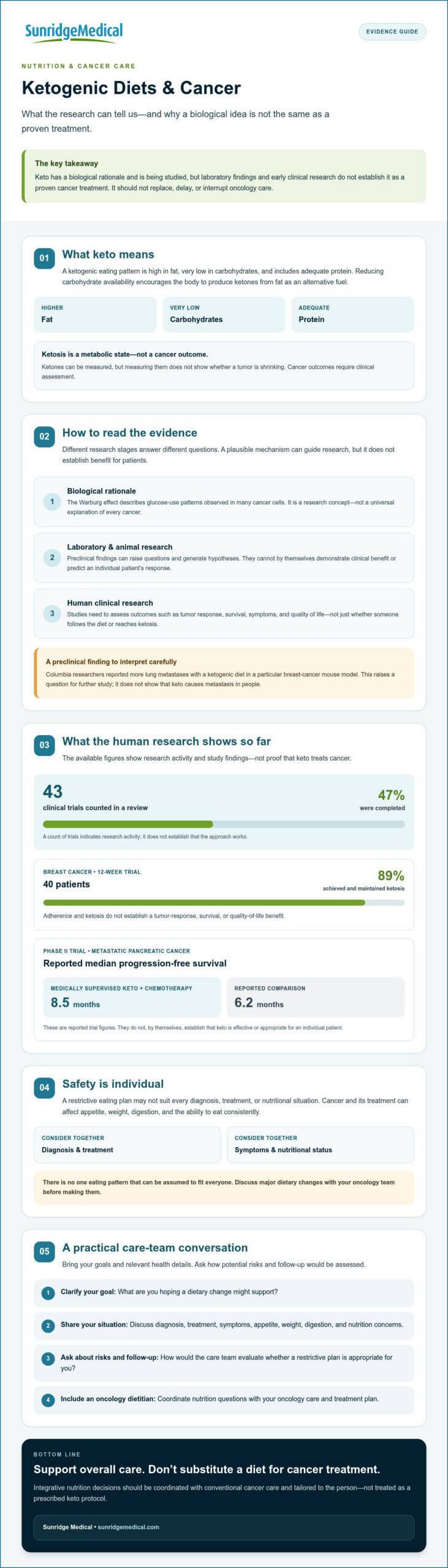
Ketosis is a metabolic state in which the body produces ketones as an alternative fuel after carbohydrate availability is reduced. Ketones can be measured, but those measurements don’t show whether a tumor is shrinking. That requires clinical assessment of cancer outcomes. A measurable change in fuel use is not, by itself, evidence of therapeutic benefit.
Why patients hear about keto and cancer
Researchers have studied whether changing fuel availability might affect processes used by some cancer cells. This idea draws partly on observations that certain tumors use glucose differently from many normal cells. It’s a hypothesis to investigate, not a rule that describes every cancer.
Cancer is biologically diverse. Tumors can differ in how they use energy, and their behavior may change with their environment and treatment. A plausible biological rationale does not establish that a diet is safe, effective, or beneficial for a particular patient. Those questions require human clinical evidence and individual medical judgment.
A practical first step is to discuss the proposed diet with your oncology team before making major changes. A clinician can consider your diagnosis, current treatment, symptoms, and nutritional status instead of assuming one eating pattern suits everyone.
What Does Research Say About a Ketogenic Diet for Cancer Patients?
Evidence about keto and cancer spans laboratory experiments, animal models, and human trials. Each type of research answers different questions. A mechanism that appears plausible in a cell or mouse can guide further study, but it cannot establish that a diet improves outcomes for patients. That distinction matters when assessing claims about the ketogenic diet for cancer patients.
What laboratory and animal studies can, and cannot, show
The Warburg effect describes a pattern observed in many cancer cells: they use glucose in ways that differ from typical cells, even when oxygen is available. It’s a research concept, not a universal explanation of cancer metabolism. A review indexed by the National Library of Medicine discusses this rationale and its limitations.
In 2024, Columbia researchers reported that a ketogenic diet was associated with more lung metastases in a particular breast-cancer mouse model. This finding raises a question for further study; it does not show that keto causes metastasis in people. Preclinical evidence can generate hypotheses, but it cannot by itself demonstrate clinical benefit or predict an individual patient’s response.
What human studies need to establish
Human research needs to distinguish whether a diet can be followed or changes ketone levels from whether it affects tumor response, survival, symptoms, or quality of life. A May 2026 review counted 43 clinical trials of ketogenic dietary interventions in cancer care, with 47% completed. The number of trials signals research activity, not proof that the approach works.
| Study type and population | Finding | Limitation and what remains unknown |
|---|---|---|
| 12-week trial, 40 patients with breast cancer | 89% of participants assigned to keto achieved and maintained ketosis. | Adherence and ketosis don’t establish tumor response, survival, or quality-of-life benefit. |
| Phase II trial, metastatic pancreatic cancer | A 2026 report found median progression-free survival of 8.5 months with medically supervised keto plus chemotherapy, versus 6.2 months with usual diet. Median overall survival was 13.7 versus 10.2 months. | One trial’s results need careful interpretation and confirmation; they don’t establish benefit across cancers or patients. |
| Phase 2 study, newly diagnosed glioblastoma | A 170-patient study was recruiting in August 2026 to compare keto with a standard anti-cancer diet alongside standard care. | Recruitment is not a result. The study’s outcomes are not yet known. |
As of late 2025 and early 2026, the American Cancer Society and American Institute for Cancer Research did not recommend keto as a cancer treatment. Research continues, but questions about safety, which patients might benefit, and meaningful clinical outcomes remain unresolved. If you’re considering how the evidence applies to your situation, Sunridge Medical describes its individualized cancer care approach as combining conventional therapies with research-based alternative treatments, not as a ketogenic diet protocol.
Is a Ketogenic Diet Safe for Cancer Patients?
There isn’t one safety answer for everyone. Whether a ketogenic diet for cancer patients is appropriate depends on the person’s diagnosis, treatment, symptoms, nutritional status, and current eating pattern. A diet one person can manage may be unsuitable for someone else, especially if treatment is already making it hard to eat enough.
Before making substantial dietary changes, ask your treating oncologist to review your situation. An oncology dietitian, when available, can help assess whether a proposed plan fits your nutritional needs and care. The goal is not to judge your food choices. It’s to identify potential concerns early and support your overall treatment plan.
Treatment and nutrition factors clinicians should assess
Describe what you’re experiencing now, not just what you hope a diet might do. Appetite, recent weight changes, nausea, bowel symptoms, swallowing or digestion difficulties, and treatment-related fatigue can all affect food intake. Existing dietary restrictions and other health conditions matter, too.
During some phases of cancer care, maintaining adequate nutrition and avoiding further unintended weight loss may be a priority. If you’re eating less than usual, losing weight without trying, or struggling to keep food down, tell your treatment team promptly rather than adding a restrictive plan on your own. A clinician can help assess the cause and decide what support is appropriate.
Potential downsides of strict dietary restriction
A very-low-carbohydrate eating pattern can narrow food choices and may make it harder for some people to meet their needs, particularly when appetite is low or treatment causes eating difficulties. That doesn’t mean every patient will experience harm. It does mean that tolerability, nutritional adequacy, and changes in weight or symptoms deserve attention and individual review.
Research has also raised concerns that require careful interpretation. Some animal studies have reported adverse effects in specific cancer models, including a 2024 mouse study of breast cancer that found more lung metastases with a ketogenic diet. That result is not proof that keto causes metastasis in human patients. It does show why findings from a single model should not be treated as a safety verdict for every person or cancer type.
Cancer patients should not begin a restrictive diet without clinical review. Ask your oncology team whether your current symptoms, treatment, and nutritional status make dietary restriction a concern, and what signs should prompt you to check in. If you’re already having difficulty eating or maintaining weight, raise that before focusing on a specific diet.
How Should Cancer Patients Discuss Keto With Their Care Team?
You can ask about diet without having to defend your interest or make a decision on the spot. Before trying a ketogenic diet for cancer patients, discuss it with your treating oncologist and, when available, an oncology dietitian. They can consider how the idea fits your diagnosis, treatment plan, symptoms, nutritional status, and personal goals.
Use this sequence to make the conversation specific and practical:
- Clarify your goal. Write down what you hope to achieve, such as understanding a claim you encountered or addressing a nutrition concern. Ask whether a dietary change is likely to address that goal.
- Gather relevant health details. Note your current and planned treatments, medications, existing dietary restrictions, appetite, digestion symptoms, and recent changes in weight or food intake. Bring the article, study, or online claim that prompted your interest.
- Ask about risks and alternatives. Find out whether carbohydrate restriction could complicate your care or make it harder to meet nutritional needs. Ask what other options might address your goal with less dietary restriction.
- Agree on follow-up. If your team considers a dietary change, ask who will monitor your intake, weight, symptoms, and any relevant laboratory measures, and when you should check in.
Questions to ask before changing your diet
- Does this approach fit my cancer diagnosis, treatment plan, current symptoms, and nutritional status?
- Could it affect my treatment, medications, or ability to maintain adequate nutrition?
- How should we monitor my food intake, weight, symptoms, and any relevant lab results?
- What changes or symptoms should prompt me to stop the diet and contact the care team?
How to evaluate claims and make a shared decision
Bring the exact claim or study rather than relying on a headline or general promise. Ask whether it involved people, laboratory research, or animal models; what outcomes it measured; and whether those outcomes apply to your situation. Weigh the strength of the evidence alongside the practical demands of the diet and your care priorities.
Agree on a plan with your clinicians before making major dietary changes. Don’t start a restrictive diet, stop cancer treatment, or change medication based on online advice. For broader context on coordinated cancer care, read Sunridge Medical’s integrative cancer treatment guide. To learn about the center’s approach, explore its alternative cancer treatment protocols.
How Can Integrative Oncology Support Nutrition Decisions?
Nutrition questions are part of a larger care picture. Integrative oncology should coordinate diet discussions with conventional cancer treatment, not replace it. That means considering how a proposed change fits alongside the care plan and the patient’s needs, rather than treating a specific eating pattern as a stand-alone answer.
What individualized care can contribute
An individualized clinical review can consider a person’s diagnosis, current and planned treatment, symptoms, nutritional status, and goals together. This broader view can help frame questions about the ketogenic diet for cancer patients in the context of the whole care plan. Individualization does not establish that keto is appropriate or effective for every patient, and it should not be mistaken for a recommendation to restrict food.
Sunridge Medical describes its individualized plans as combining conventional therapies with research-based alternative treatments. That describes its overall approach, not a ketogenic diet protocol or oncology nutrition service. Patients with diet-specific questions should discuss them with the clinicians responsible for their cancer care and ask what nutrition expertise is available to support a safe decision.
A safe next step for patients exploring keto
Keep your oncology team involved before changing your eating pattern. Share what prompted your interest, what you hope to achieve, and any symptoms or difficulties with eating. If your clinicians advise against restriction, ask what other steps may better support your needs. If they consider a change, clarify how it will fit with treatment and how concerns will be addressed.
Integrative care is most useful when it supports informed decisions and continuity of conventional treatment. For a broader overview of how care considerations may differ by diagnosis and stage, see the integrative cancer treatment by stage guide.
If you’re seeking broader information about individualized care, you can contact Sunridge Medical about its approach. Keep your treating oncology team involved in nutrition decisions, and take the time you need to discuss your questions. A thoughtful, coordinated conversation can help you make choices with greater clarity while keeping established cancer treatment central to your care.
Make Your Next Nutrition Decision With Confidence
Research on a ketogenic diet for cancer patients remains unsettled: biological theories and early studies don’t prove it improves cancer outcomes. Safety also depends on your diagnosis, treatment, symptoms, and nutritional status, so discuss any significant dietary change with your oncology team before acting on online advice.
A useful next step is to bring your questions, goals, and current eating challenges to the clinicians involved in your care. Sunridge Medical describes its approach as individualized care that combines conventional therapies with research-based alternative treatments. Led by Medical Director Dr. Steven S. Isaacman, the practice has operated since 2003. This does not mean keto is a Sunridge protocol or that the clinic provides oncology nutrition services.
If you’d like to learn more about Sunridge’s individualized approach, contact Sunridge Medical to discuss individualized care. Keep your oncology team involved and give yourself room to make informed choices that support continuity of care. Clear questions and a coordinated conversation can help you move forward with greater confidence.
Frequently Asked Questions
Is a ketogenic diet proven to treat cancer?
No. A ketogenic diet isn’t an established cancer treatment or cure. Researchers are studying how it may affect metabolism and treatment outcomes, but biological theories, animal findings, and early human studies don’t establish that it treats cancer. Don’t use keto instead of prescribed care or change your treatment plan based on diet claims. If you’re interested in dietary changes, discuss them with your oncology team first.
Can cancer patients follow a ketogenic diet during chemotherapy?
Possibly, but whether it’s appropriate depends on your diagnosis, treatment, symptoms, and nutritional status. Chemotherapy and other treatments can affect appetite, digestion, and weight, which may make a restrictive eating plan difficult or unsuitable. Before changing your eating pattern, ask your treating oncologist to review potential risks and nutrition needs. An oncology dietitian may also be able to help assess whether the plan and monitoring fit your situation.
What does research say about keto and cancer growth?
Research is still developing, and different levels of evidence answer different questions. Laboratory studies explore how metabolism might affect cancer cells, while animal studies test hypotheses in specific models. Human research is needed to determine whether any effects translate into meaningful outcomes, such as tumor response or survival. A result in one cancer type or animal model shouldn’t be treated as a prediction for every person or cancer.
Can a ketogenic diet cause cancer to spread?
A 2024 Columbia-led study reported more lung metastases in a particular mouse model of breast cancer. That finding warrants further investigation, but it doesn’t prove that a ketogenic diet causes cancer to spread in people. Animal findings can’t determine an individual patient’s response. If this study has raised concerns for you, bring it to your oncology team and ask how to interpret it in the context of your diagnosis and care.
What are the risks of a ketogenic diet for someone with cancer?
Potential concerns vary by person and may include difficulty maintaining adequate nutrition or managing treatment-related eating symptoms. A restrictive plan may be especially challenging if your appetite, weight, or food intake is already affected. Before making dietary changes, ask a clinician to review your situation. Contact your care team promptly if you’re losing weight without trying, eating much less than usual, or having difficulty eating.
Should I stop cancer treatment to try a ketogenic diet?
No. Don’t stop, delay, or change cancer treatment to try a diet. Keto hasn’t been established as a replacement for cancer therapy, and changing your care without medical guidance may create serious risks. If you’re interested in dietary approaches, tell your oncologist and ask how the question can be assessed alongside your current treatment plan. Don’t change medications or treatment based on online diet advice.
Who should I talk to before starting keto during cancer care?
Start with the oncologist responsible for your treatment, and ask whether an oncology dietitian can review your nutrition needs. Share your diagnosis, treatments, symptoms, weight or intake changes, and the specific keto claim or research you’ve seen. This context can help your care team assess possible concerns and discuss whether a dietary change is appropriate. You can raise the question without committing to a particular eating plan.