


When considering natural remedies for Raynaud’s phenomenon, a practical place to start is with the triggers you may be able to reduce. Cold exposure and stress can bring on uncomfortable, disruptive episodes, and their timing isn’t always predictable. It’s understandable to look for strategies that fit everyday life.
Lifestyle measures may help limit common triggers, but natural approaches aren’t proven cures. Supplements can have uncertain benefits and may carry risks, including interactions with medications. Symptoms can also occur alongside an underlying condition, so it’s important to consider the wider medical picture rather than treating every episode in isolation.
This guide covers ways to prepare for cold and manage stress, what evidence can and can’t tell us about supplements, and why professional guidance matters when symptoms persist, worsen, or appear with other health concerns. It also explains how physician-led, individualized care can put symptoms in the context of complex or autoimmune conditions, with research-informed options considered alongside conventional medical care.
Key Takeaways
- Raynaud’s episodes involve narrowed blood vessels and reduced circulation, often affecting the fingers or toes.
- Explore practical natural remedies for Raynaud’s phenomenon by tracking personal triggers and building manageable warmth-focused habits.
- Biofeedback, acupuncture, and supplements vary in evidence and safety. Review potential risks before trying them.
- Record episode timing, symptoms, triggers, and self-care changes to support more useful conversations about your health.
- When symptoms occur alongside other health concerns, an individualized medical evaluation can help put them in the context of your broader health.
What Is Raynaud’s Phenomenon, and Why Do Natural Remedies Focus on Triggers?
Raynaud’s phenomenon is a pattern of episodes in which small blood vessels narrow temporarily, reducing blood flow to areas such as the fingers and toes. The nose, ears, lips, or other areas may also be affected. During an episode, a body part may feel unusually cold, numb, or uncomfortable, and its appearance may change. Symptoms can disrupt everyday tasks, from handling cold objects to fastening clothing.
Cold is a common trigger, and emotional stress can also prompt an episode. Triggers vary from person to person. One person may notice symptoms after stepping into chilly air, while another may be more affected by handling refrigerated items or feeling tense. Identifying personal patterns makes self-care more targeted than following a fixed list of supposed remedies.
Natural remedies for Raynaud’s phenomenon are best understood as strategies for managing relevant triggers and supporting comfort, not as cures. Keeping warm and reducing exposure to known triggers may help some people limit episodes, but these steps don’t establish what is causing symptoms or replace medical evaluation. A broader overview of Raynaud’s phenomenon also describes its symptoms and different forms.
What happens during a Raynaud’s episode?
Reduced circulation can make an affected area look pale or bluish, feel cold or numb, or become painful or tingly. As blood flow returns, the area may look red or feel throbbing or uncomfortable. Not everyone experiences the same color changes, order, intensity, or duration. Some people notice mainly numbness or coldness. A symptom pattern alone can’t confirm Raynaud’s or determine its cause.
Primary and secondary Raynaud’s: why the distinction matters
Primary Raynaud’s occurs without an identified underlying condition. Secondary Raynaud’s is associated with another condition or contributing factor. It can occur alongside autoimmune diseases, including systemic sclerosis, lupus, rheumatoid arthritis, or Sjögren’s syndrome. These forms may look similar during an episode, so appearance alone doesn’t distinguish them. The difference matters because secondary symptoms may need evaluation in the context of the associated health issue, not just trigger management.
A clinician may consider when symptoms began, how they have changed, medical history, medications, and other findings when assessing the picture. This doesn’t mean every cold or discolored finger signals an underlying disease. It does mean persistent, changing, or concerning symptoms deserve individualized attention, especially when they occur with other health concerns. Practical trigger strategies can be useful, while the right next steps depend on the person’s overall health and clinical assessment.
Which Natural Remedies for Raynaud’s Have Practical Value?
Start with steps that are manageable and connected to your own patterns. Preparing for cold exposure and noticing which situations tend to precede episodes are practical foundations. For broader wellness education on circulation and everyday self-care, resources like Wellness Center Magazine offer practical guidance to help build healthy routines. A brief record can help distinguish a recurring trigger from an occasional coincidence and make it easier to judge whether a change in routine is useful.
Lifestyle strategies: warmth, stress, movement, and habits
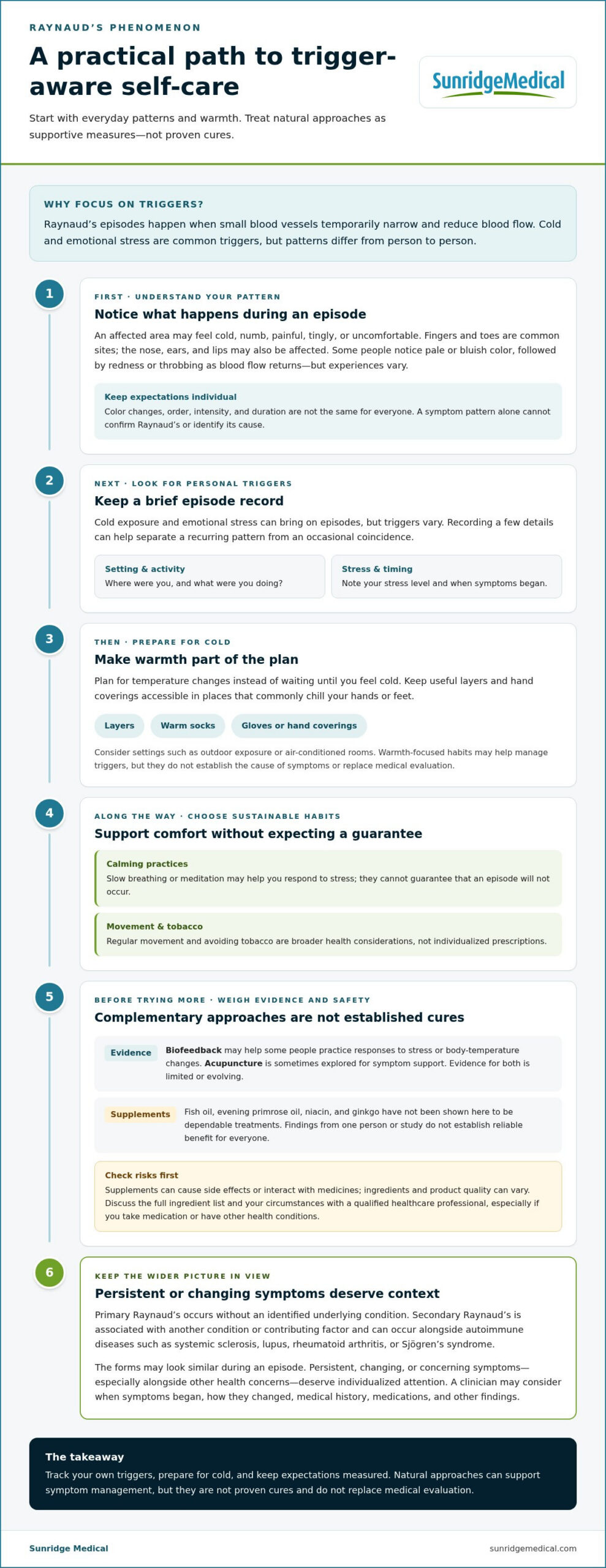
Plan for temperature changes rather than waiting until you feel cold. Layers, warm socks, and gloves may be useful in settings that commonly chill your hands or feet, such as outdoors or in air-conditioned rooms. Relaxation practices, including slow breathing or meditation, may help you respond to stress, but they can’t guarantee that an episode won’t occur. Regular movement and avoiding tobacco are broader health considerations, not individualized prescriptions. The National Institute of Arthritis and Musculoskeletal and Skin Diseases also describes lifestyle measures as part of managing Raynaud’s.
- Prepare for cold: Keep warm clothing or hand coverings accessible where temperature shifts are likely.
- Notice patterns: Record the setting, activity, stress level, and timing around episodes.
- Choose sustainable habits: Consider calming practices and regular movement that fit your routine, and discuss support for stopping smoking if relevant.
Supplements and complementary therapies: what the evidence can and cannot say
Biofeedback may help some people practice responses to stress or changes in body temperature, while acupuncture is sometimes explored for symptom support. Evidence for both remains limited or evolving, so neither should be treated as an established Raynaud’s therapy. Research on supplements is also uncertain. Fish oil, evening primrose oil, niacin, and ginkgo haven’t been shown here to be dependable treatments. Findings for one person or study don’t establish reliable benefit for everyone.
Lifestyle measures may support symptom management, but no natural remedy discussed here should be presented as a cure. Supplements can cause side effects or interact with medicines, and product ingredients and quality can vary. Before trying one, discuss the full ingredient list and your personal circumstances with a qualified healthcare professional, particularly if you take medication or have other health conditions. That conversation can help weigh a proposed benefit against possible risks instead of relying on a product’s marketing claims.
Use practical habits as supportive measures and keep expectations measured. Readers managing complex or chronic conditions alongside circulation symptoms can learn about Sunridge Medical’s physician-led integrative approach, where research-informed options are considered after an individualized evaluation and alongside conventional care.
How Do Raynaud’s Remedies Compare on Evidence, Safety, and Everyday Use?
Comparing options side by side can clarify what a remedy is intended to do, what evidence can support, and what safety questions remain. A daily habit is not equivalent to a supplement or practitioner-delivered therapy. The table offers a cautious overview, not a ranking or a personalized treatment recommendation.
| Approach | Intended role | Evidence limitations | Safety discussion |
|---|---|---|---|
| Warm clothing and trigger awareness | Reduce exposure to situations that may precede episodes. | Commonly included in self-care guidance, but individual benefit can vary. | Generally practical habits; adapt clothing and routines to your needs. |
| Relaxation and biofeedback | Support stress management and awareness of bodily responses. | Evidence for Raynaud’s is limited; results shouldn’t be assumed from other uses. | Consider whether the practice is comfortable and appropriate for you. |
| Acupuncture | Complementary symptom support. | Research is limited or evolving, so benefit isn’t established. | Discuss personal health considerations with a qualified practitioner and clinician. |
| Fish oil or evening primrose oil | Proposed nutritional support. | Available evidence doesn’t establish either as a Raynaud’s treatment. | Review ingredients, medication interactions, and suitability with a clinician or pharmacist. |
| Niacin or ginkgo | Supplements sometimes promoted for circulation. | Promotional claims aren’t proof of benefit for Raynaud’s. | Potential risks and interactions depend on the person and product. |
How should readers interpret evidence for natural remedies?
Preliminary findings or small, limited studies can suggest a question for further research, but they don’t establish a dependable treatment. Recommendations for practical self-care, such as protecting against cold, are different from proof that a supplement prevents episodes. Evidence from another condition can’t automatically be applied to Raynaud’s. The Mayo Clinic on Raynaud’s disease outlines self-care within a broader clinical overview.
Evidence strength and personal safety are separate questions when considering a supplement. Limited evidence doesn’t show that a remedy works, and a lack of strong evidence doesn’t prove it is ineffective. It means the benefit remains uncertain, so expectations should stay measured.
What safety questions matter before trying a supplement?
Before adding a product, review its full ingredient list with a clinician or pharmacist, along with your medications and health conditions. Labels alone may not resolve questions about product quality, interactions, or personal suitability. Don’t stop prescribed medication or delay recommended assessment to try a supplement. A careful review helps keep self-care complementary to appropriate medical care.
How Can You Build a Cautious Raynaud’s Self-Care Plan?
A useful plan should be simple enough to follow and specific enough to review. Rather than changing several habits at once, make one adjustment, track what happens, and avoid assuming that a change caused improvement after only a few episodes. A clear record can help you describe your experience and identify questions for a clinician.
- Observe patterns. Note when episodes happen, how long they last, which areas are affected, and what you were doing beforehand. Include possible cold exposure, stress, and other relevant circumstances without assuming any one factor caused the episode.
- Reduce triggers that seem relevant. Use your observations to plan for situations that repeatedly precede symptoms. For example, if episodes tend to happen during a chilly commute, prepare clothing or hand coverings before you leave.
- Choose manageable habits. Add one practical change at a time, such as a brief relaxation practice or a routine that helps you stay prepared for temperature shifts. If you’re considering a supplement, record its full name and ingredients and discuss it with a qualified healthcare professional before starting.
- Review and adjust. After using a habit consistently, look at your notes for patterns in episode timing, symptoms, and daily impact. Keep what feels practical, and bring unresolved concerns or changes to a medical appointment.
Track possible triggers and symptoms without overinterpreting patterns
A simple phone note or paper log can capture the date, temperature exposure, stress level, symptoms, affected areas, and approximate episode duration. Record any self-care changes too. Note whether symptoms are becoming more frequent, lasting longer, or appearing in different areas. This log can help organize a discussion, but it can’t diagnose Raynaud’s or identify an underlying cause. Patterns are clues, not conclusions.
When should you discuss Raynaud’s symptoms with a clinician?
Arrange clinical assessment for symptoms that are new, changing, persistent, or interfering with everyday activities. Persistent sores, skin changes, or ongoing pain in an affected area also warrant timely medical discussion. Bring your log and a list of medications and supplements, including any recent additions. A clinician can consider your symptoms alongside your health history and other findings, including whether an associated condition or contributing factor needs attention.
Self-care can be one part of a broader plan, but it shouldn’t delay recommended assessment or replace prescribed treatment. If symptoms occur alongside a complex or autoimmune condition, an individualized physician-led evaluation can help put the full health picture in context. Learn about Sunridge Medical’s integrative approach, where research-informed options are considered alongside conventional care according to an individual’s medical history, findings, and goals.
How Can Individualized Integrative Care Fit Into a Raynaud’s Health Plan?
Raynaud’s symptoms are worth considering in the context of a person’s overall health, particularly if they’re new, changing, or occurring alongside other symptoms or a complex condition. A broader clinical view can help distinguish everyday trigger patterns from concerns that may call for further assessment. Self-care can be useful, but it shouldn’t stand in for evaluation when symptoms persist or affect daily life.
Sunridge Medical provides physician-led care for complex and chronic conditions, including autoimmune and neurologic conditions. Its approach combines conventional medicine with research-informed nutritional, botanical, and other therapies as complementary options. Treatment recommendations depend on a physician’s evaluation of the individual’s health and goals.
What an individualized medical review considers
A physician’s assessment may take into account diagnosis, medical history, laboratory findings, medications, organ function, current symptoms, treatment tolerance, and personal goals. These details matter because a therapy that may be considered for one person could be unsuitable for another. Recommendations are case-specific, and no plan can guarantee a particular result.
Care may also evolve. If a physician recommends an option, the person’s response and tolerance, along with relevant findings and changing priorities, can inform later decisions. This measured process is different from adding multiple remedies at once and trying to infer which one made a difference. It also gives safety and clinical relevance a central place in decisions about research-informed options.
Integrative care as a complementary path
Integrative care brings conventional medical care together with selected research-informed therapies, rather than treating natural approaches as replacements for established care. Physician direction helps ensure that potential options are considered in light of the person’s condition, medications, and other clinical factors. Sunridge’s outpatient medical treatment facility provides hands-on, physician-directed care for complex or chronic health needs.
For people managing a broader chronic health picture, integrative care for chronic illness describes this complementary model. Natural remedies for Raynaud’s phenomenon remain supportive measures. Any self-care or complementary option belongs within an individualized health plan, not in place of medical assessment or prescribed treatment.
If you’re exploring how physician-led, individualized care may fit alongside conventional medicine for a complex or chronic condition, learn about Sunridge Medical’s integrative approach.
Take Your Next Step With a Clearer Health Plan
Your next step doesn’t have to be a complete overhaul. Think about what you want help understanding, what matters most to your day-to-day wellbeing, and which questions you want to bring into a medical conversation. A thoughtful discussion can put interest in natural remedies for Raynaud’s phenomenon alongside your broader health priorities, without treating online advice as a personalized plan.
For people with complex or chronic conditions, Sunridge Medical’s physician-led care is supported by licensed clinical professionals and a full nursing team. Research-informed options are considered for safety and clinical relevance, and individualized plans may evolve in response to tolerance, laboratory findings, and personal priorities. Recommendations depend on a physician’s review of the individual’s diagnosis, medical history, medications, organ function, symptoms, findings, and goals.
Learn about Sunridge Medical’s physician-led integrative care and consider whether an individualized perspective could support your broader health journey.
Frequently Asked Questions
Is there a natural cure for Raynaud’s phenomenon?
No natural remedy is proven to cure Raynaud’s phenomenon. Warmth and trigger awareness may support symptom management, but they don’t address every possible cause, and responses differ. If you’re exploring natural remedies for Raynaud’s phenomenon, start by deciding what you hope to change, such as fewer interruptions during a specific activity, then discuss persistent symptoms or new changes with a healthcare professional. This keeps self-care grounded without treating it as a substitute for assessment.
Can supplements help with Raynaud’s phenomenon?
Supplements aren’t established treatments for Raynaud’s. Evidence for fish oil, ginkgo, niacin, and evening primrose oil remains limited, and a product’s circulation claim doesn’t establish benefit for this condition. Before using one, take the container or a photo of its full ingredient panel to a clinician or pharmacist, especially if you use prescription medicines. Don’t change prescribed treatment on your own.
What is the best natural remedy for Raynaud’s?
There isn’t a single natural remedy established as best for everyone. A useful starting point is the lowest-risk change that matches a pattern you’ve noticed, such as planning clothing for a cold workplace. Keep the goal modest and observable, then review whether the habit is practical and whether symptoms feel different over time. If symptoms are burdensome, a clinician can help consider options beyond self-care.
Can stress trigger Raynaud’s episodes?
Yes, stress can trigger episodes for some people, though others may notice little connection. If you’re unsure whether stress plays a role, record what was happening before an episode, including your activity and surroundings, rather than assuming a cause. Relaxation techniques may help you manage stress, but they can’t promise episodes will stop. Discuss symptoms with a healthcare professional if they persist, change, or become concerning.
Is Raynaud’s phenomenon linked to autoimmune disease?
Secondary Raynaud’s can occur alongside autoimmune or connective tissue diseases, but Raynaud’s symptoms alone don’t establish that one is present. A clinician may consider your broader health history, other symptoms, examination findings, and any appropriate tests. Mention symptoms beyond circulation changes, such as persistent joint or skin concerns, if you have them. This context can help guide an assessment rather than relying on one symptom to identify a cause.
When should I see a doctor about Raynaud’s symptoms?
Discuss symptoms with a healthcare professional if they’re new, changing, persistent, or interfering with daily activities. Ongoing pain, persistent sores, or notable skin changes also call for timely clinical assessment. Before an appointment, note when the symptoms began and how they affect tasks such as writing or handling objects. This information can help the clinician understand the impact and consider whether another health issue may be contributing.
Are natural remedies safe to use with Raynaud’s medication?
Safety depends on the specific remedy, your medicines, and your health circumstances. Before adding a supplement, share its full ingredient list with a clinician or pharmacist and ask about possible interactions or other concerns. Bring a current list of prescription medicines, over-the-counter products, and supplements to your discussion. Don’t reduce or stop prescribed medication on your own; a qualified professional can help you consider changes in the context of your care.