


You may be searching for a naturopathic doctor in Scottsdale because fatigue has continued after treatment, a new diagnosis has raised more questions than answers, or you want help combining conventional care with nutrition, lifestyle, and symptom support. In the Phoenix metropolitan area, that search can lead to very different types of providers, from licensed naturopathic physicians to wellness practitioners with no comparable medical credential.
The right question isn't, “Is natural care available?” It's who is legally qualified, what does the proposed therapy aim to accomplish, and how will it fit with your existing medical care? That distinction matters especially for cancer, persistent symptoms after Lyme disease treatment, autoimmune illness, neurologic complaints, and any condition requiring prescription medicine or specialist oversight.
Table of Contents
- What a Naturopathic Doctor in Scottsdale Does
- How Arizona Regulates Naturopathic Physicians
- Core Services Offered at a Scottsdale Integrative Clinic
- Where Integrative Care Helps and Where the Evidence Stops
- Choosing Between Conventional, Alternative, and Coordinated Care
- Questions to Ask Before You Book a Scottsdale ND
- When a Second Opinion or Integrative Evaluation Makes Sense
- Next Steps and How to Reach Sunridge Medical
What a Naturopathic Doctor in Scottsdale Does
A Scottsdale patient with a new breast cancer diagnosis may seek help with nutrition, sleep, fatigue, and treatment side effects while continuing oncology care. Another patient may search after persistent fatigue, body aches, or difficulty thinking following Lyme disease treatment. These patients may all look for a naturopathic doctor Scottsdale patients can trust, but they do not need the same evaluation or treatment plan.
An Arizona-licensed naturopathic physician is a trained medical professional who evaluates health concerns within the state's legal scope. Naturopathic medicine includes diagnosis and treatment through natural, drugless, nonsurgical, physical, electrical, hygienic, and sanitary methods under Arizona's naturopathic medicine statutes. The licensing pathway includes graduation from an approved naturopathic medical school, clinical training, and national examinations, according to Arizona legislative materials.
The first appointment should resemble a medical consultation, not a wellness sales pitch. Expect a detailed history, review of conventional records, discussion of medications and supplements, appropriate testing, and a written plan. Depending on the patient's needs, that plan may address food, sleep, movement, stress physiology, symptom management, medication risks, referrals, and coordination with an oncologist, rheumatologist, primary care clinician, or other specialist.
For cancer and complex chronic disease, insist on clear boundaries. Supportive care may help with nutrition, symptoms, treatment questions, and risk review. It should complement oncology or specialty care, not replace it. An ND should not claim that a supplement, infusion, injection, or protocol can control cancer or cure a chronic illness without credible evidence.
The credential distinction matters
An ND, naturopathic physician, wellness coach, health coach, and unlicensed “naturopath” are different roles. A licensed Arizona ND holds a regulated professional credential. An unlicensed provider may offer food or supplement advice, but should not substitute for a medical evaluation.
Practical rule: Before discussing treatment, ask for the clinician's full name, license status, training, and role in the practice. If the answer is vague, do not pay a deposit.
Ask one more question before booking: how will the clinician communicate with your oncologist, primary care clinician, or other specialist? A credible integrative plan makes that coordination explicit.
How Arizona Regulates Naturopathic Physicians
Arizona has one of the longest-established naturopathic regulatory systems in the United States. The Arizona Naturopathic Physicians Medical Board was established in 1935, and state law was amended in 1992 to permit naturopathic physicians to perform many activities historically associated with medical doctors and osteopathic physicians, subject to statutory limits. The Arizona Auditor General's report on naturopathic physician regulation describes the profession's long institutional history and changing license categories.
Arizona regulates naturopathic physicians under A.R.S. §§32-1501–32-1581. The statute's broad definition includes natural and drugless methods as well as certain physical, electrical, hygienic, and sanitary approaches. The practical implication for a Scottsdale patient is straightforward: don't assume that the word “natural” explains the provider's authority. Ask what the clinician is licensed to do and whether the proposed intervention falls within that authority.
Use a verification process
Before booking, take these steps:
- Confirm the active Arizona license. Use the Arizona Naturopathic Physicians Medical Board's online lookup and verify the clinician's identity, current status, and any disciplinary information available through the board.
- Review the training. Arizona materials identify approved naturopathic medical education, clinical training, and national examinations as part of the licensing process.
- Ask about continuing education. Arizona licensees must complete 30 hours of continuing medical education annually, including at least 10 pharmacology hours, according to the state's licensing materials.
- Clarify the treatment authority. Ask whether the clinician can order or interpret the proposed laboratory work, prescribe or dispense a medication, administer an injection, or supervise an IV therapy.
Arizona's scope is comparatively broad, but scope is not evidence of effectiveness. A legal ability to prescribe, dispense, or administer a therapy doesn't establish that the therapy works for your diagnosis. Ask for the treatment objective, supporting human evidence, contraindications, monitoring schedule, and stopping rules.
That distinction is especially important when care involves chemotherapy, radiation, endocrine therapy, targeted drugs, prescription medicines, injections, devices, or a condition with urgent escalation needs.
Core Services Offered at a Scottsdale Integrative Clinic
A Scottsdale integrative clinic may combine several services in one care plan, but the label “integrative” doesn't place every service on the same evidence footing. The clinician should separate established medical uses, supportive applications, off-label decisions, and emerging interventions rather than presenting one large menu as equally proven.
Integrative oncology may focus on nutrition, treatment-related symptoms, sleep, anxiety, fatigue, pain, and coordination with conventional cancer care. IV services may include hydration or nutrients such as vitamin C and glutathione. These interventions require a review of kidney function, medications, treatment schedule, laboratory findings, and possible interactions. They shouldn't be marketed as replacements for surgery, radiation, systemic therapy, or urgent oncology care.
Chronic-disease programs may evaluate autoimmune symptoms, mast cell presentations, digestive complaints, fatigue, or symptoms associated with Lyme disease. The evaluation should remain broad. Persistent symptoms after Lyme treatment can have several causes, and the CDC guidance on prolonged symptoms after Lyme disease states that controlled studies generally found extended antibiotics no better than placebo for these symptoms.
Other services may include regenerative injections such as platelet-rich plasma or prolotherapy, hormone management, thyroid care, peptide protocols, detoxification plans, ozone, and other oxidative therapies. Some applications may be supportive or clinically established in a narrow setting. Others are off-label, investigational, or supported by limited human evidence. High-dose ozone and some peptide protocols should be discussed as emerging options, not assumed solutions.
| Service | Typical use | Evidence posture |
|---|---|---|
| Supportive oncology | Symptom relief, nutrition, sleep, and function during cancer care | Stronger when the goal is supportive care and the plan is coordinated with oncology |
| IV hydration or nutrients | Correcting selected deficiencies or supporting hydration | Depends on the indication, formulation, laboratory findings, and medical risks |
| Glutathione or vitamin C infusions | Adjunctive support proposed in some integrative programs | Treatment-specific evidence varies and shouldn't be confused with tumor-control evidence |
| PRP or prolotherapy | Selected musculoskeletal complaints | Evidence depends on the joint, diagnosis, preparation, and outcome being measured |
| Ozone and oxidative therapies | Offered in some integrative protocols | Emerging or off-label for many proposed uses, requiring explicit risk discussion |
| Hormone and peptide therapy | Selected endocrine, metabolic, or recovery goals | Requires diagnosis, monitoring, and clear disclosure when use is off-label |
| Detoxification or chelation | Suspected exposure or recognized toxic-metal indications | Medical supervision is essential, and over-the-counter detox claims are not a substitute for diagnosis |
A clinic may coordinate imaging, specialty laboratories, pharmacies, or referrals, but ask how those records will be stored and shared. A practical overview of this model appears in integrative medicine in Scottsdale. The important question isn't how many services appear on a website. It's whether one clinician takes responsibility for the reasoning, monitoring, and communication.
Where Integrative Care Helps and Where the Evidence Stops
The word integrative describes a care model, not a guarantee that every therapy has strong evidence. For cancer, the most defensible role is usually supportive care that helps a patient manage symptoms and function while evidence-based treatment continues.
Society for Integrative Oncology guidance reports high-level evidence for meditation, yoga, and relaxation-based imagery for mood-related outcomes. It also reports Grade B evidence for acupuncture for chemotherapy-induced nausea and vomiting. An American Society of Clinical Oncology review of integrative oncology evidence describes a Cochrane analysis of 11 randomized trials in which acupuncture benefited chemotherapy-related nausea and vomiting, while also noting safety cautions involving severe neutropenia, thrombocytopenia, and tumor sites.
That evidence supports a careful conversation about endpoint. Is the proposed therapy intended to address nausea, pain, anxiety, neuropathy, fatigue, sleep, or function? Or is it being presented as a way to shrink a tumor, prevent recurrence, or replace systemic treatment? Those are different claims requiring different evidence.
Apply a treatment-specific filter
Before agreeing to a protocol, ask:
- What outcome is being measured? Symptom relief and quality of life aren't the same as tumor response or survival.
- What evidence applies to my diagnosis? Laboratory findings or theory don't establish benefit in people with your cancer, stage, medications, or blood counts.
- What are the interaction risks? Supplements and infusions may affect chemotherapy, radiation, endocrine therapy, or targeted drugs.
- What monitoring will occur? A credible plan names laboratory checks, symptoms that require stopping, and the clinician who will respond.
- What happens if the plan fails? No complementary protocol should delay indicated surgery, radiation, systemic therapy, or urgent evaluation.
| Therapy | Evidence tier | Typical role |
|---|---|---|
| Meditation, yoga, and relaxation imagery | Higher support for selected mood-related outcomes | Supportive care |
| Acupuncture for chemotherapy-related nausea and vomiting | Grade B evidence in cited oncology guidance | Symptom management |
| Nutrition, movement, and sleep counseling | Clinically useful when individualized and medically appropriate | Supportive care and function |
| High-dose IV vitamin C for tumor control | Evidence remains condition-specific and incomplete | Adjunctive or investigational discussion |
| Ozone or ultraviolet blood irradiation | Emerging or off-label for many proposed uses | Requires careful risk and evidence review |
| Repurposed drugs for persistent Lyme symptoms | Not established as a general solution for prolonged symptoms | Avoid substituting theory for reassessment |
| Peptide protocols for neurodegeneration | Emerging and condition-specific | Only with transparent consent and monitoring |
A useful clinical guide to evidence-led protocols should leave you with clearer decisions, not a longer list of products.
Choosing Between Conventional, Alternative, and Coordinated Care
Three care pathways are available to you in Scottsdale. The key difference is who evaluates the illness, who monitors treatment, and who responds when the plan stops working. Before comparing services, verify that the naturopathic doctor holds an active Arizona license and can explain the limits of the proposed care.
Conventional-only care places guideline-based oncology or specialty treatment, established monitoring, and rapid escalation at the center. It offers a clear route for imaging changes, abnormal laboratory findings, and treatment decisions. The trade-off is that a brief specialty visit may leave limited time for nutrition, sleep, stress, medication and supplement review, or the wider experience of illness.
Alternative-only care may focus on supplements, restrictive diets, infusions, detoxification, or other natural interventions. Its quality and oversight vary widely. Treat claims that a supplement, infusion, or “detox” protocol can directly control cancer or stabilize chronic disease with skepticism, especially when the provider cannot define evidence, risks, monitoring, and referral criteria.
Integrative-coordinated care adds supportive therapies to the primary medical plan without replacing it. The clinician reviews records and medications, considers interactions, sets measurable goals, documents follow-up, and communicates with the treating oncology or specialty team. The standard is practical: each therapy must have a defensible purpose, an appropriate safety plan, and a clear reason to continue or stop.

| Care pathway | Evaluation depth | Monitoring and continuity | Main trade-off |
|---|---|---|---|
| Conventional-only | Centers on the diagnosed condition and established treatment pathway | Structured specialist monitoring and escalation | May leave less room for broader lifestyle and symptom priorities |
| Alternative-only | Varies widely, sometimes centered on natural or functional theories | Can be inconsistent when outside clinicians are excluded | Can delay effective treatment or miss interactions |
| Integrative-coordinated | Reviews diagnosis, records, medications, symptoms, lifestyle, and complementary options | Shared documentation, explicit follow-up, and communication with treating clinicians | Requires cooperation, record sharing, and firm clinical boundaries |
Use this functional medicine and conventional medicine comparison to clarify what each approach contributes. For complex illness, coordinated care is usually the safer framework because it preserves access to proven treatment while addressing symptoms and daily-function concerns a specialty visit may not fully cover.
Questions to Ask Before You Book a Scottsdale ND
Before paying a deposit, make sure you can answer four questions: who is providing care, what the plan is intended to do, how results will be monitored, and how the clinic will coordinate with your existing medical team. A polished website, a long service menu, or the phrase “root cause” does not establish medical qualifications.
Start with credentials
You already know how to verify an Arizona ND's license from the regulation section above. Use your appointment preparation time for questions the state registry cannot answer. Ask where the clinician completed naturopathic medical school, whether the education and examinations meet Arizona requirements, and who will personally evaluate you.
Ask what the clinic is legally prepared to provide. If it sells or dispenses natural substances, ask whether the required dispensing authorization is in place. If it offers IV therapy, injections, prescription medicines, or devices, ask for the supervising clinician's name and license number, then confirm both through the state lookup. Ask who responds to an adverse reaction and where urgent care takes place.
Demand a written plan
Request these details before treatment:
- A defined objective: Is the goal nausea relief, improved sleep, better function, correction of a documented deficiency, or treatment of the disease itself?
- A monitoring schedule: Which laboratory tests, symptom checks, imaging results, or medication reviews will guide decisions?
- Escalation criteria: What finding means the plan must pause, change, or return to an oncologist, rheumatologist, infectious-disease specialist, or emergency department?
- A communication process: Will the ND send a written summary to your primary clinician and review the plan with your oncology or specialty team?
- An itemized estimate: What does the first visit include, which tests are separate, and what are the cancellation and refund policies?

Clarify the visit length, telehealth availability, testing location, and whether laboratories such as Labcorp or Quest are used. Ask who answers questions between appointments and how quickly the clinic reports abnormal results. For more screening questions, review this guidance on finding a credible alternative-medicine practitioner.
Red flags include guarantees, disease-cure promises, cash-only policies that refuse coordination, pressure to stop prescribed treatment, dismissal of prior specialists, and claims that one protocol treats unrelated conditions.
When a Second Opinion or Integrative Evaluation Makes Sense
Three situations justify a second opinion: symptoms that persist after standard treatment, a proposed therapy that is costly or risky, and conflicting advice from different clinicians. The purpose is to clarify the decision, not to replace an oncologist, rheumatologist, infectious-disease specialist, or other treating physician.
For a cancer survivor, the evaluation should review pathology and treatment records, current medicines and supplements, nutrition, sleep, activity, and the pattern of ongoing symptoms. The oncology team remains responsible for surveillance and cancer treatment. An ND can add structured support for recovery, symptom management, and survivorship planning when the scope of care is clearly defined.
Ask what each recommendation is intended to do. If the plan includes a supplement, infusion, or other adjunct, the clinician should explain the expected endpoint, evidence limitations, laboratory requirements, possible interactions, and how the plan will be communicated to the oncology or specialty team. Verify the Arizona ND's license and ask which clinician will change or stop treatment if new findings appear.
A patient with persistent symptoms after Lyme treatment also merits reassessment rather than automatic escalation. The CDC's information on chronic symptoms and Lyme disease notes that many recover after a 2–4-week oral antibiotic course, while some have prolonged symptoms. As the CDC guidance notes, more antibiotics do not improve prolonged symptoms, so the evaluation should consider other causes and functional recovery.
What a deeper evaluation adds
A useful evaluation examines the symptom timeline, sleep, medicines, mood, physical function, nutrition, and possible alternative diagnoses. Testing should answer a clinical question, not generate a shopping list of abnormalities. The resulting plan may include rehabilitation, sleep assessment, symptom tracking, medication review, or referral to conventional specialty care when objective findings require it.
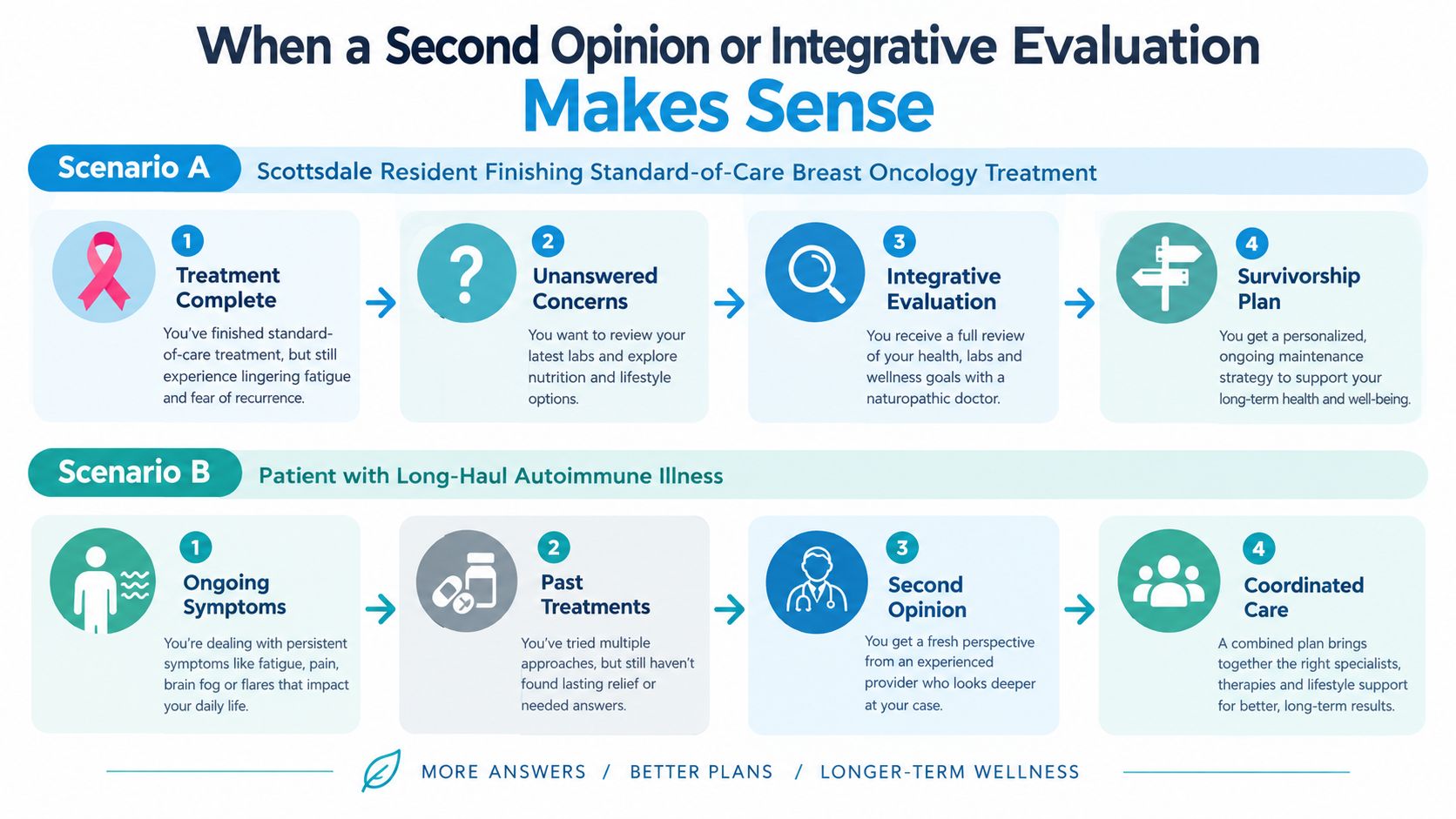
Seek another opinion before accepting a high-cost or high-risk therapy, when symptoms worsen during treatment, or when clinicians disagree about supplements, testing, antibiotics, hormones, or infusions. For suspected heavy-metal exposure, do not start an over-the-counter detox product. The FDA's guidance on unapproved chelation products explains that prescription chelating agents have specific indications and warns that chelation can cause dehydration, kidney failure, and death. Begin with exposure history and appropriate testing, then treat only when a recognized indication exists.
Next Steps and How to Reach Sunridge Medical
Prepare your records before contacting a Scottsdale clinic. Gather recent laboratory results, imaging reports and CDs, pathology reports, oncology or specialty notes, and a complete list of prescription medicines, over-the-counter products, herbs, and supplements. Include a short symptom timeline with dates, major changes, prior treatments, and the questions you want answered.
If you're traveling from Phoenix, Paradise Valley, Tempe, Mesa, Gilbert, or outside Arizona, ask about the schedule before booking flights. Scottsdale is served by Phoenix Sky Harbor International Airport, and some patients may prefer Phoenix-Mesa Gateway Airport depending on their route. Ask the clinic whether a two-day new-patient evaluation is appropriate, how much time should separate visits, and what arrangements are needed if you're immunocompromised.
Make the first contact productive
Ask whether records are reviewed before scheduling, what the initial consultation includes, and whether the clinic provides a written plan that can be shared with your oncologist, primary care clinician, or other specialist. Confirm how urgent concerns are handled when you're back home, who communicates test results, and whether a support person can attend.
Bring the original medication and supplement containers when practical, or maintain an accurate list with doses and timing. Don't leave out products purchased online. The interaction review is only as reliable as the information you provide.
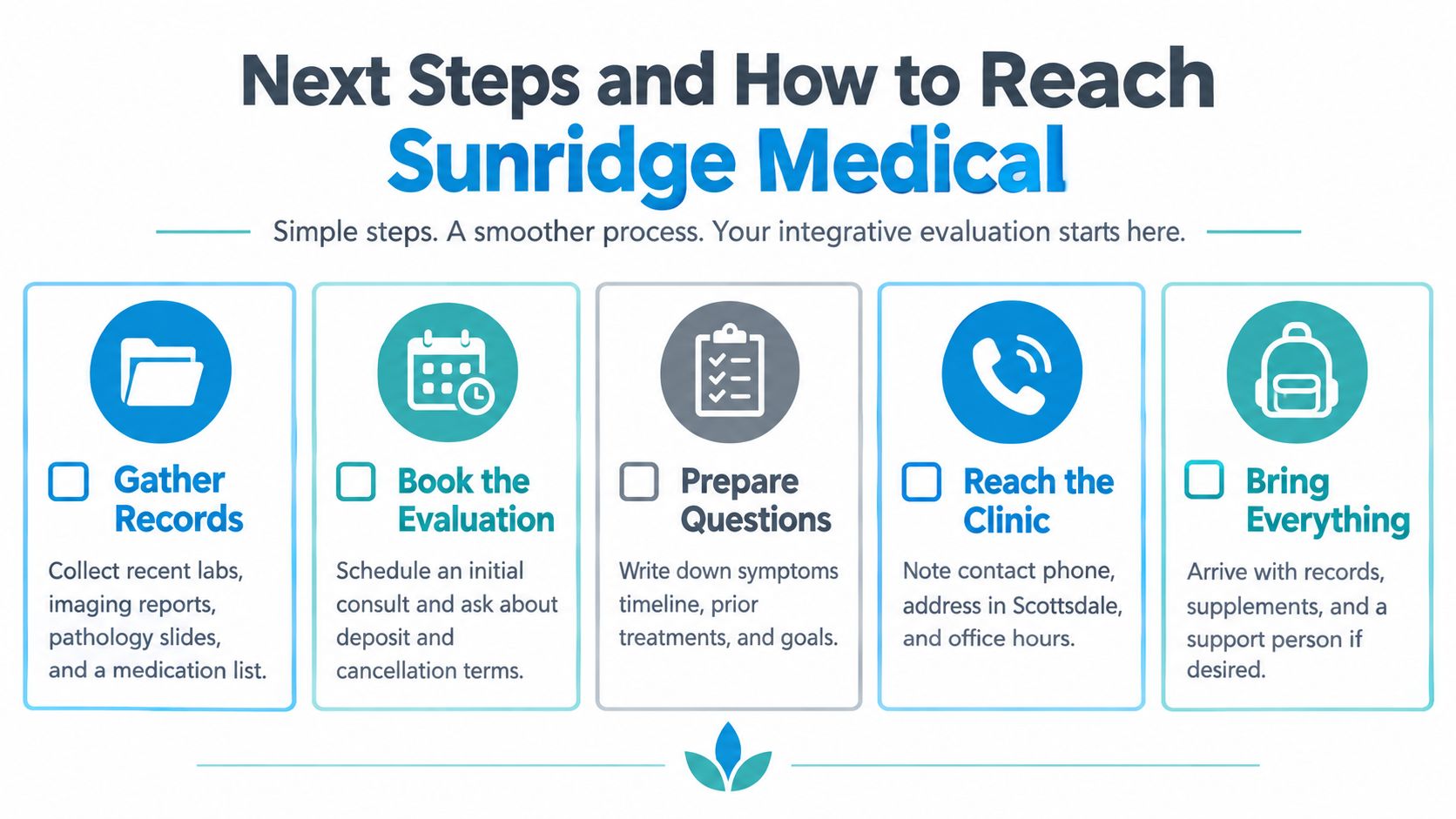
A qualified integrative evaluation should leave you with clearer priorities, safer coordination, and a realistic follow-up plan. It shouldn't require you to abandon effective care or accept unsupported claims because you're looking for more individualized attention.
Sunridge Medical offers integrative evaluations in Scottsdale for cancer care and complex chronic health concerns, with attention to records, treatment interactions, and coordination with existing clinicians. Visit Sunridge Medical to discuss whether a naturopathic or integrative consultation fits your medical needs and next steps.