


A negative antibody test often provides false reassurance when debilitating fatigue, cognitive dysfunction, and neuropathic pain persist long after a tick bite. If your physician insists you are healed after a standard course of oral antibiotics, you aren’t imagining your symptoms. You also aren’t alone in feeling exhausted by a fragmented merry-go-round of specialty referrals. Deciding between specialized lyme clinics vs general practitioners represents a vital crossroads, defining whether your care remains trapped in an acute paradigm or advances toward resolving a multi-system physiological breakdown.
Primary care excels at managing initial exposures, but persistent tick-borne pathogens demand a far more sophisticated, integrative strategy. This guide clarifies why traditional twenty-one-day antibiotic regimens frequently fail, examines direct-detection diagnostics that expose active infections, and outlines targeted protocols engineered to restore cellular and immune health. You’ll gain a clear clinical framework to evaluate your lingering symptoms and determine whether your recovery requires dedicated, physician-directed specialized care.
Key Takeaways
- Explore how brief, insurance-driven primary care visits struggle to address the complex biological realities of long-term tick-borne infections.
- Compare the limitations of standard two-tier serology with advanced multi-pathogen testing designed to identify hidden co-infections.
- Discover why understanding specialized lyme clinics vs general practitioners clarifies the shift from short antibiotic courses to targeted, multi-system recovery plans.
- Recognize critical warning signs, such as migratory joint pain and cognitive decline, indicating that frontline treatments have reached their therapeutic limits.
- Learn how physician-directed integrative protocols target persistent pathogens while simultaneously repairing mitochondrial, endocrine, and immune function.
Comparing Clinical Mandates: Primary Care Triage vs Specialized Lyme Clinics
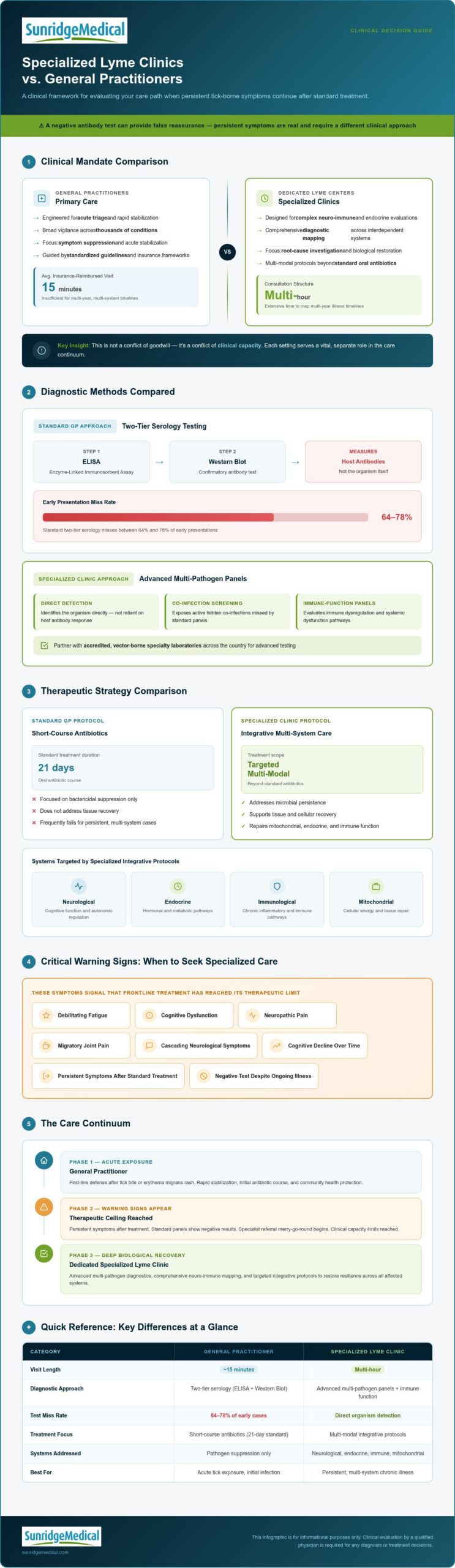
Primary care practices are engineered for acute triage, rapid stabilization, and broad population health screening. When an individual discovers a tick bite or an expanding erythema migrans rash, a family physician—accessible in person or through virtual platforms such as AskMyDoc.ca—offers an indispensable first line of defense. However, the operational architecture of conventional medicine creates an immediate structural bottleneck for persistent conditions. Insurance-reimbursed general practitioner visits average just 15 minutes, leaving physicians virtually no time to analyze intricate multi-year timelines, dynamic immune alterations, or cascading neurological symptoms. Acute infection protocols focus on swift bactericidal suppression of an active pathogen, whereas complex multisystem disease management demands targeted biological restoration across interdependent neurological, endocrine, and immunological systems.
The debate between specialized lyme clinics vs general practitioners isn’t a conflict of goodwill; it’s a conflict of clinical capacity. A family physician’s mandate requires broad vigilance across thousands of conditions. Conversely, a dedicated clinical center allocates extensive, multi-hour consultations to map how persistent pathogens disrupt underlying physiology. When standard acute paradigms prove insufficient, specialized centers step in to manage the broader physiological wreckage left behind.
The Scope and Structural Limitations of General Practice
General practitioners operate under strict clinical algorithms governed by rigid insurance structures. These frameworks prioritize symptom suppression and acute stabilization over exhaustive root-cause investigation. Because primary care clinics manage high daily patient volumes, physicians must rely on standardized guidelines: prescription of a short antibiotic course followed by immediate closure of the clinical inquiry. Standard institutional lab panels, which have well-documented diagnostic ceilings, anchor this triage model. When a patient continues to report debilitating fatigue or systemic pain after treatment, the conventional model often lacks the operational room to investigate further.
The Operational Architecture of a Dedicated Lyme Center
Dedicated clinical practices design their entire workflow around complex neuro-immune and endocrine evaluations. Instead of attempting to fit intricate chronic illness into a standard intake form, specialized clinics construct comprehensive diagnostic maps. For foundational clinical context, reviewing a verified Lyme disease overview illustrates how readily spirochetal infections disrupt diverse bodily systems. Dedicated centers respond to this reality through distinct clinical structures:
- Direct Collaboration with Vector-Borne Specialty Labs: Clinicians partner with accredited diagnostic laboratories across the country to run advanced multi-pathogen and immune-function panels.
- Systemic Dysfunction Mapping: Evaluations examine autonomic regulation, mitochondrial health, and chronic inflammatory pathways rather than isolating symptoms into disconnected specialties.
- Targeted Interventions: Teams have the clinical capacity to administer comprehensive, multi-modal protocols that go far beyond standard oral antibiotics to address microbial persistence and tissue recovery.
Evaluating specialized lyme clinics vs general practitioners demonstrates that each serves a vital, separate role. Primary care protects community health during acute exposure, while specialized clinical teams engineer deep biological recovery when illness persists.
Diagnostic Differences: Two-Tier Serology vs Advanced Multi-Pathogen Panels
Conventional diagnostic protocols rely heavily on standard two-tier testing: an initial enzyme-linked immunosorbent assay (ELISA) followed by a confirmatory Western blot. While this framework aligns with official CDC treatment guidelines established primarily for epidemiological surveillance, it frequently creates diagnostic dead ends for complex, long-standing cases. Standard two-tier serology misses between 64% and 78% of early presentations because it measures circulating host antibodies rather than directly identifying the organism itself. When evaluating specialized lyme clinics vs general practitioners, this diagnostic divergence forms the central dividing line between clinical clarity and persistent misdiagnosis.
Borrelia burgdorferi is a master of biological stealth. The spirochete alters its surface antigens, retreats into protective biofilm matrices, and migrates out of the bloodstream into collagen-dense tissues within days of transmission. When circulating antibodies drop below detectable thresholds, standard laboratory tests return a false negative. A clean laboratory report doesn’t guarantee pathogen eradication; it often merely confirms immune exhaustion or successful microbial concealment.
Why Standard Two-Tier Testing Frequently Yields False Negatives
The ELISA screen requires a robust, sustained humoral immune response to trigger a positive signal. If an individual’s immune system is suppressed by chronic infection, or if antibiotics were introduced early enough to blunt antibody production, the test fails to cross the diagnostic threshold. Surveillance criteria require strict band patterns on a Western blot to confirm infection, ignoring specific diagnostic bands that indicate active biological exposure. Patients are routinely assured their condition is resolved or purely psychosomatic based on testing that was never engineered to evaluate complex, persistent illness.
Unmasking Stealth Co-Infections and Microbial Persistence
Tick vectors rarely transmit single organisms in isolation. Feeding ticks frequently inject multiple opportunistic pathogens into host tissues simultaneously, creating complex polymicrobial infections that conventional panels routinely overlook:
- Babesia Species: Intraerythrocytic protozoa that evade standard bacterial antibiotics, driving persistent night sweats, air hunger, and profound fatigue.
- Bartonella: Fastidious intracellular bacteria causing severe neuropsychiatric inflammation, peripheral neuropathy, and vascular pain.
- Anaplasma and Mycoplasma: Secondary pathogens that dismantle cellular integrity and prolong systemic immune dysfunction.
Unidentified co-infections explain why single-agent antibiotic courses often leave debilitating symptoms untouched. Dedicated centers utilize advanced ELISpot assays, DNA PCR analysis, and multi-species immunoblots to map the full microbial footprint. Consulting advanced lyme disease specialists ensures evaluation covers all potential co-infections, allowing clinicians to design targeted, multi-layered treatment plans. If you suspect hidden infections are stalling your recovery, exploring comprehensive clinical guidance at sunridgemedical.com offers a clear pathway forward.
Therapeutic Strategies: Short-Course Antibiotics vs Comprehensive Integrative Care
Frontline general practitioners standardly prescribe a 14- to 21-day regimen of oral doxycycline or amoxicillin. This standard approach reflects the official clinical practice guidelines maintained by major infectious disease societies. While brief monotherapy resolves uncomplicated early bacteremia, it frequently falters against persistent, deep-seated infections. In the evaluation of specialized lyme clinics vs general practitioners, therapeutic philosophy is the defining difference: primary care relies on uniform oral drug courses, whereas dedicated centers design comprehensive, physician-directed protocols that blend targeted antimicrobial strategies with deep cellular and immunological restoration. Advanced intravenous supportive medicine bypasses compromised gastrointestinal absorption, directly delivering high-potency micronutrients, antioxidants, and therapeutic agents that rebuild mitochondrial respiration, modulate chronic neuro-inflammation, and restore cellular energetics.
The Limits of Monotherapy in Complex, Persistent Cases
Single-antibiotic oral regimens assume bacteria remain metabolically active and freely suspended in tissue fluids. Under physiological stress, Borrelia burgdorferi morphs into stationary persister variants, pleomorphic round-body forms, and protective microcolony biofilms. Standard oral medications struggle to breach these structural shields and display highly variable penetration across the blood-brain barrier. Subjecting a compromised system to repetitive, unmonitored cycles of oral antibiotics often collapses the gastrointestinal microbiome and degrades mucosal immunity without clearing sequestered pathogens.
Multimodal Restorative Protocols in Advanced Clinical Settings
Advanced clinical centers approach recovery through a layered, biological architecture. Over two decades of clinical experience managing complex chronic diseases show that suppressing pathogens without repairing host defenses leads directly to relapse. Specialized physicians deploy multifaceted protocols to break this cycle:
- Biofilm Disruption: Utilizing targeted enzymes and synergistic pharmacological agents to dismantle matrix coatings shielding stationary bacteria.
- Intravenous Supportive Care: Rebuilding depleted cellular reserves and neutralizing systemic toxicity through tailored nutrient, antioxidant, and membrane-stabilizing infusions.
- Immune and Endocrine Realignment: Applying modern integrative medicine for chronic illness to resolve persistent systemic inflammation and restore neuro-endocrine balance.
Choosing between specialized lyme clinics vs general practitioners comes down to therapeutic scope. When a simple antibiotic prescription fails to resolve lingering pathology, a multimodal clinical strategy creates the internal conditions necessary for lasting vitality.
When to Transition: Clinical Signs That Primary Care Has Reached Its Ceiling
Completing a frontline antibiotic course should theoretically resolve acute infection, but many individuals find their health steadily deteriorating instead of improving. When standard pharmaceutical interventions fail to halt progressive decline, primary care reaches its operational ceiling. Navigating specialized lyme clinics vs general practitioners becomes critical when lingering symptoms stop behaving like an uncomplicated bacterial exposure and start presenting as a whole-body breakdown. If your primary care provider suggests your remaining issues are psychosomatic or idiopathic despite measurable decline, it’s time to seek advanced clinical intervention.
Watch for this objective diagnostic pattern signaling that your condition has exceeded conventional primary care capacities:
- Migratory Musculoskeletal Pain: Aches, sharp joint pains, and burning muscle stiffness that travel unpredictably between limbs and joints, resisting standard NSAID therapies.
- Persistent Inflammatory Markers: Elevated cytokines, persistent ANA levels, or high C-reactive protein that primary care fails to tie to a coherent clinical driver.
- Severe Systemic Fatigue: Debilitating exhaustion unresponsive to sleep or rest, often accompanied by unrefreshing sleep cycles and post-exertional malaise.
Recognizing Progressive Neurological and Autonomic Dysfunction
When spirochetes breach deeper tissues, neuro-inflammation triggers distinct functional deficits that standard 15-minute consultations cannot adequately assess. Patients often experience sudden sensory sensitivities, severe executive brain fog, word-retrieval failures, or new-onset paresthesia like pins-and-needles across their extremities. Concurrently, autonomic instability can emerge, manifesting as postural orthostatic tachycardia syndrome (POTS), sudden lightheadedness upon standing, and erratic temperature fluctuations.
The Multi-Diagnosis Trap in Conventional Specialty Referrals
Lacking an overarching multi-system model, conventional systems disperse complex patients across isolated departments. A rheumatologist investigates joint inflammation, a neurologist evaluates nerve conduction, and a psychiatrist prescribes antidepressants for mood instability. This fragmented cycle manages localized complaints with heavy suppressive medications while ignoring underlying vector-borne triggers. Over time, continuous immune degradation fosters secondary autoimmune reactivity, requiring specialized iv therapy for autoimmune disease protocols to modulate hyperactive cellular responses. Deciding between specialized lyme clinics vs general practitioners means stepping off this exhausting referral carousel and entering a coordinated environment designed to address systemic dysfunction.
If you have hit a clinical dead end with traditional practitioners, taking control of your health journey starts with expert evaluation. Discover how targeted recovery works by scheduling an in-depth clinical consultation at sunridgemedical.com.
The Comprehensive Clinic Model: Restoring Resilience Beyond Pathogen Eradication
Eradicating persistent bacteria represents only the initial phase of biological recovery. Long after microbial loads decrease, patients frequently endure lingering tissue injury, cellular exhaustion, and autonomic collapse. Chronic infection damages mitochondrial membranes, disrupts endocrine signaling, and locks the autonomic nervous system into sympathetic overdrive. In comparing specialized lyme clinics vs general practitioners, the most profound difference lies in this post-pathogen philosophy: while primary care often concludes management once antimicrobial regimens end, dedicated centers focus intently on systemic repair, cellular energetics, and neuro-immune stability.
True clinical resolution requires evaluating total biological load. Drawing on over two decades of clinical experience managing complex chronic diseases, specialized centers treat the entire physiological ecosystem rather than treating lab sheets in isolation. Rebuilding baseline vitality demands a clinical architecture capable of repairing structural and metabolic damage across several vital biological systems:
- Mitochondrial Respiration: Restoring oxidative phosphorylation pathways to eliminate relentless cellular fatigue and muscle weakness.
- Immune Equilibrium: Down-regulating autoimmune triggers while strengthening natural defense surveillance against opportunistic reactivation.
- Neurovascular Health: Re-establishing microcirculation and optimizing central nervous system drainage pathways to resolve stubborn neuro-inflammation.
Targeting Immune Restoration and Endocrine Balance
Prolonged infection drives chronic immune activation, flooding tissues with inflammatory cytokines. Specialized medical teams actively down-regulate these inflammatory cascades to protect delicate neurological structures. Concurrently, clinicians evaluate the hypothalamic-pituitary-adrenal (HPA) axis alongside thyroid function, correcting profound hormonal deficits brought on by months or years of severe biological stress. Therapeutic protocols systematically clear accumulated endotoxins, ensuring hepatic and lymphatic clearance channels operate smoothly during recovery.
Establishing an Individualized Clinical Recovery Roadmap
Lasting recovery cannot emerge from standardized protocols. Instead, an experienced physician conducts an exhaustive clinical intake, analyzing exposure histories, genetic detoxification pathways, and past environmental burdens. The clinical team then crafts a dynamic, phased recovery plan that shifts in real time alongside objective patient progress. Supported by dedicated clinical coordinators offering nationwide access, patients receive constant medical oversight through every step of therapy.
Weighing specialized lyme clinics vs general practitioners highlights a fundamental truth: overcoming chronic illness requires far more than suppressing an isolated bug. By restoring underlying cellular resilience and immune harmony, individuals finally regain true, sustainable vitality.
Reclaiming Your Health: Moving Beyond Conventional Limits
Persistent tick-borne illness represents far more than a lingering infection; it is a profound multisystem physiological breakdown. When evaluating specialized lyme clinics vs general practitioners, the critical difference lies in shifting from temporary symptom suppression to targeted, systemic repair. If outdated testing, rigid short-course treatments, or fragmented specialty referrals have left you feeling exhausted, remember that genuine biological restoration remains entirely possible.
True healing requires clinical care tailored to your unique physiological blueprint. Backed by over two decades of clinical expertise in complex chronic disease, dedicated centers deliver comprehensive physician-led medical evaluations that uncover hidden co-infections, resolve cellular damage, and design individualized, research-based integrative protocols. You don’t have to remain trapped in a diagnostic holding pattern. Connect with a specialized physician to evaluate your chronic Lyme symptoms and take the definitive step toward rebuilding your immune resilience and reclaiming lasting wellness.
Frequently Asked Questions
Can a general practitioner adequately treat chronic Lyme disease?
General practitioners provide effective care for acute tick bites, but they generally lack the structural time, diagnostic resources, and multi-system frameworks needed to manage chronic Lyme disease. Insurance constraints restrict primary care visits to brief windows, preventing deep investigations into immune suppression, mitochondrial dysfunction, and persistent tissue-sequestered pathogens. For complex, multisystem decline, dedicated centers offer the extended oversight necessary for true biological recovery.
Why do standard Lyme disease blood tests frequently show negative results?
Standard two-tier testing relies on an indirect measure: host antibody production. When Borrelia burgdorferi evades the immune system by morphing into pleomorphic forms, entering biofilms, or migrating into collagen tissues, circulating antibody levels plummet below standard detection thresholds. Additionally, if the immune response is blunted by prior antibiotics or ongoing illness, standard serology yields a false negative despite active, persistent infection.
What specific diagnostics do specialized Lyme clinics use that GPs do not?
Comparing specialized lyme clinics vs general practitioners reveals major diagnostic contrasts. Specialized centers utilize direct and advanced indirect diagnostics, including ELISpot T-cell assays, tick-borne pathogen DNA PCR tests, and multi-species immunoblots that identify non-standard bacterial strains. They also evaluate underlying autonomic dysregulation, mitochondrial function, chronic inflammatory cytokine cascades, and endocrine disruption to build a comprehensive picture of systemic impairment.
How do treatment durations differ between primary care and specialized clinics?
Primary care physicians typically limit therapy to standard 14- to 21-day oral antibiotic regimens based on acute guidelines. Specialized clinics implement phased, multimodal protocols that often span several months. Treatment duration in a specialized setting depends entirely on clinical symptom resolution, the eradication of stealth persister pathogens, and the time required to repair damaged neuro-immune pathways and rebuild cellular stamina.
What are the most common co-infections overlooked by standard medical evaluations?
Standard medical evaluations frequently miss intracellular parasites and fastidious bacteria transmitted alongside Lyme. The most common include Babesia microti and duncani (causing drenching sweats and air hunger), Bartonella henselae (triggering profound neuropathic pain and neuro-psychiatric distress), Anaplasma, and Mycoplasma. Because standard frontline antibiotics do not eradicate these organisms, untreated co-infections remain a primary driver of ongoing chronic illness.
What should I do if my doctor says my Lyme is cured but I still have symptoms?
When weighing specialized lyme clinics vs general practitioners, persistent symptoms after frontline care signal that acute protocols have reached their ceiling. You should obtain complete copies of your lab work, document a timeline of your symptoms, and consult a dedicated clinic specializing in chronic vector-borne illness. Persistent suffering is not psychosomatic; it indicates ongoing inflammation, cellular damage, or unresolved co-infections requiring comprehensive physician-led evaluation.
Does a specialized Lyme clinic accept standard commercial health insurance?
Most specialized Lyme centers operate outside standard health insurance billing. Conventional insurance reimbursement models mandate strict treatment guidelines and rapid appointment turnover, which prevents physicians from administering customized, multimodal therapies and spending necessary hours with complex patients. By avoiding third-party payer restrictions, specialized clinics retain the clinical freedom to design personalized, research-based protocols tailored strictly to your individual recovery needs.