


What if the most significant barrier to your healing isn’t the condition itself, but the silence between your healthcare providers? You likely feel a quiet tension when considering how to talk to your doctor about alternative medicine, fearing that your interest in advanced, research-based protocols will be dismissed as a mere lifestyle preference. It’s understandable to feel caught between the desire for specialized, individualized care and the need for conventional medical supervision. You shouldn’t have to choose between clinical safety and the pursuit of every available tool for your recovery.
This article provides a structured path to initiate a transparent, research-based dialogue that positions you as an active participant in your care. You’ll learn how to present alternative methodologies as precise clinical choices rather than experimental detours. We’ll examine how to address potential contraindications with existing medications and how to foster a collaborative relationship where all your providers work in concert toward a single goal: your restored well-being. By bridging this gap, you can move forward with a unified plan that honors your choices and prioritizes your long-term health.
Key Takeaways
- Understand why clinical transparency is the cornerstone of safety, allowing you to integrate advanced alternative protocols without the risk of medication contraindications.
- Learn how to talk to your doctor about alternative medicine by presenting peer-reviewed data and professional treatment summaries that validate your choice as a research-based clinical decision.
- Utilize structured dialogue scripts to frame your integrative care as a collaborative partnership, ensuring your conventional providers feel like allies in your recovery.
- Establish a seamless coordination of care through HIPAA-compliant records sharing and strategic timeline management to prevent patient burnout.
- Recognize when complex chronic conditions require the depth of a specialized facility that offers individualized physician evaluations and custom treatment plans.
Why Clinical Transparency is Essential for Integrative Success
Transparency isn’t just a courtesy; it’s a clinical requirement. Many patients utilize Alternative medicine alongside conventional care, but there’s a vital distinction between “complementary” lifestyle changes and “advanced alternative” medical protocols. While yoga or meditation are low-risk, intensive therapies like high-dose IV protocols or targeted injections require precise coordination to maintain biological safety. Understanding how to talk to your doctor about alternative medicine begins with a commitment to full clinical disclosure. By acting as your own scientific guide, you bridge the gap between two different medical philosophies, ensuring they complement rather than conflict with one another.
The Risk of Unmonitored Interactions
The primary concern for any physician is the potential for biochemical interference. High-dose antioxidants, for instance, are potent tools for cellular support, yet they can inadvertently shield cancer cells from the oxidative stress required for chemotherapy or radiation to work effectively. Similarly, certain herbal protocols can significantly alter liver enzyme metabolism. This changes how quickly your body clears conventional drugs, potentially leading to toxic buildup or reduced efficacy. Disclosing your full protocol, including every supplement and IV treatment, allows your medical team to adjust dosages with precision. Safety is found in the details, not in the shadows. When you learn how to talk to your doctor about alternative medicine, you’re effectively protecting the integrity of every treatment you receive.
Ensuring Diagnostic Continuity Across Providers
Integrative success relies on a consistent stream of data. When you integrate advanced protocols, standard diagnostic markers, such as C-reactive protein (CRP) or specific tumor markers, may fluctuate in ways your conventional doctor doesn’t expect. Maintaining transparency allows both teams to interpret these shifts accurately. It’s also vital for emergency preparedness. Should you require urgent care, your primary physician must have access to a single, comprehensive medical record that reflects your entire biological landscape.
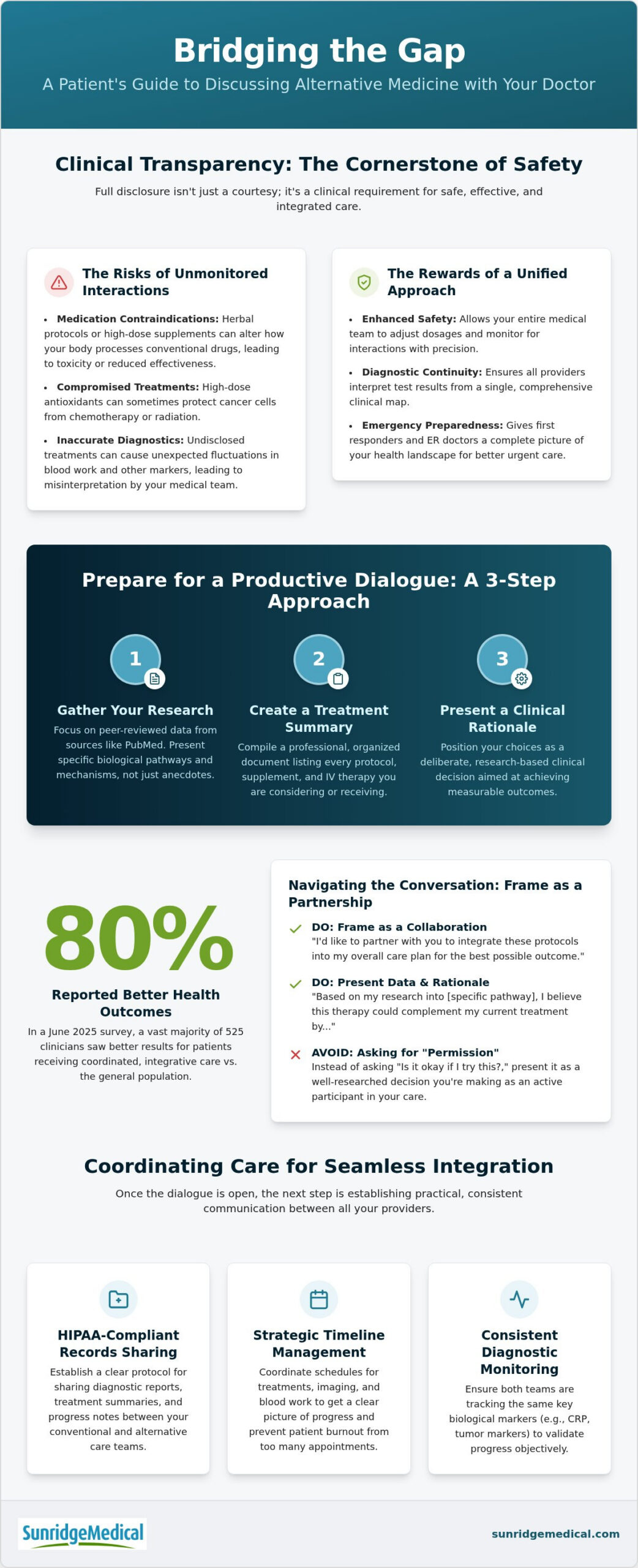
Consistent imaging and blood work schedules provide the objective evidence needed to validate your progress. This collaborative approach is supported by data; in a June 2025 survey of 525 global clinicians, 80% reported better health outcomes for patients receiving integrative care compared to the general population. These results are only possible when providers are reading from the same clinical map. A unified record ensures that every adjustment to your care plan is based on a complete, shared understanding of your current health status.
Preparing Your Case: Documentation and Research
Effective communication isn’t just about what you say; it’s about the evidence you bring to the table. When considering how to talk to your doctor about alternative medicine, preparation transforms a potentially defensive encounter into a professional consultation. You aren’t asking for permission to explore a hobby. Instead, you’re presenting a clinical rationale for an integrated approach to your recovery. With Americans spending an estimated $30.2 billion out-of-pocket annually on complementary approaches, you’re part of a growing demographic of patients seeking deeper solutions. Arriving with a structured “Treatment Summary” document demonstrates that your choices are deliberate, research-based, and focused on measurable clinical outcomes.
Vetting Research-Based Alternative Treatments
The bridge between conventional and alternative worlds is built with data. To gain your physician’s respect, move beyond anecdotal “miracle cures” and focus on alternative health medicine that targets specific cellular mechanisms. Utilize resources like PubMed or specialized medical journals to find peer-reviewed studies on the protocols you’re considering. If you’re looking into IV therapies or targeted injections, identify the specific biological pathways they influence. Presenting your doctor with a summary of these mechanisms shows that you value scientific rigor. This level of detail helps them understand how an alternative protocol might interact with your current standard of care, moving the conversation from skepticism to clinical analysis.
Organizing Your Medical Portfolio
Your current physician needs to see the “why” behind your decision. Organize your medical history to highlight why your current path may be insufficient. List all previous failed treatments, documenting why they were discontinued, whether due to lack of efficacy or intolerable side effects. This justifies your need for a change in direction. Your portfolio should include:
- A complete list of current medications, dosages, and prescribing physicians.
- Recent diagnostic imaging and lab results to establish a baseline.
- A list of specific questions regarding the limitations of your current “Standard of Care.”
- Defined clinical goals, such as reducing inflammatory markers or improving quality of life.
Preparation reduces the anxiety of the “unknown” for both you and your doctor. As noted in these 4 Tips for Talking to Your Doctor, being proactive and organized is key to a productive visit. If you feel your current case requires more specialized attention than a general practitioner can provide, a comprehensive physician evaluation at a dedicated facility can help refine your documentation and clarify your clinical path forward.
Navigating the Conversation: Scripts for Productive Dialogue
The moment you sit across from your physician, the goal is to shift from seeking permission to fostering a partnership. Understanding how to talk to your doctor about alternative medicine requires a strategic choice of language. You aren’t challenging their expertise; you’re expanding the clinical toolkit available for your recovery. By adopting an “Expert Ally” approach, you position your conventional physician as the primary guardian of your safety while acknowledging the specialized focus of your alternative providers. This framing reduces defensive posturing and focuses the visit on what truly matters: your physiological progress and long term well being.
Addressing Physician Skepticism with Data
When a doctor expresses doubt, it’s often rooted in a lack of familiarity with specific, advanced protocols rather than a direct critique of the therapy’s potential. Instead of debating the merits of the treatment, invite them into the monitoring process. You might say: “I have researched this specific protocol and its targeted mechanisms, and I would like your help monitoring its safety through our regular lab work.” This script reframes the alternative treatment as a clinical variable that requires professional oversight. It’s a powerful way to bridge the gap between different medical philosophies.
If resistance persists, propose a clinical trial period of 60 to 90 days. Ask for scheduled re-evaluations of specific diagnostic markers to objectively measure the impact. This approach allows you to distinguish between a doctor’s general skepticism and a genuine, evidence-based safety concern. It also establishes a clear boundary: you’re committed to individualized care, but you value their role in ensuring that care remains safe and effective.
Asking the Right Safety and Efficacy Questions
Productive dialogue is driven by clinical curiosity. If your doctor advises against a therapy, don’t stop at the “no.” Ask for the underlying biological rationale. Questions like, “What specific biological markers are you concerned this therapy might interfere with?” or “How can we coordinate our testing to ensure we see the full picture of my progress?” force the conversation into the realm of science rather than opinion. This shift is essential for maintaining a high level of professional gravity during your consultation.
This coordination is especially vital for complex conditions where standard protocols may have reached their limits. For those managing long term health journeys, referencing a resource like this guide on integrative cancer treatment by stage can help align your goals with your doctor’s expectations. It ensures that every provider understands the specific intent behind each protocol. By mastering how to talk to your doctor about alternative medicine, you turn a potential obstacle into a collaborative safeguard for your health.
Coordinating Care Between Conventional and Alternative Providers
Integrating advanced protocols requires more than just a conversation; it demands a logistical framework for co-management. While many standard hospital systems focus on spiritual or emotional support, true integrative success happens through the precise exchange of clinical data. You must act as the primary coordinator of your journey, ensuring that your conventional oncologist and your alternative specialist are viewing the same biological landscape. This is a critical step in how to talk to your doctor about alternative medicine, as it moves the relationship from a series of isolated visits to a unified treatment strategy. Professional gravity is maintained when every provider has access to the same HIPAA-compliant records and diagnostic markers.
Sharing Lab Results and Imaging
Redundancy is a common pitfall in complex medical journeys. You should never have the same high-cost imaging or blood panel twice in a 30-day window unless it’s clinically necessary for acute monitoring. Instead, utilize formal records release forms to ensure diagnostic transparency. When your conventional doctor sees the objective data from specialized biological treatments, their skepticism often dissolves into clinical interest. Centralized patient portals allow you to share these results in real time, ensuring that no provider is operating in a vacuum. This transparency protects you from unnecessary radiation and ensures that your entire medical team is making decisions based on the most current data available.
Managing Treatment Intersections
Timing is everything in a multi-faceted care plan. You must schedule alternative infusions, such as high-dose biological protocols, around conventional chemotherapy or radiation cycles to maximize synergy and minimize physical exhaustion. It’s also vital to distinguish between a “healing crisis”—a temporary inflammatory response as the body responds to therapy—and standard drug side effects. For example, integrating hormone therapy for autoimmune disease can significantly improve your systemic resilience during conventional treatments. Managing these intersections prevents patient burnout and ensures your body has the cellular resources required to sustain progress.
Conflict is inevitable when two different medical philosophies meet. When specialists offer conflicting advice, return to the underlying mechanisms. Ask each provider to explain the biological rationale behind their concern. This objective approach helps you make an informed choice without feeling caught in a professional tug-of-war. If you’re struggling to bridge the gap between your providers, seeking a facility that specializes in advanced alternative protocols can provide the clinical documentation and expertise needed to harmonize your care plan and restore your well-being.
Transitioning to Individualized Advanced Medical Protocols
Complex medical challenges, such as Stage 4 cancer or Chronic Lyme disease, require a level of precision that standard hospital-based complementary programs rarely provide. While many institutions offer supportive services like massage or mindfulness, these are often secondary to the primary treatment plan. Transitioning to a specialized facility like Sunridge Medical represents a commitment to advanced, research-based intervention. It’s about moving beyond general wellness and toward targeted medical protocols that address the specific cellular mechanisms of your condition. This transition is a pivotal moment in your journey, requiring a clear understanding of how to talk to your doctor about alternative medicine to ensure your entire healthcare team remains aligned and informed.
The Sunridge Medical Clinical Approach
Our methodology is rooted in the belief that effective care must be as unique as the patient receiving it. We combine conventional medical wisdom with advanced, individualized alternative protocols to target the root causes of chronic illness. Under the guidance of Dr. Steven S. Isaacman, Sunridge Medical has developed multi-faceted treatment strategies that go beyond symptom management. We focus on restoring the body’s innate biological functions through precise IV therapies and biological injections. This clinical approach allows us to act as a scientific guide for patients navigating the complexities of Stage 4 or 5 cancer and environmental illnesses, providing a sanctuary of specialized attention that honors the individual human experience.
Scheduling Your Comprehensive Evaluation
The path to a safe, integrated treatment plan begins with a methodical assessment of your medical history. Preparing for your first 1-800 call with our patient support team involves gathering your complete medical records and a clear list of your current health goals. Our individualized care plans start with a deep-dive medical history review to identify gaps in previous treatments and establish a baseline for your recovery. This thoroughness ensures that your initial consultation with our research-based specialists is productive and focused on measurable progress. We don’t view our care as a replacement for your local team; instead, we encourage your primary physician to remain part of your lyme disease specialists network. This collaborative approach is the final piece of the puzzle in how to talk to your doctor about alternative medicine, allowing for a professional relationship that prioritizes your safety and long-term restoration of well-being.
Empowering Your Path to Integrated Recovery
Successful integrative care depends on shifting from a passive role to that of an informed advocate. By prioritizing clinical transparency and presenting research-backed documentation, you transform potential skepticism into a productive medical partnership. You now understand how to talk to your doctor about alternative medicine by focusing on biological mechanisms rather than just lifestyle preferences. This collaborative approach ensures that every provider on your team is working with the same diagnostic markers and safety data, protecting your health while expanding your treatment options.
If you feel your current care requires a more comprehensive lens, specialized help is available. We invite you to Schedule a Consultation with a Sunridge Medical Physician to explore our individualized physician-led protocols. Our center focuses on advanced alternative cancer and chronic disease treatments through research-based clinical methodologies. You don’t have to navigate this complex journey alone. There is a structured, scientific path forward toward the restoration of your well-being and the progress you deserve.
Frequently Asked Questions
Is it legal for my doctor to stop treating me if I use alternative medicine?
It is generally legal for a physician to terminate a patient relationship if they feel the use of alternative medicine creates a safety risk or a breach of the agreed-upon care plan. However, they must follow specific protocols to avoid “patient abandonment,” which usually includes providing a formal notice and a period of continued care while you find a new provider. This is why learning how to talk to your doctor about alternative medicine is vital; it prevents the breakdown of trust that leads to such outcomes.
How do I know if an alternative treatment will interfere with my chemotherapy?
Determining potential interference requires a deep dive into biochemical pathways. Certain high-dose antioxidants can shield cancer cells from the oxidative stress that chemotherapy relies on to be effective. Additionally, some herbal protocols alter liver enzyme metabolism, which can change how quickly your body clears conventional drugs. You should always consult with a specialized alternative medical center that understands these specific interactions to ensure your integrated plan remains both safe and effective.
What should I do if my doctor is completely closed to the idea of alternative medicine?
If your physician remains entirely dismissive despite your presentation of research-backed data, it may be time to seek a second opinion from an integrative-friendly specialist. You deserve a healthcare team that respects your autonomy and is willing to review clinical evidence objectively. Seeking a provider who values a collaborative relationship ensures that your choice for individualized care isn’t met with judgment, but with professional oversight. A “scientific guide” approach is often more successful with open-minded providers.
Can alternative medicine be used as a primary treatment for Stage 4 cancer?
Advanced alternative cancer treatment protocols are frequently used for Stage 4 cases, often when conventional options have reached their limits. At specialized facilities like Sunridge Medical, these protocols are designed to target the root causes of the disease rather than just managing symptoms. While some patients choose these as a primary path, they are most effective when applied as a multi-faceted, individualized strategy under the supervision of a physician who specializes in complex chronic illnesses.
How do I find peer-reviewed research on alternative protocols to show my doctor?
You can find high-level clinical data by searching databases like PubMed or Google Scholar for specific biological mechanisms. Focus your searches on terms like “pharmacokinetics” or “clinical trials” related to the alternative protocol you are considering. Avoid commercial blogs or anecdotal websites. Presenting a printed abstract from a recognized medical journal is a highly effective part of how to talk to your doctor about alternative medicine, as it speaks the clinical language they respect.
Should I tell my doctor about every supplement I take, even just vitamins?
Yes, you must disclose every supplement, including standard multivitamins. Even common vitamins can influence blood clotting, liver function, or the efficacy of prescription medications. For example, high doses of Vitamin E can increase bleeding risks during surgery. Providing a comprehensive list allows your doctor to create a more accurate biological profile. This transparency is the cornerstone of a safe integrative plan and prevents unexpected fluctuations in your diagnostic lab results.
Will insurance cover my conversation with my doctor about alternative health?
Most insurance plans cover the office visit where you discuss your care plan, provided it’s coded as a standard consultation or follow-up. However, the specific alternative treatments themselves, such as specialized IV therapies or injections, are frequently out-of-pocket expenses. According to 2026 data, while chiropractic care has 91% coverage, acupuncture is only covered by 32% of plans. It’s always best to verify your specific benefits with your insurance provider before the appointment.
What are the red flags to look for in an alternative medicine practitioner?
Be wary of practitioners who offer “guaranteed” cures or who are secretive about the specific ingredients in their protocols. A legitimate research-based specialist will always be transparent about their methodologies and will encourage coordination with your other doctors. Other red flags include a lack of formal medical credentials or a requirement that you stop all conventional treatments immediately. A premiere center will always prioritize clinical safety and individualized physician evaluations over standardized, “one-size-fits-all” packages.