


What if the “normal” lab results your physician handed you are actually the very thing standing between you and the vitality you remember from a decade ago? It’s a common frustration for men over 50 who maintain a healthy lifestyle yet still struggle with a persistent loss of competitive edge and an unshakeable sense of brain fog. You know your body better than a standardized reference range does, and feeling “old” shouldn’t be the inevitable tax for reaching a certain milestone. We recognize that true testosterone optimization for men over 50 requires looking beyond the surface of a basic blood panel to address the underlying mechanisms of your systemic health.
In this 2026 guide, you’ll discover how advanced hormone optimization transcends traditional replacement therapy to restore your metabolic health, muscle mass, and cognitive clarity. We’ll move past the “packaged” care models to explore personalized, medically supervised protocols that align with the latest clinical shifts, including recent 2026 updates in medical consensus regarding therapy safety. This article provides a clear roadmap for transitioning from feeling stuck to thriving through a precise, integrated approach to your hormonal well-being.
Key Takeaways
- Shift your perspective from merely treating a clinical deficiency to achieving an optimal physiological state that restores cognitive clarity and physical performance.
- Discover how testosterone optimization for men over 50 integrates metabolic and environmental medicine to ensure long-term efficacy beyond simple hormone replacement.
- Gain insight into the clinical advantages of specialized delivery protocols, such as precision injections, for maintaining stable hormone levels without the fluctuations of standard methods.
- Learn why identifying underlying barriers like environmental illness or heavy metal toxicity is a prerequisite for successful endocrine restoration.
- Understand the value of a comprehensive, physician-led evaluation that prioritizes your unique biological profile over standardized, “packaged” medical care.
Redefining Men’s Health: Why 50 is the Threshold for Hormone Optimization
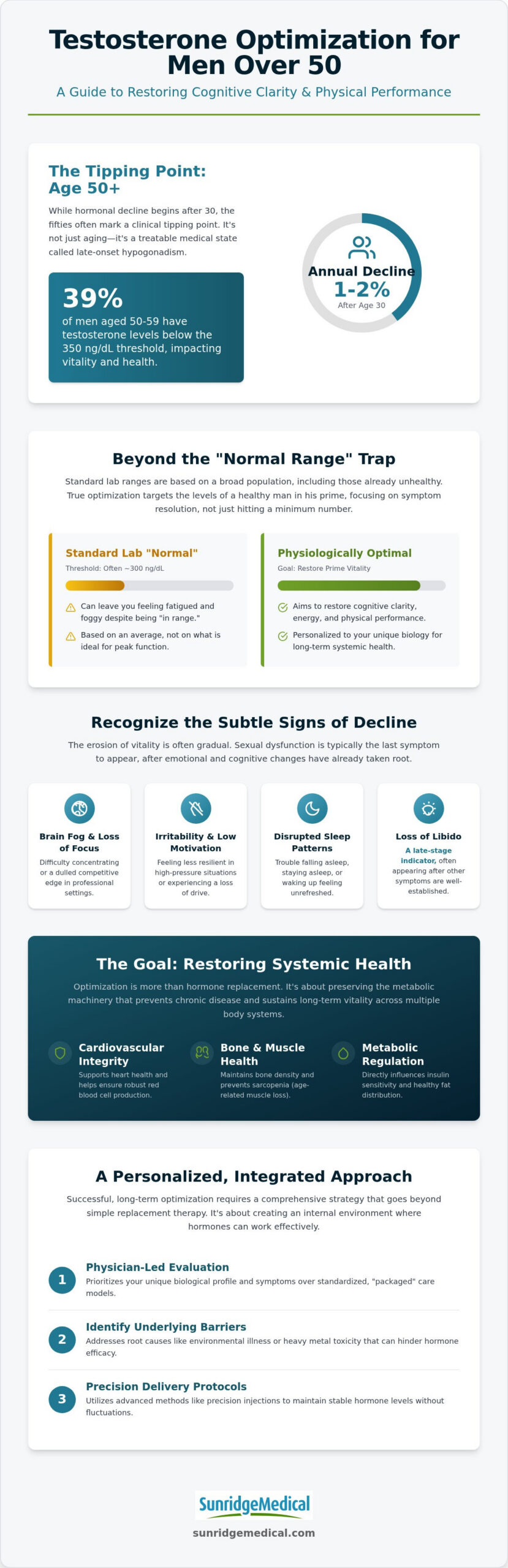
Crossing the threshold into your fifties marks a distinct physiological transition. While the decline in hormones begins much earlier, the cumulative effect often reaches a clinical tipping point during this decade. Research indicates that testosterone levels typically drop by 1 to 2 percent annually after age 30, yet the Journal of Clinical Endocrinology reports that nearly 39 percent of men aged 50 to 59 have levels below 350 ng/dL. This isn’t merely an inevitable part of aging; it’s a specific medical state known as late-onset hypogonadism. For those seeking testosterone optimization for men over 50, the focus shifts from simply reaching a “normal” number to restoring systemic health. This includes maintaining bone density, supporting cardiovascular integrity, and ensuring robust red blood cell production. Modern 2026 standards of care now prioritize biological age, emphasizing how your body actually performs rather than the date on your birth certificate. This comprehensive approach is explored in this Androgen Replacement Therapy Overview, which details the clinical foundations of hormone restoration.
The Multi-Faceted Role of Testosterone in Aging
Testosterone acts as a critical signaling molecule across multiple systems. For patients pursuing testosterone optimization for men over 50, it’s vital to view the hormone as more than a single-purpose agent. Beyond its traditional associations, it plays a vital role in preventing executive burnout by maintaining cognitive sharpness and focus. When levels drop, many men experience sarcopenia, the gradual loss of lean muscle mass that compromises physical independence and strength. Perhaps most importantly, testosterone is a key player in metabolic health, directly influencing insulin sensitivity and fat distribution. Optimizing these levels isn’t about vanity. It’s about preserving the metabolic machinery that prevents chronic disease and sustains long-term vitality.
Recognizing the Subtle Signs of Decline
The decline is rarely a sudden crash; it’s a slow erosion of vitality that often manifests as irritability, a loss of professional motivation, or disrupted sleep patterns. Many men wait for a drop in libido before seeking help, but clinically, sexual dysfunction is often the last symptom to appear. The earlier signs are frequently emotional, straining personal and professional relationships as the competitive edge begins to dull. You might find yourself feeling “stuck” or less resilient in high-pressure environments. Recognizing these subtle shifts is the first step toward a personalized intervention that honors your individual experience and restores your sense of self. We provide a steady hand for patients who are ready to move beyond these limitations through a structured and medically sound path forward.
Beyond Standard Lab Ranges: The Clinical Science of ‘Optimal’ Testosterone
Standard laboratory reference ranges aren’t always the best indicator of your true health. These ranges are calculated using a broad cross-section of the population, which frequently includes individuals who are already symptomatic or managing chronic conditions. If your results fall at 301 ng/dL, a conventional practitioner’ll likely label you as “normal” because the standard threshold is often set at 300 ng/dL, despite your persistent fatigue or cognitive decline. True testosterone optimization for men over 50 rejects this “normal range trap.” Instead, we target the physiological levels of a healthy man in his prime. Hormone Optimization is the clinical restoration of hormones to their most effective physiological range rather than merely reaching a lab-defined minimum. High-quality care relies on understanding the Evidence-Based Benefits of TRT, which emphasize that symptom resolution depends on reaching these optimized thresholds.
Total testosterone only tells part of the story. It represents the total amount of the hormone in your bloodstream, but much of it is bound to proteins and unavailable for use. Bioavailable, or “free,” testosterone is the fraction that actually enters your cells to perform its vital functions. Without measuring this specific metric, a physician can’t accurately assess your hormonal health or provide a customized plan that addresses your unique needs. You deserve a protocol that looks deeper than a single, surface-level number.
The Role of SHBG and Estrogen in Men
Sex Hormone-Binding Globulin (SHBG) acts like a lock, binding to testosterone and preventing it from interacting with receptors. As men age, SHBG levels often rise, which can create a deficiency in free testosterone even if total levels seem adequate. Additionally, managing the testosterone-to-estrogen ratio is critical after age 50. Advanced blood panels identify these underlying mechanisms, ensuring that the protocol addresses the root cause of your symptoms.
Comprehensive Physician Evaluations
A 15-minute consultation is insufficient for the complexities of testosterone optimization for men over 50. A sophisticated approach requires a deep dive into your history and an evaluation of the thyroid and adrenal axes. These systems work in concert; if your adrenals are fatigued, testosterone therapy alone often fails. This level of detail is a hallmark of integrative medicine for chronic illness. If you’re ready for a more precise path to wellness, consider a consultation with a specialized medical team that prioritizes your individual health profile.
Evaluating Therapeutic Protocols: Injections, IV Therapy, and Integrative Delivery
Precision is the goal. While various delivery methods exist, they aren’t created equal for the complexities of testosterone optimization for men over 50. Creams and gels often lead to inconsistent serum levels and pose a risk of accidental transfer to family members. Pellets, while convenient, don’t allow for the rapid dosage adjustments often needed during the initial stages of a protocol. Specialized injection protocols stand out as the clinical preference because they allow for precise, steady-state dosing. This method eliminates the “rollercoaster” effect where energy levels peak and crash between treatments, providing a more reliable path to restoration.
Addressing safety concerns is paramount for long-term health. As we look at the Future of Testosterone Therapy, recent 2026 clinical reviews have led to proposed label changes that reflect a more nuanced understanding of cardiovascular and prostate health. Newer studies have largely debunked older fears, showing that when therapy is properly monitored, it doesn’t increase the risk of heart disease or prostate cancer in healthy men. A clinical approach focuses on the data, ensuring that your treatment is based on current research rather than outdated assumptions.
Specialized IV and Injection Therapy
Optimization isn’t just about the hormone itself; it’s about the metabolic environment. Specialized IV therapy protocols use nutritional infusions to provide the precursors and cofactors your body needs for endocrine health. These infusions support liver function and metabolic pathways, ensuring the hormone is utilized effectively at the cellular level. Regular monitoring of hematocrit levels and PSA is a non-negotiable part of a responsible protocol. This thoroughness ensures that your progress is both measurable and safe, moving beyond the “packaged” care common in standard clinics.
The Myth of Over-the-Counter ‘Boosters’
Retail supplements frequently promise results they can’t deliver. Guesswork has no place in medical care. Most over-the-counter products fail to significantly move the needle on serum testosterone levels because they lack the bioavailability required for clinical impact. Worse, unregulated “natural” boosters can lead to unintended consequences like liver toxicity or disrupting your body’s natural hormonal feedback loops. Moving beyond self-medication toward a research-based medical protocol is essential for anyone serious about testosterone optimization for men over 50. It replaces vague promises with clinical certainty and specialized expertise.
Metabolic and Environmental Synergies: Maximizing Hormone Efficacy
Hormone levels don’t exist in a vacuum. You can achieve the perfect serum concentration on a lab report, yet still feel symptomatic if your cellular environment isn’t receptive. This is why testosterone optimization for men over 50 often fails when practitioners ignore the underlying metabolic terrain. Environmental toxins, particularly heavy metals like lead and mercury, can interfere with endocrine receptor sensitivity. These substances effectively “clog” the receptors, preventing your cells from responding to the hormones circulating in your blood. For many men, the frustration of “normal” labs while feeling unwell is rooted in this invisible barrier.
Chronic infections present another significant hurdle. Conditions such as Lyme disease are known to suppress the hypothalamic-pituitary-gonadal (HPG) axis, the very control center for your body’s hormone production. When the immune system is perpetually engaged in a battle against a pathogen, it often deprioritizes endocrine function. Understanding this interplay is essential for patients seeking hormone therapy for autoimmune disease. Addressing the infection is often the prerequisite for successful hormonal restoration.
Hormones and Chronic Illness Recovery
Optimizing testosterone is a vital catalyst for those navigating complex health journeys. In the context of autoimmune conditions, the hormone acts as a powerful modulator of inflammatory markers. It helps manage the profound fatigue that often accompanies these diseases, providing the energy necessary for the body to repair itself. When integrated into broader protocols, hormone optimization accelerates recovery by supporting tissue repair and immune balance. This is why consulting with lyme disease specialists who understand these synergies is critical for long-term success. A unified approach ensures that every system in your body is working toward a single goal: your well-being.
Lifestyle Catalysts for Optimization
Clinical protocols are most effective when supported by strategic lifestyle choices. Weight-bearing exercise is a primary tool for increasing hormone receptor density, making your cells more efficient at utilizing the testosterone available to them. Sleep remains the bedrock of endogenous production; your body does its most significant hormonal work during deep circadian cycles. Additionally, nutritional strategies focused on lowering systemic inflammation help manage SHBG levels, ensuring more of your testosterone remains bioavailable. If you’re ready to explore a comprehensive, individualized path to health, we invite you to contact a specialist at Sunridge Medical to begin your evaluation.
The Sunridge Medical Path: Individualized Hormone Optimization Protocols
Sunridge Medical operates on a foundational belief: medical care must be as unique as the individual receiving it. While many clinics offer a “packaged” approach to hormone replacement, we specialize in testosterone optimization for men over 50 through a lens of precision and depth. Our process begins with a comprehensive physician evaluation that goes far beyond a cursory review of lab results. We examine your history, your current physiological state, and the specific barriers preventing your vitality. This meticulous intake allows us to craft an individualized treatment plan that reflects our two decades of expertise in complex disease management. We don’t believe in one-size-fits-all prescriptions.
Since our founding in 2003, we’ve understood that hormone health is often the linchpin for recovery in patients facing multi-faceted challenges. Providing testosterone optimization for men over 50 requires a high-level specialist who is not satisfied with the status quo. We don’t view endocrine health in isolation. Instead, we integrate optimization protocols into broader strategies for those managing chronic infections, cancer support, or neurologic conditions. This multi-layered approach ensures that your hormonal restoration supports, rather than conflicts with, your overall medical journey. By addressing the whole person, we provide a steady hand for patients navigating the complexities of modern health.
A Sanctuary for Advanced Integrative Medicine
Under the guidance of Medical Director Dr. Steven S. Isaacman, our team bridges the gap between conventional clinical language and advanced, research-based alternative terminology. We’re a sanctuary for those who have felt overlooked by traditional systems. Our commitment to research-based methodologies allows us to offer specialized support, including integrative cancer treatment by stage. This high-level expertise ensures that even the most sensitive cases receive the specialized attention they require for optimal outcomes. We focus on the possibility of progress through a more comprehensive lens than standard practices.
Taking the Next Step Toward Restoration
Restoring your vitality is a collaborative process that begins with a single, decisive step. To schedule your comprehensive evaluation, we encourage you to contact our clinical specialists through our toll-free 1-800 number. This direct line of communication provides personalized support from the very start of your journey. When preparing for your consultation, please gather your relevant medical history and any recent lab work. This preparation allows our team to dive deep into your case immediately, moving you closer to the restoration of your muscle mass, cognitive clarity, and physical performance. We’re here to act as your scientific guide on the path to well-being.
Restoring Your Vitality Through Clinical Precision
Achieving true hormonal restoration requires more than a simple prescription. It demands a sophisticated understanding of how your endocrine system interacts with your metabolic and environmental health. By prioritizing testosterone optimization for men over 50, you move beyond the limitations of standardized reference ranges to target the physiological levels that define your peak performance. This comprehensive approach ensures that every system in your body supports your long-term health and cognitive clarity.
Since 2003, Sunridge Medical has remained at the leading edge of research-based alternative medicine. Under the steady guidance of Medical Director Dr. Steven S. Isaacman, we develop comprehensive individualized care plans that address the root causes of your symptoms rather than just the surface-level numbers. Whether you’re navigating the complexities of chronic illness or seeking to reclaim your competitive edge, our team provides the expert advocacy you deserve.
You don’t have to accept a decline in quality of life as an inevitable part of aging. Progress is possible, and your path to lasting well-being starts with a medical consultation rooted in precision, empathy, and clinical excellence.
Frequently Asked Questions
What is the ‘optimal’ testosterone range for a man over 50?
The optimal range for a man over 50 typically falls between 400 and 600 ng/dL, though the specific target depends on your unique physiological response. Standard lab ranges often go as low as 300 ng/dL, but being at the bottom of a “normal” range often leaves symptoms unresolved. We focus on reaching a level where you experience a restoration of energy and cognitive clarity, ensuring the hormone is bioavailable for your specific biological needs.
Are there risks of heart disease or prostate cancer with testosterone optimization?
Current medical consensus in 2026 indicates that the risks of heart disease and prostate cancer were previously overstated. Proposed FDA label changes reflect newer studies showing that monitored therapy is safe for most men. We prioritize safety through regular monitoring of PSA levels and cardiovascular markers. By maintaining physiological levels rather than excessive concentrations, we minimize potential side effects while maximizing the restorative benefits of the protocol for your long-term wellness.
How long does it take to see results from hormone optimization therapy?
Most patients begin to notice improvements in mood and energy within the first few weeks, but significant physiological changes typically take three to six months. During this window, your body undergoes metabolic shifts that restore muscle mass and improve libido. Because we use individualized care plans, your timeline may vary based on your starting point and underlying health. Consistent monitoring ensures we adjust your protocol to achieve the most efficient and reliable path to restoration.
Can I optimize my testosterone naturally through diet and exercise alone?
Lifestyle changes like weight-bearing exercise and optimized sleep are vital catalysts, but they often cannot overcome the steady 1 to 2 percent annual decline seen after age 30. For men over 50, endogenous production may no longer meet the body’s metabolic demands despite a healthy diet. Natural strategies support the protocol, but testosterone optimization for men over 50 usually requires medical intervention to reach the physiological levels necessary for systemic health and vitality.
What is the difference between TRT and hormone optimization at Sunridge Medical?
Standard TRT often follows a “packaged” model that focuses solely on reaching a minimum lab value. At Sunridge Medical, hormone optimization is a multi-faceted approach that addresses metabolic and environmental barriers, such as heavy metal toxicity or chronic inflammation. We utilize specialized IV and injection protocols to ensure steady-state levels. Our philosophy, led by Dr. Steven S. Isaacman, prioritizes a comprehensive physician evaluation to integrate hormone health with your overall systemic well-being.
Will hormone optimization help with my brain fog and memory issues?
Yes, restoring testosterone to optimal levels is a powerful tool for clearing brain fog and enhancing cognitive sharpness. Testosterone acts as a critical signaling molecule in the brain, directly influencing focus and executive function. When levels are low, many men experience a loss of their competitive edge and persistent mental fatigue. By optimizing these levels, we help restore the cognitive clarity needed for professional success and personal engagement, moving beyond the feeling of being stuck.
How does chronic illness like Lyme disease affect my testosterone levels?
Chronic illnesses like Lyme disease or autoimmune disorders often suppress the hypothalamic-pituitary-gonadal axis, which is the control center for hormone production. The body’s immune response to persistent infection can deprioritize endocrine function, leading to clinically low levels. We view testosterone optimization for men over 50 as a vital component of chronic disease recovery. Addressing these hormonal deficits helps modulate inflammatory markers and provides the energy required for the body’s essential repair processes.
Do I have to stay on hormone optimization therapy for the rest of my life?
Hormone optimization is typically a long-term commitment because it addresses a permanent physiological decline associated with aging. If therapy stops, your levels will likely return to their previous baseline, and symptoms may resurface. However, we continuously monitor your progress and adjust your protocol to maintain its efficacy and safety. Our goal is to provide a steady hand throughout your health journey, ensuring you maintain peak vitality and metabolic health through personalized care.