


What if the “mystery” symptoms preventing you from returning to your vibrant self aren’t a failure of your body, but the calculated progression of a pathogen that was never fully addressed? For many, the reality of living with persistent fatigue and migratory joint pain is compounded by the frustration of standard tests that offer no answers. It’s deeply unsettling to feel your health slipping away while conventional practitioners suggest your symptoms are unrelated to a past exposure.
We recognize that the long-term effects of untreated lyme disease are not just lingering symptoms; they represent a progressive state of immune dysregulation and bacterial persistence. This article provides a clinical deep dive into how this infection impacts your nervous and musculoskeletal systems over time. You’ll gain a clear understanding of the mechanisms behind chronic illness and discover the advanced, individualized pathways available for systemic restoration. We’ll move beyond the limitations of standard care to explore a sophisticated roadmap designed to help you reclaim your well-being and find the specialized attention your recovery deserves.
Key Takeaways
- Understand how Borrelia burgdorferi transitions from a localized skin reaction to a systemic condition; this progression is often the primary driver behind chronic cognitive decline.
- Discover the biological mechanisms of persistence, including how biofilms and persister cells allow the bacteria to shield themselves from your immune system.
- Learn how the long-term effects of untreated lyme disease can trigger a state of chronic autoimmunity through molecular mimicry and persistent systemic inflammation.
- Identify why standardized treatments often fall short and how targeted, research-based protocols offer a more comprehensive path to cellular restoration.
- Explore specialized medical pathways that integrate advanced biological treatments to address the root causes of chronic illness and restore systemic health.
The Progression of Untreated Borrelia Burgdorferi
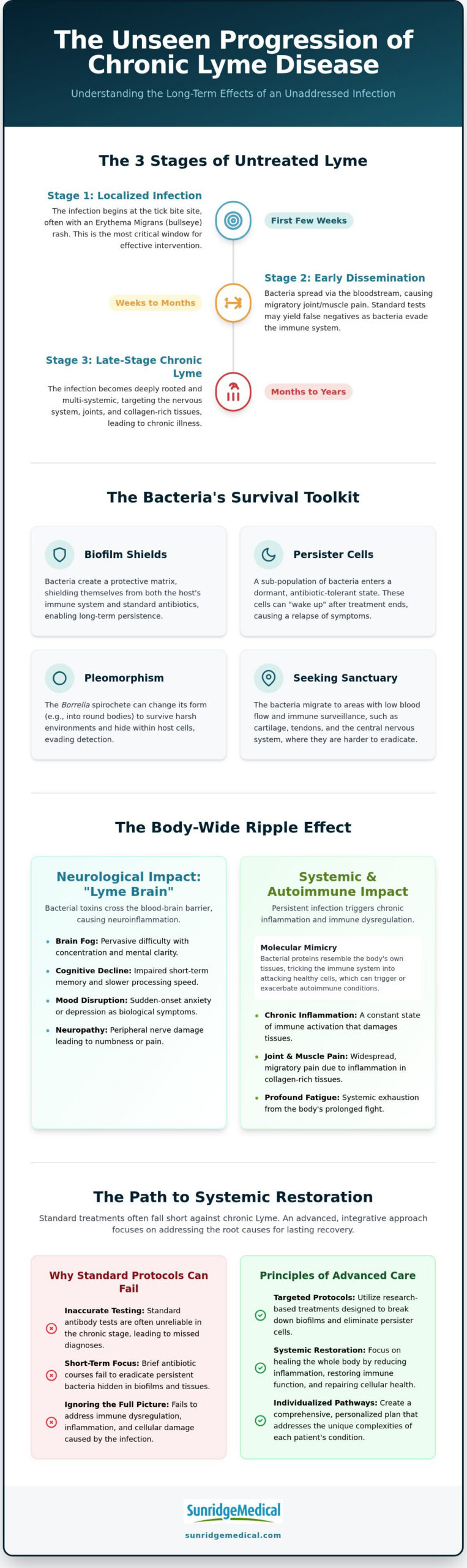
Untreated Lyme disease isn’t a static event; it’s a dynamic, progressive dissemination of the Borrelia burgdorferi spirochete bacteria throughout the human host. What begins as a localized Erythema Migrans rash at the site of a tick bite can quickly evolve into a complex systemic challenge. If the initial infection isn’t eradicated, the bacteria utilize their unique spiral shape to navigate through tissue barriers. They often seek sanctuary in low-blood-flow areas such as cartilage, tendons, and the central nervous system. This migration characterizes the Lyme disease progression from a simple infection to a deeply rooted chronic condition. Understanding the long-term effects of untreated lyme disease requires recognizing this transition from a surface-level invasion to a multi-systemic occupation.
The clinical window for intervention is most critical during the first few weeks post-exposure. Missing this window allows the pathogen to establish a foothold that standard, short-term protocols often fail to address. Once the bacteria moves beyond the skin, the complexity of the case increases exponentially.
Early Disseminated Phase vs. Late-Stage Lyme
The early disseminated phase marks the transition from a local inflammatory response to a secondary systemic spread. During this period, many patients experience migratory joint and muscle pain that seems to “travel” across the body without a clear pattern. This phase is clinically frustrating because standard lab tests frequently yield false negatives. These tests rely on antibody detection, which may be suppressed or delayed as the bacteria begins to alter its surface proteins to evade the immune system. By the time the infection reaches the late stage, it’s no longer just a bacterial presence but a driver of widespread physiological dysfunction.
The Biological Pacing of Chronic Infection
As the infection matures, it targets collagen-rich tissues and the central nervous system with clinical precision. This is where the illness crosses the clinical threshold into a truly multi-systemic disease, affecting everything from cardiac rhythm to executive cognitive function. Borrelia burgdorferi is a highly adaptive pleomorphic organism. By changing its form and hiding within the cellular matrix, it creates the foundation for the persistent long-term effects of untreated lyme disease that patients struggle with for years. This biological pacing ensures that without a targeted, multi-faceted approach, the infection remains a constant burden on the body’s primary systems.
Neurological and Cognitive Consequences of Chronic Lyme
Neuroborreliosis represents the clinical manifestation of the spirochete’s invasion into the central nervous system. This condition acts as the primary driver for late-stage cognitive decline. When left unmanaged, the long-term effects of untreated lyme disease often present as a profound disruption of executive function. Patients frequently struggle with word-finding difficulties and a pervasive brain fog that makes daily tasks feel insurmountable. This isn’t merely a subjective feeling. It’s the direct result of neuroinflammation triggered by bacterial toxins. These toxins cross the blood-brain barrier, inciting an immune response that can alter mood and behavior. Consequently, psychological manifestations like sudden-onset anxiety or clinical depression should be viewed as biological symptoms of a chronic infection rather than isolated psychiatric issues.
Cognitive Impairment and “Lyme Brain”
The term “Lyme brain” describes a specific constellation of symptoms rooted in the disruption of neurotransmitter pathways. Chronic infection can lead to significant reductions in processing speed and short-term memory loss. Current Lyme disease research suggests these cognitive deficits are linked to the presence of spirochetes within the cerebrospinal fluid. As these pathogens interfere with neural signaling, the brain’s ability to retrieve information and maintain focus becomes compromised. For those seeking to address these complex neurological deficits, exploring specialized neurologic condition treatment can provide a structured path toward cognitive clarity and systemic restoration.
Peripheral Nerve Involvement and Sensory Changes
Beyond the brain, the peripheral nervous system is frequently targeted. This leads to neuropathy, which manifests as a variety of debilitating sensations. Understanding the source of these symptoms is vital for an accurate diagnosis. The clinical presentation often includes:
- Persistent tingling or numbness in the hands and feet.
- Sharp, shooting pains that migrate without an obvious localized injury.
- Facial palsy, commonly known as Bell’s palsy, in late-stage untreated cases.
Distinguishing Lyme-related nerve pain from other conditions requires a comprehensive clinical lens. While standard neuropathy is often localized and steady, Lyme-driven sensory changes tend to be multi-focal and intermittent. These symptoms reflect the bacteria’s affinity for nerve tissue and its ability to trigger localized inflammatory cascades. Recognizing these patterns is the first step in moving past standardized care toward a targeted methodology that addresses the underlying bacterial persistence and nerve inflammation. For individuals seeking expert diagnostic support, Sapphire Clinics provides specialized medical assessments for those living with long-term pain.
Alongside these clinical interventions, maintaining spinal alignment through specialized care like Chiropractic Lifestyle Family Practice P.C. can support the body’s overall neurological function during the recovery process.
The survival of Borrelia burgdorferi isn’t a matter of simple endurance. It’s a complex biological strategy. Unlike many common pathogens, this spirochete is pleomorphic, meaning it can change its physical structure to adapt to hostile environments. It exists in its active spiral form, but can also shift into “blebs” or cell-wall-deficient cystic forms when threatened. These morphological changes are a cornerstone of the long-term effects of untreated lyme disease, as they allow the bacteria to evade the immune system’s detection. Standard antibiotic protocols often fail because they’re designed to target bacteria in their active, dividing state. They simply don’t penetrate the protective structures these organisms build.
Understanding the Biofilm Shield
Bacteria don’t always exist as solitary cells. Instead, they often aggregate and secrete a protective extracellular matrix known as a biofilm. This shield acts as a physical and chemical barrier, housing colonies of bacteria in a communal environment. Biofilm-associated infections require a more sophisticated clinical approach because the matrix prevents both immune cells and traditional medications from reaching the pathogens inside. Research indicates that biofilms can make bacteria up to 1,000 times more resistant to standard treatments compared to their free-floating counterparts. This level of protection explains why symptoms often persist even after a standard course of antibiotics has been completed.
Persister Cells and Symptom Recurrence
Within these biofilms and tissues, a subset of the population enters a dormant state known as persister cells. These aren’t mutant strains; they’re simply inactive versions of the bacteria that have “shut down” their metabolic processes. Because most antibiotics work by disrupting active metabolism, these dormant cells remain untouched. This biological reality is a major factor in the Johns Hopkins study on PTLDS, which highlights how symptoms can linger or resurface long after the initial infection.
The reactivation of these cells often triggers the frustrating cycle of “good days and bad days” that chronic Lyme patients know all too well. When the environment becomes favorable, or the immune system is stressed, these cells return to an active state, causing a flare-up of symptoms. To achieve true restoration, protocols must move beyond standardized care. We need methodologies that target the bacteria in all life stages, including the dissolution of biofilms and the eradication of persister cells. Addressing the long-term effects of untreated lyme disease requires this level of precision and biological depth.
Systemic Inflammation and Triggered Autoimmunity
Chronic infection keeps the immune system in a state of perpetual high alert. This persistent activation often leads to what clinicians describe as a “Cytokine Storm,” where the body is flooded with pro-inflammatory signaling molecules that fail to resolve. Over time, the long-term effects of untreated lyme disease shift from a purely infectious state to an immune-mediated condition. This transition occurs through molecular mimicry, a process where the immune system confuses bacterial proteins with the body’s own healthy tissues. As a result, the body begins to attack itself, leading to the development of secondary autoimmune markers that standard blood panels may finally detect. The presence of co-infections like Babesia or Bartonella further complicates this inflammatory profile, as each pathogen introduces its own unique layer of immune evasion and systemic stress.
Lyme-Induced Arthritis and Musculoskeletal Damage
One of the most debilitating consequences of this immune dysregulation is the progressive destruction of cartilage and synovial tissue. Lyme arthritis typically targets large joints, with the knees being the most common site of persistent swelling and clinical pain. Unlike standard age-related arthritis, this damage is driven by an aggressive, localized inflammatory response within the joint capsule that can lead to permanent structural changes. For those seeking a way out of this cycle, our Alternative Health Medicine pillar provides a specialized clinical path focused on cellular repair and immune modulation. We focus on calming the inflammatory cascade to allow the body’s natural healing mechanisms to engage effectively.
Lyme Carditis and Autonomic Dysfunction
The Borrelia spirochetes also have a dangerous affinity for heart tissue. In cases of Lyme carditis, the bacteria interfere with the heart’s electrical signaling, which can lead to heart block or irregular rhythms if the infection remains unaddressed. Beyond the heart itself, the autonomic nervous system often suffers significant disruption. This frequently manifests as Postural Orthostatic Tachycardia Syndrome (POTS), where patients experience racing heart rates, lightheadedness, and profound dizziness upon standing. These complications highlight the multi-systemic nature of the long-term effects of untreated lyme disease and the necessity of a comprehensive diagnostic lens. If you’re experiencing these complex cardiovascular or autonomic symptoms, our team offers specialized autoimmune disease management to help stabilize your system and address the root cause of the persistent inflammation.
Advanced Integrative Protocols for Chronic Lyme Recovery
Sunridge Medical operates on a foundational philosophy that prioritizes treating the whole patient rather than focusing solely on the pathogen. Standardized care often fails because it applies a rigid approach to a condition that is fundamentally unique to every individual. Addressing the long-term effects of untreated lyme disease requires a transition from generalized suppression to targeted, multi-faceted restoration. We believe in a sophisticated integration of research-based alternative protocols and conventional medical logic to create a sanctuary for those overlooked by traditional systems. This process begins with an individualized care plan designed to address the specific mechanisms of your illness, from bacterial persistence to immune exhaustion.
Targeted IV and Biological Therapies
Direct intravenous delivery ensures that therapeutic agents reach the systemic circulation without the limitations of digestive absorption. This is particularly critical for patients whose gastrointestinal health has been compromised by chronic inflammation or previous antibiotic courses. Our IV Therapy for Autoimmune Disease guide details how these mechanisms support the body’s natural defense systems. By utilizing oxidative therapies and high-dose nutritional infusions, we provide the cellular support necessary for deep tissue repair and detoxification. These advanced methodologies aim to penetrate the protective biological structures established by the bacteria, facilitating a level of clearance that oral medications often cannot achieve.
Restoring the Immune System and Hormone Balance
A central component of our recovery model is the stabilization of the endocrine system. Chronic infection exerts a heavy toll on the body’s hormonal reserves, which in turn weakens the immune response. Our Hormone Optimization for Autoimmune Disease guide explains how restoring these vital signals is essential for fighting persistent pathogens. By optimizing your biological environment, we empower your immune system to move from a state of reactive overdrive to one of calm, effective surveillance. This comprehensive approach ensures that every aspect of your health is being addressed simultaneously. We invite you to contact Sunridge Medical for a thorough clinical evaluation to discover a personalized path toward reclaiming your vitality and systemic well-being. It is time to find a steady hand for your journey back to health.
Reclaiming Your Health Through Specialized Care
Living with the long-term effects of untreated lyme disease requires more than just endurance; it requires a strategic medical partnership. We’ve explored how the Borrelia spirochete adapts through biofilms and triggers systemic inflammation, often leaving patients feeling stuck in a cycle of relapsing symptoms. These challenges are not insurmountable when addressed with precision and clinical depth. At Sunridge Medical, we move beyond standardized models by utilizing individualized, research-based alternative treatment protocols tailored to your unique biological needs. Under the compassionate leadership of Medical Director Dr. Steven S. Isaacman, our team brings specialized expertise to the management of complex chronic diseases and neurologic illnesses. You don’t have to navigate this journey alone. We invite you to schedule a comprehensive evaluation for Chronic Lyme Disease at Sunridge Medical to begin your path toward systemic restoration. Progress is possible, and a return to well-being is within your reach.
Frequently Asked Questions
Can Lyme disease cause permanent damage if left untreated?
Untreated Lyme can indeed cause permanent physiological damage, particularly to the musculoskeletal and nervous systems. Chronic inflammation can degrade cartilage in large joints and lead to irreversible nerve injury if the spirochetes aren’t eradicated. Early intervention is vital, but even in late stages, specialized care focuses on halting this progression. We prioritize systemic restoration to prevent further decline and support the body’s natural repair mechanisms through individualized protocols.
How long can Lyme disease go undetected in the body?
Borrelia burgdorferi can remain undetected in the human host for months or even years. This pathogen is highly adaptive, often migrating to collagen-rich tissues or the central nervous system where it remains dormant. The long-term effects of untreated lyme disease often surface long after the initial bite has been forgotten. This “stealth” nature allows the infection to establish a complex, multi-systemic foothold before significant symptoms prompt a clinical investigation.
Why do standard Lyme tests come back negative even when I have symptoms?
Standard diagnostic tests frequently yield negative results because they measure the immune system’s antibody response rather than the presence of the bacteria itself. If the spirochetes are sequestered in biofilms or have transitioned into cell-wall-deficient forms, your body may not produce detectable antibodies. This diagnostic gap leaves many patients feeling dismissed. We utilize a more comprehensive clinical lens to identify the underlying mechanisms of your symptoms beyond standardized laboratory limitations.
What are the neurological symptoms of late-stage Lyme disease?
Late-stage neurological symptoms, often termed Neuroborreliosis, include profound cognitive deficits such as memory loss and extreme brain fog. Patients also report word-finding difficulties, executive dysfunction, and sleep disturbances. Peripheral involvement can manifest as tingling, numbness, or shooting pains in the extremities. These symptoms result from neuroinflammation and the direct invasion of the central nervous system by the bacteria, requiring a targeted approach to cross the blood-brain barrier effectively.
Can chronic Lyme disease trigger other autoimmune disorders?
Chronic Lyme infection is a known trigger for secondary autoimmune disorders through a process called molecular mimicry. The immune system confuses bacterial proteins with healthy human tissue, leading to an internal attack on the joints, heart, or nerves. This keeps the body in a state of perpetual high alert. Our approach to autoimmune disease management focuses on calming this inflammatory overdrive while simultaneously addressing the persistent infection that initiated the response.
Is it possible to recover from Lyme disease years after the initial bite?
Recovery is possible even years after the initial exposure, provided the treatment addresses the multi-faceted nature of the illness. While the damage from the long-term effects of untreated lyme disease can be extensive, advanced biological therapies offer a path toward significant improvement. We focus on eradicating persistent bacteria in all life stages while restoring immune and hormonal balance. This comprehensive methodology helps patients reclaim their quality of life after years of struggle.
What is the difference between Chronic Lyme and Post-Treatment Lyme Disease Syndrome?
Post-Treatment Lyme Disease Syndrome (PTLDS) is the term conventional systems use to describe symptoms that persist after a standard antibiotic course. In contrast, Chronic Lyme often refers to an ongoing, active infection that has evaded initial treatment. The distinction is critical because it dictates the clinical path forward. We recognize that “lingering” symptoms often point to bacterial persistence and immune dysregulation that require more than just standardized, short-term protocols.
How does integrative medicine differ from conventional treatment for Lyme?
Conventional treatment typically relies on a limited course of oral antibiotics, which may not reach bacteria hidden in biofilms or low-blood-flow tissues. Integrative medicine at Sunridge Medical combines these traditional tools with advanced IV therapies, oxidative treatments, and nutritional support. We treat the patient as a whole, addressing hormone optimization and detoxification alongside the infection. This multi-layered strategy is designed to restore systemic health rather than just suppressing isolated symptoms.