


A fibromyalgia care plan doesn’t have to be an all-or-nothing choice between medication and doing nothing. Treating fibromyalgia without medication can mean combining practical strategies to address persistent pain, fatigue, disrupted sleep, or difficulty concentrating. If you’re concerned that movement or a new approach could trigger a flare, that concern belongs in the plan.
This guide reviews non-drug options and ways to introduce changes gradually, so you can notice what helps without expecting a quick fix. Exercise has the strongest recommendation in EULAR guidance, while psychological therapies such as cognitive behavioral therapy and acceptance and commitment therapy may also be considered. We’ll look at how these approaches, sleep strategies, and other options may fit different needs.
There’s no single toolkit that works for everyone. A physician-led evaluation can weigh the evidence alongside your diagnosis, medical history, laboratory findings, medications, organ function, symptoms, treatment tolerance, and goals. At Sunridge Medical, individualized care can integrate conventional medicine with research-informed options, with recommendations adapted as needs change. The aim is a thoughtful plan, not a guarantee or a replacement for care that’s right for you.
Key Takeaways
- Treating fibromyalgia without medication means exploring supportive strategies, not stopping prescriptions or stepping away from medical care.
- Compare movement, sleep support, psychological approaches, physical therapies, and home comfort measures by evidence, practical demands, and safety considerations.
- Popularity doesn’t establish effectiveness. Weigh the evidence and consider whether an approach fits your symptoms and circumstances.
- Build a manageable plan by choosing one change, adapting it gradually, tracking your response, and reviewing the results with a clinician.
- Physician-led integrative care can help assess complex symptoms and tailor recommendations to your diagnosis, medical history, laboratory findings, medications, organ function, symptoms, treatment tolerance, and goals.
What does treating fibromyalgia without medication involve?
Choosing nondrug options doesn’t mean rejecting medical care. It means considering strategies that may support symptom management alongside appropriate evaluation and follow-up, and, when prescribed, medication. People explore these options for different reasons: they may want more ways to manage daily symptoms, a broader understanding of their choices, or to consider how a treatment fits their needs. No single reason should be assumed.
Non-medication management is a personalized use of nondrug strategies to support fibromyalgia symptoms and everyday function, with professional guidance and realistic expectations.
Fibromyalgia can affect pain, energy, sleep, concentration, and physical capacity in different combinations. A strategy that suits one person may be impractical or less helpful for another, and responses can change over time. A clinical overview of fibromyalgia describes the condition and approaches discussed in its management. It can provide context, but it can’t determine which options are appropriate for you.
What can non-medication care aim to support?
The aim is often to make daily life more manageable, not to promise that every symptom will disappear. Depending on what matters most to you, goals might include maintaining everyday activities, gradually building comfortable movement, improving sleep routines, or developing ways to cope with pain and stress.
Choose priorities that are specific to your experience. For example, you might aim to manage a regular household task with less disruption or find a bedtime routine you can sustain. Progress may be uneven, and one approach may support one goal without changing other symptoms. Consider a strategy in light of your priorities and response.
Does medication-free mean managing fibromyalgia alone?
No. Nondrug care can be part of ongoing medical care, not a substitute for diagnosis, follow-up, or professional input. If you’re considering a change, discuss it with your prescriber, especially if you take medication or have other health conditions. Don’t stop, reduce, or change a prescribed medicine without their guidance.
Shared decisions connect personal goals with your diagnosis, medical history, laboratory findings, medications, organ function, symptoms, and treatment tolerance. At Sunridge Medical, physician-led care for complex conditions, including fatigue, pain, and fibromyalgia, is provided through an outpatient medical treatment facility with hands-on, onsite care. Plans may integrate conventional medicine with research-informed options, with recommendations tailored to the individual rather than presented as a guaranteed solution.
Which nondrug approaches may help manage fibromyalgia symptoms?
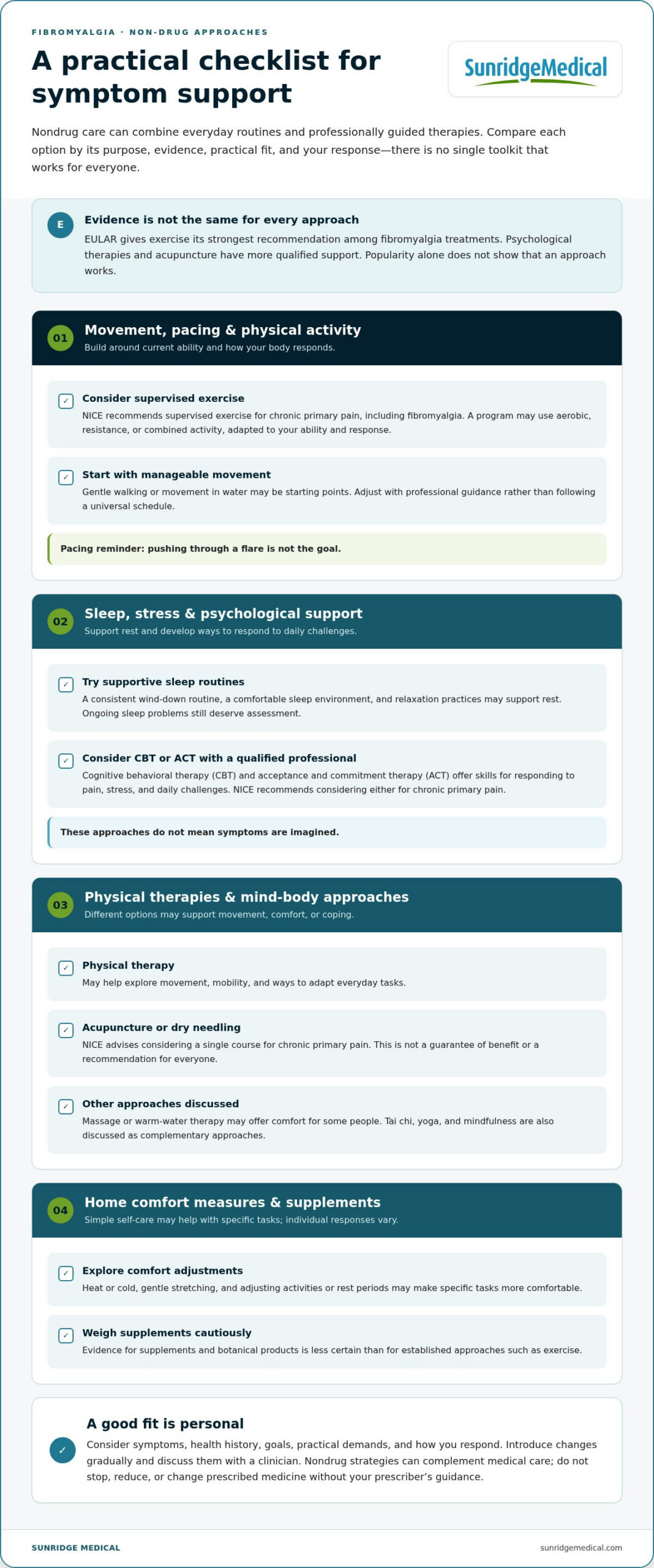
Options for treating fibromyalgia without medication range from everyday routines to therapies guided by a trained professional. They aren’t interchangeable: evidence, effort, access, and suitability differ. EULAR gives exercise its strongest recommendation among fibromyalgia treatments; psychological therapies and approaches such as acupuncture have more qualified support. Popularity alone doesn’t show that an approach works. Consider whether it fits your symptoms, health history, and goals.
Movement, pacing, and physical activity
Regular movement may support physical function, but pushing through a flare isn’t the goal. A supervised program may use aerobic, resistance, or combined activity, with type and intensity adapted to your current ability and response. NICE recommends supervised exercise for chronic primary pain, including fibromyalgia. Start with an activity that feels manageable, such as gentle walking or movement in water, and adjust with professional guidance rather than following a universal schedule. Collaborative care providers, such as Russell Health Collective, can help guide these gradual adjustments through patient-centred movement and wellness strategies.
Sleep, stress, and psychological support
A consistent wind-down routine, a comfortable sleep environment, and relaxation practices may support rest and broader symptom management, though they don’t replace assessment of ongoing sleep problems. Cognitive behavioral therapy (CBT) and acceptance and commitment therapy (ACT) offer skills for responding to pain, stress, and daily challenges. They don’t imply symptoms are imagined. NICE recommends considering CBT or ACT for chronic primary pain; practices such as Mindbender Counseling can provide qualified professional guidance to help tailor this support.
Physical therapies and mind-body approaches
Physical therapy may help you explore movement, mobility, and ways to adapt tasks, while massage or warm-water therapy may offer comfort for some people. NICE advises considering a single course of acupuncture or dry needling for chronic primary pain; this isn’t a guarantee of benefit or a recommendation for everyone. Tai chi, yoga, and mindfulness are also discussed as complementary approaches. The NCCIH guide to complementary approaches for fibromyalgia reviews options and evidence.
Home comfort measures and supplements
Heat or cold, gentle stretching, and adjusting activities or rest periods may make specific tasks more comfortable. These self-care measures differ from structured clinical treatments, and responses vary. Evidence for supplements and botanical products is less certain than for established approaches such as exercise. “Natural” doesn’t automatically mean safe: products can interact with medicines or be unsuitable with some health conditions. Review any supplement with a clinician or pharmacist who knows your medication list and health history.
Choose an option for a clear purpose, then notice whether it helps without worsening symptoms or creating an unsustainable burden. If pain, fatigue, or other complex symptoms make choices difficult, physician-led fibromyalgia care can include an individualized review of your diagnosis, medical history, laboratory findings, medications, organ function, symptoms, treatment tolerance, and goals alongside conventional care.
How do you compare fibromyalgia therapies without medication?
A useful comparison looks beyond how often an approach appears online. Consider what it is intended to support, the evidence behind it, the professional input it may require, the effort involved, and whether it fits your priorities and symptom tolerance. No single nondrug approach suits everyone; the best fit depends on the evidence, your health needs, and what feels practical to sustain.
Guidance offers a starting point, not a personal prescription. EULAR’s revised recommendations, published in 2017, give exercise the only strong recommendation for fibromyalgia; CBT, acupuncture, and meditative movement receive weaker recommendations. NICE guideline NG193, published in 2021 for chronic primary pain including fibromyalgia, recommends supervised exercise and consideration of CBT or ACT, and says a single course of acupuncture or dry needling may be considered.
How strong is the evidence for each approach?
These recommendations don’t mean a treatment will help everyone. They reflect how guidelines weigh available evidence and potential use. The NIAMS fibromyalgia resource also discusses care as an individualized, multi-component process. Use guidance to frame a conversation with a clinician, rather than ranking options by popularity or assuming a therapy mentioned in search results is proven.
| Approach | Intended purpose | Professional input | Practical demands | Key cautions |
|---|---|---|---|---|
| Supervised exercise | Support physical function and activity | Clinician or exercise professional can help adapt activity | Requires a manageable routine and gradual adjustment | Change intensity if symptoms worsen; avoid pushing through a flare |
| CBT or ACT | Build skills for coping with pain and daily challenges | Qualified mental health professional | Usually involves scheduled sessions and practice between them | Skills-based support does not mean pain is imagined |
| Acupuncture or dry needling | Try a defined course for chronic pain management | Trained practitioner; discuss suitability with a clinician | Requires appointments and may involve discomfort | NICE advises considering a single course, not indefinite treatment |
| Tai chi, yoga, or sleep routines | Support movement, relaxation, or rest | Input depends on ability and health needs | Can require adaptation and regular practice | Evidence and response vary; avoid movements that exceed tolerance |
| Supplements or botanicals | Attempt to address a symptom or general wellbeing | Review with a clinician or pharmacist | Products and regimens vary | Evidence may be limited; interactions and health conditions matter |
What safety and suitability questions matter?
Before trying an approach, consider whether mobility, other health conditions, current medication, time, access, or symptom sensitivity could affect its safety or feasibility. Review supplements, intensive therapies, and major routine changes with a clinician. For treating fibromyalgia without medication, a practical choice is one you can try safely, evaluate against a meaningful goal, and adjust if it isn’t tolerable.
How can you build a manageable non-medication care plan?
A sustainable plan is easier to evaluate when it starts small. Rather than changing several routines at once, choose an approach, notice how you respond, and decide with a healthcare professional whether to continue or adapt it. This makes treating fibromyalgia without medication a considered part of care, not a test of willpower or a promise of symptom relief.
How can you start without overwhelming yourself?
Begin with the symptom that most disrupts your day and a goal that matters to you. If fatigue makes errands difficult, for example, you might explore one manageable adjustment to activity or rest. Consider barriers such as limited energy, access to a therapy, work or family responsibilities, and fluctuating symptoms. A plan should fit real life, including days when you need to scale back.
- Identify a priority. Choose one area to focus on, such as sleep, movement, or completing a daily task. Keep the goal personal and realistic.
- Choose one change. Select a single nondrug approach that aligns with that goal and is appropriate to discuss with your clinician. Avoid starting multiple new therapies at once, which can make it harder to tell what affects your symptoms.
- Adapt gradually. Adjust the approach to your current ability and tolerance. If it increases symptoms or feels impractical, pause or modify it rather than assuming you must push through.
- Record your response. Make brief notes about symptoms, sleep, activity, and any treatment changes, including what seemed helpful or difficult.
- Review and revise. Bring your observations to a clinician and decide together whether to continue, adjust, or consider another option. There’s no universal reassessment schedule; timing can reflect your response and circumstances.
What should you track and review?
A log can be as simple as a notebook or phone note. Record the date, your main symptoms, sleep quality, relevant activities, the change you tried, and any perceived benefits or drawbacks. Note context that may help explain variation, such as an unusually demanding day. Keep the record brief enough to maintain. It can support a clinical conversation, but it doesn’t establish a diagnosis or prove that one change caused a shift in symptoms.
Progress and tolerance may vary from day to day. Review the plan flexibly, taking into account your diagnosis, medical history, laboratory findings, medications, organ function, symptoms, treatment tolerance, and goals. Contact a qualified healthcare professional if symptoms persist, become more difficult to manage, or change in a concerning way. Don’t alter prescribed medication without guidance from the prescriber.
If you’d like a physician-led review of complex fibromyalgia symptoms and individualized care options, explore care with Sunridge Medical.
How can physician-led integrative care support fibromyalgia management?
When fibromyalgia symptoms are complex or overlap with other health concerns, a physician-led evaluation can help bring the pieces together. Sunridge Medical provides care for complex and chronic conditions, including fatigue, pain, and fibromyalgia, through an outpatient medical treatment facility offering hands-on, onsite care. Integrative care may consider conventional medicine alongside research-informed options. It complements ongoing medical care; it isn’t a promised cure or a replacement for prescribed treatment.
An individualized approach means recommendations are based on the person, not a standard package of therapies. A plan may evolve as symptoms, treatment tolerance, laboratory findings, and priorities change. For context on how integrative approaches may be considered in chronic illness, see this integrative medicine guide for chronic illness. Its broader discussion shouldn’t be read as evidence that every approach described is specific to fibromyalgia.
What happens during an individualized review?
A physician’s review considers your diagnosis, medical history, current medications, and goals, alongside laboratory findings, organ function, symptoms, and treatment tolerance. These factors help determine whether a research-informed option is clinically relevant and appropriate to consider. Recommendations may change as new information becomes available or your needs shift. No single therapy is assumed to suit everyone.
An introductory call with the Patient Care Team can answer general questions and explain next steps, but the team can’t diagnose a condition or prescribe treatment during that call. Diagnosis and recommendations require appropriate clinical evaluation. Bringing a current medication list, relevant health records, and a short description of the symptoms affecting daily life can help make a subsequent medical review more focused.
What does onsite integrative care mean?
Care is delivered in an outpatient treatment setting, not through hospitalization. Physician-directed services are provided with support from licensed clinical professionals and a nursing team. Depending on an individual’s assessment, the broader care plan may consider physician-directed modalities such as IV or nutrient therapies. Their inclusion in integrative care doesn’t make them established fibromyalgia treatments; their relevance and safety must be evaluated for the individual.
The IV therapy guide for autoimmune disease discusses that modality in the context of autoimmune conditions, not as a fibromyalgia-specific recommendation. For fibromyalgia, any therapy considered should follow review of your diagnosis, medical history, laboratory findings, medications, organ function, symptoms, treatment tolerance, and goals. Physician-led care can provide a structured way to weigh these factors while keeping the plan individualized and complementary to other appropriate care.
For general questions or to discuss next steps with Sunridge Medical’s Patient Care Team, call 1-800-923-7878.
Take a thoughtful next step toward individualized care
Exploring treating fibromyalgia without medication can help clarify what matters most in your daily life and identify questions for your care team. You don’t need a complete plan before starting that conversation. Share which symptoms are most disruptive, what you’ve already tried, and what you hope to make more manageable.
At Sunridge Medical, physician-led care is supported by licensed clinical professionals and a nursing team, with hands-on, physician-directed care provided in an outpatient treatment facility. The team considers your circumstances and discusses options thoughtfully, without promising a particular result or replacing care that is already right for you.
To explore a personalized path, contact Sunridge Medical’s Patient Care Team about your next steps or call 1-800-923-7878. The conversation can begin with your questions and help you consider a manageable way forward.
Frequently Asked Questions
Can fibromyalgia be treated without medication?
Some people use nondrug approaches to help manage fibromyalgia symptoms, either on their own or as part of broader medical care. Treating fibromyalgia without medication doesn’t mean avoiding follow-up or giving up prescribed treatment. For example, you might discuss making meal preparation more manageable and explore options suited to your health and daily routine. Don’t stop or change medication without first speaking with the prescribing clinician.
What is the most effective natural treatment for fibromyalgia?
There isn’t one natural treatment that works best for everyone. A suitable choice depends on the symptom you hope to address, your health conditions, preferences, and tolerance for the approach. Be wary of programs or products that promise a cure or guaranteed relief. If you’re considering a supplement or botanical product, show a healthcare professional its ingredient list and discuss how it may fit with your medications and health history.
Can exercise make fibromyalgia symptoms worse?
It can feel difficult to stay active when pain or fatigue is present, and people’s responses differ. Rather than following a preset routine, consider whether an activity can be adapted to your current ability, such as using a supported position or reducing the effort involved. A clinician or qualified rehabilitation professional can help you think through options. If a change leads to persistent or concerning worsening, pause it and seek individualized guidance.
Does cognitive behavioral therapy help people with fibromyalgia?
Cognitive behavioral therapy (CBT) is included in some clinical guidance for chronic pain, including fibromyalgia. It can help people develop practical skills for responding to pain-related challenges, such as adjusting expectations around a demanding day or working with difficult thoughts. CBT doesn’t suggest that pain is imagined, and it isn’t a guaranteed stand-alone solution. Discuss with a qualified professional whether this form of support matches your needs and preferences.
Are supplements a proven alternative to fibromyalgia medication?
Supplements shouldn’t be assumed to be proven substitutes for prescribed fibromyalgia medication. Evidence differs among products and uses, and a supplement may interact with medication or pose concerns for someone with a particular health condition. Before starting one, ask a healthcare professional to review the specific product, ingredients, and your medication list. Don’t replace prescribed treatment or rely on a supplement’s cure claims without qualified clinical advice.
Can Sunridge Medical help with fibromyalgia without medication?
Sunridge Medical provides physician-led care for complex and chronic conditions, including fibromyalgia, pain, and fatigue. A physician’s recommendations depend on your diagnosis, medical history, laboratory findings, medications, organ function, symptoms, treatment tolerance, and goals. The outpatient medical treatment facility provides hands-on care. An introductory call with the Patient Care Team can answer general questions but can’t diagnose or prescribe. Call 1-800-923-7878 to discuss general questions or next steps.