

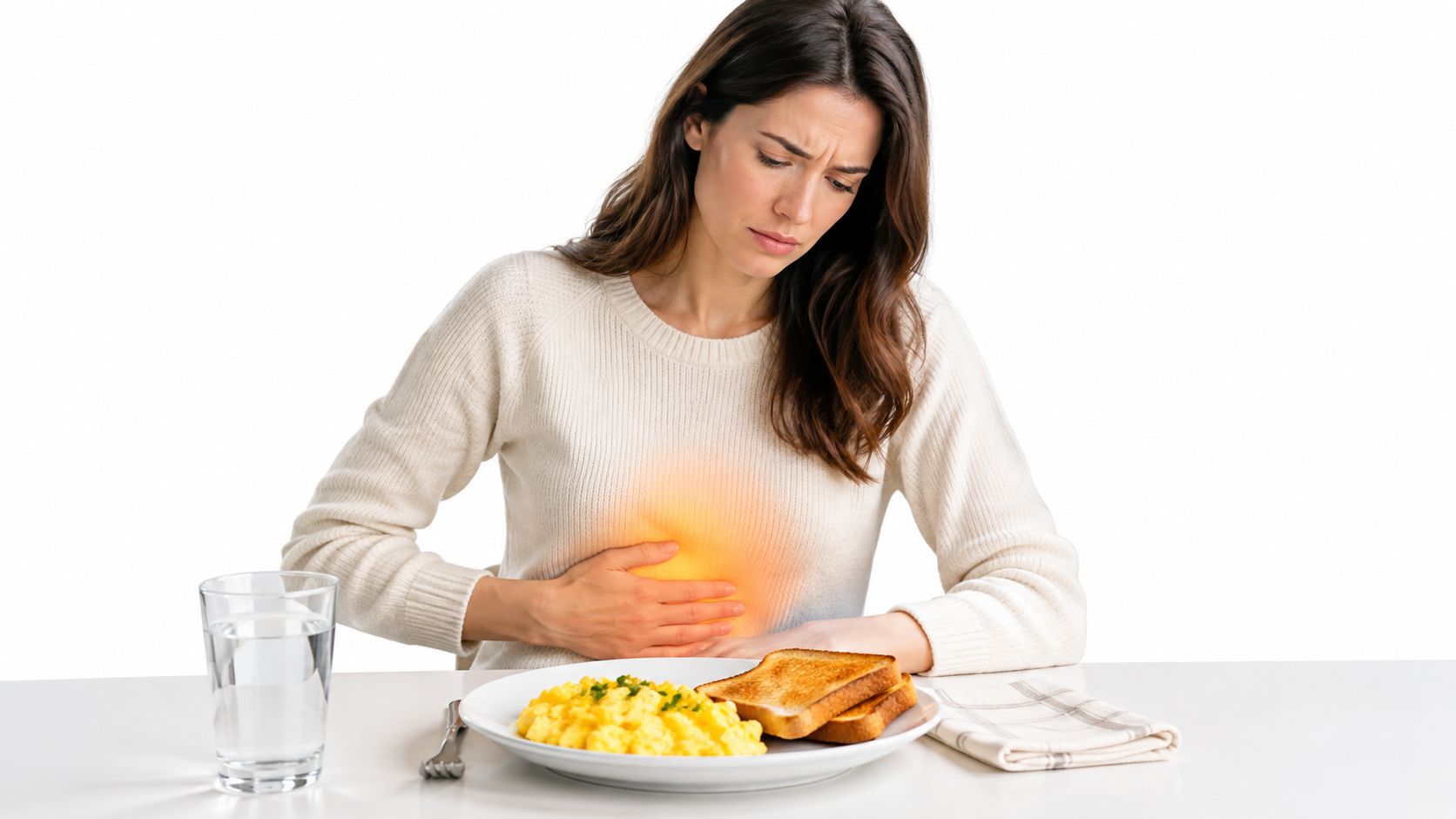
You've finished breakfast, you're into your morning routine, and then your stomach tightens. It's a cramp, a dull ache, or a bloated pressure that wasn't there before you ate, and the one food you keep noticing in the pattern is eggs. You're probably asking, why does my stomach hurt after eating eggs, and is the answer as simple as cutting them out for good? The more useful answer starts with details you'll learn to spot below.
Table of Contents
- Why Stomach Pain After Eating Eggs Happens
- Telling Egg Allergy and Intolerance Apart
- How Cooking Methods and Infection Affect Symptoms
- Gallbladder, Fat Sensitivity and Other Digestive Causes
- Red Flags That Need Urgent Medical Care
- How Clinicians Evaluate and Test Egg-Related Pain
- Managing Symptoms and Knowing When to See a Doctor
Why Stomach Pain After Eating Eggs Happens
Maybe it was a plain omelet at home in Scottsdale, or a soft-boiled egg with toast before work. Within an hour you're shifting in your chair, feeling cramping, bloating, or a dull ache in the upper abdomen. It isn't severe enough to frighten you, but it happens often enough that you've stopped treating it as a coincidence.
That pattern deserves a careful answer because eggs are rarely eaten in isolation. The pain could come from egg proteins themselves, from how the egg was cooked, or from butter, cheese, or other foods on the same plate. It could also come from a digestive condition that flares around any meal, not just an egg meal.
Why Guessing Rarely Works
These possibilities differ in timing, severity, and risk, so the pattern around the pain matters more than the fact that eggs were involved. A reaction that starts in minutes points one way, while bloating that builds over the next day points another. Pain after a rich, buttery breakfast is a different clue than pain after a single plainly cooked egg.
Removing eggs indefinitely may feel decisive, but it can leave the real driver untreated and still leave you with symptoms after other meals.
Several questions help sort this out. How soon do symptoms start? Which causes fit your pattern best? Which symptoms need urgent care? And how would a clinician evaluate this, including conditions such as small intestinal bacterial overgrowth, which can make meals in general harder to tolerate? Working through those clues calmly will get you closer to an answer than repeated self-guessing.
Telling Egg Allergy and Intolerance Apart
Timing is the most useful tool you have at home, even though it can't make a diagnosis by itself. Egg allergy is an immune-mediated reaction. When it's IgE-mediated, symptoms usually start quickly, often within minutes and sometimes up to about two hours after eating eggs.
What an Allergic Pattern Looks Like
Abdominal pain, cramps, nausea, vomiting, or diarrhea can be part of that picture. When pain arrives with hives, itching, or swelling, the pattern becomes more concerning for allergy rather than ordinary indigestion. Small amounts of egg triggering the same rapid response are another clue worth reporting.
Age also shapes how likely allergy is. Egg allergy is estimated to affect about 2% of children but only about 0.1% of adults, and gastrointestinal symptoms occur in roughly 10% to 44% of documented allergic reactions, generally beginning within 2 hours of eating the egg. That doesn't rule allergy out for an adult, but it does mean persistent pain in an adult deserves a broader look.
What Intolerance Looks Like Instead
Egg intolerance doesn't involve the same allergy antibody response. Symptoms tend to stay mainly in the digestive tract, and they can develop gradually over as long as 48 hours. Delayed bloating, cramps, or diarrhea after an otherwise normal meal fits this pattern better than a rapid reaction.
The table below puts the two patterns side by side for quick reference.
Timing and Symptom Patterns for Egg Allergy and Intolerance
| Feature | IgE-mediated egg allergy | Egg intolerance |
|---|---|---|
| Typical onset | Minutes, sometimes up to about 2 hours | Gradual, sometimes up to 48 hours |
| Digestive symptoms | Pain, cramps, nausea, vomiting, diarrhea | Bloating, cramps, diarrhea |
| Beyond digestion | Hives, itching, swelling, wheezing possible | Usually confined to the digestive tract |
| Amount that triggers it | Even small quantities can trigger symptoms | May vary with portion and preparation |
| Warning level | Breathing trouble or swelling needs emergency care | Persistent symptoms still need assessment |
Self-diagnosis is unreliable here because reflux, irritable bowel syndrome, gallbladder disease, cooking fats, and accompanying foods can all mimic an egg problem. A clinician reviewing food allergies and their digestive symptoms can often narrow the possibilities with a detailed exposure history alone. A supervised elimination-and-reintroduction plan or formal allergy testing may then help separate allergy from intolerance.
How Cooking Methods and Infection Affect Symptoms
The contrast between thoroughly cooked and undercooked eggs below captures a distinction readers often overlook.
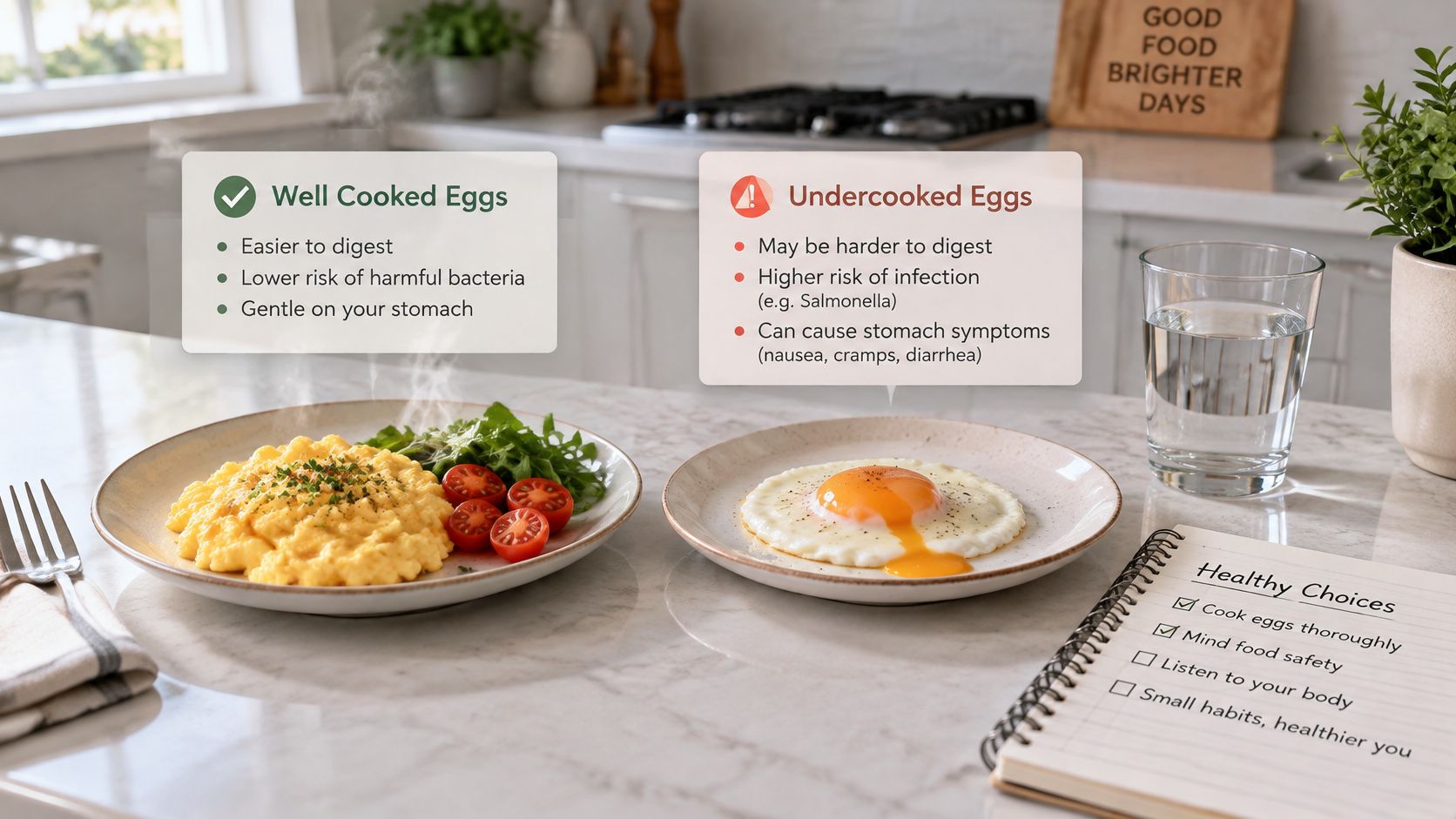
Eggs aren't a single, uniform exposure. Egg white contains proteins such as ovalbumin and ovomucoid, and yolk can also contribute to sensitization. That's one reason someone may tolerate baked egg but react to scrambled or soft-boiled egg.
Why Preparation Method Changes the Picture
Heating can alter allergenic proteins, so tolerance may differ between thoroughly cooked or baked egg and less-cooked egg. Don't test this casually at home if you've had a rapid reaction. The safer step is to describe the pattern you've noticed and let a clinician decide how to explore it.
Preparation also introduces other suspects. Milk, butter, wheat, onions, high fat, or food additives can be the actual trigger while the egg takes the blame. An omelet cooked in butter with cheese and onions is a very different exposure from a hard-boiled egg eaten on its own.
What to record: Write down the exact preparation, your portion, every accompanying food, when symptoms started, and what they felt like before you eliminate eggs broadly.
Infection After Raw or Undercooked Eggs
Foodborne infection is a separate explanation, particularly after raw or undercooked eggs. Salmonella can cause diarrhea, fever, nausea, vomiting, and abdominal cramps, with symptoms beginning 6 hours to 6 days after swallowing the bacteria and typically resolving in 4 to 7 days, and raw or undercooked eggs are a recognized source because infected hens can produce eggs containing Salmonella before the shell forms.
That long delay confuses people. Pain doesn't have to start right after the meal, and others who ate the same food may also become ill. Learning how food poisoning bacteria spread can help you think through food handling and shared exposures, which is useful context to bring to a visit.
The short video below reinforces why thorough cooking matters when you're assessing whether a meal was risky.
Repeated pain every time you eat eggs, without fever or diarrhea, is less typical of Salmonella. That pattern fits allergy, intolerance, or another gastrointestinal condition better, and it's one of the clearest signals to stop guessing.
Gallbladder, Fat Sensitivity and Other Digestive Causes
Many people who hurt after eggs are reacting to the fat that comes with them. Eggs cooked in substantial butter or oil, or served with cheese, bacon, or other rich foods, make a meal heavy enough to provoke symptoms in someone with gallbladder problems or reduced fat tolerance.
The Gallbladder Clue
Location and duration help here. Gallbladder attacks commonly cause pain in the upper-right abdomen, sometimes spreading to the back, shoulder, or chest. Gallbladder attacks typically begin about 15 to 20 minutes after a greasy, oily, or fatty meal and may last from 30 minutes to 4 hours, with pain often in the upper-right abdomen.
Compare two mornings. A plain poached egg causes nothing, but a cheese omelet fried in butter brings on right-sided pain within twenty minutes. That contrast suggests the overall meal deserves scrutiny, not just the egg.
- Favoring gallbladder involvement: Upper-right pain after fatty meals, pain spreading to the back or shoulder, vomiting, or pain that persists.
- Favoring an egg-specific pattern: Reproducible symptoms after plainly cooked egg, regardless of what else is on the plate.
- Favoring a broader digestive condition: Symptoms after many different meals, with eggs only sometimes involved.
Other Conditions That Flare Around Meals
Irritable bowel syndrome, acid reflux, and small intestinal bacterial overgrowth can all flare around mealtime. If bloating, altered bowel habits, and cramping show up after a variety of foods, irritable bowel syndrome as a possible contributor is worth discussing rather than assuming eggs are the sole issue. Reflux tends to produce burning discomfort, while bacterial overgrowth is often described with bloating and digestive unease after eating in general.
A clearer question to ask: Is it the egg, the fat it was cooked in, or a digestive system that struggles with many meals? Each answer leads to different care.
Recurrent upper-abdominal pain after fatty meals, especially with vomiting, fever, jaundice, or pain that won't settle, warrants prompt medical assessment. Assuming the egg is at fault can delay recognition of gallbladder disease that needs its own evaluation.
Red Flags That Need Urgent Medical Care
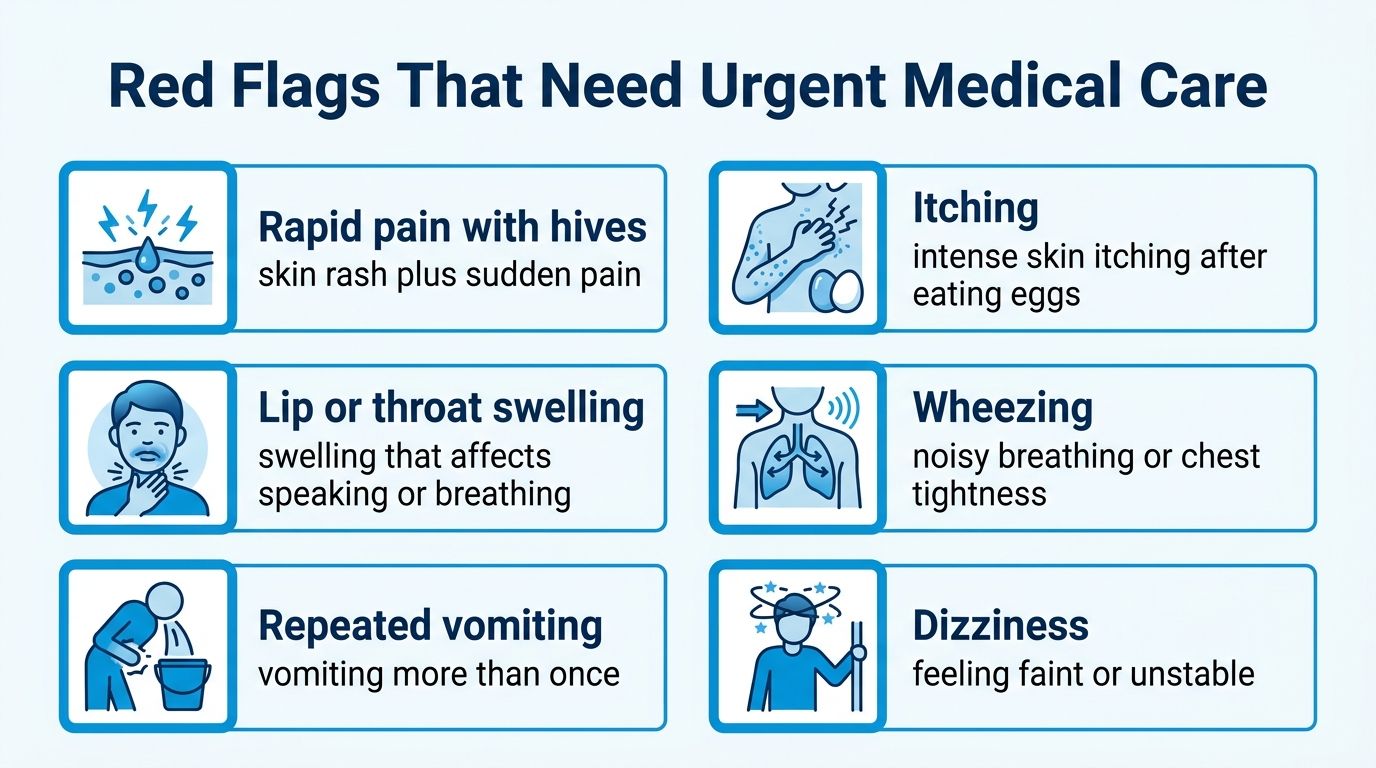
Blaming eggs by default is risky when certain symptoms appear. Rapid pain with hives, itching, lip or throat swelling, wheezing, repeated vomiting, dizziness, or difficulty breathing is more consistent with an IgE-mediated allergic reaction than with ordinary indigestion.
The checklist below summarizes the warning signs to recognize quickly.
Call Emergency Services Now
Ige-mediated allergy symptoms usually begin within minutes and sometimes up to about two hours after exposure, and gastrointestinal symptoms can be part of anaphylaxis, which requires emergency care. Breathing difficulty, throat or tongue swelling, faintness, or symptoms involving multiple organ systems at once fall into this category. Don't drive yourself or wait to see whether these pass.
- Breathing problems: Wheezing, chest tightness, or trouble getting air in.
- Swelling: Lip, tongue, or throat swelling, especially if speech changes.
- Circulation signs: Dizziness, faintness, or feeling unstable alongside other symptoms.
Seek Prompt Care the Same Day
Other warning signs call for urgent medical attention even without allergy features. These include bloody diarrhea, persistent vomiting, dehydration, high fever, or severe or worsening abdominal pain. Young children, adults aged 65 or older, and people with weakened immune systems face a higher risk of severe infection and hospitalization, a detail covered in the earlier section's source on Salmonella.
Repeated pain after eggs without fever or diarrhea is usually a matter for a prompt appointment rather than an emergency visit. Pain that persists beyond a few days, keeps returning, or steadily worsens also belongs in that prompt category. Mild, brief discomfort that resolves fully can be raised at a routine visit, ideally with your symptom notes in hand.
How Clinicians Evaluate and Test Egg-Related Pain
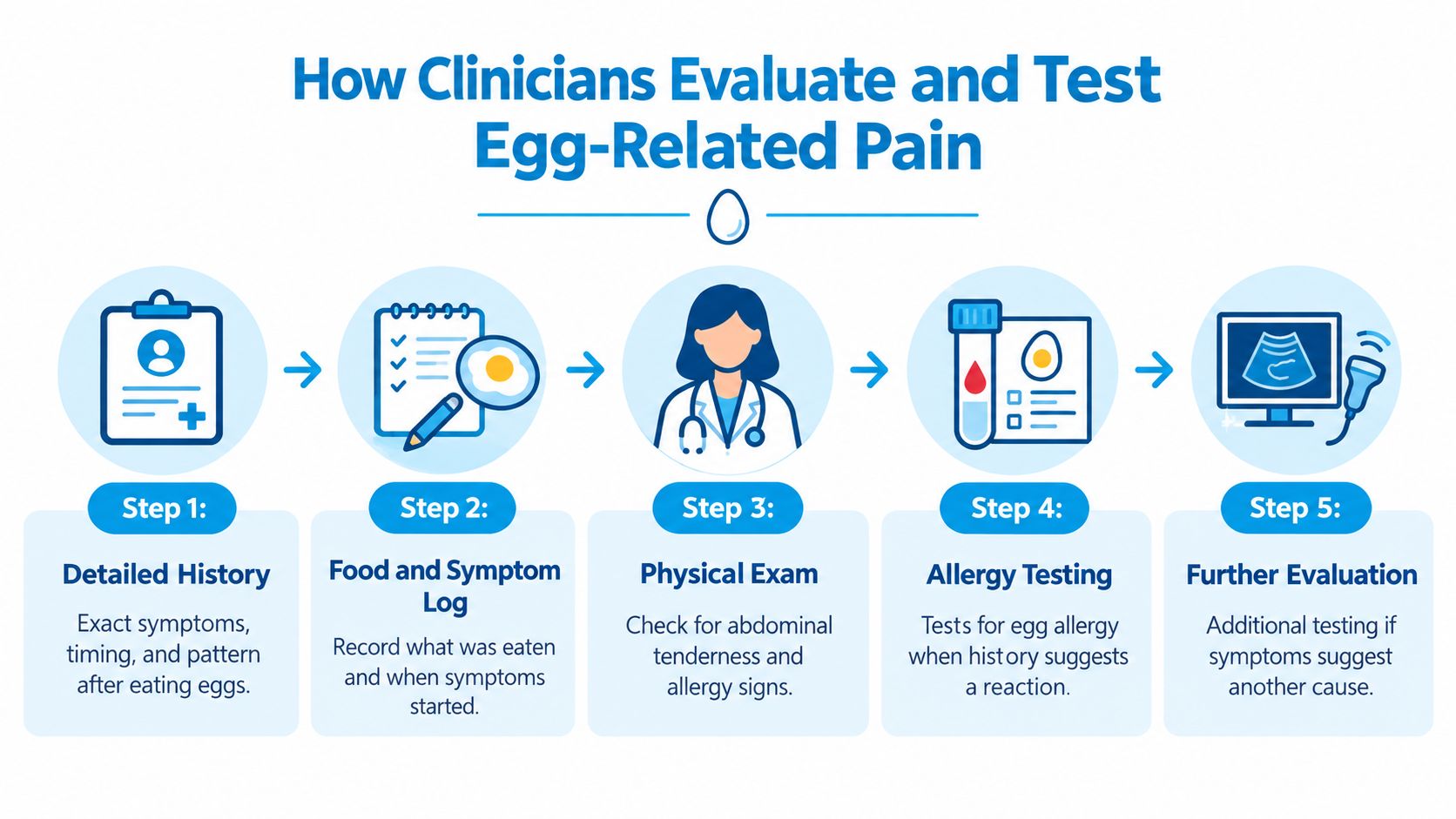
A clinician may start by comparing two meals: pain after a plain boiled egg, for example, points to a different pattern than pain after a buttery omelet eaten with other rich foods. They will ask about exact foods, portions, preparation, accompanying ingredients, onset time, and symptom pattern, along with medications and family history of allergy or gallbladder disease. Those details help decide which tests, if any, are useful.
The evaluation usually moves through five steps, from gathering clues to agreeing on what to do next.
What Happens Step by Step
Step one is the history. “Twenty minutes after a buttery omelet, right-sided pain for an hour” gives a clinician more to work with than “eggs upset my stomach.” Your meal and symptom notes can make these patterns easier to recall.
Step two is choosing targeted tests. Based on the timing and symptoms, testing may include a skin-prick test or egg white IgE laboratory testing for possible allergy. Imaging may be considered if gallbladder disease is suspected, while stool or blood tests may help assess possible infection or inflammation.
Step three is interpreting results alongside symptoms. A 2025 prospective study of 57 symptomatic children and adults found sensitization in 14% of adults, with different reactivity patterns for ovomucoid, ovalbumin, and yolk. A positive allergy test shows sensitization, not necessarily a clinical allergy. The result needs to fit the person's reaction history.
Step four may be a supervised oral food challenge. If the diagnosis remains uncertain, trained staff can monitor a person as they eat a measured amount and respond if a reaction occurs. After a rapid reaction, do not try a home challenge with baked egg, yolk, or another form.
Step five is agreeing on the diagnosis and follow-up. If intolerance is suspected, a clinician may recommend a structured elimination and reintroduction plan to check whether symptoms reliably track with egg. Reproducible symptoms after even small amounts, or uncertainty about how to test safely, are reasons to seek an allergist's evaluation rather than keep avoiding foods or experimenting at home.
Managing Symptoms and Knowing When to See a Doctor
While the cause is unclear, the most useful thing you can do is keep a simple meal and symptom log. Note the food, preparation, portion, timing, and symptoms in plain language. A few consistent entries tell a clinician far more than a month of vague restriction.
Tracking your pattern in writing, as shown below, turns guesswork into usable clinical information.

Practical Steps While You Wait
Avoid cutting out whole food groups on speculation. Broad restriction can compromise nutrition and still leave the actual cause unaddressed. Discuss any ongoing restriction with a clinician so the plan stays balanced and purposeful.
- Bring your log: Include dates, exact meals, onset times, and how long symptoms lasted.
- List medications and supplements: These can affect digestion and shape which tests make sense.
- Note related symptoms: Fever, bowel changes, reflux, or right-sided pain all change the picture.
Once a cause is identified, treatment follows the diagnosis. Allergy may mean avoidance and an emergency plan, infection calls for a food-safety approach, and gallbladder or other digestive conditions need care guided by a physician. No single remedy fits every pattern described in this article.
How an Integrative Evaluation Fits In
Conventional and integrative care can complement one another here. Standard diagnostic testing identifies allergy, infection, or gallbladder disease, while an integrative evaluation can also examine broader digestive contributors that make meals harder to tolerate. Sunridge Medical in Scottsdale evaluates persistent abdominal pain and food-related symptoms by reviewing symptom timing and food reactions, and it offers IgE food-allergy testing that can help assess an egg-related reaction.
If you live in Scottsdale, Phoenix, Paradise Valley, Tempe, Mesa, Chandler, or Gilbert and pain after eggs keeps recurring, a structured evaluation is more useful than indefinite restriction. Gather your symptom log, your medication list, and any prior test results before you call. That preparation helps the clinician decide which questions to pursue first and whether further testing is appropriate for you.
If stomach pain after eggs keeps returning despite your best attempts to track it, an individualized evaluation can help clarify whether allergy testing, digestive assessment, or another workup makes sense for you. Contact Sunridge Medical in Scottsdale to discuss whether a consultation is appropriate, and bring your meal and symptom log so your visit starts with the details that matter most.