

What if the clinical statistics you encounter online are merely a population average rather than your biological destiny? It’s common to feel a sense of profound isolation when confronted with a 5% to 10% 5-year stomach cancer survival stage 4 rate. You’ve likely spent hours searching for hope, only to be met with conflicting data or the suggestion that standard palliative care is the final destination. This feeling of being overlooked by traditional systems is heavy; however, it doesn’t have to define your journey.
We’re here to offer a different perspective rooted in clinical authority and compassionate optimism. You’ll learn how advanced integrative medical protocols are challenging standard expectations by targeting the underlying biological mechanisms of the disease. This guide provides a clear roadmap that explores how biomarker precision and immune-system support can redefine your prognosis. We’ll examine what Stage 4 means biologically and how a personalized, research-based approach offers a steady hand through the complexities of advanced care.
Key Takeaways
- Understand that stomach cancer survival stage 4 statistics are population averages that often fail to reflect the latest advancements in targeted and integrative therapies.
- Recognize how specific prognostic factors, such as Performance Status and the location of metastasis, allow for a more precise and individualized clinical strategy.
- Shift from a purely palliative mindset to a proactive approach by exploring how integrative medical protocols can complement standard oncological care.
- Discover the significance of the tumor microenvironment and how targeted methodologies can help the immune system recognize and address metastatic cells.
- Establish a structured path forward by learning the critical questions to ask when evaluating advanced, research-based alternative treatment options.
Understanding Stage 4 Stomach Cancer: Beyond the Statistics
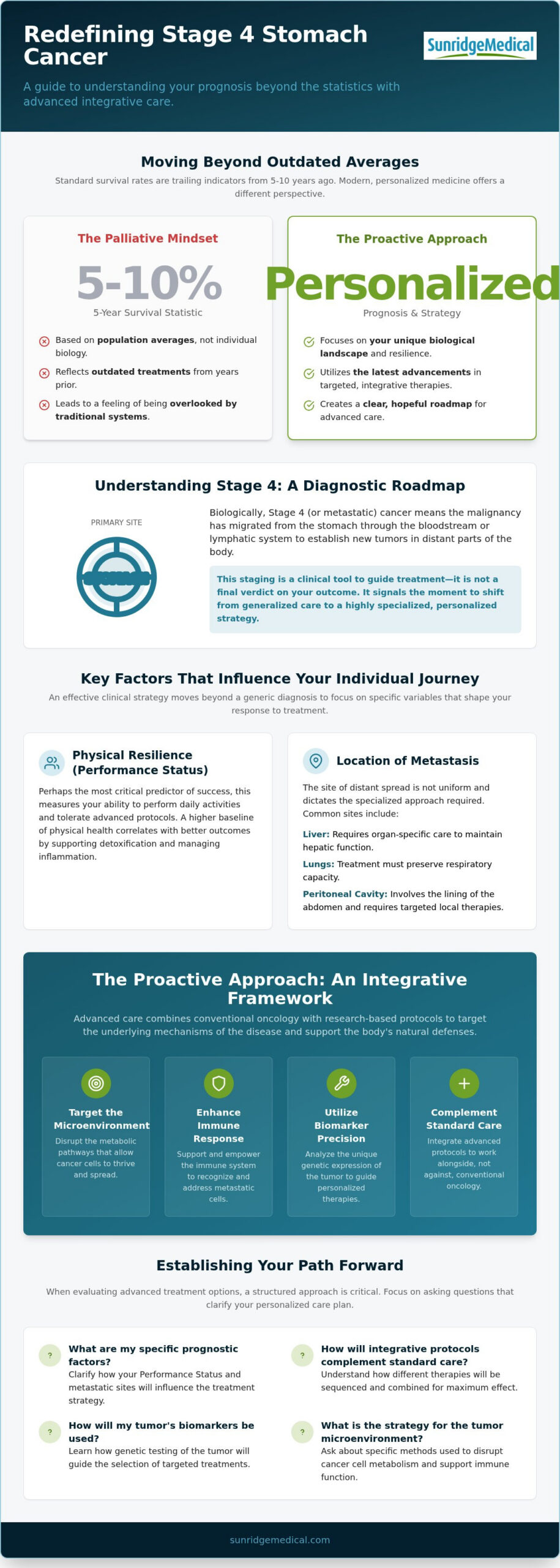
A diagnosis of Stage 4 gastric cancer often feels like an insurmountable wall, yet it’s essential to understand what this classification means in a clinical context. Biologically, Stage 4 indicates that the malignancy has migrated beyond the stomach and regional lymph nodes to distant organs. While this is a serious medical situation, staging functions as a diagnostic roadmap rather than a final verdict on your outcome. It allows physicians to identify the specific nature of the disease and implement advanced protocols tailored to your unique biological landscape. Instead of viewing this as an end point, consider it the moment where standard, generalized care must give way to high-level, specialized attention.
Many patients feel overwhelmed by historical data that doesn’t reflect the current medical reality. The 5-year stomach cancer survival stage 4 rates found in public databases are trailing indicators. These numbers typically represent outcomes from patients treated five to ten years ago, meaning they fail to account for the significant medical innovations available in 2026. For a comprehensive overview of stomach cancer, one can see how the disease’s complexity requires a departure from “packaged” treatments. Median survival is merely a mathematical midpoint for a large group; it doesn’t predict your individual prognosis or the potential for progress when using research-based alternative protocols.
The Biology of Metastatic Gastric Cancer
Adenocarcinoma cells are remarkably mobile, migrating through the lymphatic system or the bloodstream to establish new colonies. Common sites for Stage 4 spread include the liver, lungs, and the peritoneal cavity. The aggressiveness of this spread is often dictated by the tumor “grade,” which measures how much the cancer cells differ from normal tissue. High-grade, poorly differentiated cells require a more intensive, multi-faceted approach to disrupt their metabolic pathways and prevent further colonization. Understanding these underlying mechanisms is the first step toward reclaiming control over your health journey.
Deciphering Survival Statistics for 2026
In an advanced clinical setting, the focus shifts toward conditional survival. This concept acknowledges that your outlook changes and often improves the longer you remain in an active, successful treatment protocol. Early detection of metastasis through biomarker testing allows for the integration of targeted therapies before the tumor burden becomes overwhelming. Moving past population-level averages requires a focus on individual physician evaluations. By examining the unique genetic expression of the tumor and your overall physiological resilience, we can move beyond standard palliative care toward a more hopeful, proactive strategy.
Key Prognostic Factors: What Influences Survival at Stage 4?
While a diagnosis is often viewed through the lens of population averages, an individual’s stomach cancer survival stage 4 journey is shaped by a precise set of prognostic factors. These variables determine how well a patient responds to treatment and their potential for long-term progress. Recognizing these factors allows us to move away from a “one-size-fits-all” mentality and toward a customized clinical strategy that addresses the specific challenges of your condition. By identifying these biological markers, we can build a foundation for a more targeted and effective care plan.
Physical Resilience and Performance Status
A patient’s Performance Status (PS) is perhaps the most critical predictor of clinical success. It measures the ability to perform daily activities and tolerate the rigors of advanced protocols. Clinical research, such as the study on Prognostic Factors for Stage IV Gastric Cancer, highlights that a higher baseline of physical health correlates with better outcomes. Maintaining physical activity isn’t just about fitness; it supports the body’s detoxification pathways and helps manage systemic inflammation. Optimizing your baseline health through targeted support can significantly enhance your resilience during treatment.
The Impact of Metastatic Site Distribution
The location of distant spread dictates the specialized approach required for effective management. Metastasis isn’t a uniform process, and each site presents unique hurdles:
- Liver Metastasis: This often requires organ-specific care to maintain hepatic function while addressing the tumor burden.
- Peritoneal Metastasis: Often involving the lining of the abdominal cavity, this type of spread may benefit from research-based approaches like Hyperthermic Intraperitoneal Chemoperfusion (HIPEC), which applies a heated drug bath directly to the affected area.
Localized treatments remain vital even when the disease is systemic. By addressing specific sites of spread, we can reduce the overall tumor burden and improve quality of life. This multi-faceted strategy ensures that no aspect of the disease is left unaddressed.
Nutritional Integrity and Biomarker Precision
Nutritional status is a powerful, yet often overlooked, prognostic factor. Preventing cachexia, or muscle wasting, is essential because it preserves the metabolic strength needed for recovery. Simultaneously, we look at the genetic “fingerprint” of the cancer. Biomarkers such as HER2 status and microsatellite instability (MSI) provide a roadmap for precision medicine. If you’re seeking a comprehensive physician evaluation to identify these specific markers, it can change the trajectory of your care by revealing which targeted therapies are most likely to succeed. Understanding these underlying mechanisms allows for a departure from standardized care, offering a more multi-faceted and hopeful path forward.
Advanced Treatment Options: Integrating Alternative and Conventional Care
When a diagnosis reaches an advanced stage, standard oncology often shifts its focus from curative intent to symptom management. This transition to “palliative care” can leave many patients feeling as though their options have been exhausted. However, we believe in moving from a palliative mindset to a proactive one. While the Stomach Cancer Stages framework provides a necessary clinical classification, it shouldn’t limit the scope of your medical journey. By integrating targeted therapies with research-based alternative protocols, we can address the disease with a level of precision that standard, systemic chemotherapy often lacks.
The role of integrative treatment for metastatic cancer is to bridge the gap between traditional medicine and leading-edge research. Standard chemotherapy is frequently a blunt instrument, impacting healthy cells as much as malignant ones. In contrast, advanced protocols focus on reducing collateral damage through targeted delivery and metabolic disruption. Specialized IV and injection therapies play a vital role here; they support the body’s physiological resilience, allowing patients to better tolerate intensive medical interventions while maintaining their quality of life.
The Limitations of Standard Palliative Care
A “one-size-fits-all” approach to chemotherapy often fails in the context of stomach cancer survival stage 4 because it ignores the unique metabolic profile of the individual tumor. Many patients are forced to discontinue necessary treatments due to debilitating side effects that the standard system isn’t equipped to manage. Individualized physician evaluations are essential for identifying these alternative pathways. By understanding why a patient’s body might be struggling, we can implement supportive measures that address toxicity and restore the internal balance required for progress.
Advanced Alternative Cancer Treatment Protocols
Our approach centers on alternative cancer treatment that targets the specific metabolic weaknesses of adenocarcinoma cells. There is a powerful synergy between research-based alternative methods and standard surgical or oncological options. We don’t view these as opposing forces, but as complementary components of a multi-faceted care plan. Each protocol is designed to address the specific genetic and tumor characteristics of the individual. This level of customization ensures that we’re not just treating a stage; we’re treating a person with a unique biological landscape and a clear path toward well-being.
The Immune System and the Tumor Microenvironment
The “seed and soil” theory remains one of the most profound concepts in modern oncology. It posits that while the cancer cell is the “seed,” it can only take root and spread if the “soil”—your body’s internal environment—is conducive to its growth. When addressing stomach cancer survival stage 4, clinical success often depends on our ability to transform this environment into one that’s inhospitable to malignancy. By focusing on the tumor microenvironment, we move beyond simply attacking the disease and start addressing the systemic factors that allowed it to flourish in the first place. This shift in perspective is essential for those seeking a more comprehensive lens than standard practices provide.
Immune Evasion and Restoration
Metastatic stomach cancer cells are masters of disguise. They utilize specific molecular mechanisms to hide from the body’s T-cells, essentially becoming invisible to the natural immune response. This evasion is a primary reason why standard treatments sometimes reach a plateau. To “unmask” these cells, we utilize advanced protocols that restore the body’s natural defense mechanisms. Rather than solely relying on external agents to destroy the tumor, our focus is on strengthening the host. We believe that a resilient immune system is the most powerful tool in your medical arsenal, and restoring its function is a cornerstone of our specialized attention.
Managing the Tumor Microenvironment
The microenvironment surrounding a gastric adenocarcinoma is often characterized by a “storm” of chronic inflammation and the recruitment of new blood vessels, a process known as angiogenesis. These factors act as a life-support system for metastatic lesions. By clinically managing systemic inflammation, we can disrupt the signals that promote growth and spread. Our multi-faceted approach includes:
- Angiogenesis Inhibition: Targeting the blood supply that feeds metastatic lesions to limit their expansion.
- Inflammatory Modulation: Reducing the biochemical markers that signal cancer cells to proliferate and invade nearby tissues.
- Biochemical Rebalancing: Using customized protocols to alter the body’s internal landscape, making it less supportive of cancer cell metabolism.
Our goal is to create a physiological sanctuary where your body can begin to reclaim its well-being. This proactive management of the internal landscape is what separates a standard palliative approach from a pioneering, integrative strategy. If you’re ready to explore a more targeted path, we invite you to consult with our advanced alternative cancer specialists to discuss an individualized treatment evaluation. By addressing the soil as well as the seed, we provide a steady hand for patients navigating these complex health journeys.
Navigating Your Care Path: Next Steps for Advanced Support
Facing a diagnosis that carries a low stomach cancer survival stage 4 percentage requires more than just endurance; it requires a strategic shift in how you approach your care. Many individuals feel trapped by the limitations of conventional palliative options, yet the path forward often begins with a high-level second opinion. Seeking specialists in advanced alternative medicine allows you to explore the gap between standard practice and the leading edge of medical research. This transition from a passive patient role to an active participant in your recovery is a powerful psychological catalyst that can foster a sense of calm determination and hope.
When you’re evaluating a clinic for advanced support, it’s essential to move beyond surface-level promises. You should ask specific questions about their approach to customization and the research backing their methodologies. A pioneering expert won’t offer “packaged” care; instead, they’ll provide a multi-faceted strategy that addresses your unique biological landscape. At Sunridge Medical, we’re dedicated to providing a sanctuary of specialized attention where advanced cases are met with intellectual depth and empathetic advocacy rather than standardized protocols.
Individualized Physician Evaluations
A comprehensive evaluation at Sunridge Medical is a deep dive into the underlying mechanisms of your disease. We don’t rely on broad classifications; we utilize precise diagnostic testing to identify the specific genetic and metabolic markers of your tumor. This data informs the development of a proprietary treatment protocol designed specifically for your body’s needs. Because metastatic care is a dynamic process, we prioritize ongoing monitoring and protocol adjustments. This ensures that your care plan evolves alongside your progress, maintaining the precision required to address complex adenocarcinoma effectively.
Taking Action: Personalized Support and Consultations
Navigating the complexities of advanced gastric cancer can be overwhelming without a steady hand to guide you. Our team acts as a “scientific guide,” bridging the gap between technical medical knowledge and your individual human experience. We invite you to step away from the frustration of being overlooked by traditional systems and toward a more comprehensive lens of care. You can access personalized support and discuss your options through our toll-free consultation line, where we focus on the possibility of progress and the restoration of well-being. Contact Sunridge Medical today to discuss your individualized treatment plan.
Empowering Your Journey Toward Restoration
A diagnosis of advanced gastric cancer is a significant medical challenge, but it’s not a final verdict. We’ve explored how population-level statistics for stomach cancer survival stage 4 often fail to account for the unique biological factors of the individual or the impact of research-based alternative treatment protocols developed over two decades. By shifting focus toward the tumor microenvironment and immune restoration, you can move from a place of uncertainty to one of calm determination. You’re not just a data point; you’re a person with a unique physiological landscape that deserves precise, specialized attention.
Sunridge Medical serves as a comprehensive outpatient medical center, offering a sanctuary for those who feel overlooked by standard systems. We prioritize individualized physician evaluations for complex metastatic cases, ensuring that your care plan is as unique as your biology. You deserve a partner who looks beyond the ordinary to find a path toward progress. Our commitment is to act as your scientific guide, providing the thoroughness and reliability needed for this journey.
Schedule a consultation with a Sunridge Medical specialist to explore your advanced treatment options. Your well-being is a journey worth every specialized effort, and we’re here to walk that path with you with unwavering support and expertise.
Frequently Asked Questions
Can Stage 4 stomach cancer be cured?
Standard medical literature often classifies Stage 4 as incurable, but this doesn’t mean progress is impossible. Advanced protocols focus on achieving long-term disease stability and remission by targeting cancer at a cellular level. By moving beyond standard palliative care, we aim to unmask cancer cells and restore the immune system’s natural defenses. This proactive strategy allows for a more hopeful outlook that focuses on the individual’s unique biological response.
What is the life expectancy for someone with Stage 4 gastric cancer in 2026?
Life expectancy is highly individualized. While historical 5-year stomach cancer survival stage 4 rates are estimated between 5% and 10%, these numbers are population averages. In 2026, the focus has shifted toward conditional survival, where your outlook improves as you successfully navigate advanced treatment. Statistics like the 20% one-year survival rate in the UK provide a baseline, but individual biological factors remain the most important predictors.
What are the newest treatments for metastatic stomach cancer?
The newest treatments include targeted therapies and immunotherapies approved within the last two years. Zolbetuximab was approved in October 2024 for CLDN18.2-positive tumors, while Durvalumab received approval for use with the FLOT regimen in November 2025. Additionally, Givastomig was granted Fast Track designation in June 2026 for specific metastatic adenocarcinomas. These innovations represent a significant shift toward biomarker-driven, precision oncology that offers a departure from standardized care.
How does alternative cancer treatment differ from standard palliative care?
Standard palliative care is designed to manage symptoms and provide comfort when curative options are limited. Advanced alternative cancer treatment protocols differ by actively targeting the disease’s underlying metabolic and immune-evasion mechanisms. This methodology seeks to alter the tumor microenvironment and strengthen the host’s physiology. It’s a multi-faceted approach that views the patient as an active participant in their recovery rather than a passive recipient of comfort care.
Is chemotherapy the only option for Stage 4 stomach cancer?
Chemotherapy is no longer the only path for those navigating stomach cancer survival stage 4. Modern oncology now includes immunotherapy combinations, such as Pembrolizumab with trastuzumab, and targeted agents like Zolbetuximab. Additionally, research-based alternative protocols can be used alongside standard chemo to minimize toxicity. This diversity of options allows for a highly customized treatment plan that addresses the specific genetic mutations and metabolic profile of your cancer.
What factors contribute to becoming a long-term survivor of Stage 4 cancer?
Long-term survivors often share key characteristics, including a high baseline Performance Status and a tumor profile that responds well to targeted agents. Success is also linked to a patient’s ability to maintain nutritional integrity and manage chronic inflammation. By addressing the “soil” of the body as well as the “seed” of the tumor, patients can create an environment that’s inhospitable to cancer proliferation and more receptive to advanced care.
How can I improve my performance status during cancer treatment?
Improving your performance status involves a combination of nutritional support, moderate activity, and systemic inflammation management. At Sunridge Medical, we utilize specialized IV and injection therapies to bolster your body’s metabolic reserves. These clinical interventions help reduce the side effects of intensive protocols, allowing you to remain active and resilient. A stronger physical foundation directly correlates with a better ability to tolerate and respond to advanced medical treatments.
Does Sunridge Medical work alongside my current oncologist?
Our physicians are committed to a collaborative model of care and frequently work alongside a patient’s primary oncologist. This multi-disciplinary approach ensures that alternative protocols and standard treatments are synchronized for maximum efficacy. By acting as a “scientific guide” within your existing medical team, we provide a level of specialized attention that bridges the gap between conventional systems and leading-edge alternative research.