


If neuropathy pain becomes less intense, does that mean your nerves are recovering, or could you be losing the ability to feel an injury? That question exposes the problem with treating the stages of neuropathy as a simple ladder from mild tingling to severe pain. Clinicians need to understand what you feel, what your examination shows, and how your nerves affect everyday function before assigning meaning to a stage.
Table of Contents
- Understanding the Stages of Neuropathy
- How Clinicians Categorize Neuropathy
- Comparing the Main Neuropathy Grading Systems
- Diabetic Neuropathy Stages Explained
- Recognizing Neuropathy Before Severe Symptoms
- How Neuropathy Patterns Affect Progression
- Chemotherapy Neuropathy Grades and Daily Function
- Common Causes and Their Diagnostic Clues
- How Doctors Evaluate and Treat Neuropathy
- What Improvement and Prognosis Really Mean
- Quick Neuropathy Stage Reference
- Discussing Neuropathy With Sunridge Medical
Understanding the Stages of Neuropathy
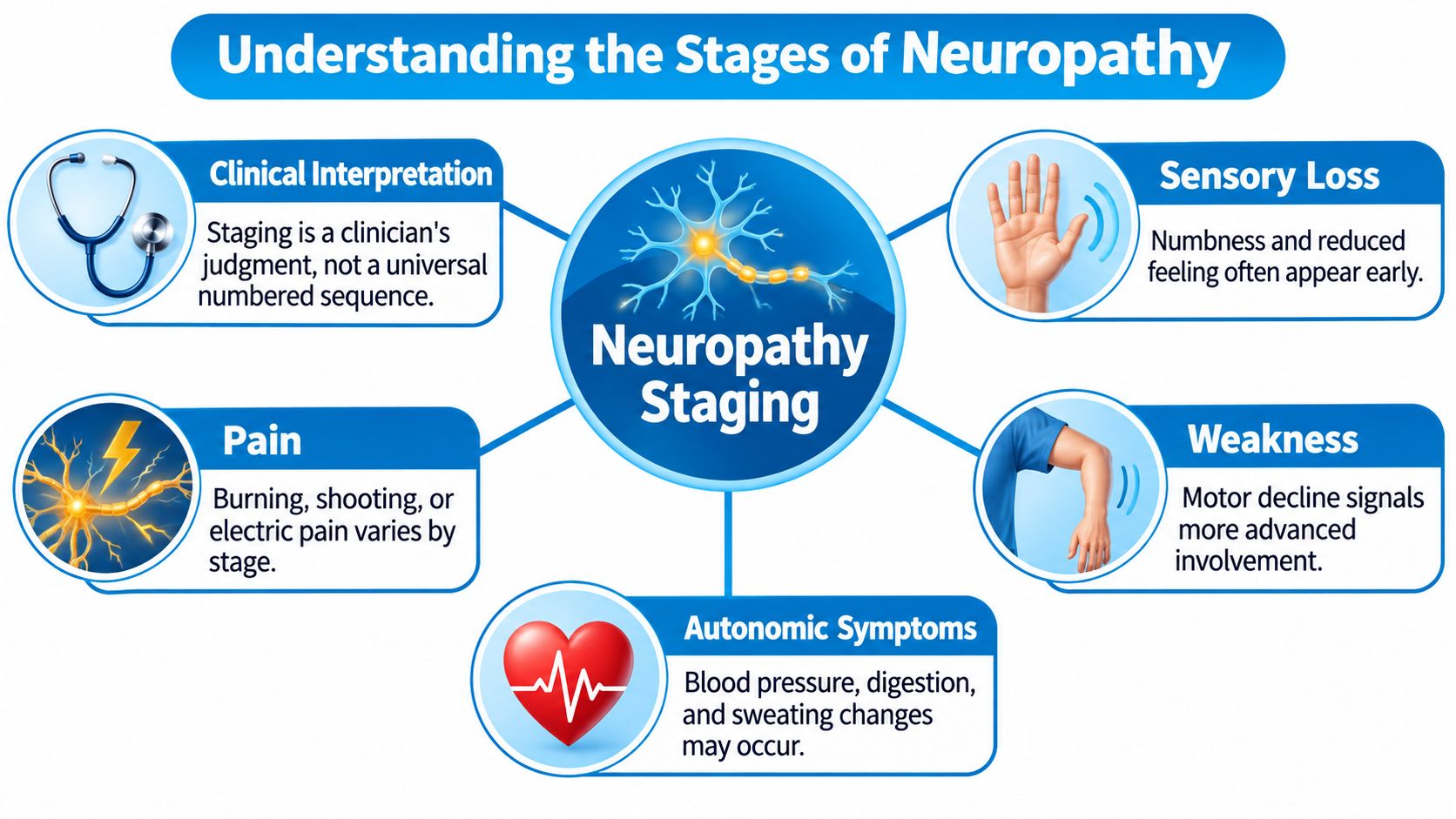
Peripheral neuropathy doesn't have a universal numbered staging system. Clinicians interpret the cause, distribution, speed of onset, nerve functions involved, and resulting disability together. A diabetes-specific stage and an oncology treatment-toxicity grade can describe different aspects of illness without contradicting each other.
The clinical picture can be uneven. Someone may have substantial burning pain without obvious weakness, while another person reports little discomfort despite reduced sensation. General neuropathy assessment therefore considers sensory changes, muscle strength, reflexes, and functional limitations rather than assuming everyone follows the same sequence, as described in the American Academy of Family Physicians' peripheral neuropathy evaluation guidance.
The concept map below brings these assessment dimensions together.
What a stage can and cannot tell you
A stage can help clinicians communicate findings, plan monitoring, and identify disability. It can't, by itself, establish the cause, predict your personal timeline, or determine which treatment is appropriate.
Diabetic, chemotherapy-related, autoimmune, compressive, hereditary, and unexplained neuropathies need interpretation within their own clinical context. A useful question is therefore not, “What stage am I?” Ask, “Which framework are you using, and what findings determine my risk?”
Practical rule: Treat a stage label as a summary of an assessment, not a substitute for one.
How Clinicians Categorize Neuropathy
Tingling is a symptom. Peripheral neuropathy is a clinical diagnosis involving peripheral nerve dysfunction. Your description matters, but a clinician still needs to determine whether the symptoms fit a nerve disorder and which nerves may be involved.
A length-dependent pattern usually begins in the feet because the longest nerve fibers are affected first. Clinicians sometimes call the resulting distribution “stocking-and-glove.” A problem confined to a particular nerve, an uneven pattern, or symptoms extending beyond that distribution requires a different interpretation.
The vocabulary behind the assessment
- Sensory involvement: Changes in pain, temperature, touch, vibration, or awareness of limb position.
- Motor involvement: Weakness or muscle wasting related to affected motor nerves.
- Autonomic involvement: Disturbances involving automatic bodily functions that require their own assessment.
- Functional impairment: The effect on walking, balance, household responsibilities, or personal care.
Small and large sensory fibers perform different jobs, so clinicians don't expect every sensory test to change together. The distinctions become especially important when symptoms and routine testing appear inconsistent.
Stage, grade, score, and pattern
A stage places findings within a defined disease framework. A grade usually expresses severity, often through functional impact. A score adds individual findings into a numerical measure, while a pattern describes where and how the disorder appears.
For an illustrative comparison, consider someone whose burning feet interrupt sleep but who retains strength and independence. Contrast that with someone who feels little pain but cannot reliably detect pressure underfoot. These aren't documented patient cases. They illustrate why discomfort and injury risk need separate assessment.
The most useful clinical description connects symptoms, nerve function, distribution, onset, and daily abilities.
Comparing the Main Neuropathy Grading Systems
The right framework depends on the clinical question. Is the clinician documenting diabetic polyneuropathy, tracking examination severity, assessing treatment toxicity, or investigating an unexplained nerve disorder?
Neuropathy frameworks at a glance
| Framework | Population | What it measures | Clinical use | Key limitation |
|---|---|---|---|---|
| Dyck staging | Primarily diabetic polyneuropathy | Objective findings, symptoms, weakness, disability | Classifying diabetic neuropathy | Not a universal system for every cause |
| Toronto Clinical Scoring System | Clinical assessment of neuropathy, particularly diabetic neuropathy | Symptoms, sensory findings, lower-limb reflexes | Recording severity over time | Doesn't establish the underlying cause |
| CTCAE | Treatment-associated adverse events, especially in oncology | Sensory or motor toxicity and functional consequences | Coordinating treatment decisions | A toxicity grade isn't a general disease stage |
| General clinical assessment | Neuropathy of varied or uncertain cause | Pattern, nerve-fiber involvement, onset, function | Guiding diagnosis and urgency | No single numerical label summarizes everything |
Where bedside scoring fits
The Toronto Clinical Scoring System, or TCSS, combines six symptom domains, five sensory tests, and lower-limb reflexes, with a maximum score of 19. Common interpretation is 0–5 for no neuropathy, 6–8 for mild, 9–11 for moderate, and 12–19 for severe neuropathy, as summarized in this clinical reference on diabetic neuropathy assessment.
That reference also describes a practical diabetic framework separating absent or asymptomatic disease, symptomatic disease, and advanced complications. Its complication category includes ulceration, Charcot neuroarthropathy, and nontraumatic amputation. That is different from the Dyck disability-based framework described below.
A person with diabetes receiving chemotherapy may need both a diabetes-focused assessment and oncology toxicity documentation. The labels answer different questions. Patients should ask clinicians to record the framework's name alongside its result rather than documenting an unexplained “moderate” or “advanced” label.
Diabetic Neuropathy Stages Explained
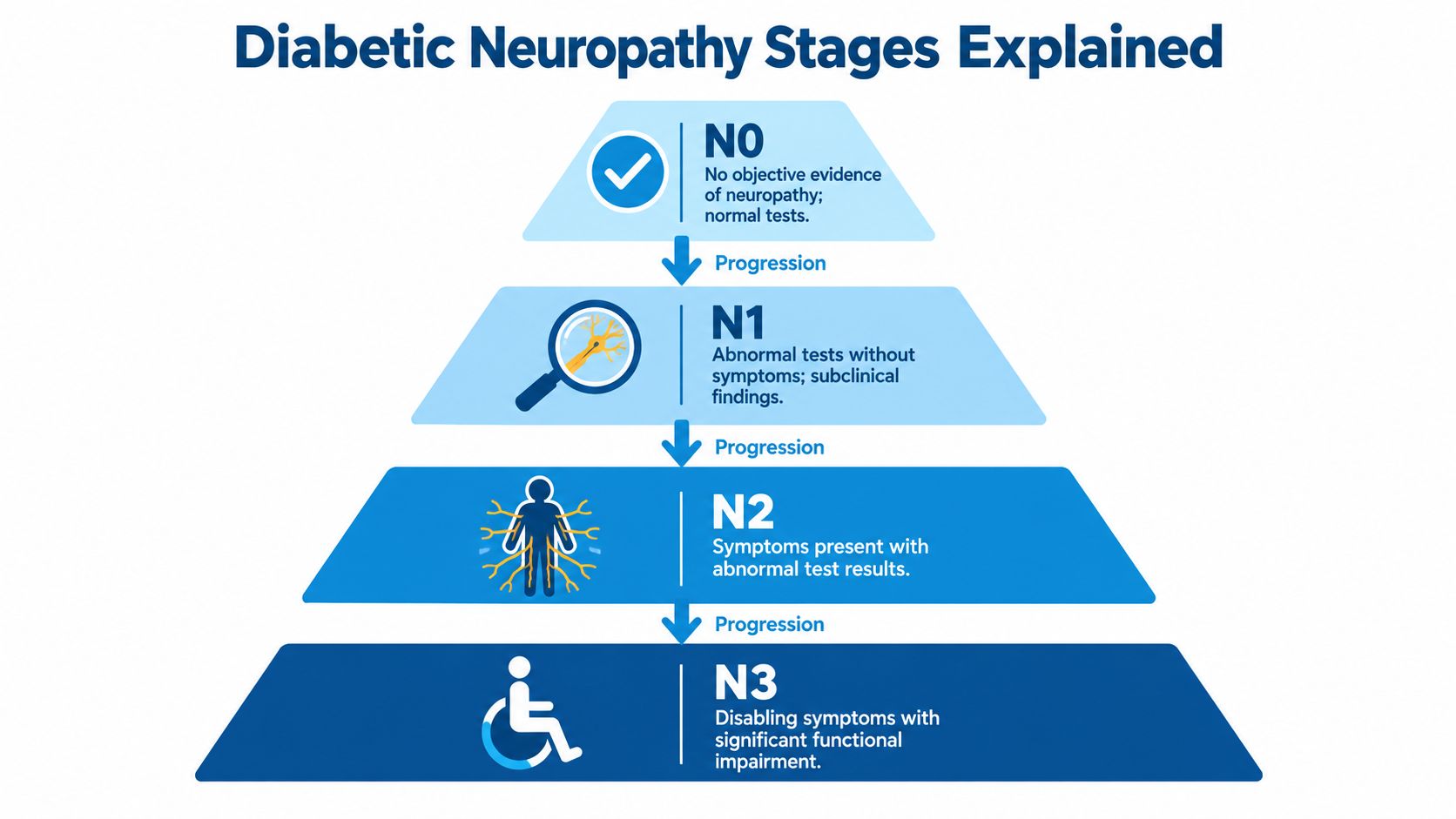
The Dyck staging system distinguishes objectively detectable disease from symptomatic and disabling diabetic polyneuropathy. Its subdivisions make clear why a person can have abnormal nerve testing before noticing symptoms.
This diagram summarizes the broad categories, but it shouldn't be read as a guaranteed personal progression.
Reading the Dyck categories precisely
The categories and subdivisions below follow the framework described in the clinical study using Dyck diabetic polyneuropathy staging.
| Dyck category | Meaning |
|---|---|
| N0 | No objective evidence of neuropathy |
| N1a | Abnormal nerve tests without symptoms or neurological examination signs |
| N1b | Abnormal tests accompanied by neurological impairment, without neuropathy symptoms |
| N2a | Symptoms, clinical signs, and abnormal nerve testing |
| N2b | Symptomatic disease with significant ankle-dorsiflexor weakness |
| N3 | Disabling polyneuropathy |
Ankle dorsiflexion means lifting the front of the foot toward the shin. The weakness distinction is therefore about motor function, not stronger pain.
For example, abnormal testing discovered during a diabetes evaluation may indicate subclinical disease even when someone says their feet feel normal. Conversely, a patient's difficulty walking requires assessment of strength, sensation, balance, and disability rather than classification from a pain rating alone.
Using the stage in care decisions
This framework is primarily validated for diabetic polyneuropathy. Clinicians shouldn't automatically transfer it to alcohol-related, nutritional, chemotherapy-related, autoimmune, or hereditary neuropathy.
A stage is most useful when it supports monitoring and risk assessment. It doesn't tell you how quickly another category might develop or whether your symptoms will reverse. For people considering a broader metabolic consultation, the clinic's diabetes care information provides relevant service context.
For another patient-facing perspective, Midwest Pain & Wellness offers a resource titled Diabetic Neuropathy Naperville. Use educational resources to prepare questions, while relying on your own clinician's findings for classification.
The following video provides an additional educational resource to discuss with your care team.
Recognizing Neuropathy Before Severe Symptoms
“I don't have much pain” is useful information, but it doesn't settle whether your feet are protected from injury. Clinicians also examine what you can detect and whether an injury could go unnoticed.
A bedside assessment may include pinprick, temperature, vibration, light touch, position sense, reflexes, and structured foot inspection. These checks examine different nerve functions rather than repeating the same test in different ways.
What protective sensation means
Protective sensation helps you recognize potentially damaging pressure or injury. Diabetes Canada recommends assessment using loss of sensitivity to a 10-gram monofilament or loss of vibration sensitivity at the dorsum of the great toe; its guidance also discusses a 128-Hz tuning fork, pinprick, and ankle-reflex testing in peripheral neuropathy screening.
An abnormal monofilament result identifies an important safety concern. It doesn't independently establish the cause or provide a complete neurological stage.
Why clinicians combine screening methods
The Michigan Neuropathy Screening Instrument, or MNSI, pairs a 15-item symptom questionnaire with an examination of foot appearance, ankle reflexes, and great-toe vibration perception. In a study of 198 participants, 57 people, or 28.8%, met its neuropathy definition; the study used questionnaire scores of 7 or higher and examination scores of 2.5 or higher, as reported in the MNSI-based diabetic neuropathy study.
Those thresholds belong to that assessment context. They aren't a self-diagnosis tool or interchangeable with TCSS severity categories.
A questionnaire records your experience. An examination tests observable function, and nerve studies address additional physiological questions. Clinicians connect these findings with medical history, medications, and metabolic assessment before deciding what they mean.
A reassuring symptom report should not override an abnormal protective-sensation examination.
How Neuropathy Patterns Affect Progression
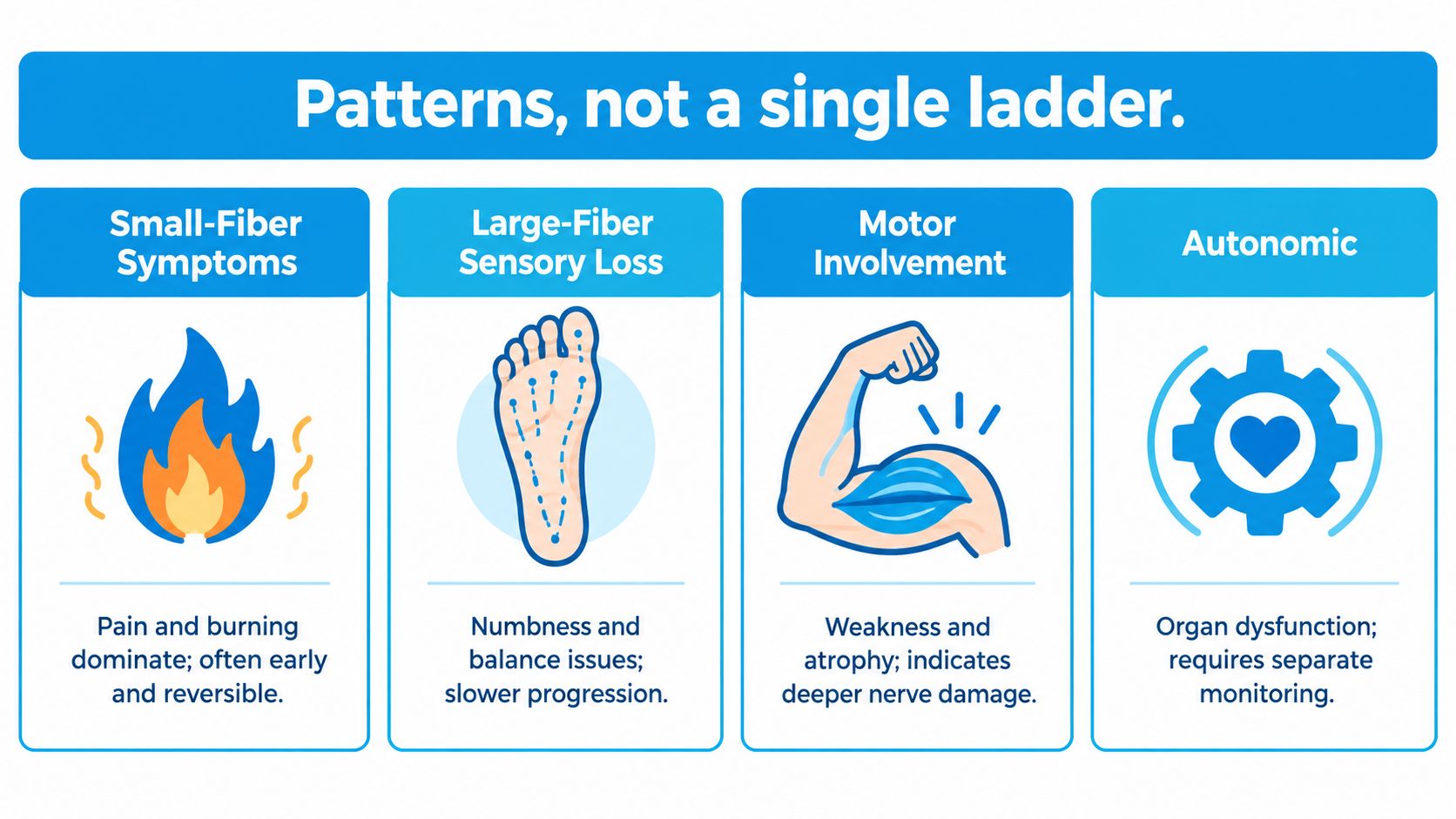
Nerve-fiber involvement changes the interpretation of symptoms. Burning pain, poor balance, muscle weakness, and automatic-function disturbances aren't necessarily consecutive steps in the same process.
The comparison below illustrates different presentations. Its visual shorthand should not be interpreted as proof that small-fiber disease is reversible, that large-fiber disease always progresses slowly, or that motor involvement must occur later.
Small-fiber and large-fiber presentations
Small-fiber neuropathy may involve burning, temperature sensitivity, or autonomic symptoms while strength, reflexes, and routine nerve-conduction studies remain normal. Large-fiber involvement more often affects vibration, position sense, and balance. Clinicians may consider skin biopsy, quantitative sensory testing, or autonomic testing when appropriate; these distinctions are discussed in the American Diabetes Association standards on neuropathy and foot care.
For example, burning feet with a normal routine nerve study may warrant a different diagnostic conversation from unsteadiness accompanied by impaired vibration sensation. Neither presentation can be reduced to a pain score.
Motor and autonomic involvement
- Motor changes: Difficulty lifting the foot, declining strength, or muscle wasting directs attention to motor examination and potentially electrodiagnostic testing.
- Autonomic concerns: Changes involving blood-pressure regulation, digestion, or sweating call for focused assessment rather than classification through a sensory-pain scale.
- Distribution and onset: A focal problem, uneven involvement, or rapidly changing symptoms may require a different diagnostic pathway from gradual, symmetric distal symptoms.
Can a normal EMG rule out neuropathy?
Not every form. Routine electrodiagnostic testing is particularly useful for evaluating large-fiber sensory and motor abnormalities, but it doesn't settle every small-fiber question.
This doesn't mean everyone with persistent burning needs a biopsy. A clinician should first establish whether the symptoms and examination support that investigation. Specialized testing is most useful when it addresses a specific unanswered clinical question, not when it is ordered merely because another test was normal.
Chemotherapy Neuropathy Grades and Daily Function
During cancer treatment, a change in independence may matter as much as a change in sensation. Difficulty preparing meals or managing transportation gives the oncology team information that “my feet tingle more” may not fully capture.
The National Cancer Institute Common Terminology Criteria for Adverse Events, or CTCAE, grades sensory and motor neuropathy separately. It is a treatment-toxicity framework, not a prediction of inevitable nerve deterioration.
Interpreting functional grades
The grade descriptions below follow the CTCAE-based treatment-associated neuropathy reference.
| Grade | Patient-friendly interpretation |
|---|---|
| 1 | Asymptomatic or mild findings, generally identified clinically or through testing |
| 2 | Moderate symptoms limiting instrumental activities, such as shopping, meal preparation, transportation, or finances |
| 3 | Severe or medically significant symptoms limiting self-care, potentially requiring an assistive device |
| 4 | Life-threatening consequences requiring urgent intervention |
| 5 | Death related to the adverse event |
The highest category describes adverse-event reporting. It isn't an expected destination for someone experiencing tingling during treatment.
What to report to your oncology team
Keep track of changes from your pretreatment baseline, including sensation, weakness, walking, balance, falls, and personal-care abilities. Be specific about tasks: explain whether you can still handle shopping independently or whether you now need help dressing.
A functional decline can prompt medication review, rehabilitation referral, fall-risk planning, and a discussion of treatment modifications. Don't change or stop cancer treatment independently. The oncology team needs to weigh neurological effects alongside cancer-treatment goals.
The clinic's guide to integrative support for chemotherapy side effects offers additional context for discussing supportive options. Complementary care should remain coordinated with the treating oncology team.
Common Causes and Their Diagnostic Clues
The location of numbness doesn't establish its cause. Similar foot symptoms may occur in people with very different medical histories, and more than one contributor may need consideration.
Clinicians examine timing, symmetry, distribution, medication exposure, and associated findings. For example, symptoms developing during a treatment course warrant a careful treatment timeline, but that association doesn't eliminate other possible contributors.
Cause categories worth reviewing
| Category | Useful history or diagnostic question |
|---|---|
| Diabetic or metabolic | What is the glucose history, and are there other metabolic concerns? |
| Treatment-associated | How do symptoms relate to medication initiation or treatment changes? |
| Alcohol-related or nutritional | Is there relevant exposure, nutritional difficulty, or possible vitamin B12 deficiency? |
| Thyroid, kidney, or liver disease | Could a systemic disorder contribute? |
| Autoimmune or infectious | Do the neurological findings and broader illness suggest targeted investigation? |
| Hereditary | Does the personal or family history support further assessment? |
| Compressive | Does the distribution fit a specific nerve problem? |
| Idiopathic | Has an appropriate evaluation failed to identify a cause? |
These categories guide questions, not conclusions. “Idiopathic” means the cause remains unidentified after evaluation; it doesn't mean the symptoms are imaginary.
When the pattern changes urgency
Rapid progression, marked asymmetry, motor-predominant findings, or demyelinating features can require prompt evaluation for inflammatory, immune-mediated, toxic, infectious, or other treatable causes. The clinical review of diagnostic approaches to peripheral neuropathy explains why electrodiagnostic pattern matters in that decision.
If environmental exposure is part of your concern, the clinic's discussion of mold illness and neurological symptoms can help you organize questions. It should not be used to assume that exposure explains an individual neuropathy.
The priority is a diagnosis supported by the clinical pattern, not a favored explanation selected before the examination.
How Doctors Evaluate and Treat Neuropathy
A productive evaluation starts with a precise history: when symptoms began, where they started, how they changed, and which activities became difficult. Previous diagnoses, medications, cancer treatments, supplements, and relevant exposures all belong in that review.
Evaluation may include glucose or HbA1c, vitamin B12, thyroid testing, renal and liver assessment, blood counts, and serum protein studies, with electrodiagnostic testing guided by the clinical pattern, as outlined in this neuropathy evaluation and management reference.
Select tests to answer clinical questions
Not everyone needs every available investigation. A clinician should explain what each proposed test could clarify and how its result might change the plan.
Electrodiagnostic testing can help distinguish predominantly axonal injury, involving nerve-fiber damage, from demyelination, involving the insulating covering. As described in the diagnostic review cited earlier, clinicians also use the findings to distinguish a single-nerve disorder from more generalized involvement.
Separate the treatment goals
- Address the contributor: Manage the identified underlying condition or review a potentially relevant treatment with the prescribing clinician.
- Relieve symptoms: Discuss pain and other burdens without treating symptom relief as proof of nerve repair.
- Protect function: Consider rehabilitation, assistive devices, and fall-risk assessment when the examination supports them.
- Prevent complications: Base foot-protection and specialist-referral decisions on risk findings.
- Monitor change: Follow relevant examination findings and practical abilities, not just a global impression.
Where integrative care belongs
An integrative consultation can bring conventional care and complementary options into the same discussion. It should still distinguish established management from approaches with limited evidence, off-label use, or investigational status.
The clinic's overview of natural treatments for peripheral neuropathy can serve as a discussion resource, not a prescription. Ask what evidence supports a proposed option for your particular cause, what risks or interactions need review, and how benefit would be measured.
A second opinion may be useful when symptoms persist, the cause remains uncertain, or several illnesses complicate treatment decisions. It should clarify the working diagnosis and plan rather than replace necessary neurological or oncology follow-up.
What Improvement and Prognosis Really Mean
Feeling better, remaining stable, and recovering nerve function are different outcomes. Each can matter, but none should be assumed from another.
Less pain may be meaningful for sleep and comfort while protective sensation remains impaired. Improved strength may help mobility even if balance still requires attention. A person can also report greater independence without a dramatic change in a test result.
Distinguish the outcome you're measuring
| Outcome | Question to ask |
|---|---|
| Symptom relief | Is discomfort less intrusive? |
| Prevention of further injury | Are examination findings and abilities remaining stable? |
| Functional improvement | Can you perform important activities more safely or independently? |
| Nerve recovery | Is there evidence that affected nerve function has improved? |
These are questions for follow-up, not a new grading system. Choosing relevant measures helps you and your clinician recognize useful progress without overstating what it means.
Does early neuropathy mean reversible neuropathy?
Early recognition provides an opportunity to identify contributors and reduce additional injury. It does not guarantee reversal. Established axonal loss may recover slowly or incompletely, as discussed in the evaluation reference above.
Your prognosis requires interpretation of the cause, pattern, duration, examination, and functional effects. There isn't a reliable universal timeline that can be assigned from a symptom description online.
Follow-up principle: Continue the protection recommended for sensory loss even when pain improves.
If your discomfort changes unexpectedly, tell your clinician whether touch, temperature awareness, walking, or daily abilities changed too. That description is more useful than deciding on your own that you have moved to a better or worse stage.
Quick Neuropathy Stage Reference
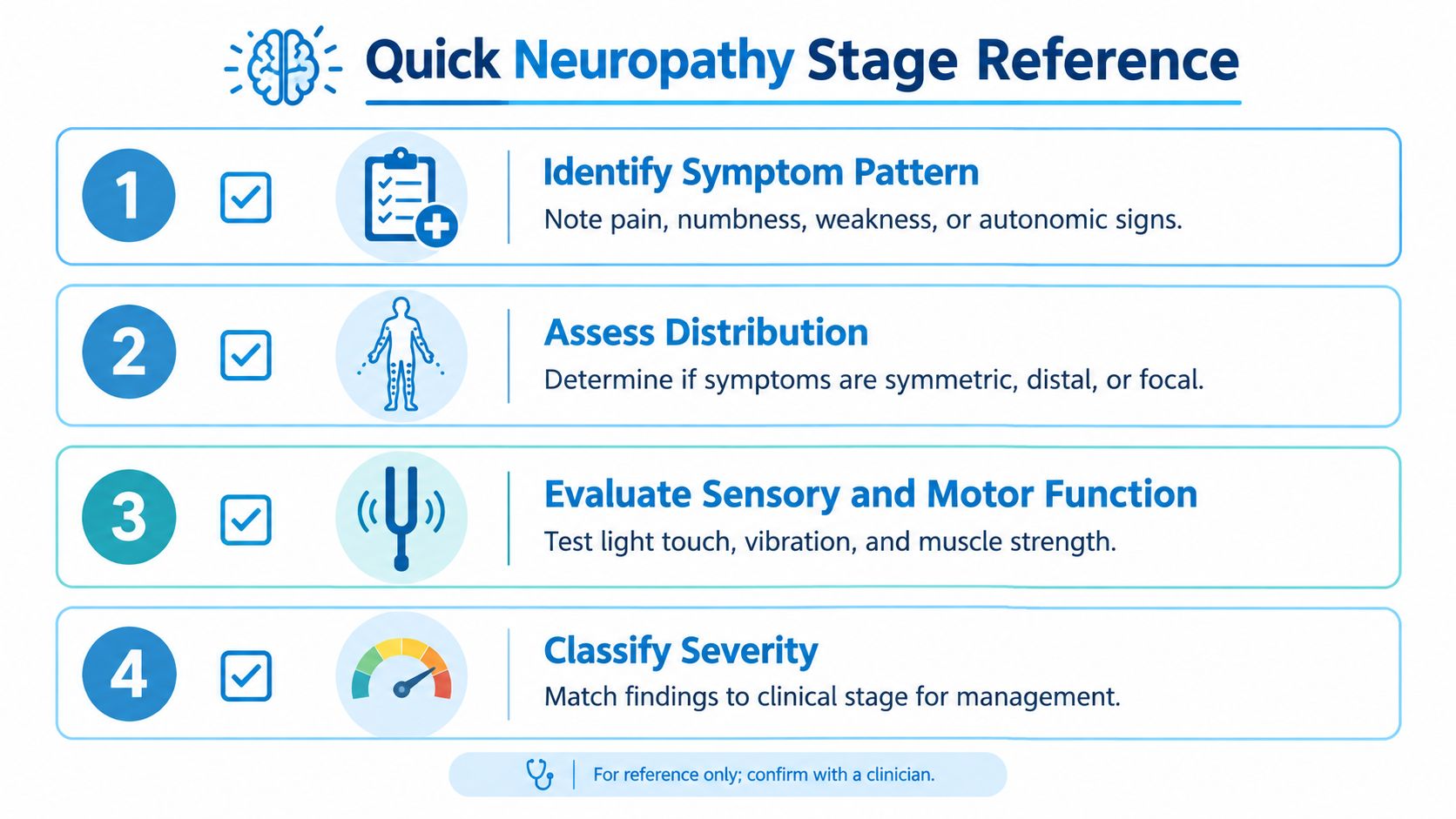
Use the following process to prepare for a clinical discussion. It connects the established frameworks without creating another numbered disease classification.
The visual summarizes assessment tasks, not a sequence patients pass through.
Match the question to the framework
- Describe the experience: Note pain, numbness, temperature changes, weakness, or automatic-function concerns.
- Map the distribution: Explain whether symptoms are distal, symmetric, focal, or uneven.
- Bring examination findings: Ask about sensory testing, strength, reflexes, and protective sensation.
- Name the functional change: Identify activities you now avoid or need help completing.
- Confirm the framework: Ask whether the clinician is using Dyck staging, TCSS scoring, CTCAE grading, or a general pattern-based assessment.
The detailed descriptions above explain how those systems differ. Don't compare results across systems as though they were interchangeable.
Decide how quickly to seek review
For stable symptoms, arrange follow-up appropriate to your clinician's plan and bring a record of meaningful changes. Don't wait for a routine consultation if symptoms progress rapidly or you develop substantial weakness, pronounced asymmetry, or major autonomic dysfunction.
A foot ulcer, new deformity, or suspected Charcot joint also calls for expedited assessment rather than symptom-only management, as described in the complication framework cited earlier.
This reference supports better questions. It cannot provide a diagnosis, establish your personal stage, or replace an examination.
Discussing Neuropathy With Sunridge Medical
For adults in Scottsdale and Phoenix, a focused consultation can help organize persistent symptoms, prior testing, and competing explanations. An individualized, evidence-informed approach should connect the neurological findings with the rest of your medical history rather than treating a stage label in isolation.
The Scottsdale integrative clinic combines conventional medical care with consideration of traditional and complementary approaches for complex chronic illness. That consultation is one option alongside primary care, neurology, podiatry, rehabilitation, and oncology services, depending on your needs.
Prepare for a useful consultation
- Bring relevant records: Include laboratory results, neurological reports, nerve studies, and specialist assessments.
- List treatments and exposures: Record prescriptions, supplements, previous therapies, and cancer-treatment history where applicable.
- Describe your priorities: Explain whether your main concern is pain, walking, sensory protection, treatment side effects, or an unclear diagnosis.
Patients from Paradise Valley, Tempe, Mesa, Chandler, Gilbert, and the greater Phoenix metropolitan area can ask whether a consultation or second opinion fits their situation. The discussion should clarify which assessments may be appropriate, how care would be coordinated, and where complementary options have uncertain evidence.
A sound plan begins with shared decision-making and realistic goals. No consultation can promise nerve regeneration, reversal, or a cure.
An integrative consultation can review your neuropathy symptoms, medical history, previous findings, and options for coordinated care. Visit Sunridge Medical to contact the Scottsdale clinic and ask whether an evaluation or second opinion is appropriate for your sensory changes, pain, or declining function.