


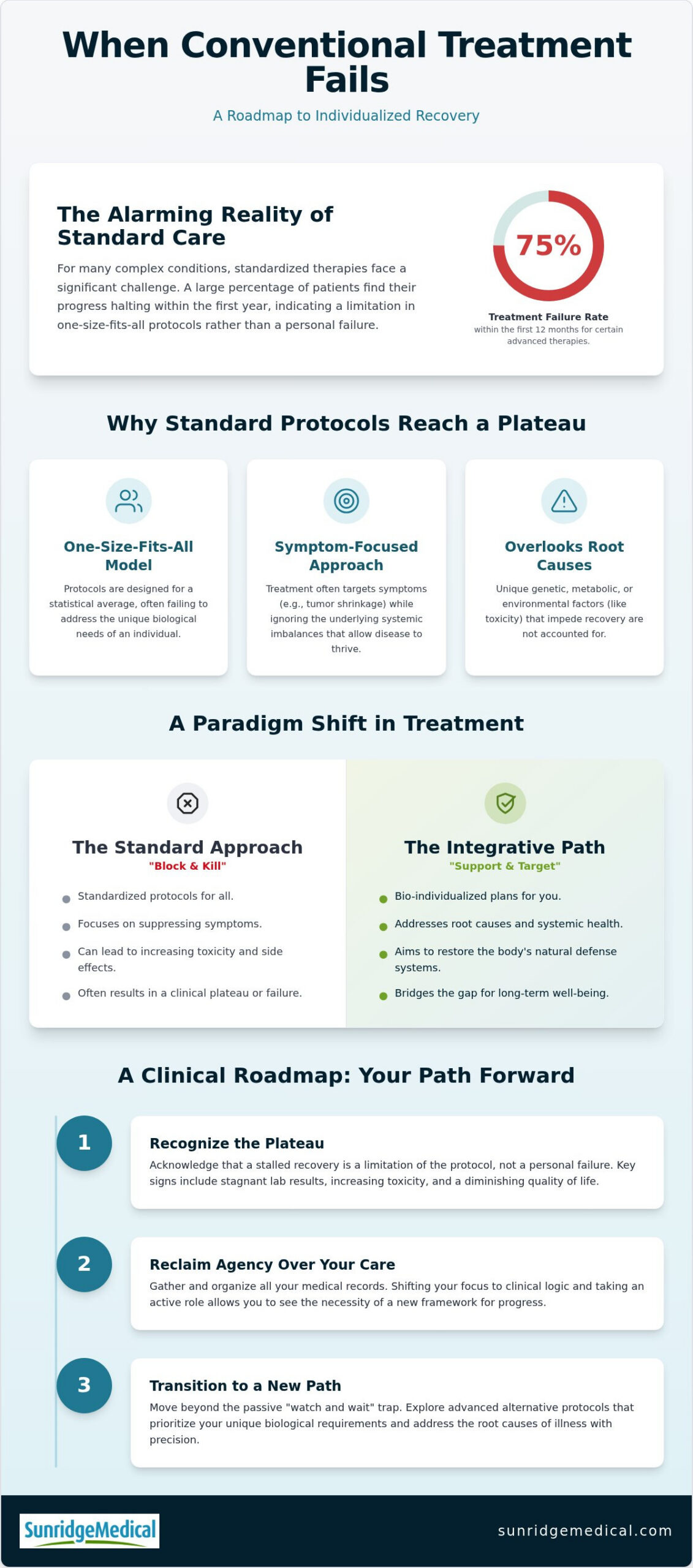
Recent clinical data reveals a sobering reality: for certain complex conditions, as many as 75% of patients experience treatment failure within the first twelve months of starting a new advanced therapy. If you’ve reached a plateau despite following every instruction from your specialist, you likely feel more like a statistic than an individual. It’s physically exhausting to endure aggressive treatments that don’t deliver the promised results, and it’s even more distressing when your medical team lacks a clear “Plan B” for your recovery.
We believe that a stalled recovery isn’t a biological dead end, but rather an indication that a standardized framework has reached its limit. This guide explains exactly what to do when conventional treatment fails by shifting the focus toward bio-individualized, research-based alternative therapies. You’ll discover why standard care often overlooks the underlying mechanisms of complex illness and how a multi-faceted approach can restore your sense of agency. We’ll provide a logical explanation for your current plateau and map out a credible, advanced path forward that prioritizes your unique biological requirements. By moving beyond one-size-fits-all protocols, you can begin to address the root causes of your illness with precision and renewed hope.
Key Takeaways
- Understand why the standard of care is designed for the average patient and how to recognize when a protocol has reached its clinical plateau.
- Learn the essential steps for what to do when conventional treatment fails, including how to organize your medical records to reclaim agency over your care.
- Explore the “support and target” methodology that addresses underlying disease mechanisms rather than relying solely on aggressive “block and kill” strategies.
- Discover how individualized recovery plans utilize advanced alternative protocols to bridge the gap between conventional medicine and long-term well-being.
Beyond the Standard of Care: Why Conventional Treatment Reaches a Plateau
In the clinical world, “treatment failure” is a technical term that describes the moment a standard medical protocol stops producing measurable progress. For many patients navigating chronic illness or advanced cancer, this realization is often accompanied by profound anxiety and a feeling of being abandoned by the system. However, it’s essential to understand that the standard of care is a generalized framework designed for the statistical average. It’s a baseline of safety and efficacy for the masses, but it often lacks the precision required for complex, non-standard cases.
When you are wondering what to do when conventional treatment fails, the first step is recognizing that the plateau isn’t your body’s fault. It’s a limitation of a system that prioritizes “packaged” care over individual biology. Validating your frustration is important, but shifting your focus to clinical logic allows you to see that a new framework is necessary for further progress.
The Limitations of One-Size-Fits-All Medicine
Standardized protocols often fail because they don’t account for unique genetic, metabolic, or environmental markers that influence how a body responds to therapy. In fields like oncology or infectious disease, a “one size fits all” approach might focus heavily on symptom suppression or tumor shrinkage while ignoring the underlying systemic imbalances that allowed the disease to flourish. Integrative medicine offers a broader perspective by combining these conventional tools with advanced methodologies that support the whole person. Bio-individualized care represents the necessary evolution of treatment when standardized protocols reach their clinical limit.
Signs That Your Current Protocol Has Exhausted Its Utility
Identifying the exact moment a treatment has plateaued requires a careful look at several clinical markers. You should consider a therapeutic pivot if you notice the following:
- Stagnant Lab Results: Biomarkers or imaging that show no improvement over several months.
- Increasing Toxicity: Side effects that become more debilitating than the symptoms of the illness itself.
- Diminishing Quality of Life: A decline in daily function despite strict adherence to the protocol.
Too often, when standard options run out, patients are told to “watch and wait.” This approach can be a dangerous trap, as it allows the underlying condition to progress without intervention. Instead of waiting, patients should consider a transition to advanced alternative protocols. Understanding what to do when conventional treatment fails involves moving from a “block and kill” mindset to one that restores the body’s natural defense mechanisms and addresses the root cause of the disease.
The Science of Individualized Recovery: Addressing Systemic Root Causes
The shift from standard care to individualized recovery begins with a fundamental change in clinical philosophy. While conventional medicine often focuses on the pathology itself, a more comprehensive approach examines the underlying mechanisms that allow disease to persist. For those seeking clarity on what to do when conventional treatment fails, the answer often lies in the restoration of the body’s internal environment. This involves a rigorous analysis of the immune system, which serves as the primary engine for healing and long-term stability. Precision is the priority.
Environmental factors frequently act as invisible barriers to recovery. Toxicity from heavy metals or environmental pollutants can impede the efficacy of standard protocols, leading to the plateaus discussed previously. By utilizing authoritative definitions from the NCCIH, we can better understand how these complex factors integrate into a total health picture. This level of detail is especially critical in oncology, where integrative cancer treatment by stage ensures that the intensity and type of support match the patient’s specific clinical needs.
Immune Modulation and Biological Treatments
Biological treatments are designed to recalibrate the body’s natural defense systems rather than simply overriding them. This is particularly vital for patients managing chronic Lyme disease or autoimmune triggers, where the immune system is often stuck in a cycle of dysfunction. Standard diagnostic panels often miss the full scope of these systemic issues. A physician-led evaluation must go deeper, identifying specific inflammatory markers and microbial burdens that remain hidden in conventional testing. This depth allows for the development of protocols that target the root cause of the dysfunction.
Advanced IV and Injection Therapy Protocols
Intravenous delivery provides a distinct clinical advantage by providing high-dose nutritional and oxidative therapies directly into the bloodstream. This method bypasses the limitations of the gastrointestinal tract, ensuring that therapeutic agents reach the cellular level where they’re needed most. For individuals with neurologic conditions, these customized IV protocols can support nerve health and reduce systemic inflammation more effectively than oral supplements alone. If you’re ready to explore these targeted methodologies, consulting with a specialist can help you determine the most appropriate biological path forward. Knowing what to do when conventional treatment fails starts with choosing a delivery method that maximizes bioavailability and cellular impact.
Comparing Standardized Protocols vs. Targeted Integrative Methodologies
Determining what to do when conventional treatment fails requires a shift in perspective. It’s vital to distinguish between “alternative” as a replacement and “integrative” as a comprehensive expansion of care. While standard protocols often focus solely on the pathology, integrative methodologies expand the clinical scope to include the host’s biological environment. Standard oncology typically follows a “block and kill” philosophy, focusing on the destruction of malignant cells through aggressive means. In contrast, integrative care adopts a “support and target” approach, aiming to weaken the disease while simultaneously strengthening the patient’s systemic resilience.
Hormone optimization plays a pivotal role in this process. Maintaining systemic resilience during treatment requires precise hormonal balance, a factor that’s often overlooked in standard protocols but is essential for metabolic stability. For a deeper understanding of these multi-faceted methodologies, refer to our clinical guide to integrative oncology. This transition from a narrow focus to a broad-spectrum strategy is often the key to breaking through a clinical plateau.
Standard Oncology vs. Research-Based Alternative Cancer Treatment
Standard chemotherapy has a narrow focus designed to hit specific cellular pathways. Research-based alternative protocols utilize a broad-spectrum approach to address the disease from multiple angles. These therapies can help people with cancer manage symptoms and improve quality of life while the primary treatment addresses the underlying mechanisms. Our objective is to minimize toxicity while maximizing clinical efficacy. Individualized patient monitoring ensures that every protocol is adjusted in real-time based on the patient’s unique metabolic response.
Conventional Lyme Care vs. Integrative Lyme Specialists
Conventional Lyme care often relies on short-term antibiotic courses. While this may be effective for acute cases, chronic presentations require a more sophisticated, multi-faceted recovery path. You need lyme disease specialists who understand the complexities of persistent biofilms and various co-infections. These specialists combine conventional clinical knowledge with advanced alternative terminology to navigate the nuances of the disease. Knowing what to do when conventional treatment fails in the context of Lyme involves addressing the microbial burden and the immune dysfunction simultaneously to ensure a thorough recovery.
A Clinical Roadmap: Essential Steps After Treatment Failure
Regaining control after a medical plateau requires a shift from passive participation to active advocacy. When you’re determining what to do when conventional treatment fails, the path forward must be built on a foundation of clinical data and logic rather than standardized guesswork. This roadmap provides a structured framework to pivot from failing protocols toward a multi-faceted integrative approach. It’s about reclaiming your agency and moving toward a system that values your unique biology over statistical averages.
The first clinical step is the consolidation of your medical history. You should gather every pathology report, imaging disc, and lab result from the last twenty-four months. This transparency allows a new medical team to identify exactly where the previous protocol reached its limit. Seeking a second opinion from a specialist who operates outside the standard-of-care constraints is vital. These practitioners offer a broader perspective on your biology, evaluating research-backed alternative protocols based on their specific mechanisms of action rather than their general popularity.
Step 1: Conduct a Comprehensive Physician Evaluation
A deep-dive evaluation is far more than a standard screening. It involves a rigorous analysis of metabolic and environmental roadblocks that may be hindering your recovery. Standard blood work often ignores the subtle shifts in cellular health or the presence of environmental toxins that can suppress immune function. During a physician-led consultation, the focus is on your unique biological markers. This thoroughness establishes a foundation of trust and ensures that no underlying mechanism is left unaddressed. It’s about moving beyond the surface to understand why your body isn’t responding as expected.
Step 2: Transitioning to an Individualized Care Plan
The transition to an individualized plan marks a shift from “what the insurance allows” to “what the patient needs.” This approach prioritizes your specific recovery over institutional convenience. A truly personalized plan integrates advanced therapies like hormone optimization and targeted nutritional support to fortify your systemic resilience. Setting realistic clinical goals is essential during this phase. We focus on both long-term recovery and immediate quality of life improvements. If you’re ready to move beyond the limits of standard protocols, you can schedule a physician evaluation to begin your personalized journey. Establishing clear milestones helps you track progress and maintain a sense of agency as you navigate this advanced path.
Pioneering a New Path: Advanced Alternative Protocols at Sunridge Medical
Sunridge Medical serves as a sanctuary for individuals who feel they’ve reached the edge of what standard medical protocols can offer. Since our founding in 2003, we’ve dedicated over two decades to treating complex chronic diseases and advanced cancer with a focus on precision and patient advocacy. Our facility is a collaborative environment where physicians refuse to accept the status quo, instead developing multi-faceted protocols that address the unique biological requirements of every individual. If you’re currently struggling with what to do when conventional treatment fails, our team acts as a scientific guide to help you navigate a more comprehensive path toward recovery.
We believe that a professional consultation should feel like a partnership. Our specialists possess deep technical knowledge but apply it with a focus on the human experience, ensuring you’re never treated like a statistic. For immediate clinical support or to discuss your specific case with a professional, our toll-free 1-800 number provides a direct gateway to personalized assistance. We maintain a high level of professional gravity because we understand the seriousness of your condition, yet we remain firmly rooted in compassionate optimism.
Our Approach to Alternative Cancer Treatment Protocols
Our methodology focuses on low-toxicity, research-based alternative therapies that target the disease while preserving the patient’s systemic health. We bridge the gap between conventional oncology and advanced alternatives, utilizing tools—such as specialized research compounds from Salus Peptides—that support the body’s natural defenses. Individualized physician monitoring is the cornerstone of this process. We don’t rely on “packaged” care plans; instead, our physicians adjust every protocol in real-time based on your specific metabolic and biological feedback. This level of customization is essential for those who have seen standard treatments reach a plateau.
Beyond oncology, we provide specialized management for those requiring integrative medicine for chronic illness. This involves the application of advanced IV protocols designed for environmental and neurologic conditions, bypassing gastrointestinal limitations to deliver biological agents directly where they are needed. We’re committed to identifying the systemic triggers and microbial burdens that standard diagnostic panels often overlook. Knowing what to do when conventional treatment fails involves choosing a path that prioritizes root-cause resolution over simple symptom suppression. Our expert-led recovery paths provide a steady hand for patients navigating the most complex health journeys.
Reclaiming Your Path to Recovery
A clinical plateau doesn’t have to be the end of your health journey. As a national center for integrative oncology and chronic disease, we’ve spent over two decades helping patients understand what to do when conventional treatment fails by looking beyond standardized protocols. We’ve explored why standard care often reaches a limit and how addressing systemic root causes, such as immune dysfunction and metabolic imbalances, can open new doors for progress. By shifting from a generalized framework to a bio-individualized care plan, you regain the agency necessary to navigate complex health challenges with precision.
Sunridge Medical offers a sanctuary of specialized attention rooted in over 20 years of clinical experience. Our comprehensive physician-led evaluations are designed to identify the hidden roadblocks that often stall recovery in traditional settings. You don’t have to navigate this uncertainty alone. We invite you to speak with a patient advocate at Sunridge Medical today to discuss your unique case. There is always a logical next step when you have the right scientific guide by your side. Your well-being deserves a strategy as unique as your biology.
Frequently Asked Questions
What exactly is considered “treatment failure” in conventional medicine?
Treatment failure is a technical term describing the point where standard protocols no longer provide clinical progress or when toxicity outweighs benefits. In conventional oncology, this might mean a tumor continues to grow despite chemotherapy. At Sunridge Medical, we view this as a framework failure rather than a biological dead end. Understanding what to do when conventional treatment fails involves pivoting to individualized methodologies that address underlying disease mechanisms rather than just suppressing symptoms.
Is alternative cancer treatment safe to combine with conventional therapies?
Integrative protocols are specifically designed to be used alongside conventional therapies to enhance efficacy and reduce toxicity. Our physicians focus on research-based alternative treatments that support the immune system without interfering with standard care. This multi-faceted approach aims to improve quality of life and systemic resilience. We carefully monitor every patient to ensure that biological treatments and conventional protocols work in harmony rather than in conflict to support your recovery journey.
How do I know if I am a candidate for integrative chronic disease management?
You are likely a candidate if you’ve reached a plateau with standard care or if your current protocol has exhausted its utility. This applies to complex conditions like chronic Lyme disease, autoimmune disorders, and neurologic illnesses. If you feel overlooked by one-size-fits-all systems, our individualized evaluations can determine your eligibility. We focus on patients who require a deeper, more comprehensive lens to address the root causes of their persistent health challenges effectively.
What makes Sunridge Medical different from a standard holistic clinic?
Sunridge Medical is a comprehensive medical center led by physicians with over two decades of clinical experience in advanced alternative medicine. Unlike standard holistic clinics that may lack clinical depth, we bridge the gap between conventional clinical knowledge and research-based alternative terminology. Our facility provides specialized IV and biological treatments within a sophisticated medical framework. We prioritize precision and customization, acting as a scientific guide for patients navigating complex health journeys across the country.
Can integrative protocols help with Stage 4 or metastatic cancer?
Integrative protocols are frequently utilized for Stage 4 or metastatic cancer to address the disease through a “support and target” methodology. These advanced alternative treatments focus on low-toxicity options that aim to weaken the disease while fortifying the host’s biological environment. While standard care often runs out of options at this stage, we offer individualized care plans that target the underlying mechanisms of the cancer. This approach helps maintain quality of life and systemic stability.
What should I bring to my first comprehensive physician evaluation?
You should bring all previous medical records, pathology reports, and imaging discs from the last twenty-four months. This transparency is crucial for our physicians to identify why a previous protocol may have reached a plateau. Knowing what to do when conventional treatment fails starts with a thorough review of your clinical history. Providing a complete list of current medications and previous interventions allows us to develop a more precise and effective individualized care plan for you.
How does hormone optimization impact the recovery from chronic illness?
Hormone optimization is essential for maintaining systemic resilience and metabolic stability during recovery. Chronic illness often depletes the body’s hormonal reserves, which can hinder the immune system’s ability to heal. By restoring these levels to their optimal state—a practice emphasized by medical professionals like Dr. Renato Lobo—we support the body’s natural defense mechanisms and improve overall energy levels. This targeted therapy is a key component of our multi-faceted approach, ensuring that the patient’s biological environment is capable of supporting long-term well-being and progress.
Every protocol at Sunridge Medical is rooted in current medical research and advanced biological principles. We utilize a clinical philosophy that prioritizes evidence-based alternative therapies, moving away from “standardized” or “packaged” care. Our physicians constantly evaluate the latest research to refine our methodologies for cancer and chronic disease management. This commitment to reliability and thoroughness ensures that our patients receive leading-edge care that goes beyond the ordinary limits of the medical status quo.