


Hyperbaric oxygen therapy isn't an established treatment for cancer itself, and no regulator or systematic review supports presenting it as one. Its best-supported cancer-related role is narrower: an adjunct for selected late radiation injuries, where pooled randomized trials found a risk ratio of 1.39 for complete resolution or substantial improvement compared with control care, with certainty rated low to moderate.
Search for cancer hyperbaric oxygen therapy and two confident claims appear side by side. One says pressurized oxygen attacks tumors. The other says any history of cancer rules the chamber out entirely. Neither survives contact with the published evidence, and both leave patients asking the wrong question. The question that decides a real clinical decision is smaller and answerable: is there a documented radiation injury in a named tissue, and does the oncology team agree on timing? Everything else, including the pressure, the number of sessions, and the insurance paperwork, follows from that answer.
Table of Contents
- What Cancer Hyperbaric Oxygen Therapy Can and Cannot Do
- How Hyperbaric Oxygen Reaches Irradiated Tissue
- Trial Results for Radiation Injury and What They Mean
- Safety Screening, Medications and Side Effects
- Using HBOT During Active Cancer or Chemotherapy
- Outcomes to Track and Questions to Ask
- Treatment Access, Session Count and Coverage
- Confirm Whether an Evaluation Fits Your Situation
What Cancer Hyperbaric Oxygen Therapy Can and Cannot Do
Could hyperbaric oxygen therapy help with a complication left by radiation, or is it being presented as a way to treat cancer itself? The U.S. Food and Drug Administration identifies radiation injury among the uses for hyperbaric chambers, while stating that the devices are not proven to cure cancer (FDA consumer update on hyperbaric oxygen therapy). The distinction is between treating damaged healthy tissue and controlling a tumor.
A 2023 Cochrane review pooled 18 studies with 1,071 participants published between 1985 and 2022 (Cochrane review of hyperbaric oxygen therapy for late radiation tissue injury). The review found that HBOT may improve or resolve late radiation injury affecting the head and neck, bladder, and lower bowel. For complete resolution or substantial improvement, the reported risk ratio was 1.39 (95% CI 1.02 to 1.89) across 5 randomized trials and 468 participants. For short-term survival, the estimate was 0.93 (95% CI 0.47 to 1.83) across 3 trials and 166 participants, showing no demonstrated benefit.
| Use of HBOT | Evidence status | Key finding | Certainty |
|---|---|---|---|
| Late radiation tissue injury (osteoradionecrosis, soft-tissue necrosis) | Established adjunct | Several randomized trials reported improvement or resolution of injury (Cochrane review) | Low to moderate |
| Hemorrhagic cystitis after pelvic radiation | Responses reported in reviewed cohorts | Reported response rates of 67 to 100 percent (Cochrane review) | Not graded in source |
| Tumor control in breast and head-and-neck cancer | Not established | Randomized trials showed no consistent benefit (Cochrane review) | Not graded in source |
| General anticancer treatment or radiosensitizer | Not supported | The reviewed evidence does not establish anticancer efficacy (Cochrane review) | Not established |
The practical question is whether a specific, documented radiation complication is present in a particular tissue. Without that, the evidence summarized here does not establish a cancer-related reason to use HBOT.
Demonstrated outcomes, mechanisms and emerging findings
These categories answer different questions. A demonstrated outcome is measured in a trial against a comparison group, such as improvement in radiation injury. A mechanism is a proposed biological explanation, such as increased oxygen delivery to damaged tissue. A mechanism can make a treatment plausible, but it does not by itself show that patients live longer or tumors respond.
Emerging evidence includes small studies and hypotheses, such as whether changing tumor oxygenation could affect response to radiation. These findings may guide further research, but they do not establish HBOT as a cancer treatment. A systematic review of radiotherapy-related hyperbaric oxygen studies describes HBOT as being used mainly to manage late treatment effects, rather than to control cancer.
When considering any additional therapy alongside oncology care, patients can ask what outcome it is intended to address, what evidence supports that use, and how the care team will coordinate decisions. Sunridge Medical offers resources such as its guide to high-dose vitamin C IV therapy for cancer for patients reviewing integrative care options.
How Hyperbaric Oxygen Reaches Irradiated Tissue
Picture healthy tissue as a neighborhood served by wide, open roads. Radiation can leave that same neighborhood with narrow, scarred lanes, so supplies arrive slowly even when the warehouse is full. Oxygen is one of those supplies. In irradiated tissue, small vessels narrow, tissue becomes fibrotic and poorly vascularized, and repair cells work in a chronically low-oxygen environment.
During pressurization, HBOT increases dissolved plasma oxygen, improving delivery to chronically hypovascular irradiated tissue in a way that red blood cells alone can't manage. Repeated exposures can then support angiogenesis, fibroblast activity, collagen formation, and wound repair, which is the sequence the Undersea and Hyperbaric Medical Society describes when it lists delayed radiation injury among recognized indications (UHMS featured resources on HBO indications).
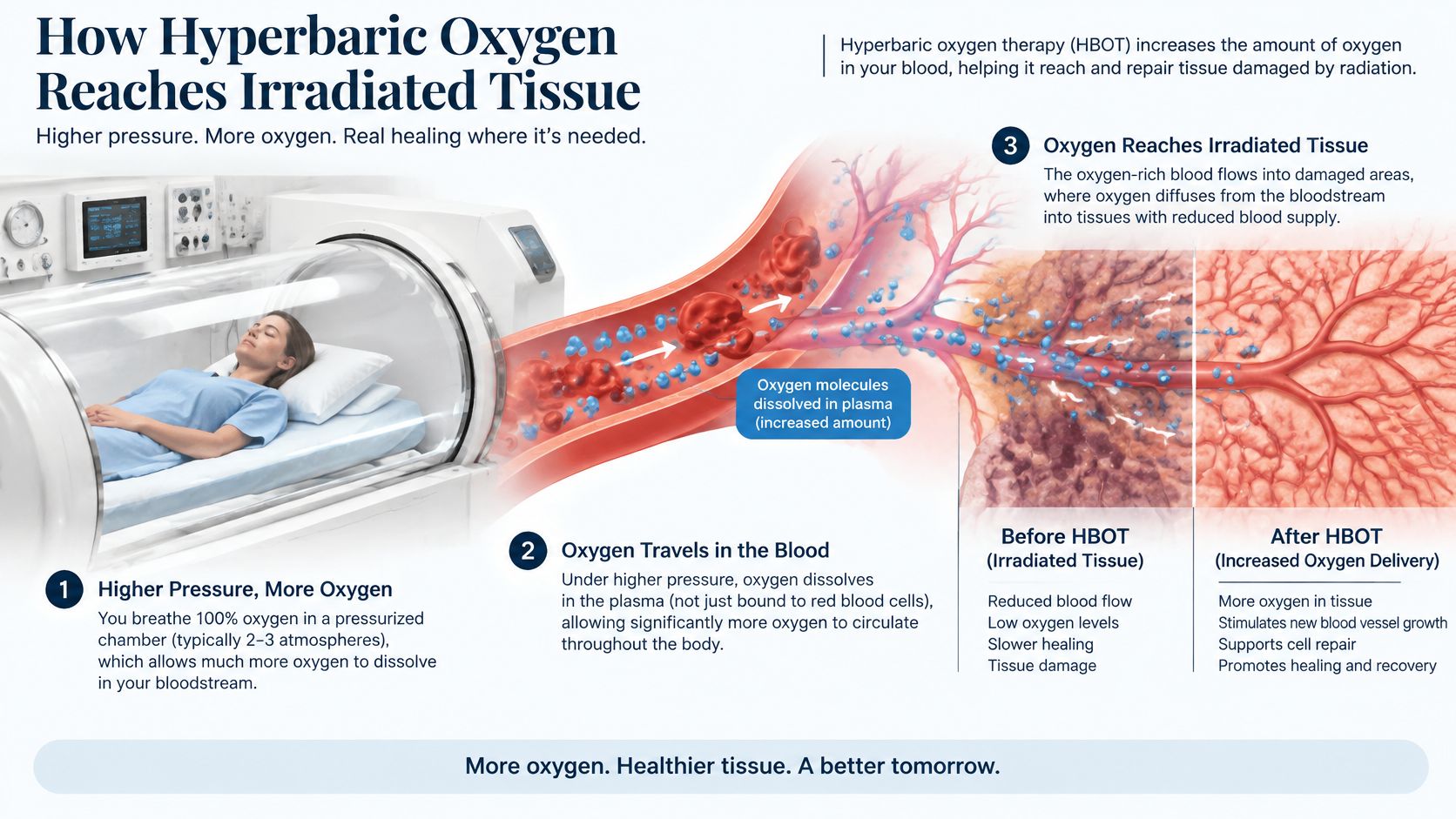
The infographic traces that path: oxygen loading into plasma under pressure, then moving into tissue that ordinary circulation has stopped reaching.
What the mechanism does and does not prove
The society draws a line between delayed radiation injury and acute radiation toxicity, and it notes that the role of HBOT in acute or subacute radiation injury remains insufficiently established. Timing after radiation therefore isn't a detail. It's part of whether the indication exists at all.
A pathway that makes biological sense isn't the same as a clinical result that has been measured. The two get confused constantly in patient-facing material.
Because the rationale is tissue repair, the treatment fits documented, delayed injuries rather than tumors. Referral belongs with radiation oncology, surgery, dentistry, or wound specialists when a delayed complication is suspected, and HBOT shouldn't replace cancer-directed therapy or be described as a tumor-eradicating treatment.
Trial Results for Radiation Injury and What They Mean
Results for delayed radiation injury offer a narrower picture than broad claims about cancer treatment. The evidence concerns specific tissue complications, and its strength varies by outcome.
| Outcome | Studies and participants | Reported result | Certainty |
|---|---|---|---|
| Complete resolution or substantial improvement of radiation tissue injury | 5 randomized trials, 468 participants | Risk ratio 1.39 (95% CI 1.02 to 1.89), reported in the Cochrane review of hyperbaric oxygen for late radiation tissue injury | Low to moderate |
| One-year mortality | 3 randomized trials, 166 participants | Risk ratio 0.93 (95% CI 0.47 to 1.83), reported in the Cochrane review of hyperbaric oxygen for late radiation tissue injury | No benefit shown |
| Mucosal coverage of exposed bone in osteoradionecrosis | 14 trials, 753 participants | Risk ratio 1.30 (95% CI 1.10 to 1.60), reported in the Cochrane review of hyperbaric oxygen for late radiation tissue injury | Moderate |
A risk ratio above 1 favors HBOT for the outcome measured. For mortality, the confidence interval crosses 1, so the trials do not establish a clear difference. The range includes both possible benefit and possible harm; it cannot support a claim that HBOT improves survival.
For osteoradionecrosis, the Cochrane review found moderate-quality evidence of improved mucosal coverage over exposed bone. It reported a P value of 0.003 and a number needed to treat of 5 among 246 participants. The review also found evidence that HBOT could reduce wound complications after surgery for mandibular osteoradionecrosis, and might reduce osteoradionecrosis after tooth extraction in previously irradiated tissue.
A confidence interval helps show how precise an estimate is. If it includes 1, the evidence does not show a statistically clear difference. If it sits entirely above 1, the result favors HBOT for that specific outcome, but does not establish benefit for other outcomes, such as tumor control or survival.
The evidence also includes potential harms. The Cochrane synthesis reported more temporary reductions in visual acuity, with a risk ratio of 4.03 (95% CI 1.65 to 9.84) across 5 studies and 438 participants, as well as more ear barotrauma during compression.
The evidence leaves practical questions open: which patients are most likely to benefit, when treatment should begin after radiation, and how many sessions are appropriate. These decisions depend on the injury being treated and the patient's clinical circumstances. Sunridge Medical's guide to recovery after chemotherapy and radiation discusses recovery considerations that may arise alongside cancer care.
Safety Screening, Medications and Side Effects
What needs to be checked before a hyperbaric oxygen therapy session? Untreated pneumothorax is identified as an absolute contraindication in Oncolink's patient-selection guidance for hyperbaric oxygen therapy. Other screening factors call for individual review rather than an automatic decision.
| Screening factor | Why it matters | What to review |
|---|---|---|
| Untreated pneumothorax | Identified as an absolute contraindication in Oncolink's patient-selection guidance | Confirm none is present before treatment |
| Lung disease that may trap air | Pressure changes can expand trapped air | Review lung history and imaging |
| Uncontrolled hypertension | Requires individual review | Check whether blood pressure is managed |
| Recent ear or sinus problems | Pressure changes affect the middle ear and sinuses | Assess the risk of barotrauma |
| Seizure disorder | Requires individual review | Review seizure history and current medications |
| Fever or acute illness | May affect whether treatment is safe at that time | Reassess before scheduling |
| Doxorubicin | Cardiotoxicity concern; Oncolink advises waiting at least 72 hours after the last dose | Coordinate timing with the oncologist |
| Bleomycin, cisplatin, disulfiram, mafenide acetate | Flagged for caution or coordination | Review with the treating team |
The review should connect each risk to a practical decision. Lung history and imaging can help identify trapped air. Blood pressure, ear and sinus problems, seizure history, and current illness also affect whether treatment should proceed or be delayed.
Medication timing requires coordination with the oncology team. Oncolink's guidance advises waiting at least 72 hours after the last doxorubicin dose because of cardiotoxicity concerns. A patient should not shorten that interval without direction from the treating clinicians.
Ask before booking: Who reviewed the lung, ear, blood pressure, seizure, and medication history? Who is coordinating treatment timing with the oncology team?
The reported side effects include ear barotrauma during compression and a usually temporary reduction in visual acuity, or short-sightedness. These effects should be considered alongside the reason for treatment and the patient's screening results.
Some symptoms need prompt medical attention:
- Chest pain or breathing difficulty during or after a session warrants prompt assessment.
- Ear pain that does not settle after pressure equalizes should be assessed before another session.
- Sudden vision change needs clinical review. Trial reports describe visual effects as temporary, so a change should not be assumed to resolve on its own.
Using HBOT During Active Cancer or Chemotherapy
Can the chamber be used while cancer is active or chemotherapy is ongoing? A history of malignancy isn't automatically treated as a contraindication, and the Undersea and Hyperbaric Medical Society reports that published evidence offers little support for the idea that intermittent HBOT promotes primary or metastatic tumor growth (Feldmeier review of HBO and malignancy).
That finding gets misread in both directions. The absence of a harm signal isn't evidence of an anticancer effect, and the literature here is largely observational or mechanistic rather than built on trials showing improved cancer survival.
The answer depends on specific factors: tumor status, timing relative to radiation, current chemotherapy or immunotherapy, implanted devices, seizure risk, lung disease, and whether the oncology team agrees with the plan. Cancer history alone tells you very little.
A three-part path makes this workable.
- Confirm a documented indication. Name the tissue and the complication, such as osteoradionecrosis of the mandible or radiation cystitis after pelvic treatment.
- Confirm the oncology team agrees on timing relative to current chemotherapy, immunotherapy, or radiation, including any drug-specific waiting period.
- Confirm the screening factors are reviewed, including lung history, blood pressure, ears, seizure history, and the full medication list.
Bring the current treatment schedule, recent imaging reports, a complete medication list, and any documentation of a radiation complication. Sunridge Medical sees many patients who continue care with an outside oncology team while receiving physician-directed integrative support, and others who arrive for a second opinion on sequencing. Either route runs through the same question about the chemotherapy schedule and how a supportive therapy fits around it.
Outcomes to Track and Questions to Ask
Improvement depends on the radiation complication being treated. A healed mucosal defect, a closed wound, less bleeding, improved swallowing, and better quality of life are distinct outcomes. Before treatment starts, the care team should identify which one will be measured.
A 2025 systematic review of 17 studies involving 640 head-and-neck cancer patients reported favorable outcomes in 14 studies, including improvements in osteoradionecrosis and selected oral-health measures. The review also highlighted low-quality evidence, small samples, inconsistent outcome measures, and high risk of bias (systematic review of HBOT in head and neck cancer). A separate review of radiation-associated swallowing difficulty found six eligible studies and reported inconsistent benefits (review of HBOT for radiation-associated swallowing difficulty). Swallowing is an important outcome for patients, yet the evidence for improvement remains limited.
Ask the care team:
- Is the problem documented as radiation injury? Which tissue is affected, and when did the complication appear after radiation?
- What change is the goal? For example, wound healing, pain reduction, salivary function, swallowing, or quality of life.
- Will other care continue? Clarify whether surgery, dental work, wound management, or rehabilitation remains part of treatment.
- How and when will progress be measured? Possible measures include wound closure, bleeding, pain scores, or function.
Stating uncertainty openly is a mark of careful clinical judgment. A reasonable plan sets a measurable goal and a review date with the care team. At that review, the questions can be specific: did the wound close, did bleeding lessen, or did function improve? Patients considering another review of their case can read Sunridge Medical's guidance on when and how to get a cancer second opinion.
Treatment Access, Session Count and Coverage
A course of hyperbaric oxygen therapy can involve repeated appointments, so session count and scheduling need to be clear before treatment begins. In a 2025 retrospective study published in Medicine, 45 patients with solid tumors received at least five sessions; the median exposure was 27 sessions (retrospective study of HBOT in solid tumors). This describes the treatment exposure in that study, not a recommended course for every patient or indication.
Ask how many sessions are proposed, what pressure will be used, how progress will be measured, and when the plan will be reviewed. The answers should connect to the specific indication rather than a fixed package.
Scheduling also has to fit around the patient's care. For example, someone attending weekday sessions may need to plan transportation and time away from other responsibilities, while coordinating the schedule with their oncology team if they are receiving radiation, chemotherapy, or preparing for surgery.
Coverage depends on the indication and payer policy. Before scheduling, ask the clinic and insurer for written details about coverage and any out-of-pocket costs. Sunridge Medical provides information about financial assistance for cancer care.
Request the indication, proposed session count, monitoring plan, schedule, and coverage determination in writing. These details make the proposed course easier to review with the patient's care team.
Confirm Whether an Evaluation Fits Your Situation
The last decision is whether to seek a consultation or second opinion at all, and it's a reasonable one to make slowly. Sunridge Medical is an integrative clinic in Scottsdale, Arizona that provides individualized, evidence-informed evaluation and explains where conventional and complementary approaches may work together. The safest starting point for a cancer patient is a case review rather than selecting a therapy from a list.
An evaluation may include review of the diagnosis, treatment records, imaging, medications, and medical history, along with discussion of coordination with the patient's oncology or radiation team. Suitability for hyperbaric oxygen therapy is determined only after that individualized evaluation, and there's no obligation to proceed afterward.
The limits deserve the same clarity as the offering. Sunridge Medical doesn't promise cures or guaranteed outcomes, and it doesn't replace emergency care, a patient's oncologist, or medically necessary standard treatment. Patients with heavy bleeding, inability to urinate, breathing difficulty, fever with a deep wound, or exposed bone in the mouth need urgent medical evaluation before any supportive therapy conversation begins.
Sunridge Medical offers integrative oncology consultations and second opinions in Scottsdale for patients who want a careful review of their records, their current oncology plan, and whether a supportive option such as hyperbaric oxygen therapy fits a documented problem rather than a general hope. The clinic's team reviews the diagnosis, imaging, medications, and treatment history with the patient and coordinates with the outside oncology team rather than around it. Visit Sunridge Medical to start that conversation and find out whether an evaluation is appropriate for your situation.