

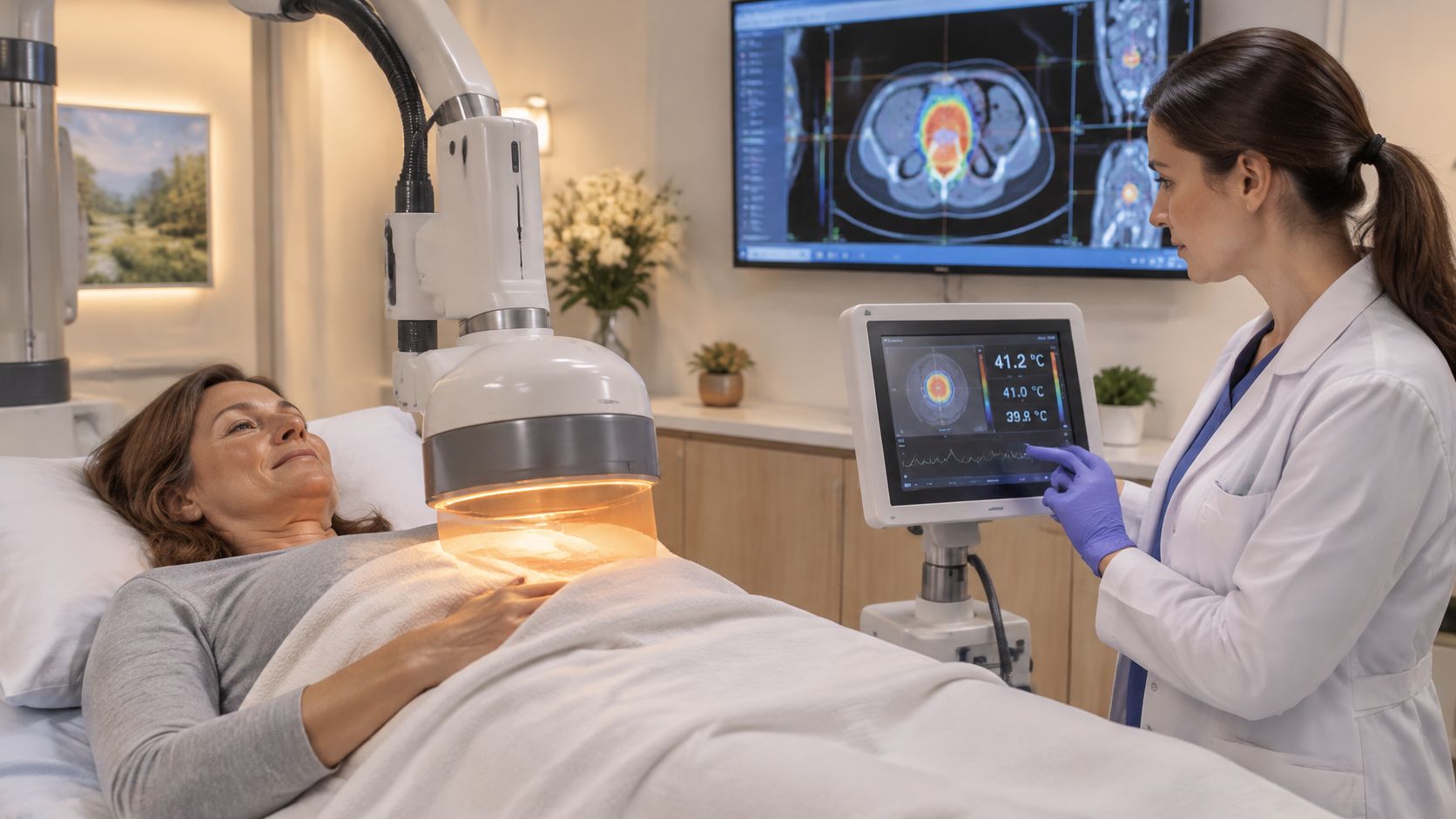
Adding hyperthermia to radiation improved local tumor control by 22.3 percentage points in recurrent breast cancer in a meta-analysis summarized in a peer-reviewed review of randomized clinical trials. That finding concerns a carefully selected cancer setting and a combined treatment, not heat therapy by itself. The distinction matters because hyperthermia treatment guidelines address several technologies with different purposes, monitoring requirements, and levels of evidence.
For patients considering integrative cancer care, the central question isn't whether heat can affect cancer cells. It's whether the proposed method, treatment target, and combination match a clinically supported use. A measured, oncology-coordinated treatment shouldn't be confused with a whole-body session marketed as a replacement for cancer care.
Table of Contents
- Hyperthermia Treatment Guidelines for Temperature, Time and Dose Checks
- Which Cancers Have Trial Evidence for Hyperthermia
- Red Flags in Whole-Body and Standalone Hyperthermia Offers
- Safety Screening and Who Should Not Receive Heat
- How Hyperthermia Is Coordinated With Oncology Care
- Confirm the Plan With the Oncology Team Before Scheduling
Hyperthermia Treatment Guidelines for Temperature, Time and Dose Checks
Clinical hyperthermia is controlled medical heating, delivered by trained teams with treatment planning and temperature monitoring. It is delivered under supervision, with targets, probe checks and stop conditions defined before the session begins. The National Cancer Institute's hyperthermia overview describes its use with other cancer treatments and whole-body approaches reaching approximately 107–108 °F for short periods, which differ from local and regional techniques.
The figures below are typical ranges from a medical-policy review of local and whole-body hyperthermia, which describes tumor targets around 40–44 °C, about 60 minutes at temperature, ceilings near 44 °C with about 42 °C for bone marrow or nervous tissue, courses of 8–12 sessions, twice-weekly or every-72-hours spacing, and a prolonged heating, cooling and observation pattern.
Reference limits and schedules in hyperthermia guidelines
| Parameter | Reference value | Why it matters |
|---|---|---|
| Tumor target temperature | About 40–44 °C in the tumor | Small increases substantially change heat effect |
| Treatment duration at target | About 60 minutes | Heat dose depends on time as well as temperature |
| Normal tissue ceiling | 44 °C general upper limit | Excess heat increases pain, burns, edema, and tissue injury |
| Vulnerable tissue ceiling | 42 °C for bone marrow or nervous tissue | These structures have a smaller safety margin |
| Course length | 8–12 sessions | Region, protocol, and indication determine the course |
| Session spacing | Twice weekly or every 72 hours | Spacing provides time for recovery between treatments |
| Heating and observation window | About 4 hours maintained at target range, about 1 hour cooling, at least 12 hours observation | Described in one medical-policy review, with schedules varying by technique |
These reference values describe different treatment settings and should be read as separate reference points. Local, regional and whole-body methods use different applicators, monitoring burdens and safety margins. A patient hearing the word hyperthermia should ask which technology is meant before asking whether the numbers sound reasonable.
The biological effect of heat does not increase evenly with temperature. Heat dose works like radiation dose: temperature is the intensity, time is the exposure. A small increase can strengthen cancer-cell injury and radiation sensitivity while narrowing the margin for protecting healthy tissue. That makes the location of the measurement as important as the displayed temperature.
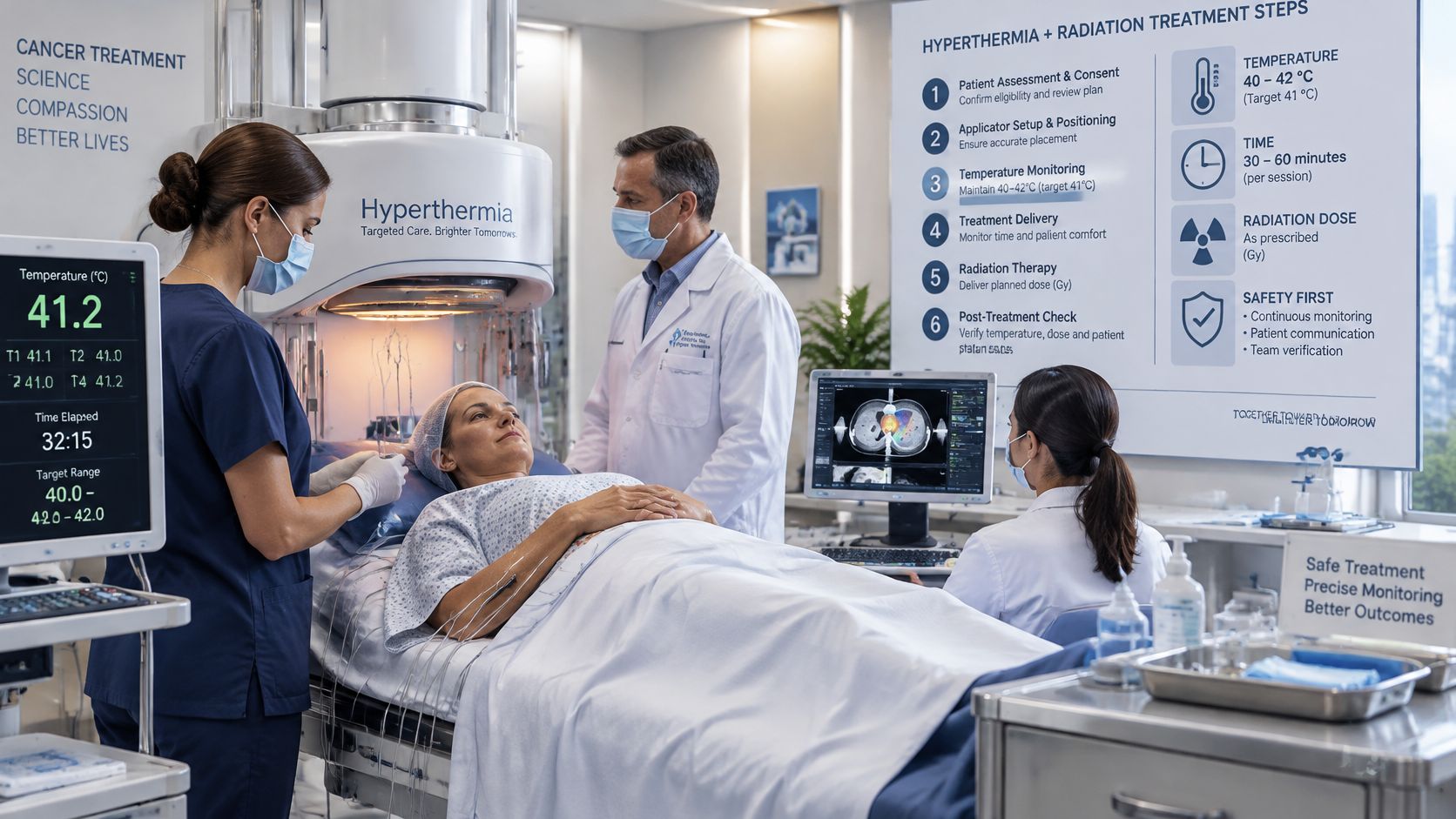
Verification means measuring the target
A technical review describing ESHO-derived quality-assurance criteria reports phantom checks of a 6 °C temperature rise within 6 minutes at 1 cm depth for superficial systems and within 10 minutes for deep abdominal or pelvic targets, a representative radiation sequence that begins heating within roughly 30 minutes after irradiation and seeks about 60 minutes at 43.0 °C or an equivalent cumulative thermal dose, and an ESHO 2–85 result in which only 57% of treatments reached the planned threshold of at least 60 cumulative equivalent minutes at 43 °C. The phantom values are equipment-verification tests using tissue-simulating material; the clinical values show why delivery has to be measured in the patient.
During treatment, the team needs to establish:
- Target coverage. The applicator must heat the intended tumor region, not just warm the skin surface.
- Normal-tissue protection. Multiple probes monitor the tumor and surrounding tissues, with readings documented at defined intervals.
- Dose documentation. T90, T50, T20, mean temperature, and maximum temperature describe the heating pattern. They help distinguish broad target coverage from isolated hot spots.
- Radiation coordination. The timing between irradiation, heating and the target thermal dose should be explicit in the plan.
Machine settings are starting instructions
A device display can show the requested power, the applicator setup and the elapsed session time. Tumor shape, blood flow, patient positioning, applicator contact, and probe coverage can change the result. The gap between requested settings and achieved thermal dose is why the table is a checklist of what a treating team should be able to explain, including where sensors sit, what temperatures were reached, how long they were held, and which tissues were protected.
Which Cancers Have Trial Evidence for Hyperthermia
No single trial settles whether hyperthermia helps, because the trial record is organized by indication and by combination partner. The strongest evidence concerns selected recurrent or locally advanced solid tumors: breast, cervical, head-and-neck, melanoma, and sarcoma cases. In these studies, clinicians added heating to radiation or chemotherapy, and the findings do not position heat as a replacement for standard oncology care.
Trial-reported effects of hyperthermia added to radiation or chemotherapy
According to the randomized-trial review cited in the introduction, the indication-specific findings below span 14 randomized clinical trials and related combined-treatment evidence.
| Indication | Combined treatment | Reported effect | Evidence status |
|---|---|---|---|
| Recurrent breast cancer | Radiotherapy plus hyperthermia | Local tumor control improved by 22.3 percentage points | Supported in randomized trials |
| Locally advanced cervical cancer | Radiotherapy plus hyperthermia | Local tumor control improved by 22.1 percentage points | Supported in randomized trials |
| Locally advanced cervical cancer | Thermochemoradiotherapy | Local failure reduced by 10.1 percentage points; mortality reduced by 5.6 percentage points, with a 95% confidence interval of 0.6–11.8 percentage points | Supported in randomized trials |
| Locally advanced head-and-neck cancer | Radiotherapy plus hyperthermia | Local tumor control improved by 25.5 percentage points | Supported in randomized trials |
| Sarcoma | Hyperthermia with radiation or chemotherapy | No single effect estimate established by this summary | Historically studied; the summary doesn't provide an effect size |
| Melanoma | Localized hyperthermia with radiation | No single effect estimate established by this summary | Selected recurrences included in utilization criteria |
All percentage-point effects in this table come from the randomized-trial review cited in the introduction and describe absolute differences between treatment groups.
Local control isn't the same as overall survival
Local tumor control asks one question: did the cancer in the heated region respond? Overall survival asks a different question: did the patient live longer? A combination can improve the first answer without establishing the second, and neither answer alone settles the risk of distant spread or quality of life.
A percentage-point difference is the absolute gap between treatment groups. Read the breast figure this way: within that trial population, 22.3 more patients out of every 100 achieved local control when heating was added. That scale also explains why the breast, cervical, and head-and-neck figures shouldn't be merged into a single success rate. Each comes from a different cancer, population, and combination.
The cervical thermochemoradiotherapy row measures a different outcome entirely: mortality within that particular treatment setting. Its confidence interval marks the range of statistical uncertainty around the estimate, and the result does not transfer to other cancers, stages, devices, or heating methods.
Evidence boundary: A positive result for a defined combination treatment doesn't prove that heating alone produces the same outcome.
Matching the evidence to a patient
A patient with a chest-wall recurrence and a patient with cancer spread across several organs face different decisions. Both may be offered something called hyperthermia, yet the treatment target and the intended outcome can share little beyond the name.
A responsible recommendation therefore identifies the cancer subtype, the treatment combination, the target location, and the outcome the supporting evidence measured. Sunridge's discussion of how to interpret hyperthermia cancer treatment success rates offers a related starting point for weighing outcome claims, because a favorable number matters only when it applies to the treatment being proposed for this patient.
Uncertainty remains around how trial size, patient selection, heating methods, and treatment delivery affect applicability. Where a summary gives no comparable effect estimate, none should be assumed.
Red Flags in Whole-Body and Standalone Hyperthermia Offers
The word hyperthermia can describe localized heating that supports radiation or a whole-body approach marketed as an independent cancer treatment. A shared name doesn't make the treatments interchangeable.
The EviCore radiation oncology utilization guideline describes selected superficial or subsurface recurrences, generally excluding disease deeper than 4 cm, with up to 10 treatments, twice weekly, and radiation within 30 minutes before or after heating. Its evidence summary also describes a systematic review of 53 publications involving 2,006 patients that found no evidence that whole-body hyperthermia or electro-hyperthermia improves cancer survival or quality of life.
Localized hyperthermia with radiation versus standalone whole-body claims
| Factor | Guideline-supported local use | Standalone or whole-body claim |
|---|---|---|
| Intended role | Adjunct to radiation for selected recurrences | Standalone treatment claim |
| Tumor depth | Superficial or subsurface, within the guideline's depth restriction | Depth and location may not be discussed in the offer |
| Radiation timing | A defined interval before or after heating | A radiation plan may be absent |
| Evidence | Trial-supported for selected indications | The cited systematic review found no demonstrated survival or quality-of-life benefit |
These utilization criteria include selected recurrent melanoma, breast or chest-wall recurrence, and recurrent cervical lymph nodes from head-and-neck cancer. They are coverage and utilization criteria in a specific policy context, not a universal prohibition on every deeper regional technique.
Claims that warrant closer review
The evidence summary states that no research-based clinical guidelines recommend whole-body hyperthermia for malignancy. That doesn't mean every investigational approach has been conclusively disproved, but it does mean a clinic shouldn't present an unestablished benefit as settled care.
Potential warning signs include:
- Promises of cure, reversal, or detoxification. These claims don't establish a cancer-treatment outcome.
- No discussion of anatomy. A recommendation made without considering tumor location or depth lacks essential treatment-planning information.
- No radiation coordination. An offer citing radiation-combination evidence should include an actual radiation plan.
- Exclusion of the treating oncologist. Patients shouldn't be asked to keep treatment secret or bypass oncology review.
- Replacement claims. Heat treatment shouldn't be presented as a reason to abandon medically necessary standard therapy.
- A package before an evaluation. Pricing a course before reviewing the case isn't evidence that the approach is suitable.
Investigational treatment requires an honest explanation
Patients should receive a clear explanation of whether an approach is established for the proposed indication, investigational, or offered within a clinical trial. Device regulatory status and evidence of clinical benefit are separate questions.
Sunridge's clinical framework for evaluating alternative cancer treatments addresses this broader decision. A persuasive mechanism or advanced machine doesn't replace evidence for a meaningful patient outcome.
Safety Screening and Who Should Not Receive Heat
Heat that is reasonable for one patient can be unsafe for another. Screening comes before scheduling, because organ function, bleeding risk, implanted devices, and treatment anatomy all shift the balance between benefit and harm.
That judgment happens patient by patient. Published work on hyperthermia and immune effects lays out the categories a screening needs to cover: how well the blood clots, whether the cardiovascular system is stable, whether an infection is active, and what sits in or near the planned treatment field.
Screening factors that change whether heat is appropriate
| Factor | Why it matters | What the team reviews |
|---|---|---|
| Coagulopathy | Raises concern about bleeding during procedures and treatment | Clotting status and anticoagulant medications |
| Major uncompensated cardiovascular or cerebrovascular disease | Heat adds physiologic strain | Cardiovascular assessment and current stability |
| Severe active infection | Treatment may add stress during significant illness | Infection status and treatment timing |
| Metallic implants or active devices in the field | Heating or electromagnetic exposure may affect nearby tissue or device function | Implant and device mapping relative to applicators |
| Pacemaker | Potential interference requires device-specific assessment | Device type, programming, and cardiology input |
| Tumor near heat-sensitive organs | Nearby structures may be injured | Anatomy, field geometry, and temperature mapping |
An implant can be compatible with some heat-based methods, depending on where it sits, what it is made of, its device specifications, and which heating technology is planned. Cardiovascular history calls for the same care: the team assesses how stable the condition is today rather than treating the diagnosis alone as the answer.
Higher heat carries its own risks
A review of hyperthermia and immune effects reports that excessive or repeated heating above 42 °C may promote immune suppression, immune-cell apoptosis, anti-inflammatory cytokine dominance, and thermotolerance, and identifies 39–41 °C as a more clinically translatable systemic range. These observations come from an active research area; they sit a long way from a settled prescription for whole-body cancer treatment.
Thermotolerance means cells can become more resistant to subsequent heating. Mechanistic immune findings do not, by themselves, establish that a particular temperature improves survival.
More heat is not the same as more benefit.
Disclosure helps prevent avoidable risk
Patients taking blood thinners, living with implanted devices, or recovering from a recent infection should disclose those details before any session. Medication review should cover prescriptions, nonprescription products, and supplements, and patients should keep taking everything until their own clinician directs a change.
Sunridge Medical states that diagnosis, stage, biomarkers, treatment history, medications, laboratory findings, and current health affect what may be reasonable or safe, so not all treatments are appropriate for every cancer patient.
Patients weighing nonmedical heat can review the distinction between sauna use and cancer treatment. Feeling comfortable, sweating, or tolerating a hot room demonstrates none of the controlled tumor heating a clinical session requires.
How Hyperthermia Is Coordinated With Oncology Care
Coordination begins with the cancer treatment objective, not the heating device. The radiation or medical oncologist establishes the oncology plan, while the hyperthermia team determines whether the intended target can be heated and monitored appropriately.
Responsibilities should be clear before treatment begins. Patients shouldn't have to negotiate conflicting schedules or decide which clinician's instructions take priority.
Each team member has a defined role
- The oncology team sets the cancer plan. This includes the purpose of treatment, the radiation or systemic-therapy schedule, and how response will be assessed.
- The heating team manages delivery. Applicator placement, temperature measurement, target coverage, and treatment adjustments require trained personnel.
- The clinical team reviews tolerance. Medication changes, organ function, symptoms, and laboratory findings may require reassessment before another session.
A coordinated plan includes a defined interval between heating and radiation when those treatments are combined. If appointments are delayed or the patient becomes unwell, the teams should decide how to proceed rather than treating the original schedule as fixed.

Where an integrative evaluation fits
Sunridge Medical is an experienced integrative clinic in Scottsdale, Arizona, using individualized, evidence-informed evaluation. Treatment planning begins with a detailed case review of records, imaging, pathology, laboratory data, treatment history, medications, and current goals before recommendations are made.
Sunridge considers potential conventional, nutritional, metabolic, immune-supportive, and complementary strategies together. A customized plan may include further evaluation, testing, physician-directed treatments, nutrition or lifestyle guidance, supportive care, and reassessment.
Information about Sunridge's integrative oncology programs can help patients understand the consultation's scope. Such a review can address whether a proposed heat-based approach fits the diagnosis, whether important records are missing, and which questions need an oncologist's input.
For a patient in Phoenix or the greater Phoenix area, practical coordination may also involve travel between treatment sites and sharing records across offices. The evaluation should clarify who communicates with whom and who handles symptoms between visits.
Coordination principle: An integrative consultation adds review and support. It doesn't transfer responsibility for cancer treatment away from the treating oncology team.
Sunridge doesn't replace an oncologist, emergency care, or medically necessary conventional treatment. Changes to standard treatment should come from the treating physician, and recommendations should be reassessed as response, tolerance, and patient priorities change.
Confirm the Plan With the Oncology Team Before Scheduling
Before agreeing to a heat-based treatment, ask for the offer in writing. The word hyperthermia can describe a measured local treatment added to radiation or a much broader whole-body claim, so consent should identify the exact method, target, and evidence. Informed consent requires a clear explanation of what is being treated, why the method fits, and how safety is checked.
A useful decision checklist includes:
- Cancer match. Confirm the tumor type, location, and depth, and the evidence for that exact indication.
- Treatment status. Establish whether the approach is standard radiation support, investigational treatment, or part of a clinical trial.
- Measurement plan. Identify how tumor temperature, normal-tissue temperature, and delivered thermal dose will be documented.
- Safety review. Confirm assessment of bleeding risk, cardiovascular stability, infection, implants, and pacemakers.
- Oncology involvement. Establish which treating physician reviewed the proposal and how the teams will communicate.
- Stopping criteria. Obtain an explanation of which symptoms, measurements, or clinical changes would lead to modification or cancellation.
Keep medical need and coverage in separate answers
Coverage cannot be assumed because a device is used medically or because some hyperthermia indications have supporting evidence. Patients should ask whether the proposed approach meets the applicable medically necessary criteria and whether authorization is required.
A written explanation should distinguish the clinical recommendation from the coverage determination. It should also identify the proposed charges and any services not included before scheduling.
If the answer is unclear, ask for clarification while continuing scheduled standard care unless the treating physician advises otherwise.
Bring records that make the review specific
The case-review questions sit earlier in the evaluation; the practical task here is arriving with documents that let clinicians answer them. A patient seeking a cancer diagnosis second opinion should bring pathology reports, imaging and reports, treatment history, recent laboratory results, and a current medication list.
A written description of the proposed hyperthermia method helps the reviewing clinician address the actual offer rather than a general treatment category. Sunridge Medical serves Scottsdale, Phoenix, the greater Arizona community, and patients who travel for care; the contact route is a consultation request through Sunridge Medical's website or a second-opinion inquiry, with suitability determined after individualized evaluation.
New or severe symptoms require prompt conventional assessment. Chest pain, difficulty breathing, confusion, uncontrolled bleeding, or sudden neurologic changes call for urgent or emergency medical care.
Sunridge Medical offers individualized cancer case review and coordinated integrative evaluation to help patients assess whether a proposed heat-based treatment fits their diagnosis and existing oncology care. Visit Sunridge Medical to discuss a consultation or second opinion in Scottsdale and learn which records to prepare; suitability is determined after evaluation, without promises of a particular outcome.