


In 2023, 76.4% of U.S. adults, more than 194 million people, had at least one selected chronic condition, while 51.4%, about 131 million adults, had multiple chronic conditions. For someone searching for a complex chronic disease doctor in Scottsdale, the practical answer is coordinated evaluation by a physician who can connect symptoms, diagnoses, medications, and treatment goals instead of managing each problem in isolation.
You may recognize the pattern. A cardiologist focuses on palpitations, an endocrinologist adjusts thyroid or blood-sugar treatment, a rheumatologist investigates inflammation, and a neurologist evaluates dizziness, weakness, or cognitive changes. Each specialist may provide appropriate care within a narrow area, yet you're still fatigued, your medication list keeps growing, and no one seems responsible for the complete picture.
That gap is where complex chronic disease management can help. The purpose isn't to replace a cancer specialist, neurologist, surgeon, or primary care physician. It's to add a physician who can examine how conditions interact, identify unanswered questions, reduce unnecessary fragmentation, and build a practical plan around your overall function.
Table of Contents
- When Multiple Specialists Leave You Without Answers
- What Conditions Do Complex Chronic Disease Physicians Treat
- How Diagnostic and Treatment Approaches Differ
- Traditional Specialty Care Versus Integrative Complex Disease Management
- What to Expect at Sunridge Medical
- Planning Your Visit and Understanding Logistics
- Outcomes, Realistic Expectations, and Frequently Asked Questions
When Multiple Specialists Leave You Without Answers
A patient with persistent fatigue, disrupted sleep, digestive symptoms, joint pain, and intermittent neurologic complaints may receive several reasonable explanations over time. One appointment addresses inflammation. Another changes a medication. A third orders imaging. The patient leaves with more instructions but no unified strategy.
This doesn't mean specialty care has failed. Conventional subspecialists are essential for acute illness, surgery, cancer treatment, organ-specific disease, and clearly defined conditions. The difficulty arises when symptoms cross several systems, when treatments create new problems, or when test results don't explain how poorly a person feels.

The missing role in fragmented care
A complex chronic disease doctor looks across the medical record rather than treating one diagnosis at a time. That work can include reconciling medications, reviewing the timeline of symptoms, comparing prior laboratory results, identifying duplicated testing, and asking whether a single diagnosis accounts for the patient's functional decline.
The need is substantial. CDC analysis found that 51.4% of U.S. adults had multiple chronic conditions in 2023, representing approximately 131 million adults. The same analysis found that 76.4% had at least one of 12 selected chronic conditions, or more than 194 million people. These figures don't prove that every patient needs an integrative physician, but they do show why single-disease care often becomes difficult to coordinate. (CDC analysis of multiple chronic conditions)
The first consultation should therefore answer practical questions. What changed first? Which treatments helped, harmed, or did nothing? Are symptoms caused by active disease, treatment effects, sleep disruption, nutritional problems, medication burden, or more than one factor?
A useful overview of the diagnostic process is available in this clinical guide to navigating a complex chronic illness diagnosis. The central principle is straightforward: coordination is itself a clinical intervention, especially when no single specialist has enough time or scope to connect every relevant detail.
What Conditions Do Complex Chronic Disease Physicians Treat
The right question isn't whether a physician treats a particular diagnosis in isolation. It's whether the patient's illness involves multiple systems, persistent symptoms, treatment limitations, or uncertainty about what is driving the problem.
Cancer and supportive care
Patients receiving chemotherapy, radiation, immunotherapy, surgery, or hormone treatment may need help with fatigue, pain, sleep, appetite, nausea, anxiety, neuropathy, and treatment tolerance. Integrative oncology combines conventional cancer care with selected supportive approaches. A review of the field notes that Society for Integrative Oncology and ASCO recommendations include supportive options such as acupuncture, massage, meditation, yoga, music therapy, exercise, and nutrition for symptoms including fatigue, pain, nausea, hot flashes, and sleep problems. (Review of integrative oncology and supportive care)
The evidence is not equally strong for every therapy, and supportive care shouldn't be presented as a cancer cure. The useful distinction is whether an intervention targets a defined symptom or function, whether it's safe with the patient's oncology regimen, and whether progress can be assessed.
Autoimmune and neurologic illness
Multiple sclerosis, Parkinson's disease, autoimmune disorders, cognitive symptoms, and chronic inflammatory conditions may involve overlapping effects on movement, mood, sleep, cognition, digestion, and energy. A whole-person evaluation can identify treatment interactions and modifiable contributors without claiming that an integrative approach reverses established neurologic or autoimmune disease.
Persistent Lyme-related symptoms
Some patients continue to experience fatigue, pain, or cognitive complaints after standard Lyme treatment. The CDC explains that about 5% to 10% of patients have prolonged symptoms at six months, and that extended antibiotic treatment has not been better than placebo for relieving those symptoms in multiple studies. The appropriate response is careful reassessment, not an automatic assumption that ongoing infection explains every symptom.
A Johns Hopkins summary also describes functionally impairing persistent symptoms in a subset of patients treated early, reinforcing that symptoms can be biologically and functionally significant even when prolonged antibiotics aren't beneficial. (Johns Hopkins discussion of persistent Lyme symptoms)
Environmental and multi-system illness
Fatigue, neuropathy, headaches, digestive problems, and cognitive complaints may prompt evaluation of environmental exposures, nutritional status, medication effects, endocrine function, and other contributors. Testing and treatments such as chelation require medical judgment and shouldn't be used just because a patient feels unwell.
People living with ongoing pain may also benefit from understanding how symptoms affect daily function, work, and disability decisions. This guide on chronic pain from Melanson Law offers a legal perspective, not a substitute for medical evaluation.
Patients with overlapping diagnoses, unexplained decline, or a long history of unsuccessful treatment may be appropriate candidates for a complex multi-system illness evaluation.
How Diagnostic and Treatment Approaches Differ
An integrative evaluation should be systematic, not a collection of attractive therapies. The physician first needs to understand what has already been done and what remains uncertain.
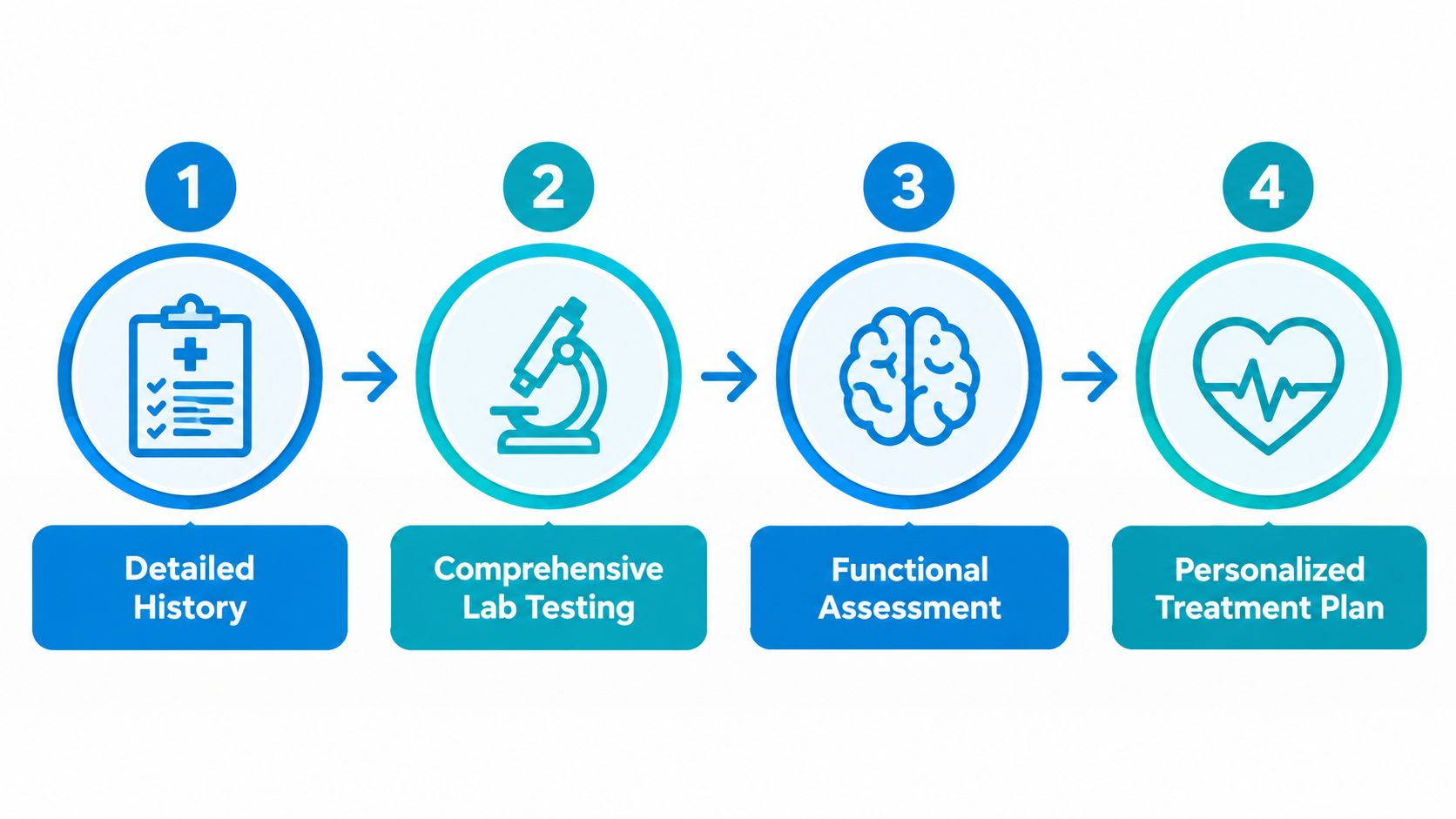
Step one is reconstruction
A detailed history traces symptoms over time, including infections, surgeries, cancer treatments, medication changes, exposures, sleep, diet, stress, and functional losses. A medication review looks for duplication, adverse effects, interactions, and therapies that no longer match the patient's goals.
Records matter. Prior imaging, pathology, laboratory trends, specialist notes, and hospital reports can reveal a pattern that isn't visible when each visit is viewed separately. The goal isn't to order every available test. It's to choose testing that answers a clinical question.
Step two is targeted assessment
Laboratory testing may evaluate conventional markers alongside selected functional measures when those results could change management. Environmental history, nutrition, exercise tolerance, sleep, cognition, mood, and daily activity also deserve attention because symptoms don't occur only inside a laboratory report.
A physician should explain what a test can and can't establish. A borderline result isn't automatically the cause of illness, and an abnormal value requires interpretation in context. This is particularly important for testing marketed directly to patients, where uncertain results can lead to expensive or distracting treatment.
Step three is layered treatment
Treatment may include conventional medication, referral to a subspecialist, rehabilitation, nutrition, sleep support, or symptom-focused behavioral care. Depending on the diagnosis and safety profile, a physician may also consider IV nutritional therapies, ozone therapy, hyperthermia, red light therapy, regenerative injections, or targeted detoxification protocols.
These options aren't interchangeable. Some are established for particular uses, some are complementary, and others remain emerging or investigational. The physician should define the purpose of each intervention, review contraindications, and establish how the team will decide whether to continue, modify, or stop it.
Practical rule: If a treatment can't be connected to a specific symptom, measurable function, safety assessment, or patient goal, it deserves closer scrutiny.
Conventional oncology, infectious disease care, endocrinology, neurology, and other specialty services may remain central. An individualized approach to chronic conditions works best when integrative care adds coordination and carefully selected support rather than asking patients to abandon appropriate medical treatment.
Traditional Specialty Care Versus Integrative Complex Disease Management
Patients shouldn't have to choose between evidence-based specialty care and a broader view of their health. The two models answer different clinical needs.
Traditional specialty care is often strongest when a disease is well defined and requires a focused intervention. A surgeon may be the right person to remove a tumor. An oncologist may direct chemotherapy. A neurologist may manage a movement disorder. An emergency physician may stabilize a dangerous acute problem.
Integrative complex disease management becomes more useful when the patient has several diagnoses, persistent symptoms, medication intolerance, or conflicting recommendations. Its value lies in synthesis, prioritization, and follow-through.
Care Model Comparison
| Dimension | Traditional Specialty Care | Integrative Complex Disease Management |
|---|---|---|
| Care model | Concentrates on one organ system or diagnosis | Coordinates multiple conditions, symptoms, and treatment goals |
| Evaluation depth | Uses standard history, examination, labs, imaging, and disease-specific protocols | Adds detailed timelines, medication reconciliation, functional assessment, and selected environmental or lifestyle review |
| Treatment philosophy | Targets disease control, acute intervention, or protocol-defined treatment | Combines disease-directed care with symptom management, function, prevention of treatment conflicts, and carefully selected complementary options |
| Patient experience | May involve several shorter visits with separate prescribers | Centers on a longer synthesis of records and a coordinated plan, while maintaining appropriate referrals |
| Best fit | Acute illness, surgery, clearly diagnosed disease, and specialized treatment | Multi-system illness, treatment resistance, unclear drivers, and complex coordination needs |
The comparison isn't a judgment against conventional medicine. Chronic diseases account for most illness, disability, and death in the United States and are major drivers of healthcare costs, according to the CDC's chronic disease data. Patients need specialists who can manage serious disease, plus a coordinated process that helps the entire care team understand what the patient is experiencing.
For Scottsdale residents, Phoenix patients, and people traveling from Paradise Valley, Tempe, Mesa, or Chandler, integrative medicine in Scottsdale can provide one setting for that broader conversation. The appropriate model depends on diagnosis, urgency, existing treatment, and the physician's ability to work alongside other clinicians.
What to Expect at Sunridge Medical
A first visit for complex chronic illness should feel different from a brief appointment focused on one symptom. The process begins with an extended review of your history, prior treatment, current medications, imaging, pathology, laboratory findings, and personal goals.

Building the clinical picture
The physician may ask questions that aren't always covered in a specialty visit. When did your energy change? Which medication caused a new symptom? Can you work, exercise, sleep, think, or manage daily tasks as you did before? What did previous clinicians suspect, and which explanations no longer fit?
The next step may include extensive laboratory testing and functional assessment. Testing should be selected because it may clarify a diagnosis, identify a treatment risk, or guide a decision. It shouldn't be used to create a long list of abnormalities without a plan for interpreting them.
Sunridge Medical is an integrative medical clinic in Scottsdale that combines conventional medicine, traditional therapies, and alternative modalities in individualized plans for cancer and complex chronic disease. Its stated clinical programs include IV therapies, oxidative medicine, hyperthermia, red light therapy, regenerative options, environmental medicine, Lyme and tick-borne disease programs, autoimmune support, and neurologic condition programs. The suitability and evidence for each option vary by patient and condition.
Turning findings into a workable plan
A treatment plan may begin with a small number of priorities rather than several interventions at once. That makes it easier to identify benefit, side effects, interactions, and changes in function. A patient receiving conventional cancer treatment, for example, may need coordination around nutrition, fatigue, sleep, pain, and treatment tolerance rather than an untested promise of tumor control.
Follow-up visits should refine the plan. Some patients may report better energy, lower symptom burden, improved sleep, or better medication tolerance. These are possible clinical goals, not guaranteed outcomes. A responsible physician also discusses what hasn't improved and when another specialist, urgent evaluation, or different treatment is needed.
The clinic's model is intended to complement conventional care, not replace necessary oncology, neurological, infectious disease, surgical, or emergency treatment.
Planning Your Visit and Understanding Logistics
Preparation can make a complex consultation more productive. Bring or send records before the appointment when possible, particularly if your history includes multiple specialists or treatment facilities.
Useful materials include:
- Imaging reports and images: Include scans, not only the written interpretation, when the clinic requests them.
- Pathology records: Bring biopsy reports and relevant oncology documentation.
- Laboratory results: Trends are often more useful than one isolated result.
- Medication list: Include prescriptions, over-the-counter products, vitamins, supplements, and recent medications you stopped.
- Treatment timeline: Note major diagnoses, procedures, infections, medication reactions, and the dates symptoms changed.
- Personal priorities: Identify the symptoms or activities you most want to address.
Patients scheduling from Phoenix, Paradise Valley, Tempe, Mesa, Chandler, Gilbert, or elsewhere in the greater Phoenix metropolitan area may find Scottsdale convenient for an in-person evaluation. Scottsdale's official city information lists a population of 243,050 for 2026 and an area of 184.5 square miles extending 31 miles north to south. (City of Scottsdale overview) Other official city materials list 244,394 residents, while a city history page identifies a 2024 population of 245,231, reflecting a local base of roughly 244,000 to 245,000 residents. (Scottsdale demographic information)
Ask the scheduling team how long the initial consultation lasts, what records are needed, whether testing occurs before or after the physician visit, and how follow-up is handled. Patients traveling from outside Arizona should also ask about nearby lodging, timing between appointments, and how local clinicians can remain involved.
Contact the clinic before traveling to discuss whether your symptoms, diagnosis, and treatment history are appropriate for an evaluation. A consultation can clarify the next step even when the eventual plan includes continued care with your existing specialists.
Outcomes, Realistic Expectations, and Frequently Asked Questions
Complex chronic disease care isn't a guarantee of recovery. Outcomes depend on the diagnosis, disease stage, previous treatment, medication burden, functional status, and individual biology. The most defensible goals are often clearer diagnosis, safer coordination, improved symptom control, better function, and treatment decisions that match the patient's priorities.
How long does it take to notice improvement?
There's no universal timeline. Some concerns may respond after a medication adjustment or focused intervention, while long-standing multi-system illness may require staged evaluation and follow-up. Ask what outcome will be measured and when the plan will be reassessed.
Can integrative treatments interact with my medications?
Yes. Supplements, IV therapies, botanical products, procedures, and other interventions can affect medication safety or treatment response. Provide a complete list to every physician, and don't stop cancer, cardiac, neurological, endocrine, or other prescribed treatment without medical guidance.
Will insurance cover the evaluation and treatment?
Coverage varies by plan, diagnosis, service, and whether an intervention is considered medically necessary. Before scheduling, ask about consultation fees, laboratory costs, procedure charges, payment expectations, and which services may fall outside insurance coverage.
How do I know whether this approach fits my condition?
Consider an evaluation if your symptoms cross several body systems, prior opinions conflict, treatments haven't addressed your main limitations, or you need help coordinating conventional and complementary care. A qualified physician should also tell you when this model isn't appropriate and when urgent or disease-specific treatment takes priority.
Discuss every medical decision with a qualified healthcare professional who understands your history.
Sunridge Medical offers physician-directed integrative evaluation for cancer and complex chronic conditions in Scottsdale, with care plans that may coordinate conventional treatment and selected supportive or complementary therapies. Visit Sunridge Medical to discuss whether a consultation is appropriate for your symptoms, diagnosis, and treatment history.