


What if the persistent exhaustion sidelining your life isn’t a psychological hurdle, but a measurable failure of your endocrine system? For many, the struggle isn’t just the fatigue; it’s the frustration of being told everything is “normal” while your professional performance and personal joy slip away. This disconnect often stems from a medical system that relies on broad, standardized ranges rather than precise, individualized data. At Sunridge Medical, we recognize that hormone therapy for chronic fatigue is not a one-size-fits-all prescription. It’s a sophisticated clinical intervention designed to recalibrate the delicate chemical balance that governs your energy and cognitive focus.
We understand the weight of waking up unrefreshed and the isolation of feeling dismissed by traditional providers. You deserve a treatment plan that targets the physiological root cause of your symptoms, not just the exhaustion itself. This 2026 clinical guide will demonstrate how advanced hormone optimization can help you reclaim your previous levels of physical activity and restore the mental clarity you’ve lost. We’ll explore the latest research on multi-axis endocrine support and how a personalized medical strategy can finally bridge the gap between merely surviving and truly thriving.
Key Takeaways
- Identify how your endocrine system functions as a biological thermostat and why pinpointing hormonal dysregulation is the first step toward restoring baseline energy.
- Learn how precise hormone therapy for chronic fatigue addresses the essential interplay between adrenal, thyroid, and sex hormones to resolve persistent exhaustion.
- Discover why standard lab results often fail to detect cellular-level hormone resistance and how comprehensive diagnostic tools reveal the actual cause of brain fog.
- Explore a structured, phased recovery strategy that prioritizes adrenal stabilization before thyroid optimization to ensure your treatment plan is both safe and effective.
- Understand the clinical advantages of an individualized care plan that moves beyond one-size-fits-all medicine to return you to your previous levels of physical activity.
Understanding the Endocrine Link to Persistent Exhaustion
Tiredness is typically resolved by a weekend of rest, but chronic hormonal fatigue feels like a biological weight that sleep cannot lift. Your endocrine system functions as the body’s energy thermostat, regulating everything from your basal metabolic rate to your response to external stress. When this system is optimized, your cells produce energy efficiently; when it’s dysregulated, your internal pilot light flickers. The primary driver is often the Hypothalamic-Pituitary-Adrenal (HPA) axis, a complex feedback loop that manages cortisol and other vital hormones. When we consider hormone therapy for chronic fatigue, we must address how this axis becomes desensitized through chronic illness or prolonged stress, causing the body to lose its ability to generate consistent energy.
The Spectrum of Chronic Fatigue Syndrome (CFS)
Distinguishing between Myalgic Encephalomyelitis (ME) and a general hormonal imbalance is critical for effective clinical intervention. While ME often involves a post-viral or immune-mediated trigger, hormonal imbalances can mimic or exacerbate these conditions, leading to a state of profound physiological exhaustion. There is often a specific tipping point where environmental or emotional stress transitions from a manageable burden into a chronic state of system failure. Hormonal fatigue is a failure of cellular energy production driven by endocrine signaling. Understanding the Management of ME/CFS requires looking beyond surface-level symptoms to address these underlying chemical messengers.
The Limitations of Conventional Diagnostic Standards
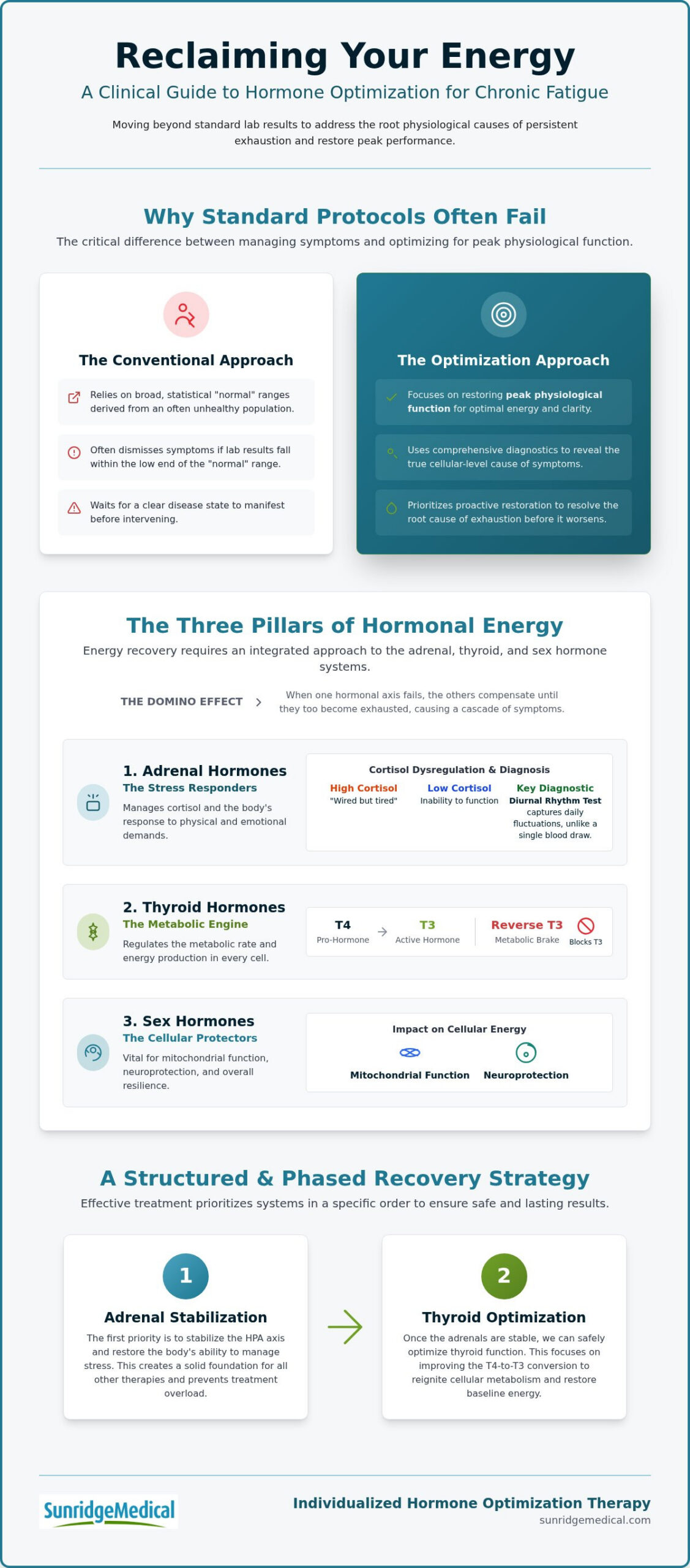
Standard medical protocols often fail because they rely on reference ranges derived from a statistically average, and often unhealthy, population. If your lab results fall within the bottom 5% of the “normal” range, a primary care physician may dismiss your symptoms, even though your body is operating in a state of deficiency. This is particularly evident in thyroid testing, where relying on TSH alone frequently misses functional hypothyroidism at the cellular level. Hormone therapy for chronic fatigue moves beyond these standard care models toward an optimization framework. Instead of waiting for a disease state to manifest on a lab report, we prioritize the restoration of peak physiological function to resolve the root cause of your exhaustion.
The Three Pillars of Hormonal Energy: Adrenal, Thyroid, and Sex Hormones
Energy recovery requires looking at the endocrine system as an integrated network. If one axis fails, the others inevitably compensate until they, too, reach a state of exhaustion. This “domino effect” is why localized treatments often provide only temporary relief. True restoration depends on stabilizing the triad of adrenal, thyroid, and sex hormones, ensuring each system supports the others rather than draining them. To support the neurological pathways that govern this network, many individuals also explore Upper cervical chiropractic as a complementary approach to systemic wellness.
Clinical cortisol dysregulation is a hallmark of chronic illness. While conventional medicine often only recognizes Addison’s disease, we see a broad spectrum of adrenal dysfunction that impacts daily life. High cortisol can cause a “wired but tired” state, while low cortisol leads to a complete inability to meet physical or emotional demands. Testing must involve diurnal rhythm assessments. A single-point blood draw cannot capture the fluctuations that define your energy cycle; we need to see how your levels change from morning to night.
Thyroid: The Master Regulator of Metabolism
Your thyroid hormones, T3 and T4, act as the spark for cellular metabolism. Relying on “Total T4” provides an incomplete picture because T4 is merely a pro-hormone that must be converted into active T3. During periods of high stress, the body may produce Reverse T3, which acts as a metabolic brake. Effective hormone therapy for chronic fatigue must address this conversion process. For those with complex histories, hormone therapy for autoimmune disease is often necessary to resolve the underlying inflammation that blocks these pathways.
Sex Hormones and Mitochondrial Health
Sex hormones do more than regulate reproduction; they are vital for mitochondrial function and neuroprotection. Testosterone provides the physical stamina and cognitive drive required for daily tasks, while Estrogen and Progesterone support neuro-regeneration and restorative sleep. When these hormones are depleted, the mitochondria, our cellular power plants, cannot produce ATP efficiently. This lack of energy production is a core challenge in diagnosing and managing chronic fatigue syndrome effectively.
Restoring your vitality involves more than just replacing what’s missing. It requires a precise calibration of all three pillars to ensure they work in harmony. If you’re ready to look deeper than standard lab results, a consultation with Sunridge Medical can help identify which of these endocrine pillars is currently failing you.
Why Standard Protocols Often Fail Complex Fatigue Patients
A common refrain among those seeking hormone therapy for chronic fatigue is the disappointment of previous attempts. You’ve likely tried standard replacement therapy only to find that your exhaustion remained stubbornly unchanged. This failure usually occurs because conventional medicine focuses on serum levels rather than cellular reception. If your cells are “deaf” to the hormonal signals being sent, simply increasing the dose won’t solve the problem. We must address the “Hormone Resistance” occurring at the receptor level, where the actual work of energy production happens. This resistance is often the result of chronic stress, which causes the body to downregulate its response to hormonal triggers as a survival mechanism.
Complex cases involving Chronic Lyme or autoimmune disorders present a unique challenge known as a “toxic load.” These conditions create systemic inflammation that physically blocks hormone receptors, preventing even the most precise doses from taking effect. This is why we emphasize integrative medicine for chronic illness as a parallel track to hormone optimization. Without clearing the biological interference, hormonal support remains a superficial fix that doesn’t reach the root cause. A comprehensive plan must involve cooling the inflammatory fire while simultaneously providing the endocrine system with the raw materials it needs to rebuild.
The Role of Chronic Infection and Inflammation
Systemic inflammation acts as a barrier to endocrine health by desensitizing the very receptors meant to trigger energy release. Many lyme disease specialists recognize that endocrine support is a priority, yet it must be integrated into a broader detoxification protocol. Environmental toxins like heavy metals or mold can also mimic hormones, fitting into receptors like a broken key in a lock. This confuses the body’s internal signaling and deepens the state of fatigue, making a multi-faceted approach essential for recovery. We find that once these environmental hurdles are cleared, the body’s responsiveness to hormone therapy improves dramatically.
Bioidentical vs. Synthetic Hormones
The molecular structure of your treatment significantly impacts its efficacy and safety. Bioidentical hormones are engineered to be an exact match for the molecules your body naturally produces, allowing for seamless integration into your metabolic pathways. Synthetic options often carry a higher risk of side effects because they’re “close enough” to bind but not identical enough to function perfectly. Individualized dosing and delivery methods ensure that your body receives exactly what it needs without overwhelming your system. We move away from the “one-size-fits-all” patches that often fail complex patients in favor of precise, customized protocols that honor your unique biological blueprint.
Clinical Strategies for Hormone Optimization and Recovery
Effective recovery from persistent exhaustion requires a methodical, phased approach rather than a broad-spectrum replacement of missing hormones. We don’t simply supplement what appears low on a lab report; we rebuild the system’s foundation. This process begins by stabilizing the adrenal glands to ensure the body can handle the metabolic demands of further optimization. If a clinician pushes the thyroid or sex hormones while the adrenals remain in a state of insufficiency, the patient often experiences a “crash” as the body’s energy production exceeds its regulatory capacity. Hormone therapy for chronic fatigue must be a strategic progression that respects the body’s natural hierarchy of needs.
To ensure these hormones actually reach the cellular level, we often integrate supportive treatments such as iv therapy for autoimmune disease. This allows for the direct delivery of essential nutrients and antioxidants that facilitate cellular uptake and reduce the oxidative stress that often blocks hormone receptors. By optimizing the cellular environment, we bridge the gap between “replacement,” which merely aims for mid-range serum levels, and “optimization,” which focuses on the restoration of peak physiological function and cognitive clarity. Continuous monitoring and fine-tuning are essential, as your hormonal needs will shift as your body begins to heal and your activity levels increase.
The Diagnostic Roadmap to Recovery
A standard blood panel provides only a static snapshot of your endocrine health, often missing the dynamic fluctuations that occur throughout the day. We utilize advanced salivary and urinary testing to create a comprehensive 24-hour hormone profile, identifying exactly when and where your system is failing. We also assess critical nutrient co-factors, such as Zinc, Selenium, and Iodine, which are the biological precursors required for hormone synthesis and conversion. Diagnostic precision is the prerequisite for clinical success. Without this level of detail, treatment remains a matter of guesswork rather than a targeted medical intervention.
Customized Delivery Systems
The method by which hormones are delivered into your system is just as important as the dosage itself. We evaluate various vehicles, including creams, gels, injections, and pellets, to determine which best suits your individualized needs and lifestyle. Bypassing the liver through transdermal or subcutaneous delivery is often preferred, as it maximizes bioavailability and reduces the production of unwanted metabolites. This precise, individualized dosing prevents the “rollercoaster” effect common with standardized HRT, providing a steady, reliable stream of support that allows your energy levels to remain stable throughout the day.
If you’re ready to move beyond standardized protocols and explore a scientific path to recovery, contact the specialists at Sunridge Medical to begin your comprehensive evaluation.
The Sunridge Approach: Individualized Hormone Optimization Therapy
Sunridge Medical operates on a foundational principle: we treat the unique human being, not a set of standardized lab results. While conventional systems often stop at “normal” blood work, we delve into the sophisticated nuances of your specific biochemistry. This philosophy is especially critical when implementing hormone therapy for chronic fatigue, as energy restoration requires a level of precision that broad-spectrum medicine simply can’t provide. Our team combines advanced research-based alternative therapies with deep clinical endocrine expertise to create a treatment environment that functions as a sanctuary for those who have felt overlooked by traditional care.
This comprehensive approach allows us to integrate hormone optimization into broader protocols, such as alternative cancer treatment and complex autoimmune management. For a patient recovering from a serious illness, hormonal balance isn’t a secondary concern; it’s a core pillar of the recovery process. By stabilizing the endocrine system, we provide the body with the metabolic resources it needs to respond to other advanced therapies. This multi-faceted methodology is why patients from across the country seek our guidance for their most challenging health journeys, trusting our commitment to thoroughness and reliability.
A Sanctuary for Complex Chronic Recovery
We are committed to pioneering expert care that challenges the status quo of standardized medical protocols. Our multi-disciplinary medical team, led by Medical Director Dr. Steven S. Isaacman, focuses on the intricate details of your specific case to identify the underlying mechanisms of your exhaustion. This isn’t a packaged service; it’s a targeted clinical strategy designed for the individual. By merging intellectual depth with empathetic advocacy, we provide a steady hand for patients navigating the complexities of chronic disease and endocrine restoration.
Starting Your Path to Restoration
Your journey toward wellness begins with a comprehensive physician evaluation that looks far beyond the surface. We don’t settle for surface-level explanations for your symptoms. Instead, we build an individualized care plan that addresses your physical, cognitive, and metabolic needs in a logical progression. This structured path ensures that every intervention is timed for maximum efficacy and long-term stability. If you’re ready to change the trajectory of your recovery through hormone therapy for chronic fatigue, we invite you to take the next step. Contact Sunridge Medical at 1-800-923-7878 to schedule your personalized consultation and begin the process of reclaiming your vitality.
Reclaiming Your Vitality Through Precise Endocrine Optimization
Persistent exhaustion doesn’t have to be your permanent reality. By recognizing that energy is a measurable result of endocrine health, you can move beyond standard protocols that have failed you in the past. Precise hormone therapy for chronic fatigue focuses on cellular optimization and the resolution of the toxic load that often blocks recovery. This methodical approach ensures that your treatment honors your unique biochemistry rather than forcing you into a standardized mold.
Under the leadership of Medical Director Dr. Steven S. Isaacman, Sunridge Medical has established itself as a premiere center for Stage 4 cancer and complex chronic disease management. We provide the specialized attention required to navigate these difficult health journeys with calm determination. You don’t have to navigate this path alone. Schedule your individualized clinical consultation with Sunridge Medical today or call 1-800-923-7878 for personalized support. Progress is possible, and the restoration of your well-being is within reach.
Frequently Asked Questions
How long does it take to see results from hormone therapy for chronic fatigue?
Results from hormone therapy for chronic fatigue typically begin to manifest within four to eight weeks as cellular energy production begins to stabilize. However, patients with deep-seated chronic illnesses may require three to six months of phased optimization to reach peak vitality. This timeline allows the body to recalibrate its metabolic thermostat and clear the inflammatory load that often blocks hormone receptors. We monitor your progress closely to ensure your individualized care plan evolves with your recovery.
Can hormone therapy help if my standard thyroid tests are normal?
Yes, standard thyroid tests like TSH often fail to detect functional hypothyroidism at the cellular level. Even if your results fall within “normal” reference ranges, your body may be struggling with poor T4 to T3 conversion or high levels of Reverse T3. Our clinical approach focuses on optimization rather than just reaching the bottom of a generic range. We look at the complete thyroid profile to ensure your metabolism is truly supported and your pilot light is relit.
What is the difference between bioidentical hormones and standard HRT?
Bioidentical hormones are molecularly identical to the hormones your body naturally produces, allowing for more seamless integration into your metabolic pathways. Standard synthetic HRT often uses chemical structures that are “close enough” to bind but can cause unwanted side effects or incomplete relief. By using bioidentical options, we can provide precise, individualized dosing that honors your unique biological blueprint. This reduces the risk of the “rollercoaster” effect often seen with standardized pills or patches.
Is hormone therapy safe for patients with a history of chronic illness or cancer?
Hormone therapy can be safe and highly beneficial for patients with complex histories, including cancer or chronic infections. Sunridge Medical specializes in these high-level cases, utilizing research-based protocols that prioritize systemic stability. Dr. Steven S. Isaacman and our team evaluate each patient’s specific oncological or inflammatory history to ensure that hormone optimization therapy supports the body’s recovery without compromising safety. We focus on providing a sanctuary of specialized attention for every individual we treat.
How do I know if my fatigue is caused by hormones or something else?
Distinguishing between hormonal fatigue and other causes requires advanced diagnostic tools that look beyond standard blood panels. We utilize 24-hour urinary and salivary testing to map your diurnal rhythms and identify specific endocrine failures. If your exhaustion is driven by environmental toxins or chronic infections, these tests help us pinpoint how those factors are disrupting your endocrine signaling. This comprehensive evaluation ensures your treatment plan addresses the actual root cause of your symptoms rather than just masking them.
Will I need to stay on hormone optimization therapy forever?
The duration of treatment depends entirely on whether the underlying cause of your endocrine failure is reversible. If your fatigue was triggered by a temporary environmental load or an acute infection, you may only need support while your system recalibrates. For others with permanent gland damage or age-related declines, long-term optimization may be necessary to maintain cognitive focus and physical activity. We design every plan with a focus on long-term wellness and metabolic independence whenever possible.
Can hormone therapy help with the “brain fog” associated with chronic fatigue?
Yes, addressing hormonal imbalances is often the key to resolving persistent brain fog. Hormones such as testosterone, estrogen, and progesterone provide essential neuroprotection and facilitate the production of ATP within brain cells. When these levels are optimized, patients frequently report a return of mental clarity and improved professional performance. Hormone therapy for chronic fatigue targets these cognitive symptoms by ensuring the brain has the chemical messengers required for sharp, sustained focus and information processing. Women looking for hormone-informed mental health support to address these cognitive shifts can visit Women’s Mental Health Specialist for integrative care.
Attempting to optimize sex hormones like testosterone or estrogen without first stabilizing the adrenal glands can lead to a metabolic crash. The adrenals act as the foundation for your body’s energy regulation; if they’re exhausted, pushing the thyroid or sex hormones is like flooring the gas pedal on a car with no oil. This often results in increased anxiety, heart palpitations, or even deeper fatigue. We prioritize a phased recovery plan that secures adrenal health before advancing to other hormonal axes.