


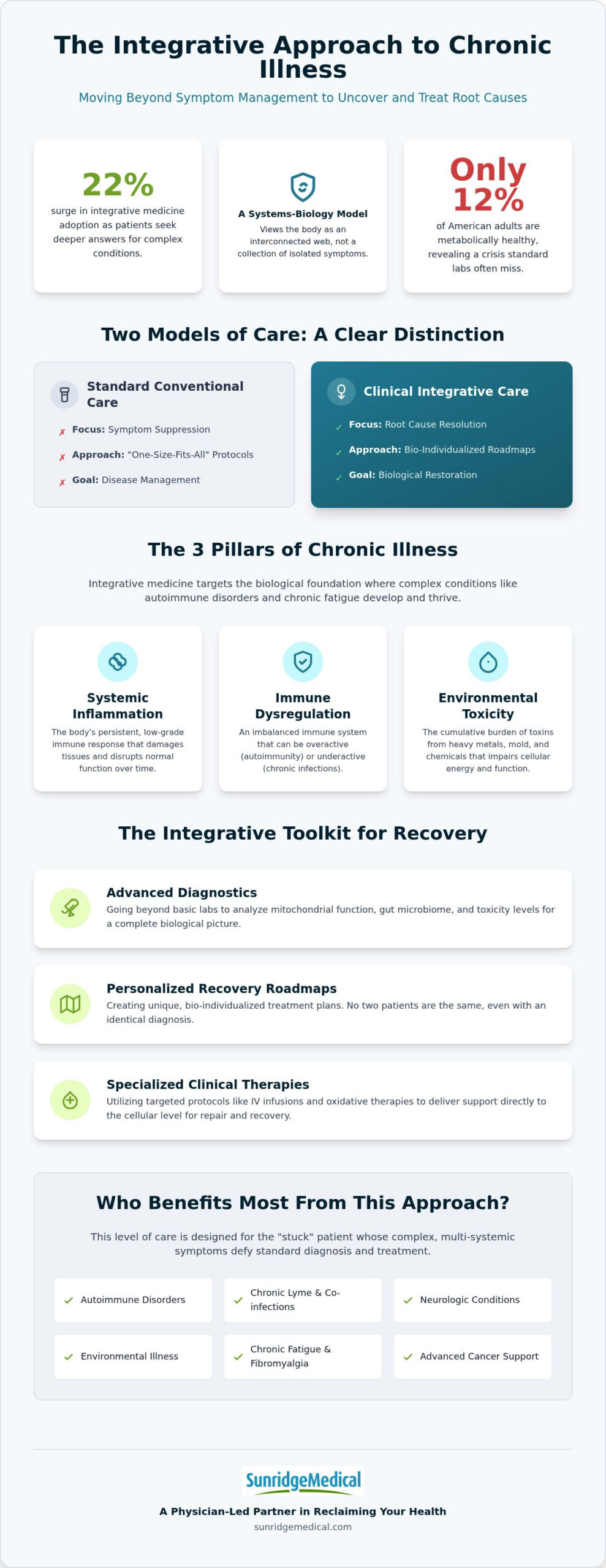
What if the reason your symptoms persist isn’t that your body is failing, but that your current medical strategy is only reading half the story? With a 2025 study showing that integrative adoption surged by 22 percent as patients seek deeper answers, it’s clear the standard model is no longer sufficient for complex cases. For those navigating the exhausting cycle of chronic fatigue and cognitive fog, the standard clinical setting often feels like a dead end where symptoms are dismissed. It’s a frustrating reality that has led many to seek out integrative medicine clinics for chronic illness. These centers represent a necessary evolution in care, combining rigorous diagnostics with the targeted precision of advanced biological protocols.
You’ve likely felt the fear that your condition is permanent or progressive. We recognize that standard care often fails to address the underlying metabolic shifts that drive long term sickness. This 2026 guide will show you how integrative medicine bridges the gap between conventional care and advanced protocols to help you reclaim your health. We’ll explore how to identify the actual root causes of your symptoms and build a personalized roadmap to recovery. From specialized IV protocols to environmental illness management, you’re about to discover a level of specialized attention that moves beyond the status quo.
Key Takeaways
- Understand the systems-biology model that identifies the three pillars of chronic illness—inflammation, immune dysfunction, and toxicity—to move beyond mere symptom suppression.
- Discover how integrative medicine clinics for chronic illness utilize advanced diagnostics and research-based alternative protocols to provide clarity on complex, long-term symptoms.
- Gain insights into specialized clinical therapies, including targeted IV infusions and oxidative protocols, designed to support the body’s biological recovery.
- Learn the essential criteria for selecting a clinical partner, focusing on the importance of physician-led evaluations and specialized expertise in complex disease management.
- Explore how individualized recovery roadmaps provide a structured path forward for those facing advanced cancer, chronic Lyme, or autoimmune disorders.
Defining Integrative Medicine Clinics for Chronic Illness in 2026
Integrative medicine is not merely a collection of therapies; it’s the strategic synthesis of conventional diagnostics and research-based alternative protocols. In 2026, the evolution of Defining Integrative Medicine has moved beyond basic supplementation into highly precise, bio-individualized recovery plans. While standard medical settings often rely on a symptom-suppression model that manages disease through pharmaceutical intervention, integrative medicine clinics for chronic illness utilize a systems-biology approach. This model views the body as an interconnected web where dysfunction in one area inevitably impacts the whole. It’s a departure from the “one size fits all” methodology that leaves so many patients feeling overlooked.
The year 2026 represents a pivotal shift toward biological depth. We now have the diagnostic tools to map an individual’s unique biological environment with unprecedented accuracy. This allows for the creation of protocols that don’t just guess at the cause of fatigue or brain fog but target the specific mitochondrial or immune pathways responsible. You need a scientific guide who understands this complexity. This advocate acts as a steady hand, translating deep technical knowledge into a clear, supportive path forward for those who have exhausted traditional options.
The Shift from Wellness to Clinical Integrative Care
There is a critical distinction between general holistic wellness and the high-level medical protocols required to resolve chronic illness. Wellness focuses on optimization for the healthy; clinical integrative care focuses on restoration for the sick. At the core of this distinction is the physician-led evaluation. These assessments establish a rigorous clinical baseline, ensuring that every therapy is rooted in research-based evidence rather than trends. Modern protocols must be clinically administered, often utilizing specialized IV and injection therapies to deliver biological agents directly where they can initiate cellular repair. It’s about moving from “feeling better” to achieving documented clinical progress.
Who Benefits Most from an Integrative Clinical Approach?
This specialized care is designed for the “stuck” patient. These individuals often present with multi-systemic symptoms that defy standard diagnosis, leaving them feeling dismissed by traditional systems. Whether you’re dealing with autoimmune dysfunction, neurologic conditions, or environmental illnesses, a standardized approach will likely fall short. You require a strategy that adapts to your specific biological markers and environmental history. Integrative medicine is a multi-faceted approach to restoring biological homeostasis by addressing the unique environmental and genetic factors driving your specific condition.
The Biological Framework: How Clinics Address Root Causes
Standard clinical evaluations often provide a snapshot of health, but they rarely capture the cinematic complexity of chronic disease. Leading integrative medicine clinics for chronic illness focus on the three pillars of illness: systemic inflammation, immune dysregulation, and environmental toxicity. These pillars form the biological foundation where conditions like autoimmune disorders and chronic fatigue thrive. Considering that only 12 percent of American adults are considered metabolically healthy according to recent data, standard labs often miss the underlying dysfunction. Physicians utilize Advanced Protocols that look beyond reference ranges to examine mitochondrial function and gut microbiome diversity.
Bio-individuality is the cornerstone of this approach. Two patients may share a diagnosis of fibromyalgia, yet one may suffer from heavy metal toxicity while the other deals with latent viral reactivation. Each requires a distinct roadmap. Hormone optimization also plays a vital role here, acting as a stabilizer for the endocrine system to ensure the body can handle more intensive therapies. By addressing these root causes, we can stop managing symptoms and start restoring the body’s natural balance.
Immune Dysregulation and Chronic Infection
In many cases of chronic illness, the immune system is either overactive or dangerously suppressed. Pathogens like Borrelia often persist by evading standard detection, leading to the long-term symptoms seen in Chronic Lyme Disease. The goal is immune retraining, which teaches the body to recognize and address these persistent threats without causing excessive collateral damage. For those navigating these complexities, our clinical guide to Lyme disease specialists provides essential insights into choosing a deep-dive recovery path.
Environmental Toxicity and Neurologic Health
Environmental illness is a growing driver of neurologic dysfunction. Toxins from mold, heavy metals, or chemicals can trigger neuro-inflammation, which patients experience as persistent brain fog or memory issues. Clinical detoxification protocols are essential for integrative medicine clinics for chronic illness to clear these obstructions and restore cognitive clarity. We also link hormone optimization directly to neurologic recovery, as balanced hormones support the repair of the myelin sheath and neurotransmitter function. If you’ve felt stuck in your progress, a detailed physician consultation can help identify which toxins are impeding your health.
Advanced Protocols: Bridging Alternative and Conventional Care
The bridge between alternative and conventional care is built on clinical precision. Leading integrative medicine clinics for chronic illness don’t view these two worlds as mutually exclusive. Instead, they utilize advanced alternative protocols to enhance the efficacy of conventional diagnostic baselines. This “Bridge” philosophy ensures that patients receive the most comprehensive care possible without sacrificing the safety of professional medical monitoring. By maintaining high-level clinical authority, these clinics provide a sanctuary where advanced biological treatments are administered with the same gravity as any hospital procedure. It’s a methodical approach that prioritizes patient safety through continuous physician oversight.
The Role of Specialized IV and Injection Therapy
Intravenous delivery is a cornerstone of advanced recovery because it bypasses the digestive system. Many patients with chronic conditions suffer from malabsorption or gut permeability, making oral supplementation largely ineffective. Specialized IV protocols, including nutritional infusions and oxidative therapies, deliver biological agents directly into the bloodstream for immediate cellular repair. These customized protocols are essential for autoimmune support, providing the body with the specific building blocks needed to recalibrate the immune response. For a deeper look at these specific mechanisms, see our 2026 guide to IV therapy for autoimmune disease.
Individualized Treatment Plans vs. Standardized Care
Standardized care often treats the diagnosis rather than the individual. In large hospital systems, patients frequently receive “packaged” care that follows a rigid, predetermined path. In contrast, integrative clinics offer targeted care where physician monitoring allows for real-time protocol adjustments. If a patient’s response to an oxidative protocol shifts, the physician can pivot the strategy immediately. This level of specialized attention is what differentiates a high-level clinic from a standard clinical setting. It ensures that the treatment evolves alongside the patient’s recovery journey.
| Feature | Conventional Standardized Care | Integrative Clinical Care |
|---|---|---|
| Core Focus | Symptom suppression and management | Root-cause resolution and homeostasis |
| Protocol Type | Fixed “standard of care” packages | Bio-individualized, adaptive plans |
| Delivery Method | Primarily oral pharmaceuticals | Advanced IV and biological injections |
| Clinical Monitoring | Intermittent laboratory reviews | Continuous, physician-led adjustments |
Navigating Your Journey: Selecting the Right Integrative Partner
Selecting a clinical partner is the most critical decision in your recovery journey. When you are searching for integrative medicine clinics for chronic illness, you’re looking for more than just a provider; you’re seeking a scientific guide with the clinical gravity to handle complex, multi-systemic conditions. Experience matters. A clinic founded in 2003, for instance, offers a level of historical data and protocol refinement that newer wellness centers simply cannot match. National reach is also a vital indicator of quality. Clinics that serve a national patient base are often at the leading edge of medical research, as they must consistently deliver results for the most challenging cases that have failed standard treatments elsewhere.
The first step toward clarity is always a comprehensive initial consultation. This shouldn’t be a brief overview but a deep dive into your medical history and current biological markers. It’s during this phase that a physician establishes the diagnostic baseline necessary to build an individualized roadmap. If you’re ready to move beyond standard management, you can schedule your initial physician evaluation to begin this process of clinical discovery.
Evaluating Clinical Gravity and Expertise
The Medical Director’s experience in complex cases is the most critical factor in your success. You need a leader who has spent decades navigating the nuances of late-stage cancer, chronic Lyme, and autoimmune dysfunction. A high-level clinic treats the whole person rather than a single organ system, acknowledging that neurologic symptoms often have environmental or inflammatory roots. Beware of red flags during your search. Any clinic that promises “cures” without first conducting comprehensive diagnostics is not practicing evidence-based medicine. Use this checklist when interviewing potential partners:
- Does the clinic have a physician-led team with over 20 years of specialized experience?
- Are the protocols bio-individualized based on advanced lab work?
- Is there a focus on clinical administration of IV and biological therapies?
- Does the facility provide a sanctuary-like environment with dedicated patient support?
Understanding the Logistics of Integrative Care
What should you expect when you begin? The first week of an advanced integrative protocol is often the most intensive. This period is dedicated to stabilizing your system and initiating the first phase of cellular repair. Unlike the “packaged” care of standard hospitals, your protocol will be adjusted in real-time. Physician monitoring ensures that as your body responds to treatment, the therapies evolve to match your needs. For those looking at the long-term horizon, understanding the path for chronic illness recovery is essential for setting realistic expectations and staying committed to the process of biological restoration.
The Sunridge Approach: Advanced Recovery Protocols
Sunridge Medical serves as a sanctuary for those facing the most daunting health challenges. We understand that a diagnosis of advanced cancer or complex chronic disease requires more than standard management. The Sunridge Method is built on a foundation of clinical excellence and compassionate optimism. It begins with an exhaustive physician evaluation that goes beyond surface-level symptoms to map your unique biological landscape. This data-driven approach allows us to develop customized biological treatments that target the specific mechanisms of your illness. Among the premier integrative medicine clinics for chronic illness, we prioritize the restoration of well-being through a comprehensive, multi-faceted lens.
Our philosophy is rooted in the belief that progress is always possible when you apply the right scientific tools to the right biological targets. We don’t just treat the disease; we support the individual human experience. This commitment to clinical authority ensures that every protocol is administered with precision and care. By combining conventional evaluations with research-based alternative therapies, we offer a level of specialized attention that goes beyond the ordinary. It’s a steady hand for patients who have felt overlooked by traditional systems.
Alternative Cancer Treatment and Integrative Oncology
A significant gap exists in modern medicine regarding the synergy between conventional oncology and alternative protocols. At Sunridge, we bridge this gap by focusing on advanced cancer stages, including Stage 4 and 5 cases that require high-level biological integration. Integrative oncology doesn’t mean ignoring conventional diagnostics. Instead, it means supporting the body’s immune and metabolic systems while simultaneously targeting the disease. This dual approach helps maintain the patient’s quality of life during intensive treatment cycles. For those seeking a deeper understanding of these methodologies, our comprehensive clinical guide to alternative cancer treatment provides essential insights into our specialized oncology protocols.
Commitment to Bio-Individualized Recovery
The strength of our approach lies in its versatility. Sunridge Medical addresses autoimmune dysfunction, chronic Lyme disease, and hormone optimization under one roof. We recognize that these conditions often overlap, requiring a unified strategy to restore biological homeostasis. By identifying the unique environmental and genetic factors driving your condition, we can move from a broad medical philosophy to a specific, actionable application. This is how integrative medicine clinics for chronic illness provide a true roadmap to recovery. If you’re ready to gain clinical clarity on your symptoms, your first step is a consultation with our medical team. We invite you to call our toll-free line at 1-800-923-7878 to speak with a patient advocate. Recovery is not a matter of chance; it’s a logical progression toward health through expert guidance and specialized care.
Reclaiming Your Health Through Clinical Precision
Navigating a complex health journey requires more than just a diagnosis; it demands a comprehensive strategy that addresses the cellular environment where illness persists. By focusing on the biological pillars of inflammation, immune dysfunction, and toxicity, integrative medicine clinics for chronic illness provide a structured path toward restoration. You don’t have to accept a life of managed symptoms or progressive decline. Modern protocols now allow for the strategic synthesis of conventional diagnostics and advanced biological therapies; they offer a level of customization that standard hospital systems often overlook.
Sunridge Medical stands as a national leader in integrative oncology and alternative medicine, bringing over 20 years of clinical experience to the most challenging cases. Our physician-led individualized treatment protocols are designed to act as a steady hand for those seeking a departure from standardized care. We invite you to contact Sunridge Medical at 1-800-923-7878 to schedule your individualized physician consultation and take the first step toward clinical clarity. Your recovery is a logical progression toward well-being, and we’re here to guide you with calm determination and scientific expertise. Better health isn’t just a possibility; it’s a goal we pursue together with unwavering focus.
Frequently Asked Questions
What makes integrative medicine clinics different from standard hospitals?
Integrative medicine clinics differ from standard hospitals by moving beyond a symptom-suppression model. While hospitals often rely on standardized pharmaceutical interventions, these clinics utilize a systems-biology approach to identify root causes. This involves physician-led evaluations that combine conventional diagnostics with research-based alternative protocols. The focus is on restoring biological homeostasis rather than just managing a diagnosis. This creates a personalized roadmap to recovery that is rarely available in standard clinical settings.
Can integrative medicine help with late-stage or metastatic cancer?
Integrative protocols are specifically designed to address the complexities of late-stage and metastatic cancer. Sunridge Medical specializes in Stage 4 and 5 cases, utilizing integrative oncology to support the body’s immune system while targeting the disease. These protocols are individualized to the patient’s specific biological markers and health needs. By combining advanced alternative treatments with conventional monitoring, physicians aim to improve outcomes and maintain quality of life during the most challenging stages of a cancer journey.
How do integrative clinics diagnose chronic illnesses that standard tests miss?
Integrative clinics use advanced diagnostics that look deeper than the standard reference ranges found in typical lab results. Physicians examine mitochondrial function, gut microbiome diversity, and latent pathogen presence to uncover why symptoms persist. This comprehensive approach helps identify the underlying triggers of chronic fatigue, brain fog, and immune dysfunction. By mapping the patient’s unique biological environment, these clinics can provide the clinical clarity necessary to resolve conditions that standard medical tests often miss.
Are the treatments at integrative medicine clinics safe to use with chemotherapy?
Yes, advanced alternative protocols are often used in conjunction with chemotherapy to support the patient’s overall well-being. This integrative oncology approach focuses on reducing the toxic load and supporting the immune system while conventional treatments target the cancer. Every protocol is clinically administered and monitored by a physician to ensure safety and synergy. It’s a methodical strategy that prioritizes the patient’s biological resilience without interfering with the primary goals of their conventional oncological care.
What types of chronic illnesses are most commonly treated in an integrative setting?
Integrative medicine clinics for chronic illness frequently address a wide spectrum of complex, multi-systemic conditions. The most common illnesses treated include late-stage cancer, chronic Lyme disease, and various autoimmune disorders. Additionally, these clinics specialize in environmental illnesses, neurologic conditions, and hormone optimization. Because these conditions often overlap, the integrative approach is ideal for patients who have multiple symptoms that defy a single, standard diagnosis. It provides a sanctuary for those seeking targeted, research-based recovery paths; for instance, those interested in traditional systems can explore Ayurvedic medical treatments and therapeutic wellness services to see how ancient wisdom supports modern restoration.
The duration of a protocol is highly individualized and depends on the patient’s unique biological response. While some initial stabilization occurs within the first few weeks, a comprehensive recovery roadmap often spans several months. This timeline allows for the deep cellular repair and immune retraining required to resolve long-term illness. Your physician will continuously monitor your progress and adjust the therapies in real-time. This ensures that the treatment evolves alongside your body’s specific needs and recovery pace.
Will I need to travel to a national clinic for integrative care?
For patients requiring additional support during these months, home-based nursing and physical therapy—such as the services offered by AVIAN Care—can be an essential component of the recovery roadmap, helping to maintain quality of life outside the clinic.
Many patients choose to travel to national leaders like Sunridge Medical to access advanced biological treatments not available in local hospitals. Because specialized IV and injection therapies require clinical administration by experienced physicians, visiting the facility is necessary for the most intensive phases of care. This national reach ensures that you are working with specialists who have over 20 years of experience in complex chronic disease. It provides an exclusive level of care that prioritizes your long-term health.
How do I know if I am a candidate for advanced alternative medicine?
You are likely a candidate if you feel dismissed by standard clinical settings or if your current treatment has failed to resolve your symptoms. Those experiencing persistent fatigue, brain fog, or multi-systemic dysfunction often benefit most from a systems-biology approach. The first step is always a comprehensive physician evaluation. This consultation provides the clinical clarity needed to determine if advanced alternative protocols are the right path for your specific biological environment and recovery goals.