


You live in Scottsdale, Phoenix, or another part of Arizona. After a trip to the Northeast or upper Midwest, you developed fatigue, headaches, joint pain, or unusual nerve symptoms. The first Lyme test was negative, treatment didn't resolve everything, and you're left wondering whether you need a Lyme disease specialist in Arizona or just more time.
That uncertainty is understandable. Lyme disease is uncommon as a locally acquired infection in Arizona, but it remains a significant U.S. clinical burden. The right evaluation depends on more than symptoms alone. It requires careful attention to travel, timing, prior treatment, laboratory testing, and other possible causes of persistent illness.
Table of Contents
- What Is a Lyme Disease Specialist
- Signs You Need a Lyme Specialist
- Conventional vs Integrative Treatment Approaches
- How Lyme Disease Presents in Arizona
- The Diagnostic Pathway for Complex Lyme
- Sunridge Medical Approach to Lyme Disease
- Taking the Next Step in Scottsdale
What Is a Lyme Disease Specialist
A primary care clinician can often manage a straightforward early Lyme infection. A patient with a compatible expanding rash and a clear exposure history may not need a lengthy specialist workup. The challenge changes when symptoms continue, involve several body systems, or don't match the initial diagnosis.
Consider a patient who returns to Scottsdale after hiking in an endemic region. Weeks later, she develops exhaustion, migrating joint discomfort, poor concentration, and intermittent palpitations. Her first visit focuses on fatigue, and a later appointment focuses on anxiety. Neither visit connects the symptoms with travel, timing, previous medication, and possible neurologic or cardiac involvement.
A Lyme-focused clinician approaches that history differently. The clinician asks where the patient traveled, when symptoms began, whether a rash appeared, what testing was performed, which medications were used, and whether symptoms improved or changed. The evaluation may also consider other tick-borne infections, autoimmune conditions, endocrine disorders, medication effects, sleep problems, and post-infectious inflammation.

Expertise for complicated presentations
A specialist isn't defined only by prescribing antibiotics. The important distinction is the ability to separate active infection, past exposure, post-treatment symptoms, reinfection, coinfection, and unrelated illness rather than treating every lingering symptom as proof of ongoing Lyme disease.
The clinical guide to choosing advanced integrative Lyme care can help patients understand what questions to ask about testing, treatment philosophy, coordination with other doctors, and follow-up.
A qualified specialist should also explain uncertainty plainly. No test answers every question, and persistent symptoms deserve a broad medical assessment rather than an automatic label. That balance protects patients from both dismissal and unsupported treatment.
Signs You Need a Lyme Specialist
The need for specialist input usually becomes clearer when symptoms are persistent, multisystem, or poorly explained. Early Lyme may begin with a rash, fever, headache, muscle aches, or fatigue. Later manifestations can involve the joints, nervous system, or heart, and those presentations require more careful clinical reasoning.
Symptoms that deserve a deeper review
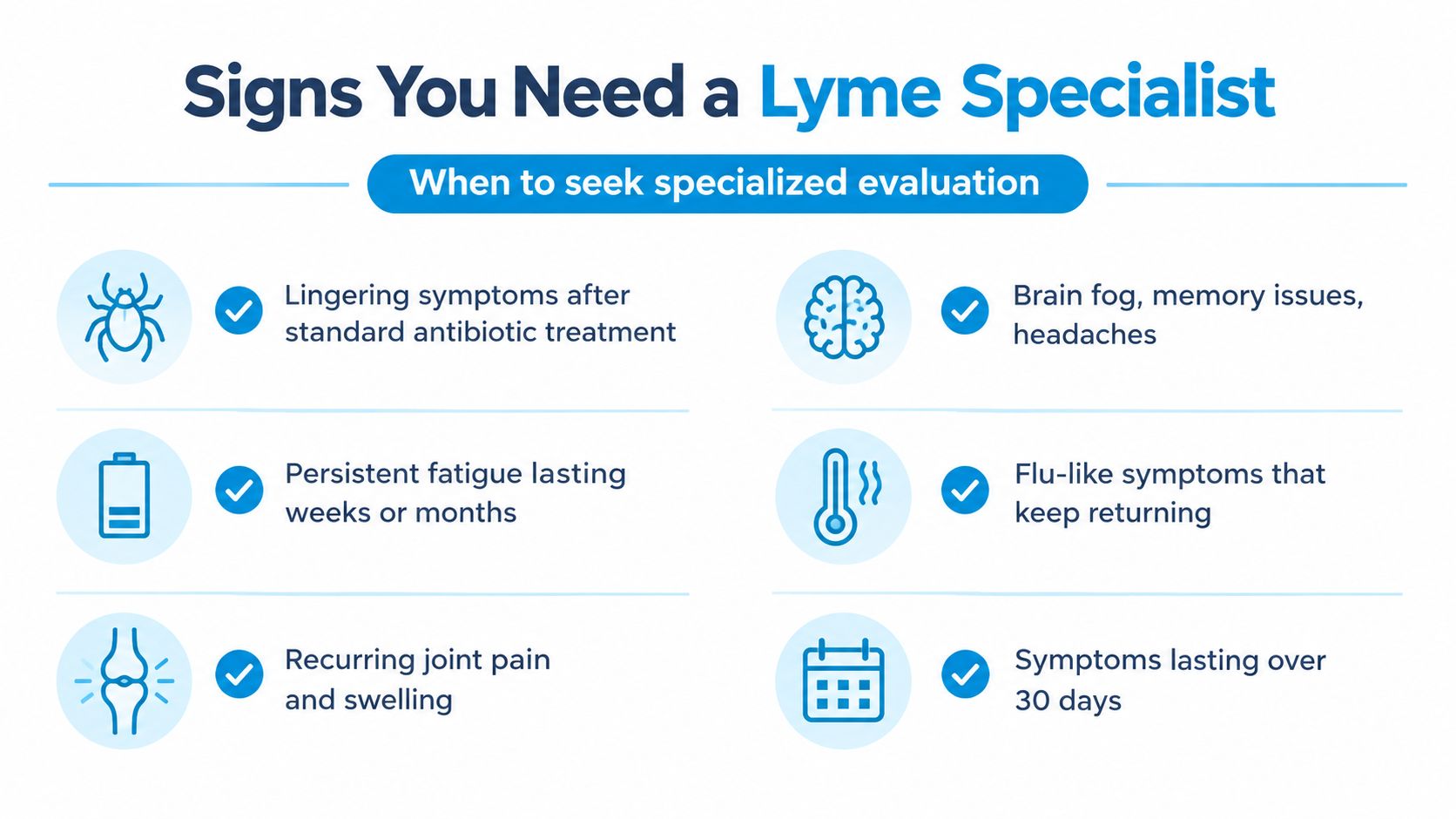
Seek a more thorough evaluation if you have:
- Lingering symptoms after treatment: You still feel unwell after a clinician has treated suspected Lyme disease, especially if the symptom pattern has changed.
- Persistent fatigue: Exhaustion interferes with work, exercise, sleep, or normal daily activities.
- Recurring joint symptoms: Pain, stiffness, or swelling returns or moves between joints.
- Neurologic complaints: Brain fog, memory changes, headaches, tingling, burning pain, weakness, facial changes, or balance problems need medical assessment.
- Repeated flu-like episodes: Fevers, chills, sweats, or body aches recur without a clear explanation.
- A complicated exposure history: You traveled through an endemic region, had multiple possible exposures, or received testing after antibiotics had already begun.
A negative initial test doesn't always close the case. Antibodies may not yet be detectable early in infection, and the meaning of a result depends on timing, the assay used, symptoms, and exposure risk. At the same time, persistent symptoms alone don't prove that active Lyme infection remains.
Clinical principle: A complex symptom pattern calls for a broader evaluation, not a stronger assumption.
A useful next resource is this discussion of persistent Lyme disease and possible misdiagnosis. Patients should bring their records to a qualified clinician who can reassess the original diagnosis and consider alternative explanations.
Urgent symptoms require prompt care rather than a routine consultation. New chest pain, fainting, severe shortness of breath, sudden weakness, confusion, or severe neurologic changes should be evaluated urgently.
Conventional vs Integrative Treatment Approaches
Conventional and integrative care can overlap, but they don't ask exactly the same clinical questions. Conventional treatment focuses on identifying a recognized infection and using validated antimicrobial therapy when the diagnosis and disease stage support it. Integrative care may add nutritional, symptom-supportive, and rehabilitation measures while continuing to evaluate other contributors to illness.
For classic erythema migrans, the 2020 IDSA, AAN, and ACR guideline recommends clinical diagnosis without laboratory testing and oral treatment with doxycycline, amoxicillin, or cefuroxime axetil. The guideline describes typical treatment durations of 7 to 14 days for erythema migrans, with 14 to 28 days for other manifestations, including 14 days for carditis, 14 to 21 days for neurologic Lyme disease, and 28 days for Lyme arthritis. These recommendations are detailed in the IDSA Lyme disease guideline.
Where the approaches differ
| Conventional focus | Integrative focus |
|---|---|
| Confirming a recognized infection and disease stage | Reviewing infection, inflammation, nutrition, sleep, medications, and function together |
| Using guideline-supported antimicrobial treatment | Adding individualized supportive care when clinically appropriate |
| Monitoring response and adverse effects | Tracking symptoms, activity tolerance, organ systems, and quality of life over time |
| Referring for specialty care when complications appear | Coordinating multiple disciplines when symptoms remain complex |
An integrative plan shouldn't mean unproven treatment without safeguards. Therapies such as IV nutrients, oxidative medicine, supplements, or other complementary interventions may have different levels of evidence, risks, and regulatory status. A responsible clinician explains what is established, what is adjunctive, and what requires additional caution.
The purpose is also not to assume that every lingering symptom represents persistent bacteria. Post-treatment symptoms may have several possible causes, including inflammation after infection, another medical condition, medication effects, sleep disruption, or a separate tick-borne illness. The guide to integrative Lyme disease protocols provides a framework for discussing individualized care without replacing a medical evaluation.
The strongest plan is the one that matches the patient's diagnosis and risk profile. It may involve standard antimicrobial treatment, supportive care, referral to another specialist, or a second opinion before additional therapy begins.
How Lyme Disease Presents in Arizona
A Scottsdale resident develops fatigue and migrating joint pain after a hiking trip outside the state. A tick found in Arizona may seem like the obvious explanation, yet the relevant exposure could have occurred weeks earlier during travel. Arizona changes the starting point of a Lyme evaluation because local and travel-related risks are not interchangeable.
The Arizona Department of Health Services Lyme protocol reports no confirmed cases acquired from tick bites in Arizona. Maricopa County's Lyme disease guidance also describes no evidence of Lyme disease transmission in the state through CDC surveillance. These findings make geography important, while they do not rule out infection acquired elsewhere.
Lyme disease is concentrated in the Northeast, mid-Atlantic, and upper Midwest. The EPA's Lyme disease indicators report that 15 states plus the District of Columbia accounted for about 95% of reported U.S. cases in 2022. A clinician should therefore ask where the patient was before symptoms began, not only where the patient lives now.
Build a timeline before the appointment
A useful history connects exposure, symptoms, and treatment:
- Travel: List states or regions visited before symptoms appeared.
- Activities: Record hiking, camping, gardening, hunting, and time in brush or tall grass.
- Tick clues: Note a known bite, a tick on clothing, or an unexplained rash.
- Symptom sequence: Describe the first symptom and how the pattern changed.
- Previous care: Bring test reports, medication names, treatment dates, and treatment response.
Joint discomfort alone cannot identify Lyme disease. Other conditions can produce similar symptoms, as explained in these Thermo Recovery Wear joint pain insights, which provide general education rather than a diagnosis.
For Scottsdale patients, a Lyme disease doctor in Scottsdale should understand travel-related exposure and established tick-borne disease protocols. The aim is a careful connection between illness pattern, credible exposure, and appropriate testing, rather than dismissing symptoms or prescribing antibiotics from symptoms alone.
The Diagnostic Pathway for Complex Lyme
An Arizona resident may develop fatigue, joint pain, or neurologic symptoms after returning from travel, yet assume the desert environment caused the illness. Lyme disease is uncommon in Arizona compared with regions where transmission is established, so the diagnostic process must connect symptoms with travel, possible tick exposure, and timing. A specialist familiar with complex tick-borne evaluations will not reduce that process to a quick antibiotic prescription.
Lyme disease is usually assessed through antibody testing rather than one direct blood test. The CDC diagnostic guidance recommends a two-step process using FDA-cleared assays, generally beginning with a screening enzyme immunoassay or similar test, followed by a confirmatory assay when indicated.
Timing can change the result. Early in infection, the immune system may not yet have produced detectable antibodies, creating a false-negative result. If a patient has a compatible erythema migrans rash, a clinician may weigh the rash and exposure history instead of waiting for antibody production.
What a specialist reviews
A later or unclear presentation calls for the original laboratory report, not only the label “negative.” The clinician may ask:
- Was testing performed at an appropriate point in the illness?
- Was the two-step process completed?
- Did antibiotics begin before testing?
- Does travel history fit a region where Lyme disease is transmitted?
- Are there objective findings?
- Could another infection, inflammatory condition, neurologic disorder, or medication effect explain the symptoms?
The peer-reviewed review of Lyme diagnosis and testing explains two-tier serology and the early period when antibodies may be absent. Results therefore need interpretation alongside the examination and medical history.
Further evaluation may address other conditions, review organ-system findings, and involve neurology, cardiology, rheumatology, or another clinician when appropriate. Each test should answer a defined clinical question. More testing alone does not make the diagnosis clearer.
Sunridge Medical Approach to Lyme Disease
A Scottsdale resident may develop fatigue, pain, or cognitive changes after returning from a trip, then receive conflicting explanations when routine care does not restore function. In Arizona, a careful review asks whether symptoms relate to travel or an exposure outside the state, rather than assuming a local tick encounter or reaching immediately for another antibiotic prescription.

Sunridge Medical is an integrative clinic in Scottsdale offering physician-directed evaluation and individualized care for Lyme and other tick-borne disease concerns. Its clinicians may combine conventional assessment with supportive services such as IV therapies, oxidative medicine, and targeted protocols. The choice depends on the patient's findings, medical history, safety considerations, and treatment goals.
A consultation works like assembling a medical timeline from separate pieces. The clinician reviews Infection history, including travel, outdoor exposure, prior diagnoses, testing, and antimicrobial treatment. Persistent symptoms, such as fatigue, pain, disrupted sleep, gastrointestinal problems, or neurologic complaints, are considered alongside Potential coinfections, which may require separate testing and treatment. Inflammatory and metabolic factors, including laboratory abnormalities, nutrition, and medication tolerance, can affect the plan. Functional goals, such as walking farther, returning to work, sleeping better, or managing daily tasks, make progress measurable in everyday terms.
The purpose is to understand the whole patient, not to apply a fixed protocol. Supportive therapies do not replace urgent treatment or validated care when a serious infection or complication is present. Each option should be discussed in terms of evidence, possible benefit, side effects, interactions, and monitoring. Patients should also know whether a therapy is established, complementary, off-label, or investigational.
This brief video overview provides additional context on the clinic's medical perspective.
The practical result may be treatment, further evaluation, coordination with an existing physician, or a second opinion before therapy changes. The plan should match the evidence and the patient's priorities.
Taking the Next Step in Scottsdale
A productive consultation starts before you arrive. Gather your test reports, imaging, medication list, treatment dates, specialist notes, and a short timeline of symptom changes. Include travel dates and locations, even if the trip occurred months before symptoms began.
What to bring to the appointment
Use a simple record:
- Exposure timeline: Where you traveled, outdoor activities, known bites, and any rash.
- Symptom timeline: The first symptom, later developments, patterns of improvement, and relapses.
- Treatment history: Antibiotics, supplements, infusions, adverse effects, and perceived response.
- Laboratory results: Original reports are more useful than a patient's summary of the result.
- Current health information: Medical conditions, allergies, prescriptions, sleep quality, diet, and functional limitations.
Write down your main questions. You might ask whether the exposure history supports Lyme disease, whether the testing was performed at the right time, what alternative diagnoses should be considered, and how the clinician will monitor safety and progress.
Patients from Phoenix, Paradise Valley, Tempe, Mesa, Gilbert, and the broader Phoenix metropolitan area may be able to arrange an in-person consultation in Scottsdale. Patients traveling from outside Arizona should ask the clinic about records review, telehealth availability, laboratory coordination, treatment logistics, and how often in-person visits may be needed. Travel planning is easier when you know which parts of care can happen remotely and which require an examination or supervised therapy.
Don't stop prescribed medication or begin a new antimicrobial or supplement regimen without speaking with a qualified clinician. Bring a trusted family member if fatigue or cognitive symptoms make it difficult to remember details, and seek urgent care for severe or rapidly worsening symptoms.
The first appointment doesn't have to promise a cure. It should give you a clearer diagnostic framework, a review of previous care, and a safe discussion of reasonable next steps.
Sunridge Medical offers physician-directed integrative evaluation for Lyme disease and persistent tick-borne illness symptoms in Scottsdale, including individualized review of testing, treatment history, and supportive care options. Visit Sunridge Medical to request a consultation and discuss whether an in-person or remote evaluation is appropriate for your situation.