

Median annual out-of-pocket spending for insured GLP-1 users is approximately $1,528, while cash-pay compounded protocols often range from $1,200 to more than $4,800 annually, depending on the medication and monitoring required. Your actual peptide therapy cost may be lower or higher because insurance design, clinical oversight, laboratory testing, supplies, and pharmacy charges all affect the final bill.
You may be comparing a prescription quote from your insurer with a clinic's monthly cash price, wondering why neither estimate seems to tell the whole story. A vial or prescription is only one part of treatment. The meaningful question is what you'll spend across the full care pathway, and whether the plan is medically appropriate, legally supplied, and monitored for your health history.
For patients in Scottsdale, Phoenix, and surrounding communities, that distinction matters even more when peptide therapy is being considered alongside cancer care, autoimmune disease management, metabolic concerns, or other complex conditions. A lower sticker price can become a poor value if it excludes follow-up, laboratory surveillance, dose adjustments, or safe medication sourcing. Before comparing options, it can also help to compare TRT pricing options because hormone and peptide programs often share the same problem, a quoted medication price that doesn't reflect the complete clinical service.
Table of Contents
- Understanding the True Cost of Peptide Therapy
- Breaking Down the Price Components
- FDA-Approved Medications vs. Compounded Protocols
- The Role of Insurance and Out-of-Pocket Spending
- Case Scenarios – Realistic Cost Expectations
- Navigating Costs at Sunridge Medical in Scottsdale
Understanding the True Cost of Peptide Therapy
Why the monthly vial price can mislead
A patient may receive a low monthly quote and still face substantial costs after the first consultation, laboratory work, supplies, and follow-up are added. “Peptide therapy” covers different treatments, including prescription GLP-1 receptor agonists, compounded sermorelin, and investigational protocols. Each can involve different regulatory requirements, prescribing decisions, monitoring, and payment arrangements.
Market estimates for supervised care cluster around $300 to $800 monthly for a single-peptide protocol and $600 to $1,500 for multi-peptide programs. One bundled estimate places medication, clinician oversight, and laboratory monitoring at approximately $400 to $1,200 per month (Get Healthspan). These figures describe market pricing, not standardized medical fees.
A branded prescription price is not interchangeable with a compounded protocol quote. One clinic may include visits and laboratory review, while another bills separately for consultations, testing, shipping, dose changes, or supplies. Patients comparing options may also compare TRT pricing options, since hormone and peptide programs can present the same pricing problem.
Practical rule: Ask for the annual cost of the complete plan, not merely the monthly medication price.
The financial pathway is clinical, not transactional
A responsible protocol can include a medical history review, medication reconciliation, baseline testing, prescribing, injection education, follow-up assessments, and adjustments based on response or adverse effects. Patients receiving cancer care or managing chronic disease may also need coordination with an oncologist, primary care clinician, or other specialist.
The quote should separate required care from optional services. That distinction helps patients judge whether a lower price reflects efficient care or merely excludes monitoring and follow-up.
Review these five categories before committing:
- Medication: Peptide, dose, formulation, dispensing, and shipping.
- Evaluation: Initial consultation and prescribing assessment.
- Monitoring: Baseline and follow-up laboratory testing, with results reviewed by a clinician.
- Supplies: Syringes, needles, alcohol swabs, storage, refrigeration, and disposal.
- Management: Follow-up visits, titration, adverse-effect assessment, and coordination with other care.
A protocol can appear affordable because several of these costs are billed later or left to the patient. The complete financial commitment is the amount required to obtain, use, and monitor the treatment safely.
Breaking Down the Price Components
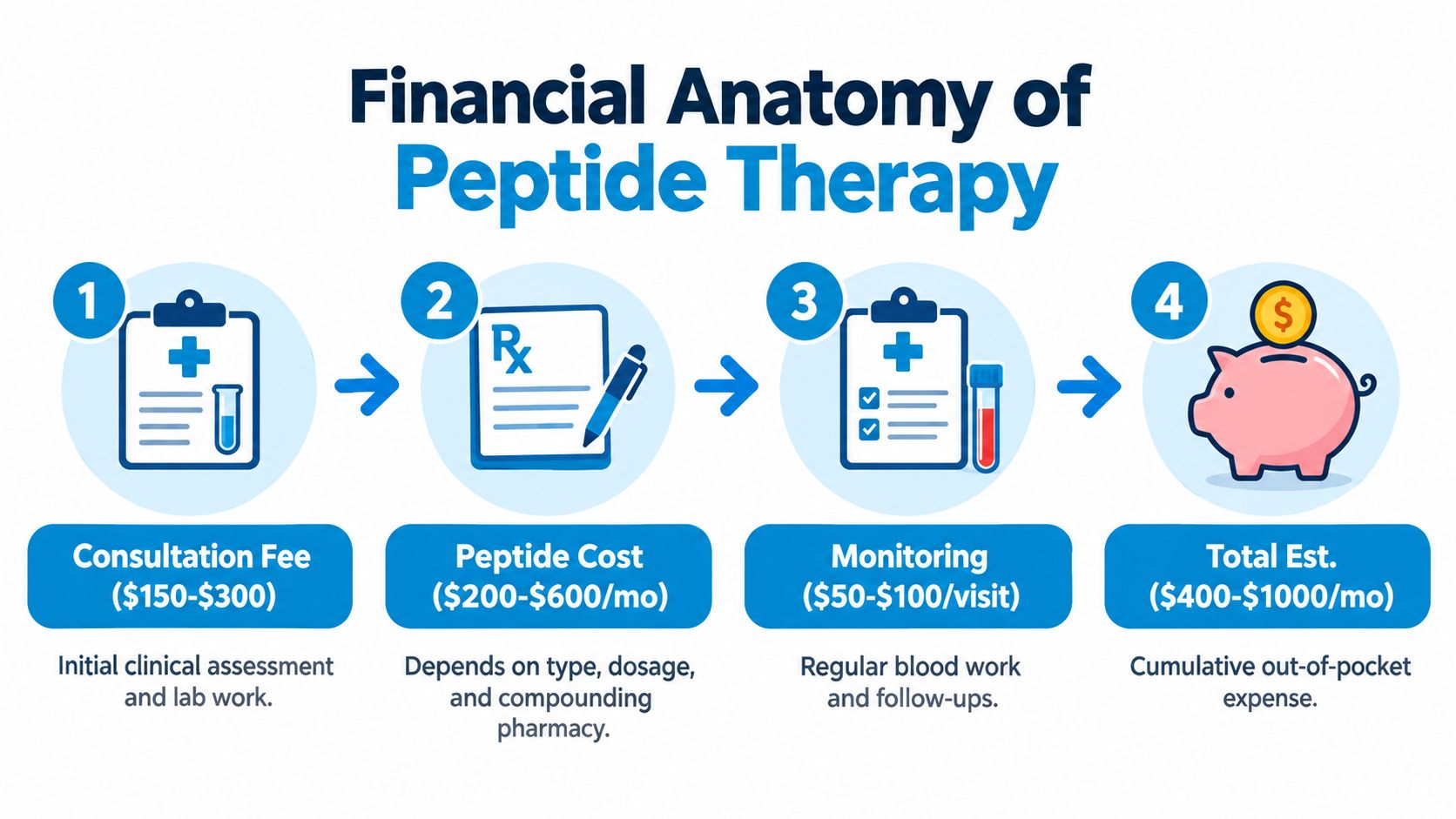
A patient comparing peptide therapy prices may see a monthly medication figure and miss the costs required to prescribe, monitor, and manage the protocol. For compounded care, representative U.S. estimates place medication at approximately $100 to $400 per month, the initial prescribing consultation at $150 to $350, follow-up care at $75 to $200, laboratory testing at $100 to $500, and injection supplies at about $20 to $40 monthly (Peptide Journal). These ranges support planning, not a guaranteed quote.
A practical protocol budget
| Component | Typical Range | What to Ask |
|---|---|---|
| Compounded medication | $100 to $400 per month | Which peptide, concentration, dose, dispensing schedule, and pharmacy are included? |
| Initial consultation | $150 to $350 | Does the evaluation cover medical history, current prescriptions, allergies, prior treatment, and prescribing decisions? |
| Laboratory testing | $100 to $500 | Which baseline and follow-up tests are required, who reviews the results, and is the laboratory charge separate? |
| Follow-up care | $75 to $200 | How often are visits scheduled, and are dose changes, response assessment, and side-effect review included? |
| Injection supplies | $20 to $40 monthly | Are syringes, needles, alcohol swabs, disposal, storage guidance, shipping, and temperature control covered? |
The medication line can change with the formulation and dose. Instructions should cover storage, administration, missed doses, and the response to a suspected reaction. Shipping or replacement costs may apply, especially for patients traveling from Phoenix, Tempe, Mesa, Chandler, Gilbert, Paradise Valley, or elsewhere in Arizona.
Laboratory charges deserve close attention. Baseline results establish a reference point, while later testing may identify tolerance concerns or support a change in the plan. A low consultation price can be misleading if risk assessment, results review, or follow-up decisions are excluded.
Supportive services require a separate estimate. An IV therapy program in Scottsdale may carry different clinical and administrative charges, so it should not be folded into a peptide budget unless the provider explains the relationship between the services.
Before paying: Confirm the medication source, total dose supplied, monitoring schedule, visit frequency, shipping policy, and process for handling side effects.
FDA-Approved Medications vs. Compounded Protocols
Regulatory status affects both price and the financial risks a patient assumes. An FDA-approved medication has completed the agency's review pathway for its approved use. A compounded preparation is not FDA-approved as a compounded formulation. The U.S. Food and Drug Administration states that compounded drugs are not reviewed before marketing for safety, effectiveness, or manufacturing quality. Its materials also describe serious risks for certain compounded peptide substances, including severe allergic reactions such as anaphylaxis.
Price does not establish quality. Patients need to know what they are receiving, why it was prescribed, and what evidence supports the intended use. A branded medication may cost more because its price reflects clinical development, biologics manufacturing, quality control, pharmacovigilance, distribution, and intellectual-property costs. A compounded preparation follows a different pathway and may be considered for a patient-specific reason, with different regulatory and quality-control considerations.
A side-by-side financial view
| Cost Component | FDA-Approved Brands | Compounded Protocols | Questions to ask your prescriber |
|---|---|---|---|
| Medication pricing | Some branded peptide products are reported at approximately $15,000 to $18,000 annually when paid entirely out of pocket, and some exceed $1,000 monthly before insurance or assistance (Peptide Journal). | The medication may have a lower cash price, but the prescription still requires verification of formulation, dose, and dispensing terms (Peptide Journal). | What is the total protocol cost after medication, consultations, laboratory testing, supplies, shipping, and possible replacement doses? |
| Coverage | Coverage may apply for a labeled indication, subject to prior authorization, step therapy, diagnosis requirements, formulary limits, or exclusions. | Compounded formulations are generally self-pay and are not usually reimbursed. | Is the prescription being submitted to insurance, and what happens if the claim is denied? |
| Clinical use | The medication is prescribed within its FDA-approved indication unless a clinician documents another rationale under appropriate medical practice. | Use may be off-label or individualized, so the reason for compounding should be specific. | What patient need does compounding address, and is an approved alternative appropriate? |
| Oversight questions | Ask about authorization, copay, deductible, quantity limits, and manufacturer assistance. | Ask for the pharmacy name, lot traceability, concentration, storage requirements, and beyond-use date. | Who reviews results, manages adverse effects, and adjusts the plan? |
The medication price is only one part of the comparison. A compounded protocol can still involve consultation time, laboratory monitoring, injection supplies, shipping, and follow-up decisions. Those charges determine the actual financial commitment and should be listed before treatment begins.
Patients exploring hormones and peptides should also recognize that a clinical guide to bioidentical hormones for perimenopause addresses a separate treatment question. Hormone symptoms, metabolic disease, cancer history, and fatigue can overlap, but they are not interchangeable diagnoses. Combining products because they sound complementary can increase spending and clinical complexity without establishing that the combination is appropriate.
The Role of Insurance and Out-of-Pocket Spending
A patient can receive the same prescription with a manageable copay or face a substantial cash bill. Coverage depends on the diagnosis submitted, whether the medication is FDA-approved for that indication, the plan formulary, prior authorization, deductible status, and exclusions for weight-management treatment. These rules affect the medication line item, while consultations, laboratory monitoring, supplies, dispensing, shipping, and follow-up can remain separate expenses.
National spending on GLP-1 receptor agonists rose from $4.4 billion in 2013 to $64.9 billion in 2023, nearly 15-fold, with an estimated average annual growth rate of 31.02% (Journal of General Internal Medicine). That trend does not determine an individual bill, but it explains why coverage design receives close attention from insurers, employers, and patients.

Three different payment experiences
An insured patient may have a GLP-1 prescription processed through a pharmacy benefit. In one AJMC survey, 57.7% reported that their first prescription was at least partly covered, while 31.3% reported no coverage. Among those reporting initial payments, 29.6% paid less than $25, including 15.0% who paid nothing, while 20.3% paid $150 or more. The same survey found that 68% said cost influenced starting or continuing treatment, 24% paid more than $250 per fill, nearly 8% paid at least $500 per fill, and 31% of former users stopped because of high out-of-pocket costs (American Journal of Managed Care).
Partial coverage can still leave substantial annual spending. A 2026 analysis reported median annual out-of-pocket spending of $1,528, with higher spending among privately insured and higher-income adults (Journal of General Internal Medicine). That figure may not include consultation, laboratory, dispensing, or administration fees.
A cash-pay compounded protocol creates a different budget. The out-of-pocket cost of GLP-1 therapy should be evaluated separately from compounded peptide pricing because the product, indication, and coverage rules may differ. Ask for the full pathway cost, not only the advertised medication price.
Review this guide to integrative medicine insurance coverage, then confirm benefits and exclusions directly with your insurer.
Case Scenarios – Realistic Cost Expectations
A patient may see an attractive medication price and still face a larger treatment bill. The examples below are illustrative budgeting examples, not promised prices or clinical recommendations. Each one follows the full pathway, including evaluation, medication, laboratory monitoring, supplies, and follow-up.
Scenario one with an insured GLP-1 prescription
A patient in Scottsdale has a qualifying diagnosis and receives an FDA-approved GLP-1 prescription through an insurance plan. The medication is processed under the pharmacy benefit, but the patient must confirm the copay, deductible, prior authorization, quantity limits, and any step-therapy requirement.
Once coverage is approved, the medication cost may be relatively predictable. The broader budget can still include office visits, laboratory testing, injection supplies, and appointments related to dose changes. The previously reported national median of $1,528 in annual out-of-pocket spending offers context, but it is not a quote for this patient.
A practical estimate should therefore list the expected pharmacy spending separately from clinical services. It should also show what the patient may owe if coverage changes, authorization expires, or the prescription is denied.
Scenario two with a single compounded peptide
A patient from Phoenix is considering one compounded peptide through a cash-pay plan. The medication may cost $100 to $400 per month, creating a medication budget of $1,200 to $4,800 for the first year. The hidden costs appear when the rest of the care pathway is added.
A sample first-year calculation might include:
- Medication: $1,200 to $4,800
- Initial consultation: $150 to $350
- Baseline and follow-up laboratory testing: $200 to $1,000
- Injection supplies: $240 to $480
Estimated Scenario 2 total for year one: $1,790 to $6,630.
These figures are planning examples, not a price quote. The patient should ask whether the consultation includes record review, whether laboratory interpretation is billed separately, and whether shipping, storage instructions, and disposal materials are included. The estimate should also explain how costs change if the medication is stopped, adjusted, or replaced.
Scenario three with a complex chronic illness
A patient from Paradise Valley, Tempe, or elsewhere in the Phoenix metropolitan area has autoimmune symptoms, multiple prescriptions, and previous treatment intolerance. The patient is considering a peptide protocol while continuing established medical care.
The first expense may include a longer evaluation, medication reconciliation, review of prior records, and laboratory assessment. A single product may be less expensive than a multi-peptide plan, but the lower initial price does not establish medical suitability. The clinician should first determine whether the proposed therapy has a defensible role and how monitoring will be handled.
For budgeting, a multi-peptide plan can be modeled as $600 to $1,500 per month, or $7,200 to $18,000 for medication over a year, before consultation, laboratory, supply, and coordination costs. A patient should request a written total that identifies which services are included and which are billed separately.
Patients facing cancer-related expenses can also review this guide to financial aid for alternative cancer care. Assistance eligibility and coverage remain separate from the question of whether a peptide is medically appropriate.
A useful safeguard: Do not purchase a protocol until you know the cost of continuing it, monitoring it, modifying it, or stopping it.
Navigating Costs at Sunridge Medical in Scottsdale
Bring your current medication list and recent laboratory results to the consultation. The clinician can review possible interactions, assess whether the proposed peptide has a defensible indication for your diagnosis, and explain how it would fit with oncology treatment or specialist care.
Sunridge provides a written estimate before any prescribing decision. The estimate should identify the consultation and records review, the pharmacy, formulation, dose supplied, and dispensing schedule. It should also list the laboratory panel with CPT codes, the contents of any injection supply kit, and the expected follow-up interval, titration policy, and care coordination. This format lets patients compare the projected first-year commitment, rather than judging the plan by vial price alone.
Ask which services are included in the quoted amount and which are billed separately. A lower medication cost may still lead to higher spending if laboratory interpretation, injection supplies, shipping, or follow-up visits are excluded. Clear terms also show what happens if the dose changes, adverse effects develop, or the treatment is stopped.
Sunridge Medical serves patients in Scottsdale, Phoenix, Paradise Valley, Tempe, Mesa, Chandler, Gilbert, and the greater Phoenix metropolitan area. Its integrative practice considers conventional care alongside traditional and alternative modalities, with individualized planning for cancer care and complex chronic conditions. Patients should leave knowing what is established, what remains uncertain, and which decisions require another clinician's involvement.
The right question isn't only “What does the vial cost?” It's “What care do I need to use this treatment responsibly, and what will that care cost over time?”
Sunridge Medical offers individualized, evidence-informed evaluations for peptide therapy alongside cancer care, chronic disease management, hormone optimization, or other integrative goals. Visit Sunridge Medical to discuss your history, request an itemized estimate, and determine whether a Scottsdale consultation is appropriate.