

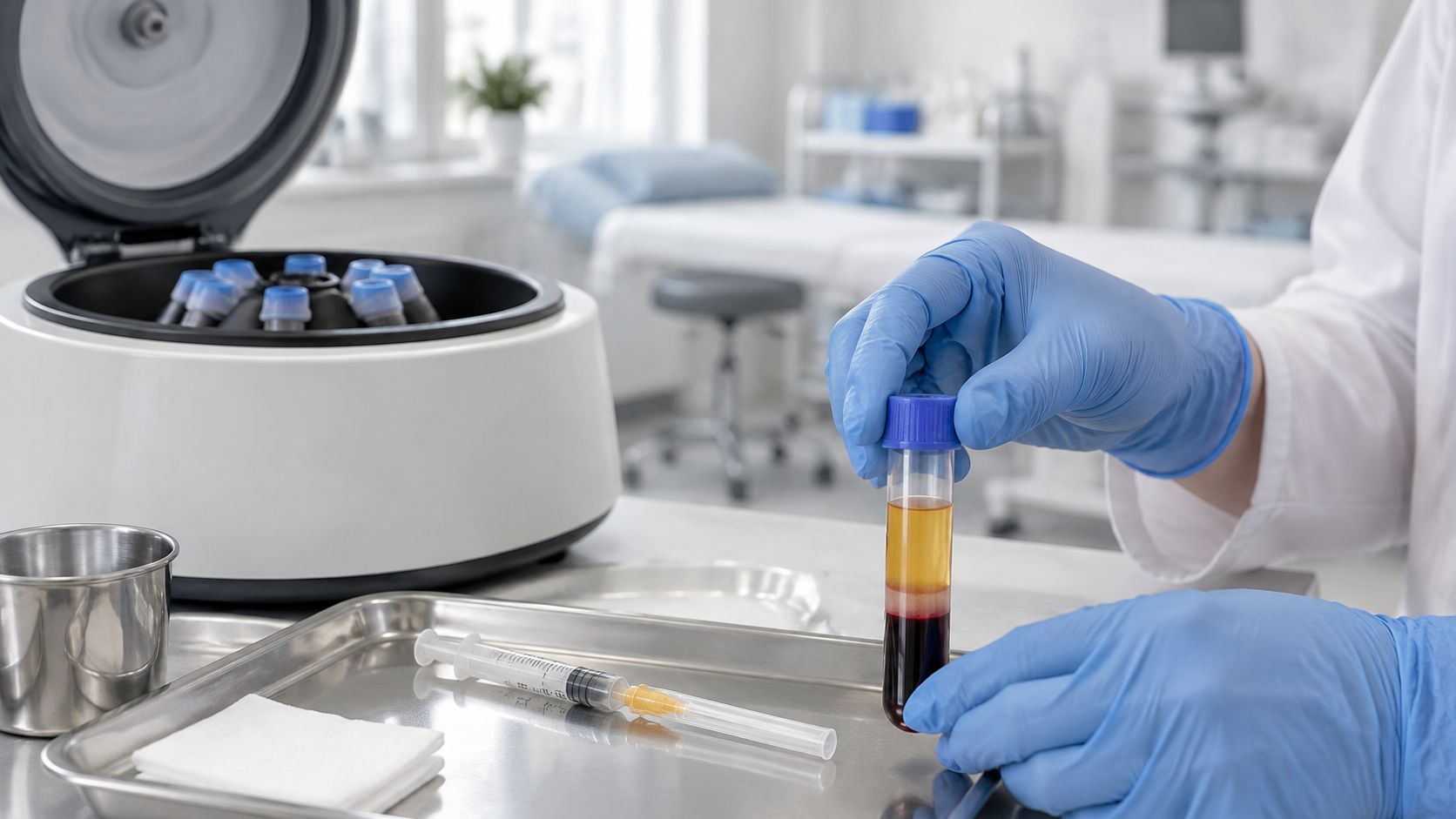
If two clinics both offer platelet-rich plasma, are they offering the same treatment? Not necessarily. A platelet rich plasma protocol describes how blood is collected, processed, characterized and administered, and those choices can produce meaningfully different preparations.
For patients and caregivers, the useful question isn't whether PRP might help. It's whether the proposed preparation, injection approach and follow-up plan have a reasonable evidence base for the specific condition. Written documentation makes that discussion more concrete, especially when cancer treatment, abnormal blood counts or complex chronic illness may affect suitability.
Table of Contents
- The Platelet Rich Plasma Protocol at a Glance
- Who Is Screened Before Platelet Rich Plasma
- How Blood Is Drawn and Spun Into Plasma
- Injection Technique and How Courses Are Spaced
- What the Evidence Shows for Expected Outcomes
- Complications, Red Flags and When to Seek Care
- Questions to Confirm Before Agreeing to Treatment
The Platelet Rich Plasma Protocol at a Glance
PRP is a family of preparations, not a single recipe. Blood volume, anticoagulant, centrifugation force and duration, platelet recovery, leukocyte content and activation can differ. A review of PRP preparation methods explains why a treatment label alone doesn't adequately describe the product.
The following sequence gives patients a practical way to compare what a clinic actually records.
| Stage | What Happens | What to Document |
|---|---|---|
| 1. Screening and consent | Medications, bleeding history, infection and treatment goals are reviewed | Indication, risks, alternatives and evidence for the condition |
| 2. Blood draw | Venous blood is collected under sterile technique | Volume collected and anticoagulant used |
| 3. First centrifugation | Plasma is separated from red cells | Force, time and handling conditions |
| 4. Second centrifugation | Platelets are concentrated | Force, time and final volume |
| 5. Product preparation | Product is classified and optionally activated | Platelet concentration, leukocyte classification and activation method |
| 6. Injection | Product is placed at the target site | Site, needle size, injection plane and imaging use |
| 7. Course planning | Number of treatments and interval are set for the condition | Evidence for the indication and planned reassessment |
| 8. Follow-up | Response, function and side effects are reviewed | Symptoms, outcome measures and any change to the plan |
Product labels need an explanation
Leukocytes are white blood cells. A preparation described as leukocyte-rich retains more of these cells, while leukocyte-poor PRP contains fewer. Neither label, by itself, establishes whether the preparation is appropriate for a particular tissue.
Cellular purity is a separate classification. A review of PRP classification describes preparations as very pure when platelets account for more than 90% of the cellular fraction relative to red cells and leukocytes, pure at 70–90%, heterogeneous at 30–70%, and whole-blood PRP below 30%.
Those percentages describe the mixture of cells, not a patient's chance of improvement. They also aren't interchangeable with platelet concentration or enrichment compared with the original blood sample.
Practical rule: A written protocol should describe both what clinicians do and what product they intend to administer.
The table describes a typical clinical sequence, not instructions for self-treatment. Some validated systems differ from this sequence, making documentation more useful than assuming that every clinic follows identical steps.
Who Is Screened Before Platelet Rich Plasma
| Screening Factor | Why It Matters | Question to Ask |
|---|---|---|
| Anticoagulant or antiplatelet medicines | Can change bleeding risk and platelet function | Which medicines were reviewed, and does the prescriber need to weigh in? |
| Platelet count and anemia | Baseline counts shape the product and how results are interpreted | Was a baseline platelet count measured before preparation? |
| Bleeding disorders | Raise concern about bleeding and bruising | Has bleeding history been reviewed in full? |
| Active infection | Treatment is typically postponed during active local or systemic infection | Does an infection need treatment first? |
| Cancer treatment or immune suppression | Recent treatment can change suitability and evidence quality | Has the treating oncologist been consulted? |
| Injection near a tumor or recently treated tissue | Local risks and evidence may differ from studied sites | Is this site suitable, and what alternatives exist? |
| Autoimmune or inflammatory disease | Inflammatory state may alter product composition and response | How does this condition affect candidacy? |
Suitability begins with a case review, not a blood draw. At Sunridge Medical, treatment planning begins with a detailed review of records, imaging, pathology, laboratory data, treatment history, medications and current goals before recommendations are made.
For someone considering treatment for musculoskeletal injuries or chronic soft-tissue pain, that review helps distinguish the diagnosis being treated from symptoms that may need further evaluation. It also gives the clinician an opportunity to discuss conventional care and complementary options without assuming an injection is the next step.
Findings that may change the decision
Medication review matters because the clinician must consider both procedural bleeding risk and the reason a medicine was prescribed. Patients shouldn't independently stop anticoagulants or antiplatelet medicines to qualify for PRP. Any proposed change requires coordination with the prescribing physician.
Blood counts also matter. The starting sample influences the preparation, so an abnormal baseline can change both candidacy and interpretation of the final product. Infection is another decision point, rather than something to work around during an elective procedure.
Cancer care requires particular caution. A review addressing PRP composition and patient-related considerations emphasizes the limitations of generalizing findings across different medical contexts. Reassuring results from orthopedic or aesthetic studies don't automatically establish suitability for an immunocompromised patient or an injection near a tumor.
Why the patient's own blood isn't automatically suitable
Autologous means that the preparation comes from the patient's own blood. It doesn't mean risk-free: the sample may still yield an inadequate or unsuitable product, and processing must remain sterile.
A review of PRP in knee osteoarthritis identifies standardization of preparation, patient selection and outcome reporting as important unresolved needs. For patients, that supports requesting an explanation of why the proposed protocol fits their diagnosis and medical context.
Before scheduling, patients can request the records Sunridge Medical needs for review and ask which findings would lead the clinician to postpone, modify or decline treatment.
How Blood Is Drawn and Spun Into Plasma
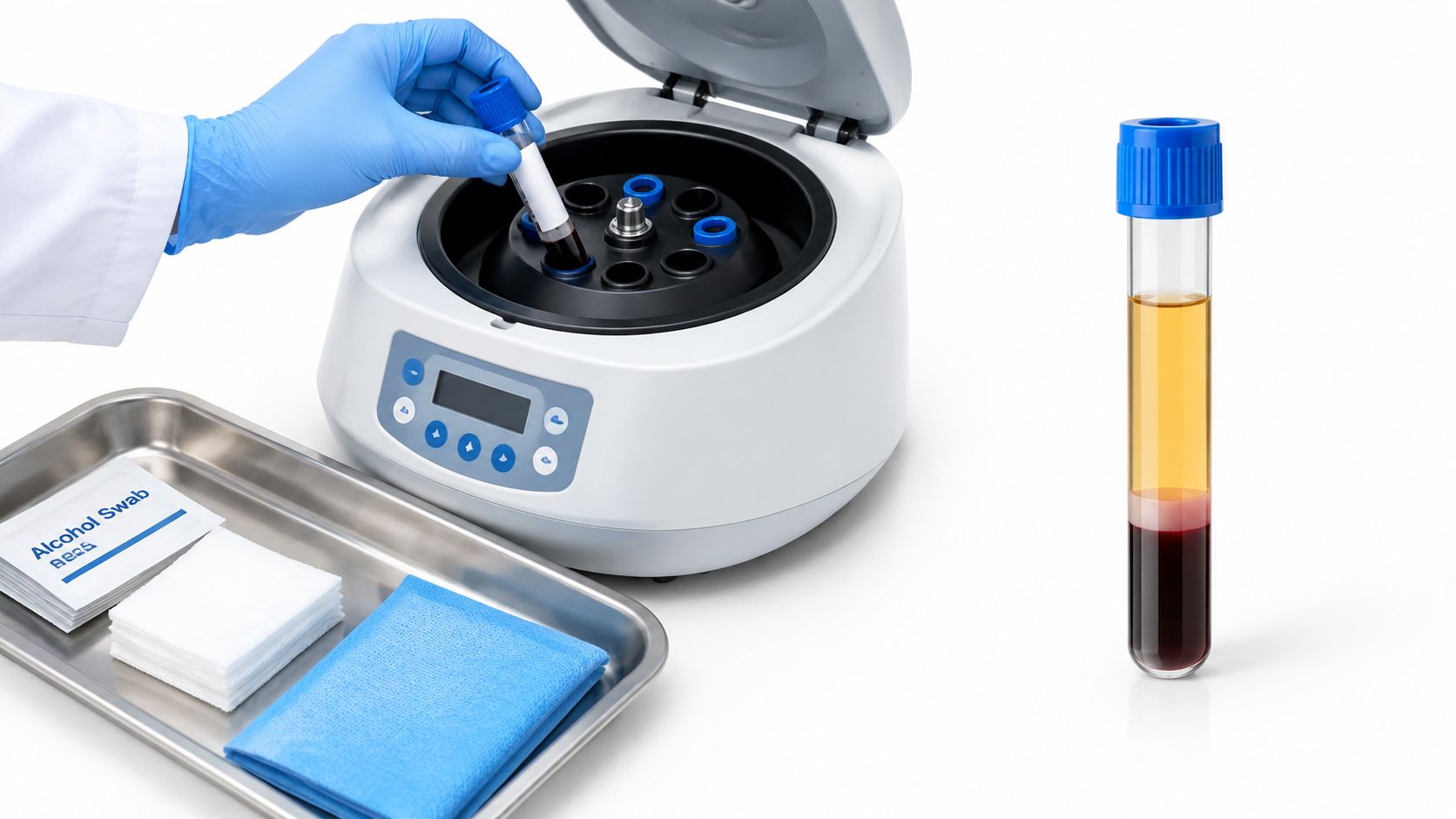
The preparation process is easier to understand when each stage has a defined purpose. The following sequence describes clinical processing, not a method patients should attempt themselves.
- Consent and sterile setup come first. Clinicians confirm the treatment plan and prepare for venipuncture using aseptic technique.
- Venous whole blood is collected into an anticoagulant tube. Acid-citrate-dextrose appears in foundational preparation research, which also describes avoiding chilling the sample.
- A lower-speed first centrifugation separates plasma from red cells.
- The second centrifugation concentrates platelets within the selected plasma fraction.
- Collection volume is recorded, alongside the amount of PRP ultimately prepared.
- Clinicians characterize leukocyte content and document whether the product will be activated before administration.
Published consensus describes a practical whole-blood collection range of approximately 8–50 mL, adjusted to the required final volume and target enrichment, in a review of clinical PRP preparation and administration. That range isn't a recommended blood draw for every patient.
What published centrifugation settings mean
Centrifugation force and duration need to be recorded together. A statement that blood was processed with a double-spin method leaves unanswered questions about the conditions used and the product recovered.
The preparation review linked earlier reports experimental and device-related comparisons. A separate dermatology expert consensus on PRP preparation provides indication-specific manual processing targets and identifies ACD-A as its preferred anticoagulant.
| Setting | Reported Values | What It Showed |
|---|---|---|
| Dermatology consensus first spin | 100–300 × g for 5–10 minutes | Separates plasma from red cells |
| Dermatology consensus second spin | 400–700 × g for 10–17 minutes | Concentrates platelets; suggested target of about 1–1.5 million platelets per microliter for several dermatologic uses |
| Experimental second spin, highest efficiency | 1,500 × g for 15 minutes | 84% platelet-concentration efficiency |
| Experimental second spin, range | 1,000 × g for 15 minutes to 3,000 × g for 5 minutes | Efficiency varied across conditions |
| Double-spin protocol in a 2020 scoping review | 100 × g for 10 minutes, then 400 × g for 10 minutes | About 5 times baseline platelet concentration |
| Device systems compared in the same review | Roughly 1–1.7 times baseline to 3–6 times baseline | Device choice changes platelet yield |
These are research reference values, drawn from the preparation review and dermatology consensus identified above. They aren't operating instructions for a patient, a home centrifuge or an unfamiliar clinical device.
Yield isn't the same as benefit
Platelet-concentration efficiency describes a processing result. It doesn't describe the percentage of patients who improve, the amount of pain relief or the likelihood that tissue will recover.
Similarly, fold enrichment compares the final platelet concentration with the patient's baseline. A preparation with greater enrichment hasn't automatically demonstrated a better clinical outcome.
For example, a clinic might document a concentrated preparation but omit the final volume or leukocyte classification. That record would still leave uncertainty about what the patient received. Concentration, volume and cellular composition belong together when clinicians characterize the product.
Activation is another variable to document. The written record should state whether activation occurred and, if so, which method was used, rather than leaving patients to assume that all PRP is handled identically.
Published centrifuge settings help explain variability. The clinic's validated system, manufacturer guidance and indication-specific protocol determine the settings used in practice.
Patients don't need to choose centrifuge settings themselves. They need a clinician who can explain the selected method, identify its limitations and provide a meaningful record of the preparation.
Injection Technique and How Courses Are Spaced
The injection stage involves several documented decisions, not a single universal technique. Clinicians prepare the target site using sterile technique, select the needle size and injection plane, and consider image guidance when anatomy or placement precision warrants it.
The injection plane is the tissue layer or space where the product is placed. A patient comparing proposed treatments should know the intended target, not just the body region. A description such as a knee injection is less informative than a record that identifies the actual structure or space being treated.
Leukocyte-rich or leukocyte-poor PRP should be selected according to the tissue and indication. The rationale should connect the product described in the preparation record with the target described in the injection record.
Course length needs its own explanation
There's no universally standardized PRP dosing schedule. A systematic review discussing PRP regimens reports that European experts commonly recommend 1–3 injections of approximately 4–8 mL per treatment course, while other reviews describe courses ranging from one injection to five.
Those ranges describe published practice, not a prescription for an individual patient. They don't establish that the same volume, number of sessions or interval is appropriate for a joint, tendon or scalp condition.
The interval between treatments should therefore be explained using evidence for the specific indication. A proposed series should also include a reassessment point, rather than treating every scheduled injection as inevitable regardless of response.
Questions that clarify the procedure
- Target and plane: Which tissue or space is intended, and why?
- Imaging: Will image guidance be used, and what determines that decision?
- Treatment count: How many procedures are proposed for this condition?
- Spacing: What interval is planned, and what evidence supports it?
- Stopping criteria: What symptoms, findings or lack of progress would prompt a pause or change?
Alternatives deserve discussion before a course begins. For joint-related concerns, educational information about hyaluronic acid joint injections can help patients prepare questions about another injection category without assuming that either option is appropriate or superior.
The consent discussion should distinguish a clinician's individualized judgment from a regimen established by strong evidence. When evidence is limited, that uncertainty belongs in the explanation before treatment, not only after an unsatisfactory result.
What the Evidence Shows for Expected Outcomes
A favorable PRP result for one condition doesn't establish benefit for another. A study of an orthopedic complaint cannot, by itself, answer whether a patient with a different diagnosis should receive the same preparation or injection course.
The literature describes promising results in some applications while leaving efficacy unproven in others. Patients need an indication-specific discussion rather than a general claim that PRP is regenerative.

Why results don't transfer cleanly
The knee-osteoarthritis review cited earlier describes differences in preparation, treatment regimens, patient populations and outcome measures. When those elements differ, apparently similar treatments may not be directly comparable.
The assumption that more platelets must produce more benefit is also unreliable. Composition and tissue context may matter as much as concentration. An outcome discussion should therefore address the entire preparation rather than treating enrichment as a standalone quality score.
A patient reading about potential platelet-rich plasma benefits should connect each proposed benefit to a diagnosis, a defined outcome and the protocol used to study it. A biological rationale is not the same as demonstrated patient benefit.
What a meaningful outcome discussion includes
- A stated goal: The desired change should be specific, such as improved function or reduced symptom burden.
- A baseline measurement: The starting condition should be recorded before treatment.
- A follow-up measure: Clinicians should use a validated or clearly defined method to assess change.
- A reassessment timeline: Patients should know when the clinician expects to review progress.
- A definition of no benefit: The discussion should explain what would make further treatment difficult to justify.
For example, a patient whose main goal is walking more comfortably needs more than a general question about whether the injection helped. Recording the relevant limitation before treatment and evaluating it consistently afterward makes the assessment more useful.
Recovery and effectiveness also need separate conversations. Temporary soreness doesn't necessarily establish treatment failure, while tolerating an injection doesn't demonstrate that it worked.
Sunridge Medical individualizes care over time according to response, tolerance, laboratory findings and changing priorities. That process allows the clinical discussion to remain responsive to the patient rather than assuming the original approach must continue unchanged.
A PRP outcome claim is only as useful as the protocol behind it and the evidence for the specific condition.
Complications, Red Flags and When to Seek Care
Short-term injection-site pain should be anticipated. In a systematic review of lateral epicondylitis trials, 39 of 298 PRP-treated patients (13.09%) reported injection-site pain, compared with 22 of 317 controls (6.94%) across 10 randomized trials; no severe complications were reported, and pain resolved within the study periods.
The same analysis associated leukocyte-rich PRP with higher overall complications than leukocyte-poor PRP, with an odds ratio of 1.97 and a 95% confidence interval of 1.12–3.48. That finding supports deliberate product specification, but it doesn't establish the risk for every patient or injection site.
Expected symptoms versus warning signs
| Symptom | Typical Expectation | Appropriate Response |
|---|---|---|
| Soreness, mild swelling or bruising at the site | Anticipated and generally temporary in trial reports | Follow written aftercare instructions and report if it worsens |
| Progressive redness or warmth spreading from the site | Not expected | Contact the treating clinician promptly; seek urgent care if it is spreading quickly |
| Fever, chills or drainage from the site | Not expected; may signal infection | Seek same-day medical evaluation |
| Numbness, tingling, a pale or cold limb, or new weakness | Not expected; may signal neurovascular change | Seek emergency care now |
| Pain that is disproportionate or escalating | Not expected | Contact the clinician the same day; seek emergency care if severe |
| Bleeding that does not stop with pressure | Possible in people with bleeding risk | Seek emergency care |
The absence of severe complications in these trials isn't proof that severe complications cannot occur. The evidence comes from a specific condition and shouldn't be generalized automatically to people with immune suppression, abnormal blood counts or substantially different medical circumstances.
Sunridge Medical does not replace emergency care. Anyone with severe or rapidly worsening symptoms should seek emergency care immediately rather than waiting for a routine clinic response.
Aftercare should be written and individualized
Patients should follow the written instructions supplied for their procedure, care for the injection site as directed and report new or worsening symptoms early. Information about platelet-rich plasma side effects can support preparation, but it doesn't replace procedure-specific instructions.
Pain-reliever selection also belongs in the medication review. Patients should confirm which medicines are appropriate given their existing prescriptions, bleeding risk and medical history rather than independently adding or stopping a drug.
Before discharge: The patient should know which symptoms require a routine call, same-day evaluation or emergency care.
The clinician should establish stopping rules for suspected infection and unexpected symptoms before treatment begins. A clearly documented response plan is more useful than general reassurance that the procedure uses the patient's own blood.
Questions to Confirm Before Agreeing to Treatment
Before consenting, patients can request a written summary covering the following points:
- Product identity: Intended leukocyte-rich or leukocyte-poor classification, platelet concentration and red-cell contamination.
- Preparation record: Collection tube, anticoagulant, centrifuge force and duration, final volume and handling conditions.
- Activation and sterility: Whether the preparation is activated, the method used and how sterile processing is maintained.
- Condition-specific evidence: What supports treatment for the diagnosis and what remains uncertain.
- Course and reassessment: Proposed treatment count, spacing and points for reviewing progress.
- Outcome criteria: Measures of benefit and the findings that would count as no meaningful improvement.
- Care coordination: How the treating oncologist or other specialists will participate when relevant.
A brand name or a general description of concentrated platelets doesn't substitute for these details. Patients comparing categories may also find Sunridge's explanation of platelet-rich plasma versus stem-cell approaches useful for separating treatments that shouldn't be treated as interchangeable.
An individualized next step
Sunridge Medical is an experienced integrative clinic in Scottsdale, Arizona, offering regenerative medicine that includes platelet-rich plasma, stem-cell treatments and prolozone therapy. Suitability is determined only after individualized evaluation, not by interest in a treatment alone.
The clinic doesn't promise cures or guaranteed outcomes and doesn't replace emergency care, an oncologist or medically necessary conventional treatment. Its Patient Care Team can explain treatment and financial considerations so patients can make an informed decision without pressure.
Sunridge Medical offers individualized integrative evaluation and regenerative medicine, including PRP, for patients whose clinical circumstances make consideration appropriate. Patients in Scottsdale, Phoenix and those traveling for care can visit Sunridge Medical to contact the Patient Care Team about a consultation or second opinion, with suitability determined after review of the diagnosis, medical history and available evidence.