

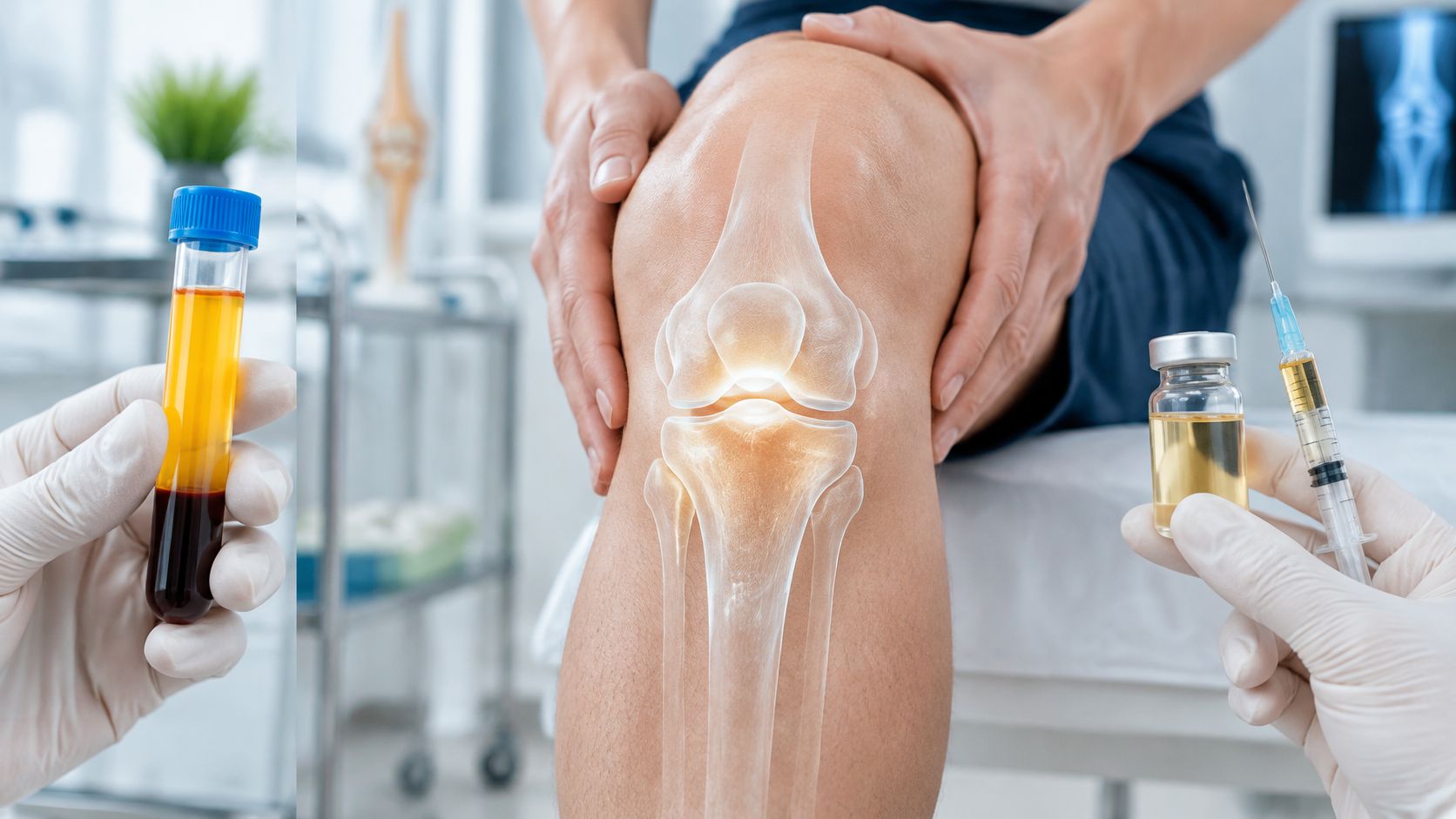
If two injections are described as regenerative, does that mean either is appropriate for the same painful joint or tendon? Prolotherapy and PRP aren't interchangeable, and the diagnosis matters more than the label.
For adults considering care in Scottsdale or the greater Phoenix area, the useful question isn't which injection sounds more advanced. It's whether a particular preparation, delivered to a particular tissue, has credible evidence for a meaningful outcome, alongside rehabilitation and appropriate conventional care.
Table of Contents
- Which Injection Fits Which Diagnosis
- How Prolotherapy and PRP Differ
- What Studies Report at Six to Twelve Months
- What the Visit and Recovery Involve
- Applying the Evidence to Knees, Tendons, and Spine
- Risks Limits and Reasons to Pause
- Adjunctive Use Alongside Cancer and Systemic Care
- Decide Whether a Scottsdale Consultation Fits
Which Injection Fits Which Diagnosis
Could the same injection suit knee arthritis and a tendon problem? The answer depends on the diagnosis, the tissue being treated, and the evidence for that specific use. Rehabilitation or no injection may be the more reasonable next step.
Prolotherapy and PRP by common diagnosis
| Diagnosis | Stronger question to ask | What reviews suggest | Do not expect |
|---|---|---|---|
| Knee osteoarthritis | PRP versus rehabilitation and other injections | PRP reduced pain versus placebo at six months; one review found dextrose less effective than PRP for pain and function | Cartilage restoration or a substitute for standard osteoarthritis care |
| Lateral epicondylitis | Structured rehabilitation first; PRP isn't automatic | A 2025 review of PRP evidence covering 10 trials found no meaningful PRP pain or function advantage | That beating a steroid proves the injection works |
| Rotator-cuff tendinopathy | Prolotherapy as a possible adjunct | A systematic review of sports-related tendinopathy found prolotherapy superior or equivalent to control in 83% of studies involving lateral epicondylitis or rotator-cuff tendinopathy combined | Benefit when a significant tear needs surgical assessment |
| Plantar fasciitis, Osgood-Schlatter disease, or Achilles tendinosis | Diagnosis and tear severity before any injection | The same systematic review of sports-related tendinopathy found prolotherapy superior or equivalent in 88% of studies involving these conditions | The same result for every tendon |
| Chronic musculoskeletal pain | Dextrose prolotherapy versus saline or exercise | A review of prolotherapy evidence reported pain standardized mean differences of approximately −0.44 versus saline and −0.42 versus exercise at six to twelve months | Universal regeneration for every chronic illness |
Knee osteoarthritis and tendon disorders need separate evaluation
Knee osteoarthritis and tendon disorders involve different tissues and require diagnosis-specific interpretation. The 2025 review of PRP evidence describes benefits in selected knee osteoarthritis populations, while evidence from 10 randomized trials found no meaningful pain or functional advantage for lateral epicondylitis.
A result in the knee does not establish effectiveness at the elbow. The injection may use the patient's blood in both cases, but PRP products are not interchangeable, and the diagnosis and treatment target differ.
The prolotherapy percentages describe how study findings compared with controls. They do not mean that the same percentage of patients improved, or predict an individual's outcome. The studies grouped different diagnoses and injection targets, so their results should not be read as one general success rate.
Practical rule: Match the diagnosis first, then examine the comparison treatment and the outcome being measured.
Improvement after an injection does not by itself show what caused the change. Rehabilitation, the natural course of the condition, and regression to the mean, when unusually severe symptoms return toward their usual level, may also contribute. A useful decision starts with the relevant diagnosis and the treatment options suited to it.
How Prolotherapy and PRP Differ
Could two injections offered for the same shoulder pain work in different ways? The answer depends partly on what tissue the clinician is targeting: a joint, a tendon attachment, or another structure.
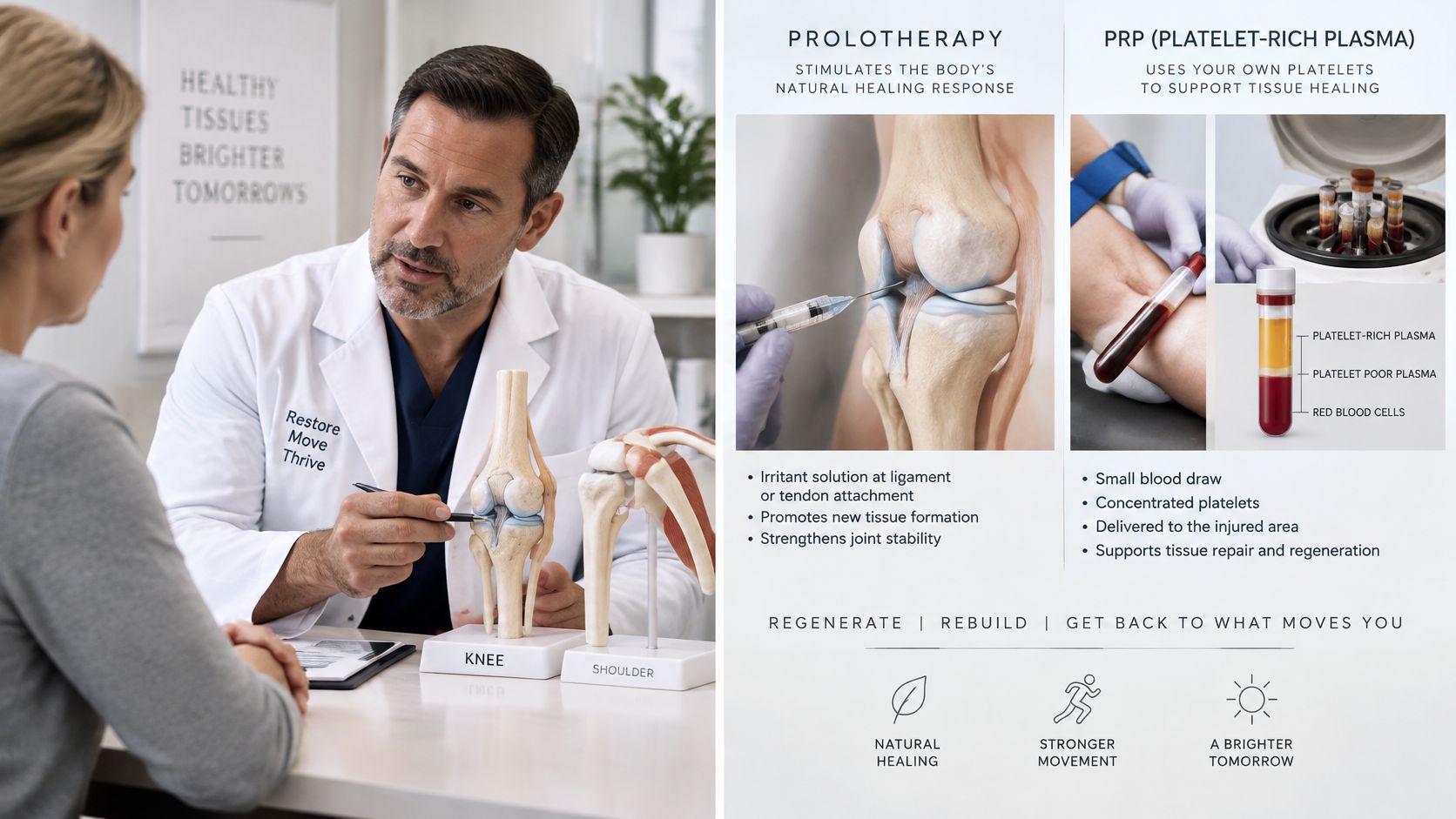
Dextrose and a proposed local response
Prolotherapy is a clinician-directed injection, often using hypertonic dextrose, into a joint area, ligament, or tendon attachment. Hypertonic means the solution is more concentrated than surrounding body fluids.
A systematic review of sports-related tendinopathy describes a proposed sequence: a controlled local injury signal may increase platelet-derived growth factor expression and activate signaling involved in collagen remodeling. These processes are biologically plausible, but they do not establish that an injection repairs a particular person's tissue.
The same review reports prolotherapy as superior or equivalent to control in 83% of studies involving lateral epicondylitis or rotator-cuff tendinopathy and 88% involving plantar fasciitis, Osgood-Schlatter disease, or Achilles tendinosis. These percentages describe study findings, not the share of patients who improved. They support considering the treatment for selected diagnoses, not using it as a universal option.
PRP preparation varies
PRP begins with a patient's blood, which is processed to concentrate platelets. The resulting preparation depends on how the blood is handled, including the anticoagulant and centrifugation protocol used. Those choices can affect the platelet concentration and the other cells retained, so PRP is a preparation-dependent product rather than one standardized medicine.
Leukocyte-rich PRP retains more white blood cells, while leukocyte-poor PRP contains fewer. Neither label alone shows which preparation is appropriate for an individual diagnosis. A clinical overview of platelet-rich plasma benefits can provide context for a discussion, while proposed effects should remain distinct from demonstrated outcomes.
Prolotherapy's modern development is associated with George Hackett's work during the 1950s. A clinical review of prolotherapy reports that its first randomized controlled trial was published in 1987. A long history of use and rigorous clinical evidence are different measures.
For either injection, ask what the preparation contains and which tissue it is intended to reach. The answer helps connect the proposed treatment to the diagnosis, while evidence remains specific to the condition and comparison used.
What Studies Report at Six to Twelve Months
What counts as improvement depends on the diagnosis and the outcome being measured. Pain relief, better function, and structural repair are separate findings. A statistically significant change in a pain score does not show that cartilage has regrown or predict how much relief an individual will experience.
Read the result with its comparator
Key reported results by condition and comparator
| Condition | Comparison | Time point | Reported result | Evidence base |
|---|---|---|---|---|
| Knee osteoarthritis | PRP versus placebo | Six months | Pain mean difference −2.45 for a single injection and −2.07 for double injections, both p < 0.00001 | 2015 systematic review and meta-analysis, limited-to-moderate evidence quality |
| Knee osteoarthritis | PRP versus hyaluronic acid | Six and twelve months | No significant overall clinical difference, p = 0.069 and p = 0.188; pain favored PRP, p = 0.001 at both | Review of 12 controlled studies involving 1,248 cases |
| Knee osteoarthritis | PRP across protocols | Approximately three to twelve months | Improvements reported in pain, function, stiffness, activity, and quality of life | 2024 review of systematic reviews and meta-analyses |
| Chronic musculoskeletal pain | Dextrose prolotherapy versus saline | Six to twelve months | Less pain, standardized mean difference −0.44 | Systematic-review evidence summarized in a prolotherapy review, 10 randomized trials involving 750 participants |
| Chronic musculoskeletal pain | Dextrose prolotherapy versus exercise | Six to twelve months | Less pain, standardized mean difference −0.42 | Same 10-trial evidence base |
| Sports-related tendinopathy | Prolotherapy versus comparator | Study-specific follow-up | Superior for all outcomes in 25%, selected outcomes in 30%, equivalent in 30%, inferior in 15% | 2024 systematic review, 20 randomized trials, 1,136 patients |
| Lateral epicondylitis and rotator-cuff tendinopathy | Prolotherapy versus control | Study-specific follow-up | Superior or as effective as control in 83% of studies | 2024 systematic review |
| Plantar fasciitis, Osgood-Schlatter disease, Achilles tendinosis | Prolotherapy versus control | Study-specific follow-up | Superior or as effective as control in 88% of studies | 2024 systematic review |
| Lateral epicondylitis | PRP versus placebo or control | Study-specific follow-up | No meaningful pain or function advantage | 2025 review of 10 randomized trials, moderate certainty |
The comparison group shapes what a result means. PRP's reported advantage over placebo in knee osteoarthritis supports considering it for pain, while concerns about risk of bias limit confidence. The mean differences are changes on study outcome measures, not percentages of recovery.
Results also differ by comparator. In the knee studies comparing PRP with hyaluronic acid, pain favored PRP, while broader clinical outcomes did not differ significantly. A person may value pain relief for daily activities, but that finding does not demonstrate joint restoration.
Reading mean differences for an individual patient
Standardized mean differences let researchers combine pain measures that use different scales. The dextrose results indicate a modest average difference versus saline or exercise across the reviewed studies. They do not predict whether treatment will outperform a particular person's exercise program.
Evidence is diagnosis-specific. A result against saline or corticosteroid does not by itself establish benefit over placebo or rehabilitation, and PRP preparations are not interchangeable. Differences in preparation and study design matter when applying a group result to an individual.
For expectations between appointments, planning your prolotherapy recovery offers a discussion starting point. Recovery guidance should still reflect the injection site and the treating clinician's plan.
Prolozone is a distinct procedure, so findings for dextrose prolotherapy or PRP should not be assumed to apply to it. The Prolozone therapy research overview discusses that separate evidence base.
What the Visit and Recovery Involve
A useful injection visit begins with a diagnosis and ends with a plan for activity, monitoring, and follow-up. It shouldn't end with an unexplained recommendation to repeat treatment.
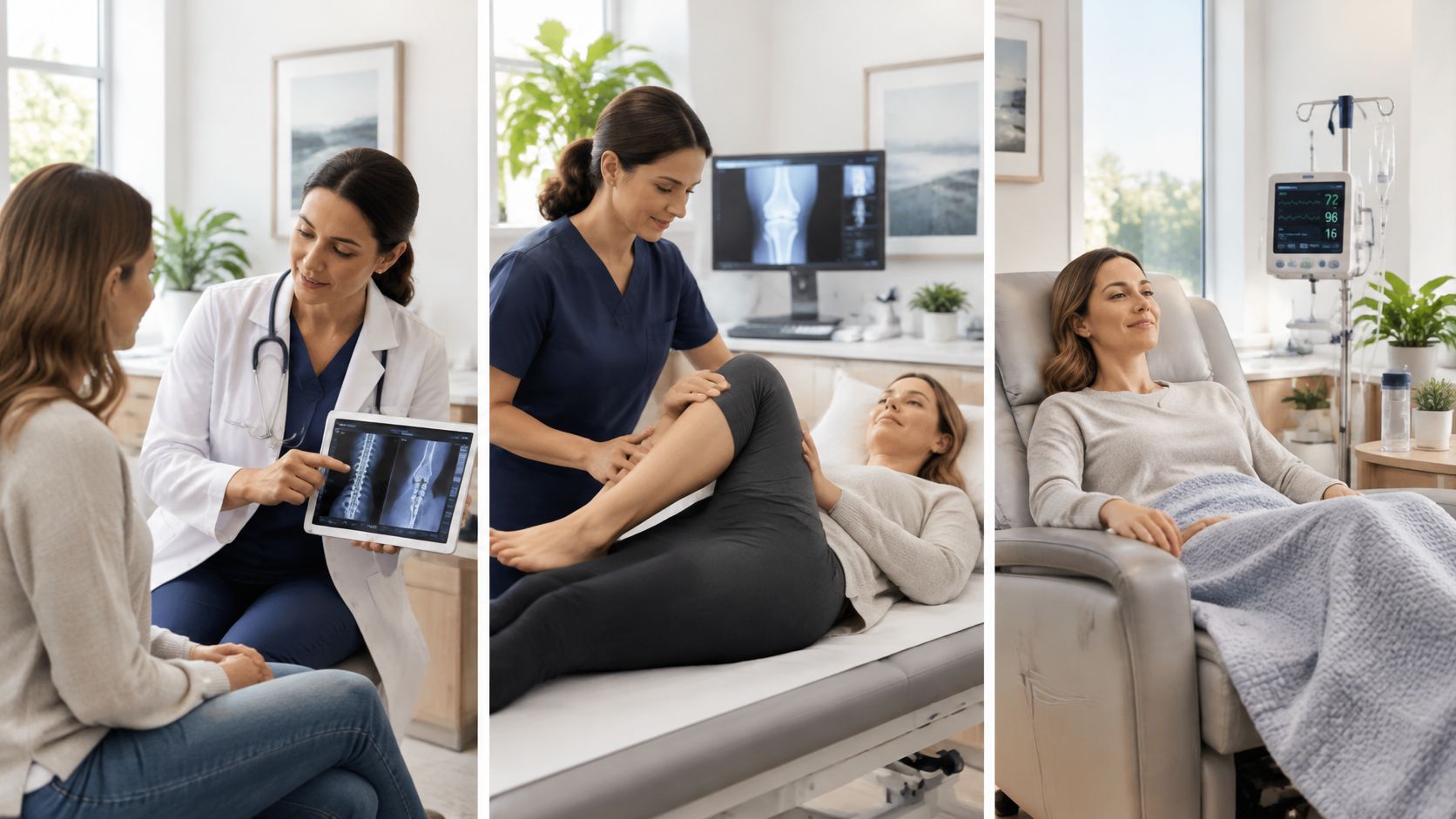
A clinician-directed sequence
- Confirm the pain source. History and examination help distinguish joint disease from tendon injury or referred pain. Imaging or other evaluation may be needed when a tear, fracture, infection, or inflammatory disorder is possible.
- Review medical risks. The clinician should review medicines, bleeding history, pregnancy, infection, allergies, and recent steroid injections. Patients shouldn't stop prescribed medication independently.
- Identify the preparation. PRP requires a blood draw and centrifugation. Documentation should identify platelet enrichment, white-cell content, red-cell contamination, anticoagulant, activation, injection volume, and intended target.
- Perform the injection with appropriate technique. Skin preparation and accurate targeting matter. Ultrasound guidance may be appropriate for some structures, but it doesn't make an ineffective treatment effective.
- Provide observation and written aftercare. Instructions should explain expected symptoms, activity restrictions, whom to contact, and which changes need prompt assessment.
- Coordinate rehabilitation. The plan should specify how movement and loading will resume rather than treating the injection as the entire intervention.
- Set a reassessment point. Pain and function should be measured against an agreed baseline. An unchanged outcome should trigger reconsideration rather than automatic continuation of a series.
Why the preparation record matters
A review of PRP preparation and clinical applications documents differences in blood volume, centrifugation, cell composition, activation, and treatment schedules. It also describes broadly similar short- to mid-term osteoarthritis outcomes with leukocyte-rich and leukocyte-poor preparations, without consistent evidence that adding white cells improves benefit.
That means two clinics can use the term PRP while delivering biologically different products. More concentrated isn't automatically more appropriate, and a preparation should be evaluated as a complete protocol.
The platelet-rich plasma protocol overview can support preparation for a clinical discussion. Important questions include how many injections are proposed, why that schedule was chosen, and what would justify stopping.
A recovery plan should name the next activity milestone and the next clinical checkpoint, not promise a fixed date for tissue healing.
Study follow-up windows aren't instructions to wait indefinitely. New or worsening symptoms deserve assessment even when a longer-term outcome review is already scheduled.
Applying the Evidence to Knees, Tendons, and Spine
An adult with confirmed knee osteoarthritis and limited walking is a clear case for discussing whether PRP fits. The decision depends on the person's goals, prior care, and diagnosis, not on the presence of joint pain.
A knee-pain decision
If walking remains limited despite appropriate exercise and weight management when relevant, PRP may be discussed for symptom relief, with uncertainty made clear. A practical goal could be completing a usual neighborhood walk with less pain, rather than expecting a new joint surface.
Footwear and activity planning also matter. The guide to how cushioning affects knee discomfort offers practical context, but cushioning does not establish that shoes treat osteoarthritis. For a broader look at joint symptoms and evaluation, see this chronic joint pain evaluation overview.
Evidence must be matched to the diagnosis and comparison used. A result favoring PRP over corticosteroid or saline does not establish that PRP is better than placebo or rehabilitation. PRP preparations also differ, so findings from one product or protocol cannot automatically be applied to another.
An elbow or Achilles decision
With lateral elbow pain, first confirm the tendon diagnosis and review progressive strengthening, work demands, and tolerance for loading. An injection should not substitute for an incomplete rehabilitation program because symptoms have lasted a long time.
Prolotherapy may be considered for selected tendon problems, but favorable findings across mixed trials do not show that it suits every elbow condition. The decision also depends on whether pain comes from the tendon and whether a substantial tear changes management.
Achilles and patellar symptoms need similar assessment. Sudden loss of function, suspected rupture, or imaging that shows a significant tear may call for orthopedic evaluation rather than another injection.
A spine-pain decision
For low-back pain, uncontrolled case reports and case series cannot reliably distinguish a treatment effect from other reasons for improvement. That limitation makes diagnosis and study design especially important when considering prolotherapy for the spine.
A person with back pain needs an assessment of the likely pain source, neurologic findings, prior treatment, and suitability for rehabilitation or specialty care. Across knee, tendon, and spine conditions, the central question is whether the proposed treatment matches the diagnosis and the patient's goals.
Risks Limits and Reasons to Pause
Autologous blood use still carries procedural and clinical risk. Preparation, the injection itself, any additives, and a patient's medical circumstances all shape the risk discussion. PRP products also vary, so findings from one preparation cannot automatically be applied to another.
Reported short-term effects to discuss
These published comparisons describe selected studies, not a complete risk list or a forecast for every treatment site.
| Finding | PRP or prolotherapy | Comparison | Patient meaning |
|---|---|---|---|
| Any complication in foot and ankle studies (2025 foot and ankle safety synthesis) | 41.1% | 33.7% | Additional short-term problems were reported; the estimated number needed to harm was 13 |
| Post-injection pain in those studies (2025 foot and ankle safety synthesis) | 15.1% | 10.2% | Soreness was reported more often than with the comparison |
| Bruising in one knee dextrose trial (systematic review of knee osteoarthritis trials) | 3 participants | 5 saline participants | Reported bruising was transient; uncommon harms remain uncertain |
| Single PRP versus placebo reactions | No significant difference in total short-term reactions | Placebo | No detected difference does not establish zero risk |
In the foot and ankle studies, complications were reported in 41.1% of PRP-treated participants versus 33.7% of comparison participants, and post-injection pain in 15.1% versus 10.2%. Serious events were uncommon. These figures describe those studies and should not be applied automatically to knee or shoulder injections.
For dextrose, one knee trial reported transient bruising in 3 dextrose participants and 5 saline participants. The review's studies were not large enough to define uncommon complications confidently. A result against saline or corticosteroid also does not, by itself, show benefit over placebo or rehabilitation.
When treatment should pause
Some circumstances call for assessment before an elective injection:
- Possible infection: Fever, infected skin, or an acutely hot, swollen joint needs evaluation.
- Bleeding concerns: Anticoagulants, platelet disorders, or abnormal blood counts require individualized review.
- Unreviewed medical circumstances: Pregnancy, allergy to a planned additive, or recent steroid treatment may affect suitability or timing.
- Uncertain diagnosis: A suspected tear, fracture, or inflammatory disorder needs clarification first.
The platelet-rich plasma side-effects overview can help frame questions about possible reactions. Individual risk still depends on clinical review.
Safety boundary: Fever with rapidly worsening swelling, new neurologic symptoms, chest symptoms, or pain after major trauma warrants prompt conventional assessment rather than routine injection follow-up.
Neither procedure replaces emergency care, indicated surgery, or medically necessary standard therapy.
Adjunctive Use Alongside Cancer and Systemic Care
Prolotherapy and PRP aren't established cancer treatments. The musculoskeletal evidence discussed here doesn't support using either to slow tumor growth, improve survival, or replace oncologic treatment.
A person receiving cancer treatment may still have a separate joint or tendon concern. Before considering a local procedure, the treating oncologist should help clarify whether the pain needs investigation and whether an injection is compatible with the current treatment plan.
Coordination before a local procedure
Blood counts, bleeding risk, immune suppression, medicines, and treatment timing can change candidacy. Low platelet counts or anticoagulant use shouldn't be handled through a generic injection protocol.
The same distinction applies to autoimmune disease, chronic infections such as Lyme disease, and other specialist-managed conditions. Treating a local painful structure doesn't establish treatment of the underlying systemic illness.
- Specialist agreement: The plan should identify which treating clinician has reviewed relevant risks.
- A local objective: The intended benefit should concern a specific joint or tendon function, not a claim of systemic disease control.
- Shared monitoring: Clinicians should agree on how symptoms, adverse effects, and treatment response will be assessed.
Integrative care can complement standard care when communication is clear. An elective injection shouldn't delay diagnostic evaluation, necessary medicines, or indicated oncology treatment.
Decide Whether a Scottsdale Consultation Fits
A patient may arrive with imaging, prior injection records, and a specific question: what information would help determine whether another step is appropriate? Bringing that context can make a consultation more focused. The outcome may be a treatment discussion, further investigation, rehabilitation coordination, or a recommendation against an injection.
Sunridge Medical is an integrative medical clinic in Scottsdale, Arizona, serving patients from Phoenix, the greater Arizona community, and those who travel for care. It offers regenerative medicine treatments, including platelet-rich plasma, stem cell therapy information with candidacy and limitations considered, and Prolozone therapy.
Four checks before a decision
- Bring the clinical context: Share imaging reports, rehabilitation notes, current medications, and records of previous injections.
- Describe the goal: Explain which activities or functions are limited and what change would matter to you.
- Bring relevant specialist information: Patients with cancer or complex systemic illness can bring a treatment summary and recent clinical information to support coordination with their clinicians.
- Ask about the proposed care: Discuss the rationale, preparation, schedule, risks, and how the procedure would fit alongside rehabilitation and necessary medical care.
A consultation can also help clarify what remains uncertain. Suitability depends on the diagnosis, medical risks, treatment history, and the patient's goals. Any proposed care should be coordinated with necessary conventional treatment, and no particular result can be promised.
Patients considering prolotherapy or PRP can contact the Scottsdale clinic about an individualized evaluation or second opinion. The aim is to support an informed decision, whether that means discussing a treatment or considering another course of care.
Sunridge Medical offers individualized integrative evaluation and regenerative medicine options for selected joint and tendon concerns. Patients can contact Sunridge Medical to ask about a consultation or second opinion. Treatment suitability is determined after evaluation.