


The strongest human evidence for prolozone exists for mild-to-moderate knee osteoarthritis, where randomized trials show pain and function improvements comparable to hypertonic dextrose prolotherapy. That evidence does not yet support using prolozone to treat cancer, Lyme disease, or autoimmune conditions.
Why, then, do some discussions present prolozone as though one injection protocol could address almost any chronic illness? The answer lies in a gap between promising clinical signals and established medical evidence. Patients in Scottsdale and the greater Phoenix area deserve to understand not only whether people improved in a study, but also what the researchers compared, how many participants were enrolled, whether the study was blinded, what formulation was injected, and how long outcomes were followed.
Table of Contents
- What Prolozone Therapy Research Actually Reveals
- Understanding What Prolozone Therapy Is
- Reviewing the Key Clinical Trial Evidence
- Evaluating Evidence Quality and Ozone's Added Value
- Comparing Prolozone to Alternative Conservative Options
- Safety Considerations and Route-Specific Risks
- How to Evaluate Whether Prolozone Is Right for You
What Prolozone Therapy Research Actually Reveals
What does the research show once you look past the marketing language?
The main issue in prolozone therapy research is not whether some patients report less pain after a series of injections. The more useful question is whether ozone adds measurable value beyond the rest of the procedure: the proliferant solution, the needle placement, the comparison treatment, and the natural ups and downs of musculoskeletal symptoms. That is where many patient-facing summaries become too simple.
A clinical trial works a bit like testing one ingredient in a recipe. If several ingredients change at once, it becomes hard to know which one affected the final result. In prolozone studies, that problem appears often. Sample sizes are usually modest. Blinding can be difficult or absent. Formulations vary from one protocol to another. Injection route matters too, because a periarticular injection, an intra-articular injection, and treatment near ligaments or tendons do not answer the same safety or effectiveness question.
So the fairest conclusion is measured rather than dramatic. Prolozone appears to be an emerging, investigational or adjunctive symptom-management approach with the most relevant human evidence in musculoskeletal pain, especially selected cases of mild-to-moderate knee osteoarthritis. An early randomized trial comparing ozone prolotherapy with hypertonic dextrose prolotherapy illustrates why design details matter, as the detailed trial breakdown below shows. That is more useful than asking whether prolozone "works" in the abstract.
Patients in Scottsdale often do better with a practical framework. Ask what exact mixture was injected, what condition it was used for, whether the study compared it with an active treatment, and whether the injection route matches your diagnosis. Those details often determine whether a study is relevant to your case.
It also helps to separate human treatment evidence from discussion of laboratory materials or other “regenerative” products. Bulk Aussie Peptides research peptides is a separate resource, not proof that prolozone is safe or effective for any specific diagnosis. For a broader evidence-based framework, this clinical guide to research-based alternative medicine offers useful context.
Understanding What Prolozone Therapy Is
Prolozone therapy is best understood as an ozone-based form of prolotherapy. Traditional prolotherapy commonly uses a hypertonic solution, often dextrose, injected near painful or damaged connective tissue. The intended effect is a localized irritant or proliferant stimulus that may encourage a healing response. Prolozone adds an ozone component, but formulations and protocols can differ.
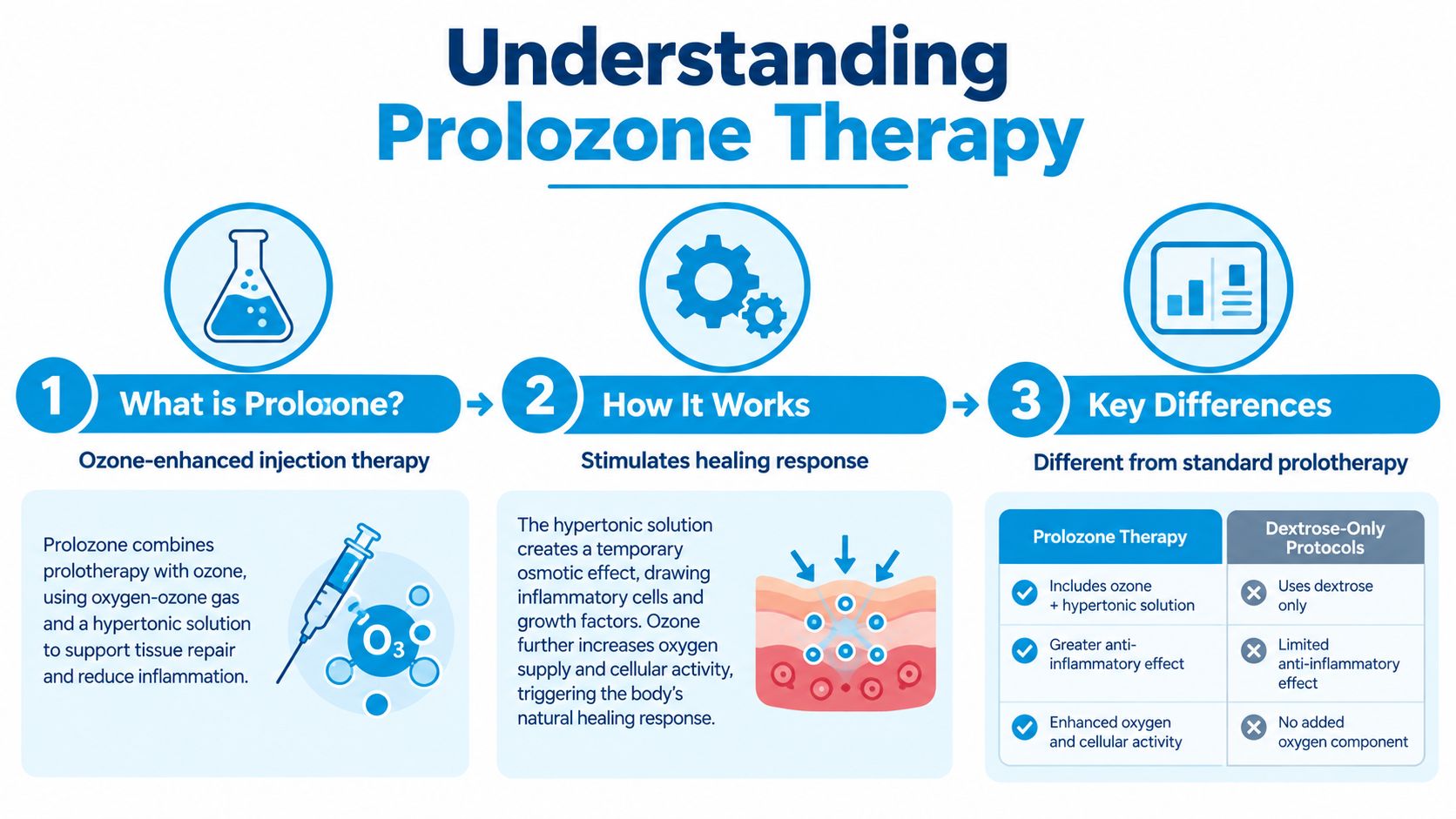
A simple analogy is to think of the injection as a signal rather than a replacement part. The solution doesn't rebuild cartilage in the way a mechanic replaces a worn component. Instead, the proposed goal is to alter the local environment and stimulate tissue responses that might reduce pain or improve function. Ozone has also been proposed to influence inflammatory and oxidative processes, but a proposed mechanism isn't the same as proof of a clinical outcome.
Formulation changes the meaning of a study
A trial may study ozone plus saline, ozone plus dextrose, or a mixture that also contains other agents. Those aren't interchangeable interventions. One randomized trial evaluated 10 mL hypertonic dextrose plus 4 IU somatropin, with or without 10 mL ozone at 25 mcg, so its findings concern a multimodal injection rather than ozone alone. The full report illustrates why patients should ask exactly what will be injected.
The route matters just as much. A localized injection into or around a joint has a different risk profile from a systemic procedure involving blood handling. Calling both “ozone therapy” hides clinically important differences in equipment, training, monitoring, and possible complications.
For that reason, a consultation should identify the diagnosis, injection site, image-guidance plan, exact ingredients, concentration, route, and follow-up measures. Without those details, “prolozone” describes a broad category rather than a standardized treatment.
Reviewing the Key Clinical Trial Evidence
What do these trials test, and what do they leave unanswered?
The 2015 ozone versus dextrose trial
One randomized clinical trial published in 2015 studied 80 adults aged 40 to 75 with mild-to-moderate medial-compartment knee osteoarthritis, defined as Kellgren-Lawrence grades I or II. Researchers assigned 40 participants to intra-articular ozone prolotherapy and 40 to hypertonic dextrose prolotherapy, with three injections at 10-day intervals. The PubMed record and the full clinical report show statistically significant improvement within each group in pain and WOMAC function, with P < 0.001 for those within-group changes.
The harder question is the one patients usually care about. Did ozone outperform another active injection? In this study, it did not. The between-group comparison showed no statistically significant difference in pain relief or functional improvement. That matters because a positive before-and-after change can reflect several things, including the injection process itself, regression toward the mean, or benefit shared by both treatments.
The sample size also limits confidence. With only 40 patients per arm, the study can suggest signal, but it cannot settle the question of superiority.
Ozone plus saline versus saline
A second randomized trial approached the same problem from a different angle. It included 34 analyzed participants with painful primary knee osteoarthritis. Although 38 people were randomized, four withdrew for personal reasons, leaving 15 in the ozone-plus-saline group and 19 in the saline control group. Follow-up covered four weeks, using the Oxford Knee Scale, WOMAC, and visual-analog pain scores. The study report found improvement over time in both groups, but the between-group p-value was 0.734 for changes in visual-analog pain and Oxford Knee Score. WOMAC domains improved as well, again without significant differences between groups.
This is a useful reality check. If both groups improve and separate poorly, the study supports the possibility that injection-related effects are doing much of the work, or that any added ozone effect is too small for this trial to detect.
The multimodal injection study
A third trial is often cited as stronger support, but its design needs careful reading. In a randomized single-blinded controlled study of 60 adults with chronic knee osteoarthritis and Kellgren-Lawrence grades 1 through 3, participants received either hypertonic dextrose plus somatropin or the same mixture with ozone. At 16 weeks, the comparator group's mean WOMAC score fell from 64.9 ± 10.6 to 49.2 ± 9.0, while the ozone-containing protocol showed greater improvement in pain, stiffness, and function. The trial publication supports interest in that specific combination, not in every treatment labeled prolozone.
For patients exploring ozone therapy in Scottsdale, the practical takeaway is straightforward. Ask which ingredients are being used, what route is planned, whether imaging guides placement, and which condition the protocol is meant to match. Across these trials, differences in injectate, comparator, blinding, outcome scales, and follow-up are large enough that simple averaging would blur more than it clarifies.
Evaluating Evidence Quality and Ozone's Added Value
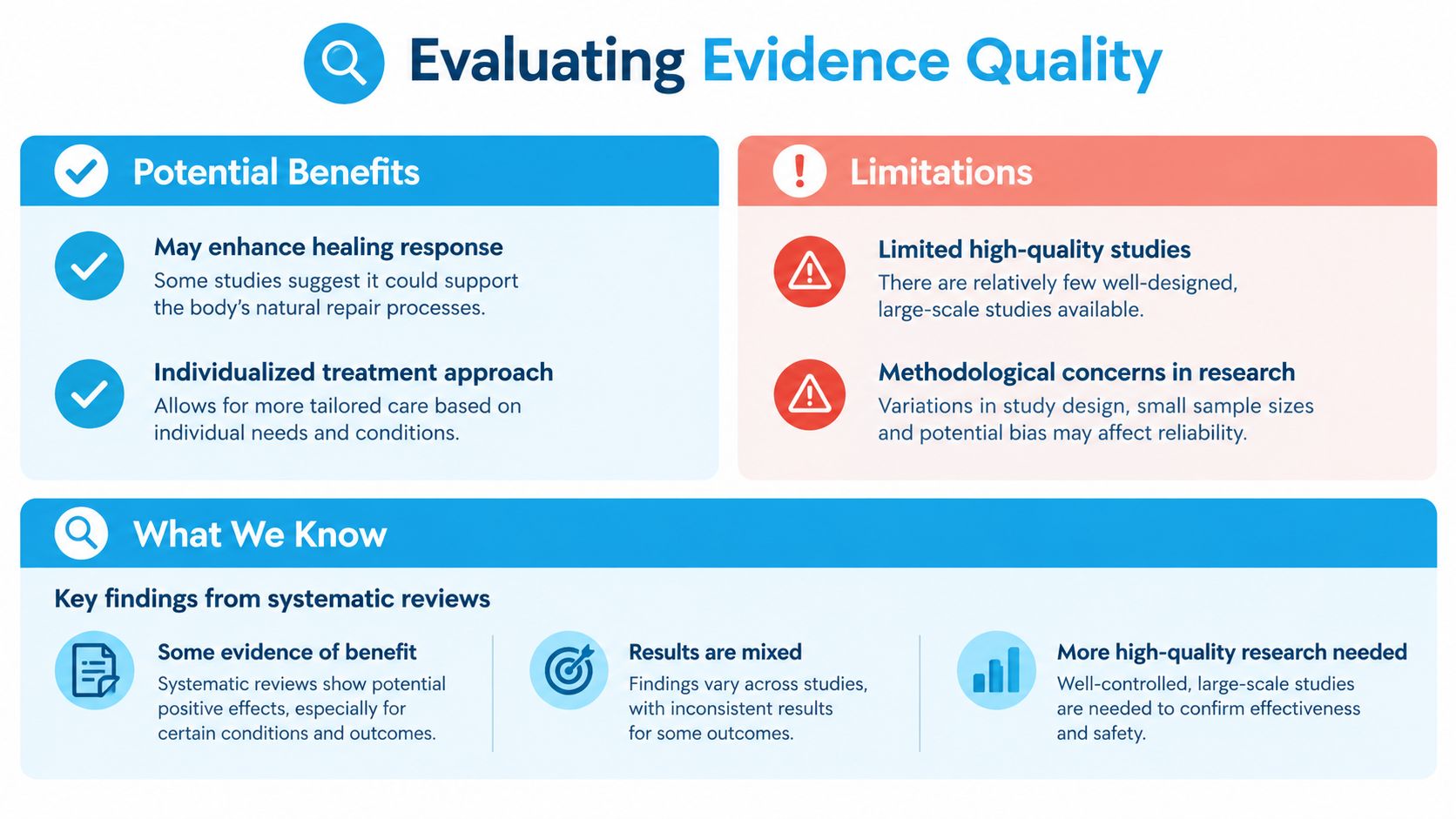
A positive result becomes more useful when it survives comparison with other explanations. In prolozone research, the recurring uncertainty is whether ozone adds clinically meaningful benefit beyond the proliferant or injection process.
A 2021 systematic review and meta-analysis of dextrose prolotherapy for knee osteoarthritis included 11 studies published from 2000 through 2020, representing 837 patients. Individual study sizes ranged from 31 to 120 participants. Across the reviewed evidence, prolotherapy wasn't significantly different from platelet-rich plasma on the pain subscale at six months. The review therefore supports a cautious interpretation of apparent benefit, because improvement may not be unique to ozone-containing protocols.
A 2024 review characterized the randomized trial literature as generally having subpar methodological quality. An umbrella review found ozone comparable with other therapies in one review and not superior in five others. These findings don't prove that prolozone never helps. They do show why individual positive trials shouldn't be treated as proof of durable, disease-modifying benefit. Readers interested in how researchers assess bodies of literature can consult this overview of literature review methods, while keeping in mind that methodology education isn't clinical evidence for prolozone itself.
Symptom relief isn't disease modification
Pain scores and WOMAC function scores tell us how participants felt and moved during the study period. They don't automatically demonstrate cartilage restoration, prevention of osteoarthritis progression, or a lasting change in the disease process. The current trials don't establish that prolozone modifies joint structure or replaces established knee-osteoarthritis care.
A practical evidence hierarchy helps:
- Clinical signal: Participants report less pain or better function.
- Comparative value: The treatment outperforms a credible alternative.
- Durability: Benefits persist over meaningful follow-up.
- Disease modification: Objective disease progression changes.
Prolozone has a clinical signal in selected knee studies. The evidence is much less conclusive for the other questions. A careful discussion of oxidative approaches should therefore distinguish biological rationale from demonstrated outcomes, as outlined in this clinical guide to oxidative therapy.
Comparing Prolozone to Alternative Conservative Options
Prolozone makes more sense when viewed as one possible component of conservative care, not as an isolated solution. Dextrose prolotherapy uses a proliferant without ozone. Platelet-rich plasma uses a preparation derived from the patient's blood. Hyaluronic acid aims to alter joint lubrication and symptoms, while physical therapy targets strength, mobility, load tolerance, and daily function.
The evidence doesn't support a universal winner. In the reviewed knee research, dextrose prolotherapy and prolozone produced comparable improvements in one randomized comparison, while ozone plus hypertonic saline didn't demonstrate superiority over saline in another. The broader systematic review found no significant six-month pain difference between prolotherapy and platelet-rich plasma. Those results make treatment selection a matter of diagnosis, goals, risk tolerance, availability, and clinician judgment.
| Option | What it is intended to do | Evidence interpretation | Practical question |
|---|---|---|---|
| Prolozone | Combine ozone with a proliferant-based injection | Emerging evidence, with uncertain added value from ozone | What exact formulation and route are proposed? |
| Dextrose prolotherapy | Use a hypertonic proliferant to stimulate a local response | Directly compared with ozone in knee osteoarthritis, with comparable reported improvement | Would a simpler protocol address the same goal? |
| Platelet-rich plasma | Deliver a concentrated blood-derived preparation | Included as a comparator in broader prolotherapy evidence | What preparation and outcome measure will be used? |
| Hyaluronic acid | Provide an intra-articular conservative injection option | Not directly established by the cited prolozone trials | How does it fit the patient's diagnosis and alternatives? |
| Physical therapy | Improve strength, movement, and load management | A noninjection approach that can address function directly | Has a structured rehabilitation plan been attempted or optimized? |
Cost can vary substantially by clinic, formulation, imaging, number of visits, and insurance coverage, so patients should request a written estimate rather than assume one protocol's expense. The meaningful comparison is not injection versus injection alone. It's whether a proposed intervention has a clear target, measurable outcome, acceptable risk, and a plan if it doesn't help.
Safety Considerations and Route-Specific Risks
“Natural” doesn't mean risk-free, and “low risk” isn't a sufficient safety assessment. Patients should first ask whether the proposed treatment is localized or systemic, because route, equipment, sterility, and monitoring can change the risk profile.

Localized injections may involve procedure-related pain, bleeding, infection, tissue injury, or an unexpected response. Reviews describe more serious complications, including gas embolism and bloodborne infection, particularly in systemic blood-handling ozone procedures. Rare but potentially severe events reported in the broader safety literature include stroke, myocardial infarction, thrombosis, and hemolysis. The recent evidence review also reports very low overall evidence quality, limited systematic safety monitoring, and a lack of long-term safety data.
That doesn't mean every local knee injection carries the same risk as a systemic blood-handling procedure. It means patients need route-specific information rather than a single general reassurance.
Questions that improve procedural safety
Ask the clinician:
- Route: Is the treatment intra-articular, periarticular, spinal, intravenous, or blood-handling?
- Preparation: What equipment, concentration, volume, and additional ingredients will be used?
- Guidance: Will imaging guide placement when the anatomy or injection site requires it?
- Sterility: How are the solution, supplies, and injection field handled?
- Monitoring: Which symptoms require immediate attention, and who should be contacted?
- Suitability: How do cancer, anticoagulant use, infection risk, vascular disease, pregnancy, or complex comorbidities affect the decision?
Patients should seek urgent medical evaluation for sudden neurological symptoms, chest pain, severe shortness of breath, fainting, rapidly worsening swelling, or signs of serious infection after a procedure. For a plain-language discussion of possible adverse effects and warning signs, review ozone therapy side effects.
A useful educational overview can supplement, but never replace, a clinician's assessment:
How to Evaluate Whether Prolozone Is Right for You
A sound decision begins before the injection. First, confirm the diagnosis and the treatment target. Knee pain can arise from osteoarthritis, meniscal disease, ligament injury, inflammatory arthritis, referred pain, infection, or another condition that needs a different evaluation.
Next, ask for a protocol specific enough to evaluate. “Prolozone” isn't one uniform recipe, so the clinician should explain the exact injectate, dose, route, imaging plan, number of sessions, spacing between visits, expected response window, and potential alternatives.
Questions to bring to a consultation
- What diagnosis are we treating, and how certain is it? Ask what examination, imaging, or laboratory information supports the diagnosis.
- What precisely will be injected? Request the ingredients, concentration, volume, and whether other agents are included.
- What evidence applies to my condition? The strongest human evidence discussed here concerns selected knee osteoarthritis, not cancer, Lyme disease, autoimmune illness, or complex systemic disease.
- How will improvement be measured? A baseline pain score, functional assessment, or validated tool such as WOMAC can make the decision less dependent on memory.
- When will we reassess? Agree in advance on the follow-up interval and what counts as meaningful improvement.
- What happens if it doesn't work? A responsible plan includes discontinuation criteria and other conservative, conventional, rehabilitative, or specialist options.
The most honest interpretation is that evidence is mixed on whether ozone itself adds clinically meaningful benefit beyond the proliferant. Positive findings in individual studies shouldn't be treated as proof of a durable or disease-modifying effect. For a patient considering prolozone, an evidence-informed consultation should clarify the diagnosis, treatment alternatives, outcome measures, and the uncertainty surrounding long-term effectiveness. The broader review literature supports that measured approach.
For patients in Scottsdale, Phoenix, Paradise Valley, Tempe, Mesa, Chandler, Gilbert, and the greater Phoenix metropolitan area, an individualized evaluation can place prolozone in the context of the complete medical picture. Sunridge Medical offers integrative assessment and treatment planning that may coordinate conventional care with selected complementary or regenerative approaches, depending on the diagnosis, medical history, goals, and safety considerations.
If you're considering prolozone therapy, contact Sunridge Medical in Scottsdale to discuss your diagnosis, prior treatments, medication history, and appropriate alternatives with a qualified medical team. A consultation can help determine whether an evidence-informed evaluation is appropriate and establish clear goals and safety criteria before treatment.