

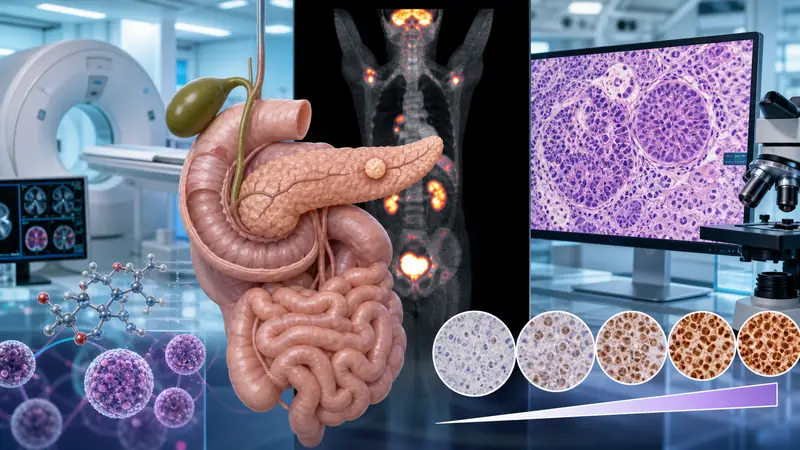
Neuroendocrine Tumor and Neuroendocrine Carcinoma Are Not Interchangeable
Well-differentiated neuroendocrine tumors, or NETs, often retain the structure and receptor biology of normal neuroendocrine cells. They may grow slowly for years, although some behave more aggressively. Poorly differentiated neuroendocrine carcinomas, or NECs, include small-cell and large-cell forms that usually grow quickly and are commonly treated with platinum-based chemotherapy. A grade 3 well-differentiated NET is biologically different from a poorly differentiated NEC even though both have high proliferation.
Primary site also matters. NETs can arise in the small bowel, appendix, rectum, stomach, pancreas, lung and other organs. Pheochromocytoma and paraganglioma form a related but distinct group with specific biochemical, genetic and safety requirements. Medullary thyroid cancer, Merkel-cell carcinoma and small-cell lung cancer also require their own disease-specific pathways.
Grade 1, 2 or 3
Ki-67 index, mitotic rate, primary site, somatostatin-receptor expression, growth rate and disease volume help determine whether observation, surgery or systemic therapy is appropriate.
Small-Cell or Large-Cell Biology
These cancers can progress rapidly. Expert pathology and prompt systemic treatment are important; an indolent NET plan should not be applied to NEC.
Hormone-Related Syndromes
Carcinoid syndrome, insulin excess, gastrin excess, glucagon, VIP or catecholamine secretion can create serious symptoms independent of tumor size.
Symptoms From Tumor Location or Burden
Pain, obstruction, bleeding, weight loss or liver-related symptoms may occur even without a measurable hormone syndrome.
Grade, Receptors and Disease Pace Guide the Sequence
Pathology should document differentiation, morphology, mitotic rate and Ki-67 proliferation index. Immunostains such as synaptophysin, chromogranin and INSM1 may support neuroendocrine differentiation, while site-directed markers can help identify the primary. When behavior changes unexpectedly, expert pathology review or a new biopsy may clarify whether grade or biology has changed.
Contrast CT or MRI defines anatomy and liver involvement. Somatostatin-receptor PET/CT—often with gallium-68 or copper-64 DOTATATE—shows whether tumor cells express receptors that may respond to somatostatin analogues or peptide-receptor radionuclide therapy. FDG PET can add information in higher-grade or more aggressive disease. Biochemical testing should be chosen for the suspected syndrome rather than ordering nonspecific markers without context.
Symptoms Can Be Biologically Active Even When Imaging Looks Stable
Flushing, diarrhea, wheezing, low blood sugar, severe ulcers, watery diarrhea or episodic hypertension deserve targeted evaluation. Treating the hormone syndrome can improve safety, nutrition and quality of life while the cancer-directed plan is being built.
Surgery, Hormone Control, Targeted Therapy, PRRT and Chemotherapy Can All Have Roles
Surgery can be curative for localized disease and may remain useful for selected liver-dominant or symptom-producing tumors. Somatostatin analogues such as octreotide or lanreotide can control hormone symptoms and slow growth in receptor-positive well-differentiated NETs. Peptide-receptor radionuclide therapy with lutetium-177 dotatate delivers targeted radiation to somatostatin-receptor-positive cells.
Other options may include everolimus, sunitinib for pancreatic NET, cabozantinib after prior therapy, capecitabine-temozolomide or other chemotherapy, liver-directed embolization or ablation, external radiation and clinical trials. Telotristat may help refractory carcinoid-syndrome diarrhea. Poorly differentiated NEC is commonly treated with platinum plus etoposide or another aggressive-cancer regimen rather than a typical low-grade NET sequence.
Localized or Resectable
Clarify the primary site, grade, hormone function, lymph nodes, surgical risk and whether inherited-syndrome testing is indicated.
Receptor-Positive Advanced NET
Consider somatostatin analogues, PRRT and other systemic or liver-directed strategies based on symptoms, growth and organ function.
Pancreatic NET
Options may include surgery, somatostatin analogues, everolimus, sunitinib, cabozantinib, chemotherapy, PRRT and liver-directed treatment.
High-Grade or Poorly Differentiated
Re-review pathology, consider FDG imaging and act promptly because chemotherapy and clinical-trial choices differ from indolent NET care.
Protect Nutrition, Muscle and Daily Function Over a Long Treatment Journey

An individualized integrative plan may address:
- Protein, calories, hydration and weight stability
- Diarrhea, flushing, bloating and food-trigger patterns
- Pancreatic-enzyme needs and fat-soluble vitamin status
- Niacin and other deficiencies associated with carcinoid syndrome
- Safe aerobic and resistance activity for muscle and fatigue
- Sleep, anxiety, mood and living with a chronic cancer
- Recovery around surgery, PRRT or liver-directed therapy
- Every herb, extract, vitamin and supplement being used
Natural and supportive care can be active, practical and hopeful. A tailored eating plan, adequate protein and energy, symptom-guided hydration, appropriately dosed exercise, sleep support, mindfulness and acupuncture for selected symptoms may help people preserve strength and quality of life. Restrictive “anticancer” diets can worsen weight loss, diarrhea or nutrient deficiency and should not be assumed to fit every NET syndrome.
Natural Products Must Fit the Treatment, Hormone Syndrome and Organ Function
Everolimus, sunitinib, cabozantinib and other oral therapies can interact with CYP3A-modifying products, grapefruit, St. John’s wort, anticoagulant botanicals and concentrated extracts. Somatostatin analogues may affect glucose, gallbladder function and digestion. PRRT requires attention to kidney protection, blood counts and radiation-safety instructions. Severe diarrhea can rapidly alter hydration and electrolytes.
Sunridge’s approach is selective: identify the syndrome and treatment, verify each product and dose, screen for metabolic, bleeding and drug-level effects, introduce changes deliberately, and monitor symptoms, blood counts, kidney and liver function, glucose, nutrition and hormone markers when appropriate.
With Carcinoid Syndrome
Track individual food and alcohol triggers without imposing a needlessly restrictive diet; monitor diarrhea, hydration, nutrition and heart symptoms.
During PRRT
Follow amino-acid kidney protection, hydration, blood-count monitoring and radiation precautions from the nuclear-medicine team.
With Oral Targeted Therapy
Review grapefruit, St. John’s wort, blood-pressure products, anticoagulant supplements and all concentrated botanical extracts.
With Hypoglycemia or Catecholamine Symptoms
Do not rely on supplements alone. Low glucose, severe headache, palpitations or extreme blood-pressure changes require condition-specific medical treatment.
What We Review
Helpful records include the primary site, pathology report and slides when available, differentiation, Ki-67 and mitotic rate, immunostains, CT or MRI reports and images, somatostatin-receptor and FDG PET findings, operative notes, liver-directed procedures, and the complete treatment timeline with response and toxicity.
Please include syndrome-specific hormone testing, CBC, kidney and liver tests, glucose, nutrition and vitamin assessments, germline testing when performed, current symptoms and every prescription, nonprescription medicine, herb and supplement. We also want to understand bowel patterns, flushing, pain, weight, appetite, sleep, activity and the goals most important to the patient.
Questions About Integrative Neuroendocrine Tumor Care
Are all neuroendocrine tumors slow growing?
No. Many well-differentiated NETs grow slowly, but some grade 3 NETs progress faster. Poorly differentiated neuroendocrine carcinomas are usually aggressive and require a different, often urgent treatment strategy.
Can Stage IV neuroendocrine cancer still be treated?
Yes. Some metastatic well-differentiated NETs can be controlled for years with surgery, somatostatin analogues, PRRT, targeted drugs, chemotherapy, liver-directed therapy and clinical trials. Prognosis varies greatly by differentiation, grade, site and disease pace.
Can natural therapies cure a neuroendocrine tumor?
No natural therapy has been proven to replace surgery or effective systemic treatment. Integrative care may support nutrition, strength, hormone-related symptoms and quality of life while we explain what is supported and what remains uncertain.
What does a positive DOTATATE PET scan mean?
It shows that lesions express somatostatin receptors. This can support diagnosis and staging and may help determine whether somatostatin analogues or PRRT are appropriate. It does not by itself determine grade or treatment sequence.
Can I come while receiving octreotide, lanreotide or PRRT?
Potentially. Many people seek integrative support during active therapy. The plan must be coordinated around hormone symptoms, treatment timing, kidney function, blood counts, nutrition, glucose and drug–supplement interactions.
Will you coordinate with my neuroendocrine specialist?
Yes. Coordination is important because pathology, receptor imaging, hormone syndromes, surgery, systemic treatment, PRRT and supportive therapies affect one another.
References
- National Cancer Institute. Gastrointestinal Neuroendocrine Tumors Treatment (PDQ®)—Health Professional Version.
- National Cancer Institute. Gastrointestinal Neuroendocrine Tumors Treatment—Patient Version.
- National Cancer Institute. Pancreatic Neuroendocrine Tumors Treatment (PDQ®).
- National Cancer Institute. Pheochromocytoma and Paraganglioma Treatment (PDQ®).
- National Cancer Institute. Neuroendocrine Tumors: Treatment in the Era of PRRT—Executive Summary.
- U.S. Food and Drug Administration. Lutetium Lu 177 dotatate prescribing information.
- U.S. Food and Drug Administration. Cabozantinib prescribing information for neuroendocrine tumors.
- Health-related quality of life in neuroendocrine neoplasia: critical review.
- Neuroendocrine tumors: comprehensive review of nutritional approaches.
- ENETS position statement on nutritional support in neuroendocrine neoplasms.
- National Cancer Institute. Cancer Therapy Interactions With Foods and Dietary Supplements (PDQ®).
This page is educational and does not replace diagnosis or treatment advice from a qualified neuroendocrine medical oncologist, endocrinologist, surgical oncologist, nuclear-medicine or multidisciplinary team. Treatment outcomes cannot be guaranteed.