


If you've just been diagnosed with cancer, or you're already in treatment and wondering whether you should add anything beyond surgery, chemotherapy, radiation, or immunotherapy, you're in the same position as many of the patients I meet. You want relief from fatigue that doesn't lift, nausea that ruins your week, anxiety that keeps you awake, and the nagging feeling that you should be doing more than showing up for the next infusion.
That instinct isn't irrational. It also doesn't mean you've lost faith in your oncologist. It means you're trying to solve the parts of cancer care that standard treatment doesn't always handle well enough for day-to-day life.
The problem is that patients often get pushed toward two very different paths. One is coordinated complementary cancer treatment that works alongside oncology care. The other is unproven “alternative” treatment that asks you to step away from oncology, delay it, or work around it. I'm strongly in favor of the first path and strongly against the second.
Table of Contents
- Why Patients Look Beyond Standard Oncology Care
- What Complementary Cancer Treatment Actually Means
- Common Modalities and Their Evidence
- Safety, Interactions, and When to Pause
- Coordinating Complementary Care With Your Oncology Team
- Inside the Sunridge Medical Integrative Model
- Questions to Ask Any Integrative Provider
- Bringing It All Together and Next Steps
Why Patients Look Beyond Standard Oncology Care
Standard oncology is built to attack the cancer. That's exactly what it should do. But many patients quickly learn that shrinking a tumor and helping a person function through treatment are related goals, not identical ones.
In practice, drivers are simple:
- Fatigue: You may be technically “responding” to treatment and still feel wiped out most of the week.
- Fear: A new diagnosis often turns every decision into a question about recurrence, progression, and whether you're missing something.
- Family pressure: Someone always has a supplement, clinic, diet, or protocol they want you to try.
- Loss of control: Cancer treatment can make you feel like things are being done to you, not with you.
A large oncology study shows just how common this is. Among 749 respondents, 83.31% had heard of or been recommended complementary and alternative medicine, and 91% used it alongside conventional treatment. The most common categories used during treatment were vitamins and minerals (56%), mind-body approaches (52%), herbs and supplements (38%), and special diets (30%). In that same study, 42% said the goal was symptom management, 30% said cancer treatment, and 15% said mental health support. Use was especially high in breast cancer (84%), prostate cancer (66%), and lung cancer (79%) according to this 2022 multi-institutional oncology study.
The motivation is reasonable. The execution matters.
Patients usually aren't looking for magic. They're looking for help. They want better recovery between cycles, fewer side effects, better sleep, less pain, and some sense that their nutrition, stress response, and resilience are being addressed too.
That's where judgment matters. If you're considering adding supportive care, a thoughtful cancer second opinion in Scottsdale can help separate what belongs in a coordinated plan from what should be avoided.
Practical rule: Wanting more support is sensible. Replacing proven oncology care with unsupported claims is where patients get hurt.
The fork in the road
The same emotional starting point can lead to wise decisions or dangerous ones. Good complementary care asks, “How can we improve tolerance, function, and quality of life while standard treatment does its job?” Bad alternative care asks, “How can we work around standard treatment?”
Those are not the same question.
What Complementary Cancer Treatment Actually Means
Here's the clean definition. Complementary cancer treatment means therapies used alongside conventional oncology care. They're added to help with symptoms, recovery, side effects, and quality of life. They are not substitutes for surgery, chemotherapy, radiation, immunotherapy, or other disease-directed treatment.
Alternative treatment means using something in place of standard cancer care. That's the line I don't want patients to cross.
The National Center for Complementary and Integrative Health is explicit: no complementary approach has been shown to cure cancer or cause remission, and delaying standard treatment can reduce the chance of remission or cure, as explained in NCCIH's guide to cancer and complementary health approaches.
Think of it as a support crew
A surgeon removes a tumor. A medical oncologist manages systemic therapy. A radiation oncologist handles local control. Complementary care is the support crew. It can help you get through treatment better, but it does not replace the people treating the cancer itself.
That distinction sounds obvious until supplements, IVs, and online protocols enter the picture. A therapy doesn't become “integrative” just because it sounds natural. It becomes part of integrative oncology only when someone with medical judgment reviews timing, dosing, interactions, and treatment phase.
If you want a deeper overview of that model, this reference on the role of integrative oncology in modern cancer care is useful background.
Coordination is what makes it legitimate
Supplements, IV nutrients, ozone, herbal products, meditation, acupuncture, and diet changes all sit in very different evidence categories. The mistake is treating them like one big basket labeled “natural.”
A coordinated model matters because your oncology team needs a complete chart. If they know what you're taking, they can watch for liver stress, bleeding risk, treatment timing conflicts, and side effects that get misread as treatment toxicity.
The safest version of complementary care is the version your oncology team actually knows about.
Your job is simple. Learn the vocabulary. Stop hiding what you're taking. Bring the full list to your next visit.
Common Modalities and Their Evidence
Some complementary options are useful. Some are promising but still unsettled. Some are popular mainly because marketing outran evidence. Don't treat them as a menu where every item is equally valid.
A major evidence overview found that complementary therapies often improve quality of life and symptom burden in cancer populations. In the reviewed evidence base, 58 of 91 clinical trial reports showed beneficial quality-of-life effects, while 12 of 57 trial reports suggested overall survival benefit, though survival evidence was much weaker and heterogeneous. A separate review of manipulative approaches such as massage, reflexology, and acupressure found 25 studies with positive effects versus 9 without, but also reported high risk of bias and a mean Jadad score of 2, which is a reminder not to overclaim broad anti-cancer benefit from symptom-focused therapies, as discussed in this overview of systematic reviews on complementary therapies in cancer.
Where the evidence is strongest
Professional guidelines support several symptom-focused therapies during active care. The SIO-ASCO guideline overview notes recommendations for mindfulness-based interventions, yoga, music therapy, relaxation, reflexology, acupressure, and acupuncture for issues such as depressive symptoms, anxiety, pain, and treatment-related nausea in this guideline overview.
ASCO and the Society for Integrative Oncology go further on fatigue. They give strong recommendations for mindfulness-based stress reduction, mindfulness-based cognitive therapy, tai chi, and qigong during treatment, and they advise clinicians against using cannabis or cannabinoids to augment cancer treatment outside a clinical trial, as summarized in ASCO Educational Book guidance on integrative oncology.
NCCIH also notes that acupuncture may help reduce cancer pain, manage chemotherapy-related nausea and vomiting, and relieve cancer-related fatigue, and that it should be offered for aromatase inhibitor-related joint pain in breast cancer and may be offered for general pain, musculoskeletal pain, and chemotherapy-induced peripheral neuropathy in NCCIH's science digest for cancer symptoms and treatment side effects.
Modalities that deserve a more skeptical lens
Nutritional therapy is not one thing. Medical nutrition counseling can be practical and valuable. High-dose IV nutrient protocols are a different category. Mistletoe, oxidative therapies, hyperthermia, immune-modulating protocols, and regenerative approaches all require far more careful case-by-case review.
Some of these may be used in integrative settings. That does not mean they have the same level of evidence as acupuncture for nausea or mindfulness for fatigue. In many cases, the evidence is suggestive, mixed, early, or highly dependent on timing, formulation, and treatment context.
If you're looking for physician-directed care in Arizona, one option patients explore is integrative oncology in Phoenix, where therapies are selected around the oncology timeline rather than added randomly.
Complementary Modalities at a Glance Evidence Use Case and Interaction Risk
| Modality | Primary Clinical Use | Evidence Strength | Notable Interaction Risk |
|---|---|---|---|
| Acupuncture | Nausea, pain, fatigue, neuropathy support | Stronger for symptom relief | Bleeding risk and procedural timing issues in some patients |
| Mindfulness, tai chi, qigong | Fatigue, stress, coping, sleep support | Stronger for fatigue and patient-reported outcomes | Low direct interaction risk |
| Yoga, relaxation, music therapy | Anxiety, mood, distress, function | Supportive guideline-backed symptom role | Usually low, but needs adaptation for frailty or pain |
| Massage, reflexology, acupressure | Anxiety, tension, symptom relief | Mixed but often helpful for comfort | Caution with fragile tissue, pain, anticoagulation, or low counts |
| Medical nutrition therapy | Weight, intake, tolerance, recovery | Clinically practical, individualized | Major if it turns into unsupervised supplement stacking |
| IV vitamin protocols | Often pursued for recovery or support | Context-dependent and not broadly established | Potential timing conflicts with active treatment |
| Mistletoe and peptide-based immune approaches | Pursued for support in integrative settings | Variable and not uniformly established | Fever, immune effects, monitoring issues |
| Ozone and oxidative therapies | Often marketed broadly | Evidence is less established for most cancer claims | Unknowns, treatment timing, symptom attribution problems |
| Hyperthermia | Supportive adjunct in selected settings | More plausible than many marketed options, still selective | Needs careful coordination with radiation and overall treatment plan |
| PRP and IPT-type protocols | Regenerative or adjunctive use in selected programs | Not standard cancer-directed therapy | Case selection and oncology coordination are essential |
Safety, Interactions, and When to Pause
Patients get into trouble. “Natural” doesn't mean harmless, and low evidence doesn't mean low risk. A recent review makes the problem plain: many complementary and alternative medicine interventions have heterogeneous evidence, small sample sizes, inconsistent outcomes, and poor standardization, while use of herbal and other nonstandard products remains limited by insufficient high-quality evidence and herb-drug interaction concerns, especially during active treatment. The review also notes that supportive options such as acupuncture, ginger, and mind-body therapies have measurable benefits, while many other products still lack enough evidence to recommend broadly, as described in this review of CAM in active cancer treatment.
What creates the real risk
Interaction risk usually shows up in four settings:
- During chemotherapy: Antioxidant-heavy products, herbs, or metabolic supplements may affect how treatment works or how toxicity appears.
- During immunotherapy: Anything that alters immune signaling can muddy the picture if side effects emerge.
- Around radiation: Topicals, antioxidants, and oxygen-related therapies may be mistimed or used without a rationale.
- Before surgery: Bleeding risk, anesthesia concerns, wound issues, and infection precautions become more important.
Patients often want exact lab cutoffs and timing rules. Those details must come from the treating oncology team and the clinician supervising the complementary therapy. They depend on the drug, the procedure, the cancer type, and the patient's blood counts and organ function. If someone gives you one universal supplement handout for every cancer patient, that's poor medicine.
Common Complementary Agents and Their Interaction Risks
| Agent | Treatment Phase | Interaction Risk | Pause or Modify When |
|---|---|---|---|
| Herbal supplement blends | Any active treatment phase | Unknown ingredients, metabolism effects, side effect confusion | Pause when ingredients aren't fully disclosed or oncology review hasn't happened |
| High-dose antioxidants | Chemotherapy or radiation periods | Potential treatment-timing conflict | Pause unless the oncology team has reviewed timing and rationale |
| Turmeric, green tea extracts, mixed botanicals | Pre-op and active treatment | Bleeding, liver stress, metabolism concerns | Pause before procedures or if bruising, bleeding, or abnormal labs appear |
| St. John's Wort | Chemotherapy and immunotherapy | Drug metabolism interference | Avoid unless specifically cleared |
| Mistletoe-type immune products | Active systemic therapy | Fever, immune reaction, confusion with treatment toxicity | Pause with new fever or unexplained systemic symptoms |
| IV therapies of any type | Any active oncology phase | Fluid, access, timing, and symptom attribution issues | Modify when new fatigue, infusion reactions, or lab changes occur |
If you're considering oxidative therapies, it's worth reviewing a medically grounded discussion of ozone therapy side effects before you assume the risk profile is simple.
If a new symptom starts after adding a complementary therapy, assume it matters until proven otherwise. Don't just push through it.
Coordinating Complementary Care With Your Oncology Team
Most problems in complementary cancer treatment aren't caused by the therapy itself. They're caused by bad coordination. The safest system is boring, written down, and shared early.
Use a real coordination protocol
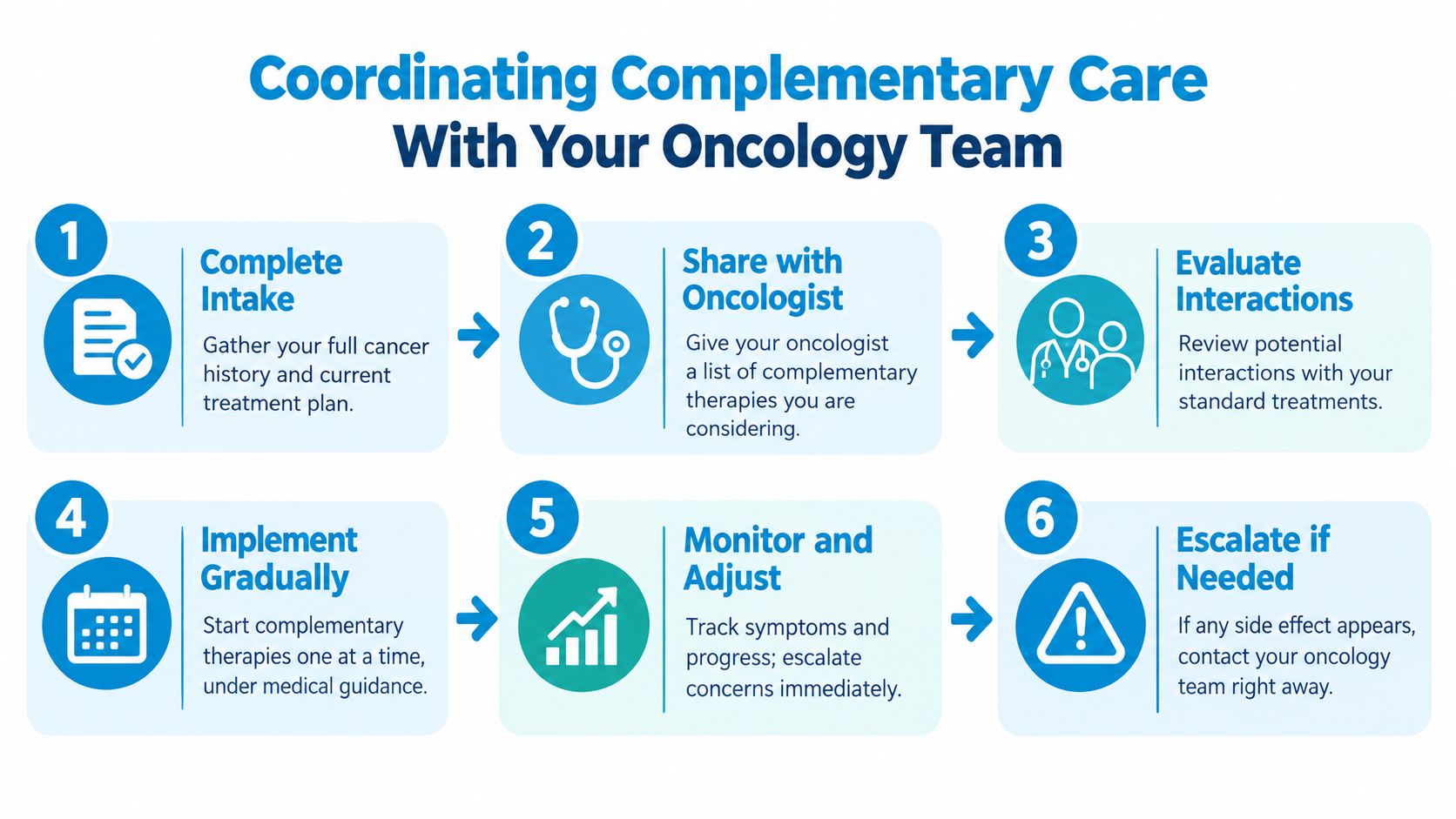
Start with a written inventory. Every supplement, powder, tea, IV, injection, off-label medication, and complementary appointment should be listed with dose, frequency, and start date. Give that list to your oncologist before your next treatment cycle, not after something goes wrong.
Then use this sequence:
- Share the full plan early. Don't ask, “Is it okay if I try something natural?” Ask about the specific product or modality.
- Add one thing at a time. If you start three therapies together, no one can tell what helped or what caused trouble.
- Set escalation triggers in advance. New neuropathy, unusual fatigue, abnormal liver tests, fever, rash, bleeding, or infusion reactions should trigger a joint review quickly.
- Keep one shared folder. Put pathology, imaging reports, medication lists, treatment dates, and outside recommendations in one place.
- Name a liaison. One nurse, care coordinator, spouse, or adult child should know what's been added and when.
Exact wording to use with your oncologist
Patients often avoid the conversation because they're afraid the oncologist will shut it down. Don't make it adversarial. Use plain, cooperative language:
“I'm not looking to replace treatment. I want help with side effects and recovery, and I want to make sure anything I add is coordinated with your plan.”
That phrasing changes the discussion. It signals judgment.
For patients who like systems thinking, this overview of models of continuity of care is useful because cancer care works better when information follows the patient across settings instead of staying trapped in separate offices.
Inside the Sunridge Medical Integrative Model
Patients who pursue integrative care often arrive with a folder full of pathology, scans, treatment summaries, medication lists, and a lot of conflicting advice. The first useful move is not another supplement. It's sorting the timeline.

What a disciplined intake looks like
At Sunridge Medical, the evaluation starts with the basics that should never be skipped: pathology, imaging, staging context, prior treatment lines, current medications and supplements, treatment dates, and the next planned oncology milestone. That's how an integrative plan becomes a medical plan rather than a collection of preferences.
From there, the work is phased. A patient in active chemotherapy may need a very conservative symptom-support strategy. A patient between treatment blocks may have more room for nutritional IV support, recovery-focused therapies, or carefully timed adjunctive options. A patient seeking a second opinion after progression needs a different conversation entirely.
How therapies get selected
Many clinics become vague. They shouldn't. Modalities such as nutritional IVs, ozone-based approaches, hyperthermia, hyperbaric-oriented care, red light therapy, insulin potentiation therapy, PRP, chelation, and immune-modulating protocols should be chosen only after three things are clear:
- The tumor biology and treatment context
- The immediate clinical goal
- The monitoring plan
If the immediate goal is nausea control, fatigue reduction, pain support, recovery between cycles, or improving function, that's a legitimate supportive target. If the claim is that a loosely defined protocol will replace disease-directed therapy, that's where caution should rise fast.
How out-of-town coordination should work
Many patients travel from Phoenix-area communities such as Paradise Valley, Tempe, Mesa, Chandler, and Gilbert, and some come from much farther away. For those patients, logistics matter almost as much as treatment selection.
A well-run model should include:
- Compressed scheduling: Grouping visits when travel is difficult.
- Telehealth follow-up: Reviewing symptoms and plan changes without unnecessary trips.
- Lab coordination: Using local bloodwork when possible and sharing results with the home oncology team.
- Written documentation: Sending recommendations back to the treating oncologist so the record stays complete.
Good integrative care is not mysterious. It is documented, timed, monitored, and shared.
Questions to Ask Any Integrative Provider
Before you commit time, money, or trust, ask sharper questions. A credible integrative provider shouldn't be annoyed by scrutiny. They should welcome it.

Ask about credentials and oncology literacy
Start with the basics:
- Who's making the plan? Ask about licensure, board certification, and actual oncology training.
- Who do they communicate with? Ask which conventional oncology teams they typically coordinate with.
- What records do they review first? If they don't insist on pathology, imaging, and your current treatment schedule, stop there.
Ask how each recommendation maps to your case
You want specifics, not philosophy.
- How does this fit my cancer type and stage?
- What is the immediate goal? Symptom control, treatment tolerance, recovery support, or something else.
- What outcome will you track? Pain, nausea, fatigue, sleep, appetite, function, or lab trends.
If the answer to every question is “it boosts the immune system,” that's not enough.
Ask about safety and operational details
Push into the practical side:
- How do you check supplement and drug interactions?
- How often do you monitor labs?
- What's your emergency plan if symptoms change after treatment?
- What are the costs, what might insurance cover, and what travel delays should I expect?
Red flags are straightforward. Walk away if a clinic guarantees a cure, pressures you to abandon oncology care, refuses to communicate with your oncologist, or tries to start treatment before doing a real medical records review.
Bringing It All Together and Next Steps
The right way to think about complementary cancer treatment is not as a shopping list. It's a coordination problem. Every option has to pass three filters before it belongs in your plan: evidence weight, interaction safety, and clear communication with the oncology team.
That framework keeps you out of the weeds. It also keeps you from spending energy on therapies that sound impressive but don't match your actual needs.
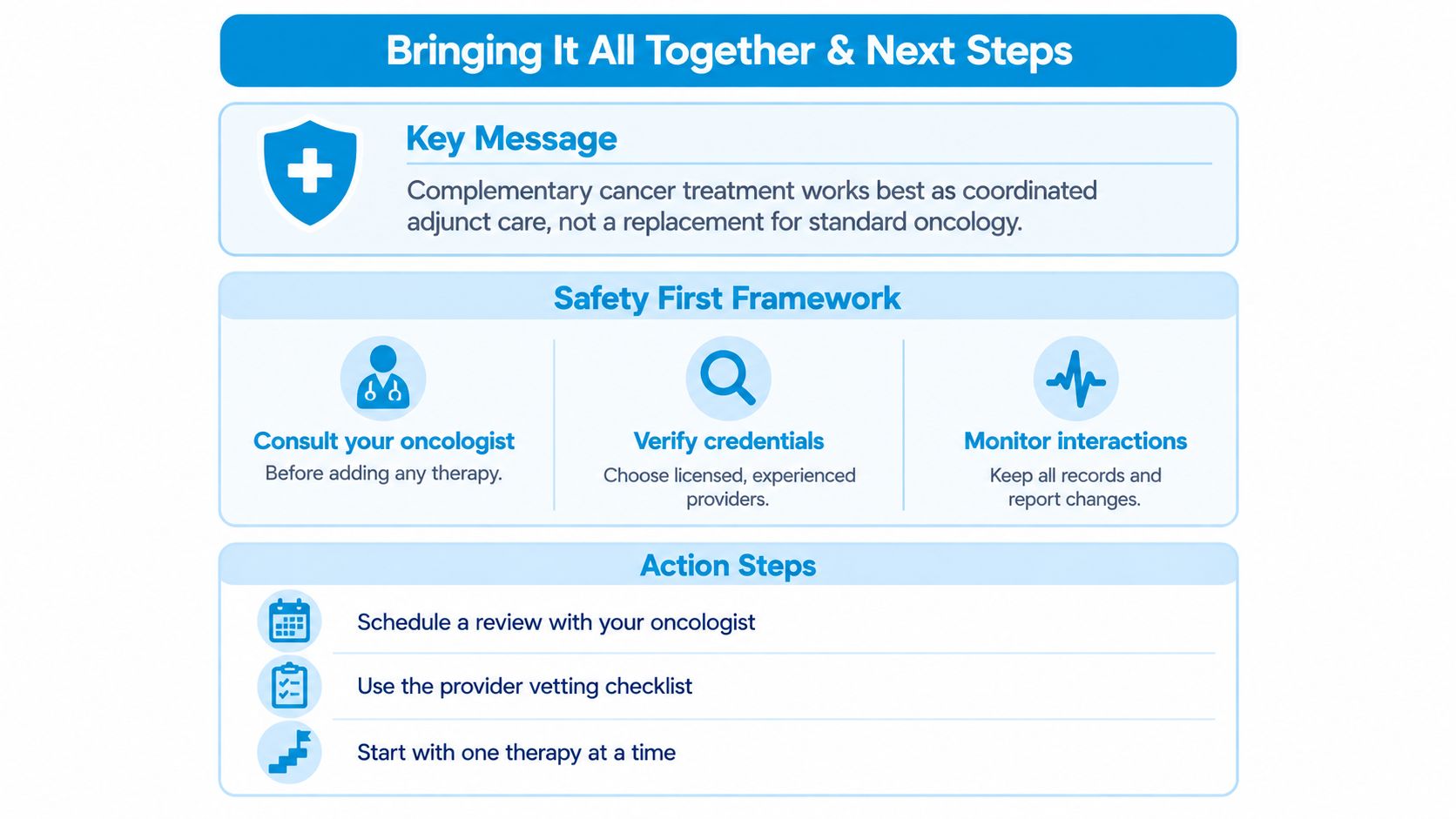
A practical next step is to write down your goals before your next oncology visit. Are you trying to reduce nausea, improve fatigue, support sleep, ease pain, improve appetite, or understand whether a specific supplement is safe? Clear goals produce better recommendations.
Access matters too. Global integrative oncology leaders report that roughly 80% of respondents cite lack of coverage or out-of-pocket cost as a barrier, and 88% say patients cannot afford complementary therapies, according to a report summarized by UCI Health on access barriers in integrative oncology. That's why cost and prioritization should be part of the conversation from the start.
Some patients also like objective health tracking tools when they're organizing a broader care plan. If you're comparing ways to monitor baseline physiology and recovery trends, Telomyx health and performance testing is one example of the kind of outside resource patients sometimes review as part of a more structured wellness discussion.
This short video may also help frame the broader topic before your next appointment.
The next move is simple. Bring a complete list of everything you're taking. Pick one or two priorities. Ask your oncologist which supportive options fit your treatment phase, and insist on a coordinated answer rather than a casual guess.
If you want a structured review of complementary cancer treatment options, Sunridge Medical in Scottsdale offers physician-directed integrative evaluations built around your diagnosis, current treatment plan, and safety concerns. If you're in Scottsdale, Phoenix, or anywhere in the greater Phoenix area and want to discuss whether a coordinated consultation makes sense, visit Sunridge Medical.