


If Lyme disease changes a patient's antioxidant defenses, does replacing an antioxidant improve the illness? That question sits at the center of glutathione and Lyme disease, yet biological findings and treatment claims often get blended together.
The distinction matters for patients considering supplements or infusions. A change inside an immune cell, an abnormal blood marker, and meaningful improvement in daily function are different findings. An evidence-informed decision starts by identifying which finding supports the proposed treatment.
Table of Contents
- What the Evidence Shows for Each Glutathione Route
- How Lyme Infection Changes Glutathione Markers
- Why Oral Glutathione Behaves Differently
- Injectable Glutathione Safety and Who Needs Extra Review
- Where Glutathione Fits Beside Standard Lyme Care
- Questions to Ask Before Any Glutathione Plan
- How an Integrative Lyme Evaluation Works and Next Steps
What the Evidence Shows for Each Glutathione Route
Glutathione biology changes during Lyme disease, but that doesn't establish glutathione as an effective Lyme treatment. The available evidence doesn't demonstrate that oral, intravenous, or intramuscular glutathione clears Borrelia burgdorferi, prevents post-treatment symptoms, or restores immune function.
The PNAS study examining glutathione metabolism during Borrelia exposure supports a role for glutathione in immune-cell signaling and documents altered metabolism in early Lyme disease. It doesn't establish the clinical effectiveness of supplementation or identify a validated dose, treatment duration, or preferred route.
Glutathione routes and their Lyme-related evidence
| Route | Evidence for Lyme outcomes | Main concern |
|---|---|---|
| Oral glutathione | No validated Lyme outcome trial identified | Absorption may be limited because most is hydrolyzed in the gut |
| Intravenous glutathione | No trial identified showing it clears Borrelia or reliably resolves persistent symptoms | Anaphylaxis, liver injury, and kidney injury reported in safety reviews |
| Intramuscular glutathione | Not established in the available sources | Lyme-specific dosing, safety, and benefit remain unestablished |
| Oral N-acetylcysteine, a precursor rather than glutathione itself | Studied for glutathione biology, not proven for Lyme outcomes | Nausea, abdominal pain, and diarrhea reported |
These comparisons describe evidence gaps, not a ranking. A route that bypasses digestion doesn't automatically provide greater clinical benefit, and limited published information about an injection isn't evidence that it's safe.
Mechanism, association, and clinical benefit
Cell and mechanistic studies examine what happens when immune cells encounter Borrelia or when investigators alter glutathione metabolism. They can identify a plausible biological pathway without showing that a patient benefits from treatment.
Observational biomarker studies compare laboratory findings in patients and controls. They can establish an association, but they can't determine whether changing the marker changes the illness.
Clinical outcome trials must test whether an intervention improves outcomes that matter to patients. Most Lyme-related glutathione evidence falls into the earlier categories.
For formulation terminology, readers can explore liposomal glutathione supplementation through REVETIX, while keeping product explanations separate from evidence of Lyme treatment benefit. Sunridge's educational overview of what IV glutathione is provides context for discussing the intravenous route.
Decision rule: Each route represents a question for a clinician, not a recommendation to begin treatment.
How Lyme Infection Changes Glutathione Markers
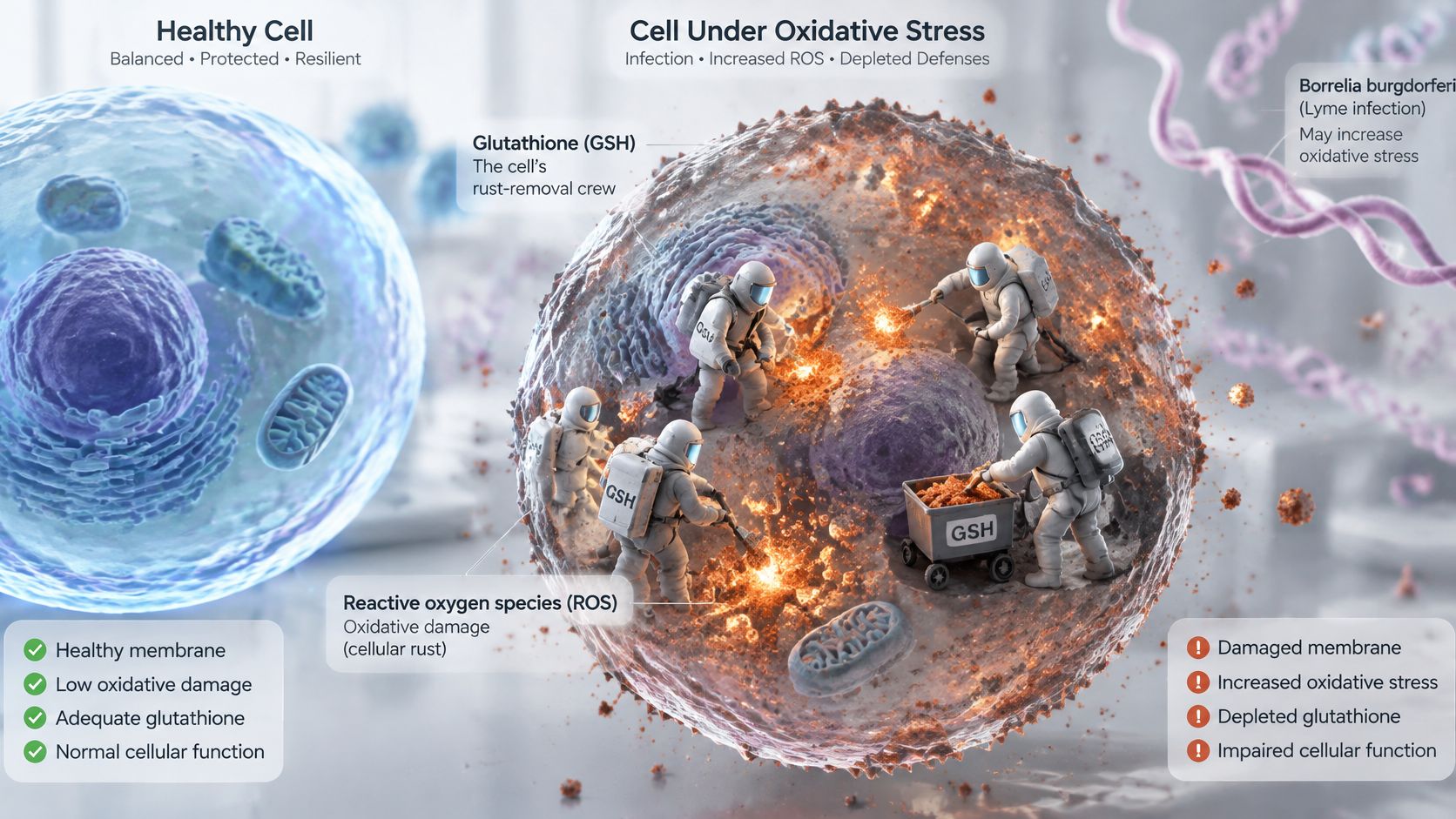
Glutathione can be understood as part of a cell's rust-removal crew. The analogy isn't literal, but it captures its role in managing oxidative reactions before those reactions damage cellular components.
A review of Lyme-related oxidative-stress studies describes a series of 20 patients with erythema migrans whose plasma reduced glutathione, glutathione reductase, and glutathione peroxidase were significantly lower than healthy controls, while malondialdehyde was higher. The same review describes a separate series of 32 Lyme disease patients with higher mitochondrial superoxide in blood mononuclear cells and lower cytosolic calcium than controls.
Lyme-related glutathione markers and what they show
| Marker | Direction reported | What it does not show |
|---|---|---|
| Reduced glutathione in erythema migrans patients | Lower than healthy controls | Doesn't establish that depletion causes symptoms |
| Glutathione reductase and glutathione peroxidase | Significantly lower in the same patient series | Doesn't provide a validated diagnostic threshold |
| Malondialdehyde, a lipid-peroxidation marker | Higher in the same series | Doesn't identify infection type or stage |
| Mitochondrial superoxide in blood mononuclear cells | Higher in a separate patient series | Isn't a stand-alone diagnostic test |
| Intracellular glutathione in monocytes exposed to Borrelia | Rose sharply in cell experiments | Doesn't establish patient treatment benefit |
The apparently opposite findings deserve attention. The human-monocyte and patient metabolomics study found increased intracellular glutathione after Borrelia exposure and altered cytokine production when investigators manipulated glutathione metabolism. Lower plasma glutathione and higher glutathione inside experimentally exposed cells aren't interchangeable measurements.
This means the simple explanation that Lyme always depletes glutathione throughout the body goes beyond the evidence. The tissue, timing, measurement method, and biological setting all matter.
A changed marker is a clue for research and clinical discussion, not a diagnosis.
A higher or lower personal result doesn't prove active infection, treatment failure, or persistent Lyme disease. Sunridge's page on total glutathione in whole-blood testing identifies a measurement patients may encounter, but test availability doesn't establish a Lyme-specific interpretation.
For patients whose main concern is pain, Thermo Recovery Wear on managing joint pain offers a separate educational starting point. Pain still requires its own clinical assessment rather than an assumption that an antioxidant result explains it.
Why Oral Glutathione Behaves Differently
A patient takes an oral glutathione product for several weeks, and a follow-up blood test shows a higher reading than her baseline. Her clinician then asks the harder question: what changed inside the immune cells the supplement was meant to reach? The digestive tract sits between the capsule and that cellular target, and the NIH Office of Dietary Supplements immune-function fact sheet notes that most research indicates orally consumed glutathione is hydrolyzed in the gastrointestinal tract, potentially limiting increases in intracellular glutathione.
The same fact sheet describes an alternative mechanism worth separating out: N-acetylcysteine, or NAC, supplies cysteine, a building block the body uses to synthesize glutathione rather than supplying the molecule itself.
Replacement compared with precursor support
That mechanistic split matters when reading a study or a label. A trial showing a glutathione-related change after NAC describes precursor support; it says nothing about what a glutathione capsule does, and the reverse holds as well. Neither route, on its own, demonstrates improvement in Lyme-related symptoms.
Label language deserves the same separation. "Liposomal" describes a proposed delivery method, a claim about how much of the molecule may reach circulation. Evaluating that delivery claim is a different step from evaluating whether glutathione in any formulation treats Lyme disease, and a stronger absorption argument doesn't automatically carry over to a clinical-outcome argument.
The measurement rungs stay distinct the same way: a circulating glutathione level is a biomarker result, an intracellular change is a different biomarker result, and relief of pain, fatigue, or difficulty concentrating is a clinical outcome. Each step requires its own evidence.
Practical checks before an oral plan
- Define the intended result. A proposal should state whether it targets a laboratory marker, a symptom, or daily function, because the evidence behind each differs.
- Explain the mechanism. The clinician should clarify whether the product supplies glutathione directly or supports its synthesis, and why that distinction matters in the patient's situation.
- Match the claim to the measurement. A study or label citing blood levels describes a biomarker finding, which stands apart from intracellular change or symptom relief.
- Identify the actual product. Formulation, delivery claims, ingredient list, quality verification, and other supplements belong in the review, not just the ingredient name on the front.
One confound is worth noting before any oral trial: NAC can produce gastrointestinal effects, so new nausea or digestive complaints during use may reflect the supplement rather than the illness being tracked.
Dosing belongs to individualized clinical review, not an online protocol. Route selection works best when it starts with a defined goal, then weighs absorption, medication interactions, product quality, and how the product fits the patient's wider treatment plan.
Injectable Glutathione Safety and Who Needs Extra Review
A review discussing injectable glutathione safety reports associations with anaphylaxis and hepatotoxicity, notes the absence of standardized dosing protocols, and discusses severe reported events including liver failure, kidney failure, and Stevens–Johnson syndrome. These reports warrant informed discussion without implying that every patient experiences such complications.
Reported events don't establish a predictable risk for an individual patient. They do establish why an infusion shouldn't be described as harmless just because glutathione occurs naturally in the body.
A consultation checklist for injectable treatment
The safety discussion should turn broad concerns into concrete questions:
- Liver and kidney status. Which existing laboratory results need review, and would additional evaluation change the decision?
- Allergies and respiratory history. Does the physician know about asthma, previous infusion reactions, and medication or ingredient allergies?
- Medications and supplements. Has the complete list been reconciled, including products used intermittently?
- Active cancer treatment. Has the oncology team reviewed the proposed complementary treatment and its timing?
- Pregnancy or breastfeeding. What information supports use in that specific circumstance, and what uncertainty remains?
- Product sourcing and sterility. How are the preparation, handling, and administration reviewed?
- Monitoring and response. Who observes the patient, documents adverse effects, and provides instructions after treatment?
These questions aren't a list of universal contraindications. They identify circumstances in which the physician needs enough information to make a defensible recommendation, including a recommendation against treatment.
What informed consent should explain
Informed consent means more than signing a form. The discussion should cover the proposed purpose, known risks, unresolved uncertainties, alternatives, and what would lead the clinician to stop.
Sunridge's educational discussion of glutathione IV side effects can help patients prepare questions. It doesn't replace a review of the individual patient's health history.
Intramuscular glutathione requires a separate conversation. The available sources don't establish its Lyme-specific safety, effective dosing, or advantage over other routes, so findings about intravenous use shouldn't be transferred to it.
Safety principle: A different route changes the evaluation required. It doesn't remove the need to demonstrate a worthwhile clinical purpose.
Injectable glutathione isn't a routine substitute for Lyme treatment. A physician must determine whether any injectable approach is appropriate, whether conventional options better address the concern, and whether the uncertainty outweighs the proposed benefit.
Where Glutathione Fits Beside Standard Lyme Care
Diagnosis comes before antioxidant selection. Established Lyme evaluation and antibiotic treatment, when indicated, remain distinct from complementary discussions about oxidative stress or symptom support.
The CDC Lyme disease clinical resources and IDSA Lyme disease treatment guidelines are reference points for diagnosis and antibiotic care. CDC materials also describe post-treatment symptoms, which shouldn't be interpreted solely through an antioxidant laboratory result.
Persistent symptoms require a broader assessment
Some patients report fatigue, joint or muscle pain, or concentration problems after treatment. Those concerns deserve evaluation without assuming either that every symptom proves ongoing infection or that previous treatment makes further assessment unnecessary.
A clinician may need to consider sleep disorders, thyroid problems, medication effects, or another diagnosis alongside the patient's Lyme history. The practical question is which explanation best fits the symptom pattern and what findings would change management.
Sunridge Medical offers treatment for Lyme disease and tick-borne illness, as well as IV therapies including alpha lipoic acid, IV glutathione, and other nutrient-based treatments. Its integrative Lyme disease care overview provides context for a discussion that can be coordinated with existing physicians rather than conducted separately from them.
Symptoms that shouldn't wait for a routine appointment
The following warrant prompt conventional medical assessment, with emergency care for severe or sudden symptoms:
- Neurologic changes. Fever with confusion or new facial weakness.
- Cardiac symptoms. New heart palpitations, fainting, or collapse.
- Severe allergic symptoms. Trouble breathing or a serious reaction after an infusion.
- Possible organ injury. Yellowing of the skin or eyes, or dark urine, particularly following treatment.
These signs don't identify a single cause. Their importance is that they shouldn't be managed by adding supplements, waiting for an integrative consultation, or labeling a deterioration as an expected treatment response.
Complementary care can be discussed alongside medically necessary treatment when the purpose and limits are explicit. Integrative care doesn't replace emergency services, an oncologist, or necessary conventional care.
Questions to Ask Before Any Glutathione Plan
The value of a pre-treatment consultation lies in how precisely it defines the decision: what is being tried, on what evidence, and against which measure of success. The Today's Dietitian discussion of nutrition support in Lyme disease highlights the need for individualized review rather than a universal antioxidant approach.
Questions that clarify the decision
What specific goal is being pursued?
Reduced fatigue, improved daily function, and a change in a laboratory marker are different goals, and each calls for a different way of judging progress.How will progress be measured?
A consistent symptom scale, documented activity tolerance, or an appropriate repeated test is more useful than an undefined impression.Which level of evidence supports this route for Lyme disease?
The answer should state whether the case rests on cell-mechanism data, an association with glutathione biomarkers, or patient-level clinical outcomes, and why reasonable alternatives were set aside.How long is the initial trial, and what ends it?
A review point agreed in advance prevents an open-ended course. The stopping condition should be as explicit as the starting one.What does the complete plan cost, in writing?
Written information should itemize laboratory testing, administration, and follow-up visits, so the patient can weigh the total without price becoming the sole deciding factor.How is coordination documented?
The plan should name who communicates with the antibiotic prescriber, primary physician, specialist, or oncology team, and where that communication is recorded.What happens if symptoms don't improve?
The clinician should explain how lack of benefit or adverse effects would trigger reassessment.
A transparent recommendation states the evidence behind the proposal, the measure that will be checked, the date it will be checked, and the result that ends the trial.
What a satisfactory answer sounds like
A clinician's answer might run as follows: "The case for IV glutathione here rests on mechanistic rationale and biomarker associations in chronic illness. There is no validated Lyme-specific dose, no standardized protocol, and no comparative trial showing one delivery route produces better patient outcomes than another. We would set one functional goal, track it with a consistent fatigue score, review it at an agreed interval, and stop if the score hasn't moved."
That style of answer is useful because it locates the plan on the evidence ladder. The patient can see which rung, mechanism, biomarker, or clinical outcome, each claim stands on, and where confidence may be running ahead of the data. Limited comparative evidence means confident claims that one route is universally preferable deserve scrutiny.
How an Integrative Lyme Evaluation Works and Next Steps
A patient may arrive with prior antibiotic records, several laboratory reports, ongoing fatigue, and a question about IV glutathione. At Sunridge Medical, an experienced integrative clinic in Scottsdale, Arizona, the useful starting point is the patient's history rather than a predetermined infusion plan.
An individualized conversation may examine tick exposure, previous testing, treatment history, and the order in which symptoms developed. The purpose is to distinguish what has been established from what remains uncertain before considering additional interventions.

Building a clinically useful timeline
Consider a patient whose pain improved after treatment but whose sleep and concentration didn't. A timeline helps the physician examine those concerns separately instead of treating every symptom as evidence of the same process.
Existing laboratory reports can also prevent a discussion from beginning with assumptions. The physician may review what was measured, why the test was ordered, and whether the result meaningfully changes the current decision.
Medication reconciliation should include prescriptions, nonprescription medicines, supplements, and previous reactions. A patient may consider a product unrelated because it was purchased without a prescription, but it still belongs in the medical review.
Comparing options after evaluation
Depending on the concern, an evaluation may include review of liver and kidney laboratory findings and a discussion of measurable goals. Conventional options and complementary approaches should be compared according to the diagnosis, expected purpose, uncertainty, and monitoring burden.
IV glutathione is considered only when clinically suitable, not as a default response to a Lyme history. A consultation can reasonably end with a recommendation against it, a recommendation to obtain missing information, or a decision to prioritize another aspect of care.
Sunridge Medical's treatment recommendations depend on diagnosis, medical history, medications, laboratory findings, and physician evaluation, and no outcome can be promised. Individualization means the recommendation may differ between patients who report similar symptoms.
Coordination may involve the primary physician or an infectious disease specialist when relevant. For patients receiving cancer care, the oncologist's involvement matters before introducing complementary treatment or changing its timing.
Preparing for a consultation or second opinion
A focused set of records makes the conversation more useful:
- Prior Lyme testing. Include complete reports rather than only a summary of positive or negative results.
- Treatment records. Bring medication names, treatment dates, and documented responses or adverse effects.
- Current medicines and supplements. Include labels or clear ingredient lists where possible.
- A symptom timeline. Note which problems began first, which changed with treatment, and which most affect daily activities.
- Written questions. Identify the decision that needs clarification, such as whether testing would change management or whether any glutathione route has a reasonable purpose.
Patients in Scottsdale, Phoenix, and the greater Phoenix area, as well as those traveling for care, can review information about Lyme specialist evaluation in Arizona. Patients considering travel can ask preliminary questions by phone before arranging a visit.
No decision about treatment is required today. The next useful step is a clear review of the records, the unresolved question, and whether an individualized consultation or second opinion is appropriate.
Sunridge Medical offers individualized evaluation for Lyme disease and tick-borne illness, including discussion of whether physician-directed glutathione therapy has a suitable role alongside necessary conventional care. Visit Sunridge Medical to contact the Scottsdale clinic about a consultation or second opinion; suitability is determined after individualized evaluation, without a promise of benefit.