

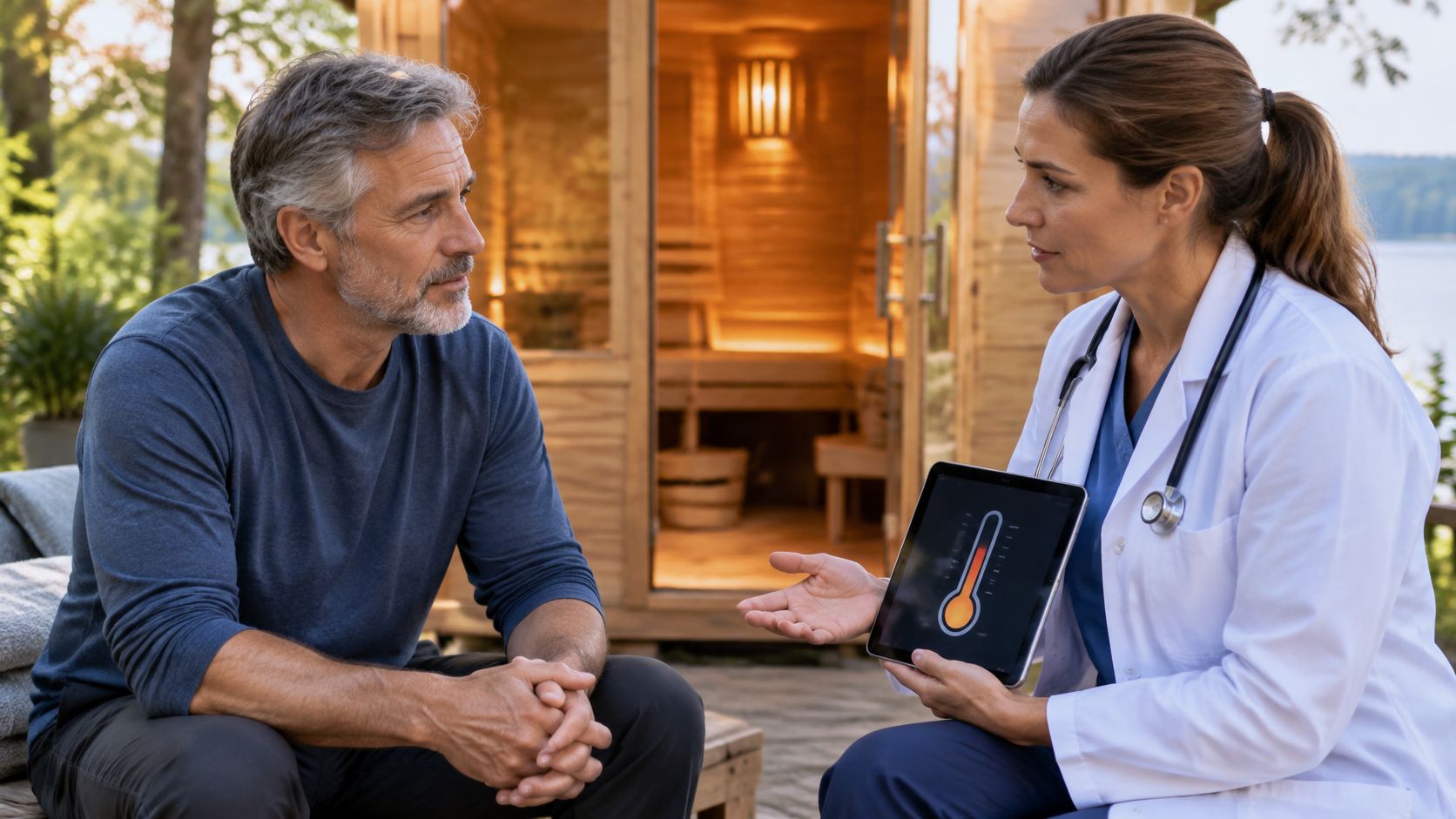
Sauna is not an established cancer treatment, and current research doesn't show that it shrinks tumors, prevents recurrence or improves survival. Sauna for cancer remains, at most, a question about comfort and supportive wellness for selected patients after individualized medical review.
Does heat help because it feels restorative, or because it changes cancer itself? That distinction is often lost when population studies, laboratory ideas and hospital heat treatments are described as if they're the same intervention. They're not. Each type of evidence answers a different question, and confusing them can lead a patient to expect a treatment effect that a wellness practice hasn't demonstrated.
Table of Contents
- Sauna for Cancer Research and What It Does Not Show
- How Home Sauna Differs From Medical Hyperthermia
- Why Researchers Study Heat Against Tumors
- Potential Wellness Benefits and How Strong the Evidence Is
- Risks, Contraindications and When Sauna Is Off-Limits
- Confirm Sauna Suitability With Your Care Team
Sauna for Cancer Research and What It Does Not Show
The clearest human evidence doesn't show that sauna bathing prevents cancer. It also doesn't show that frequent sauna use increases overall cancer risk. Neither finding makes sauna a treatment for a person who already has cancer.
What the Finnish cohort found
A large prospective Finnish cohort followed 2,173 men aged 42 to 61 years who had no cancer history at enrollment, with a median follow-up of 24.3 years, and 588 participants, 27.1% of the cohort, developed some form of cancer, according to the Finnish prospective cohort report. Men were grouped by use once or less weekly, two to three times weekly, and four or more times weekly. After multivariable adjustment, men using a sauna four or more times weekly had a hazard ratio of 0.92 for all-cause cancer compared with the once weekly or less group, with a 95% confidence interval of 0.66 to 1.27.
A hazard ratio below 1 can look protective at first glance. A confidence interval works like the wobble room around an estimate: because this one stretches from 0.66 to 1.27, the true effect could plausibly be a lower risk, no difference, or a higher risk. Crossing 1 means the result is not statistically significant, so there is no reliable evidence here of either harm or protection. Prostate and gastrointestinal cancers within the same cohort followed the same pattern, with no statistically significant association in either direction.
The limits matter. Participants were middle-aged Finnish men, the design was observational, and the cohort didn't test sauna in people receiving cancer treatment. The findings can't automatically be generalized to women, older adults, other ethnic groups or patients managing active disease. A structured approach to evaluating alternative cancer treatment claims can help patients separate a population association from a personal treatment decision.
What the evidence shows for each sauna claim
| Claim | What the evidence shows | Evidence level |
|---|---|---|
| Regular sauna use changes all-cancer risk | No statistically significant increase or decrease across long-term follow-up in the large Finnish cohort | Observational cohort |
| Home sauna shrinks tumors or prevents recurrence | No demonstrated effect in the available research | No clinical evidence |
| Clinical hyperthermia helps cancer treatment | Tumor-shrinking or treatment-enhancing effects seen in trials when combined with radiation or chemotherapy; survival benefit uncertain | Clinical trials, adjunct only |
| Sauna detoxifies tumors | No supporting evidence in the research reviewed | Unsupported claim |
A separate Finnish cohort involving 2,575 Finnish men recorded 1,618 deaths over a median 27.8-year follow-up, as reported in the separate Finnish cohort report. Mortality associations in observational research can't prove that sauna caused an outcome. Fitness, socioeconomic factors, health behaviors and medical conditions may influence both sauna use and survival. That report therefore doesn't establish a survival benefit for people with cancer.
An association in healthy sauna users is not evidence that heat changes the course of an established cancer.
Read this way, the evidence sorts into three distinct buckets. Population studies answer questions about risk in healthy people. Clinical trials answer questions about treatment. The wellness claims in between remain open. That sorting gives a patient something practical to carry into an oncology appointment: the verdict describes the state of the evidence, not an individual's prognosis, heat tolerance or suitability for any supportive practice.
How Home Sauna Differs From Medical Hyperthermia
During a clinical hyperthermia session, the treatment team records temperature at the tumor site, adjusts equipment output and watches the patient's vital signs through every minute of a defined treatment window. Nothing comparable happens inside a sauna. That gap in measurement and intent is why results from hospital-based heat treatment can't be transferred to a home sauna session.
Heat with a medical target
In oncology, medical hyperthermia deliberately raises tumor or body temperature, typically to approximately 39 to 45 °C (102 to 113 °F), using controlled equipment, defined treatment durations and temperature monitoring, according to the National Cancer Institute hyperthermia summary. The goal is a planned thermal exposure, often alongside radiation or selected anticancer drugs.
A home or Finnish sauna works differently. The user selects the setting and session length, the only temperature measured is usually the air in the room, and no oncology protocol controls the exposure. Infrared saunas deliver heat through a different mechanism again, and different delivery still produces a room-level exposure without a measured tumor dose.
Patients exploring medically supervised options can review how hyperthermia treatment planning differs from self-directed wellness use before raising the subject with an oncology team.
Home sauna compared with medical hyperthermia
| Feature | Home or Finnish sauna | Medical hyperthermia |
|---|---|---|
| Purpose | Relaxation and passive heat exposure | Adjunct to radiation or chemotherapy under oncology direction |
| Target temperature | Set by equipment and user; not tied to tumor temperature | Approximately 39-45 °C (102-113 °F), the range given in the NCI summary above |
| Temperature monitoring | Usually room-level thermometer only | Controlled equipment with temperature and physiologic monitoring |
| Session length | Chosen by the user | Defined by the treatment protocol |
| Supervision | Self-directed | Oncology team or clinical trial staff |
| Evidence for cancer effects | Observational associations only | Clinical trials as adjunct; overall survival benefit uncertain |
Why the same word causes confusion
"Hyperthermia" appears in oncology journals and in sauna marketing, and it describes very different things in each place. Trial findings for medical hyperthermia generally concern heat combined with radiation or chemotherapy under oncology direction. Wellness data from sauna users, clinical hyperthermia research and home-sauna claims sit in three separate evidence categories, and reading one as if it were another leads patients to overestimate what a session can do.
Practical rule: A temperature number without tumor measurement, defined timing and medical monitoring is not a cancer treatment protocol.
The closest equivalent to clinical heat treatment is supervised oncology hyperthermia or an approved clinical trial. That distinction protects patients from assuming that longer or hotter home sessions somehow become more therapeutic. Increasing exposure without monitoring mainly increases heat stress.
Why Researchers Study Heat Against Tumors
Heat-based cancer research isn't new. A review indexed by the U.S. National Institutes of Health describes the use of heat to treat masses now recognized as cancer across thousands of years of medical history. That long record explains scientific interest. It says nothing about whether modern home sauna use treats cancer.

Modern hyperthermia is much more controlled than historical practice. Whole-body approaches commonly target about 41.8 to 42°C, while regional techniques may use approximately 41 to 45°C under clinical supervision, as described in the thermal therapy history review. At those temperatures, the trials measure whether a controlled thermal exposure at a tumor site changes treatment response.
Why tumors might respond differently to heat
Tumors often grow blood vessels in a disorganized way, leaving uneven flow and patchy oxygen supply. Healthy tissue generally has more orderly circulation. That difference gives researchers a reason to investigate whether cancer cells could be more vulnerable to carefully delivered heat, or more sensitive to another treatment given alongside it.
The rationale has limits. Tumors vary widely, and heating the whole body in a sauna doesn't create the same conditions inside a tumor.
Proposed mechanisms, not home-sauna proof
Researchers discuss several hypotheses for controlled hyperthermia:
- Direct heat injury: Sufficient heat may injure cancer cells under controlled conditions.
- Blood flow and oxygenation changes: Heat may alter the tumor environment in ways that affect treatment delivery or response.
- Protein, membrane and DNA repair effects: Heat may disrupt protein stability, cell-membrane function and DNA repair processes.
- Treatment sensitization: Heat may increase sensitivity to radiation or selected anticancer drugs.
Each item is a laboratory or clinical hypothesis tied to a controlled exposure. None demonstrates that a home sauna produces the same effects.
Clinical results also point toward combination treatment rather than heat alone. Hyperthermia added to established treatments has produced tumor responses in selected clinical trials, while heat used by itself has generally produced weaker responses. That pattern supports investigation as an adjunct, not replacement therapy. Patients comparing claims can look at how hyperthermia cancer treatment success rates are described in trial settings rather than wellness marketing.
A major uncertainty remains. Evidence hasn't established that hyperthermia improves overall survival. Tumor response, treatment sensitivity and longer survival are related questions, but they aren't interchangeable outcomes.
Potential Wellness Benefits and How Strong the Evidence Is
Many patients ask about sauna for a simpler reason than tumor biology. It may feel relaxing, quiet and physically soothing during a period filled with appointments, scans and treatment side effects. That hope deserves a respectful answer, but it still needs an evidence boundary.
Comfort goals are not disease-modifying claims
A comfort goal might involve relaxation, temporary muscle ease or a calmer bedtime routine. A disease-modifying claim asserts that an intervention shrinks cancer, prevents recurrence or extends life. The first category may be reasonable to discuss when safety allows. The second isn't supported for sauna.
Confusion often begins when a practice feels helpful and that experience is presented as proof that it's treating the disease. Both statements can be considered separately. A patient might value a supportive routine while still understanding that it hasn't been shown to change cancer outcomes.
What nearby heat and water research shows
A systematic review of water-based therapies in people with cancer included 10 publications covering 12 studies and 430 patients, with some studies reporting improvements in quality of life, lymphedema, neck and shoulder pain, fatigue, or body mass index, while others found no meaningful change, according to the systematic review of water-based therapies. The results were heterogeneous rather than consistently positive.
The reviewers concluded that clear advice wasn't possible because study quality was moderate, methods were limited and outcomes were inconsistent. Safety data were also lacking for higher-temperature water. For sauna claims, reported benefit was associated with active exercise in water rather than passive heat treatments. Movement in water and sitting in a hot room are different interventions, so the review doesn't validate sauna as an oncology therapy.
That evidence doesn't prove sauna has no subjective value. It shows why broad wellness promises shouldn't be made from indirect, mixed research. Patients considering supportive options can place sauna within the wider context of complementary cancer treatment approaches, where coordination with standard care remains central.
A sorting rule for the next appointment
A useful preparation step is to write down the benefit being hoped for, then sort it into one category:
- Comfort goal: Relaxation or short-term physical ease.
- Function goal: A measurable aim, such as sleep quality, stiffness or daily activity.
- Disease claim: Tumor shrinkage, recurrence prevention or survival.
Comfort and function can be discussed as supportive goals. A disease claim requires clinical evidence that sauna doesn't currently have.
Only the first two categories belong in a sauna discussion with the care team. The third should prompt caution, especially if a product or program suggests delaying surgery, systemic therapy, radiation or surveillance. Clear goals also make follow-up easier. If the aim is relaxation, the team can ask whether that aim was met without implying that cancer itself changed.
Risks, Contraindications and When Sauna Is Off-Limits
Heat exposure isn't neutral just because it's familiar. It can increase sweating, heart rate, fluid loss and orthostatic stress, meaning blood pressure may drop when a person stands, according to the observational sauna safety review. Those effects explain why a person who tolerates heat when well may tolerate it poorly during illness or treatment.
Situations requiring clearance or avoidance
Situations that call for clearance or avoidance
| Situation | Why it matters | What to do first |
|---|---|---|
| Fever or active infection | Heat adds stress and fever is a reason to avoid heat exposure | Skip sauna and contact the care team |
| Dehydration, vomiting or diarrhea | Heat increases sweat and fluid loss | Ask the team before any session |
| Cardiovascular disease or unstable blood pressure | Heat raises heart rate and can cause orthostatic stress | Obtain clearance before any use |
| Kidney dysfunction | Fluid and electrolyte balance may be affected | Discuss hydration and heat limits with a clinician |
| Chemotherapy, radiation or immunotherapy | Treatment-related weakness, infection risk and fatigue may change tolerance | Obtain oncology approval and ask about timing |
| Dizziness, palpitations, nausea or breathlessness during heat | Possible warning signs of heat stress or a serious problem | Leave the heat at once; seek urgent or emergency care if symptoms are severe or persist |
The table is a clearance framework, not permission for everyone outside those categories. Cancer type, disease extent, recent surgery, medications, blood counts, nutrition and recent laboratory findings can also affect tolerance. A treating team may identify a reason for caution that isn't obvious from a general list.
A cautious framework, not a home prescription
When a clinician considers passive heat potentially reasonable, the discussion generally stays conservative. Key points include short exposure, a comfortable temperature, hydration only as medically appropriate, immediate cessation for warning symptoms, and no sauna during fever or acute illness. Hydration advice isn't universal because some patients have heart or kidney conditions that require individualized fluid guidance.
Treatment phase matters as well. Passive heat during chemotherapy, radiation, surgery recovery or immunotherapy requires oncology approval, and timing relative to treatment may matter. Fatigue, weakness, low blood pressure, poor oral intake or infection risk can change from one week to the next. Approval at one point doesn't automatically apply throughout treatment.
Consider a clearly hypothetical example. A patient feels lightheaded after leaving a sauna, sits down and remains weak rather than recovering promptly. The appropriate response is to stop heat exposure and contact the oncology team the same day for guidance. Chest pain, fainting or trouble breathing requires emergency care right away, not observation at home.
Warning signs: Dizziness, palpitations, weakness, nausea or shortness of breath mean the session ends immediately.
Clinical hyperthermia raises separate safety and interaction questions. It should be pursued only through qualified oncology services or a clinical trial, where temperature and treatment interactions can be monitored.
Confirm Sauna Suitability With Your Care Team
Integrative care has a specific meaning in this context. A complementary approach is used alongside standard treatment, while an alternative approach is used instead of it. Sauna belongs only in the first category, and only when the oncology team agrees that passive heat is appropriate for the patient's current condition.
Who makes which decision
The oncology team owns the cancer treatment plan. An integrative clinician may review evidence, medications, supplements, interactions, heat tolerance and symptom goals, then communicate within the broader care picture. The patient remains part of every decision and should receive a clear explanation of what is known, what is uncertain and what would cause the plan to change.
A second opinion checks the plan the oncology team has already set and identifies risks. It confirms that a comfort measure like sauna fits the treatment phase rather than working against it. Guidance on talking with a doctor about alternative medicine can help patients prepare for that conversation without creating conflict between clinicians.

Questions worth bringing to an oncology visit
- What is the specific goal: Is sauna being considered for relaxation, sleep, stiffness or another comfort aim?
- What evidence applies: Does any evidence address this cancer type and treatment phase, or is the discussion based only on general wellness experience?
- What could interact: Could heat affect medications, blood pressure, fluid balance, surgical healing or upcoming treatment?
- When should use pause: Which symptoms, laboratory changes or treatment days mean sauna should stop or be deferred?
- Who monitors the response: Which clinician should receive reports of dizziness, unusual fatigue, palpitations or breathlessness?
Specific questions prevent a vague answer from being mistaken for unrestricted approval. They also make hidden assumptions visible. A clinician who supports gentle heat for stiffness months after treatment may still advise against it while a surgical wound is healing, so the answer should name the exact conditions attached.
What an individualized review may involve
At Sunridge Medical in Scottsdale, the safest starting point for cancer patients is a case review, not selecting a therapy from a list. The practice offers second opinions and case review for cancer patients, care alongside oncology treatment, and treatment for advanced and difficult cases. A suitability review may consider diagnosis, cancer type, stage, biomarkers, current and past treatments, medications and supplements, heart and kidney history, recent laboratory results, personal goals and prior heat tolerance.
Not all treatments are appropriate for every cancer patient, because diagnosis, stage, biomarkers, treatment history, medications, laboratory findings and current health affect what may be reasonable or safe. Possible conclusions include discouraging sauna, deferring it until a treatment phase ends, or discussing it as a comfort measure with clear limits. No outcome is promised before evaluation.
Helpful records include oncology notes, a complete medication and supplement list, recent laboratory reports and written questions. Those materials let a clinician assess interactions and timing instead of relying on a general opinion about heat. Patients coming from Scottsdale, Phoenix or farther away may need coordination notes sent back to the treating oncology team, depending on the outcome of the review.
This kind of review does not replace emergency care, a patient's oncologist or medically necessary standard treatment. Its role is to inform decisions alongside oncology care, and no heat exposure, supplement or treatment should be started, stopped or changed without first discussing the decision with the oncology team.
Patients considering sauna during or after treatment can visit Sunridge Medical to request a consultation and ask whether passive heat has any reasonable supportive role alongside their oncology care.