


What if the medical community’s insistence on a “cured” status is based on an incomplete understanding of how certain pathogens survive? It’s a profound frustration to live with debilitating fatigue and neurological decline while being told your infection is a thing of the past. For anyone wondering is chronic lyme disease real, the answer lies not in a lack of symptoms, but in the clinical evidence of bacterial persistence and systemic inflammation that standard testing often fails to capture.
We understand that your struggle is tangible and that the loss of quality of life requires more than a standardized protocol. This article explores the sophisticated mechanisms that allow Borrelia burgdorferi to evade the immune system and explains why the current medical debate exists. You’ll gain a clear perspective on the science of persistence and discover how advanced, individualized diagnostic pathways are finally validating the patient experience through rigorous, research-based medicine. By looking beyond conventional limitations, we can begin to map a structured path toward the restoration of your well-being.
Key Takeaways
- Understand the clinical nuances between PTLDS and persistent infection to finally answer the question, “is chronic lyme disease real” through the lens of modern science.
- Identify the limitations of standard ELISA and Western Blot testing and why these methods often fail to detect late-stage bacterial activity.
- Explore how Borrelia burgdorferi utilizes biofilms and morphological changes to survive conventional antibiotic courses.
- Recognize the role of co-infections and chronic inflammation in your “total body burden,” which often dictates the complexity of your recovery journey.
- Discover the Sunridge philosophy of combining conventional precision with advanced alternative protocols to create a targeted, individualized path toward wellness.
The Lyme Wars: Understanding the Controversy Between PTLDS and Chronic Lyme
The medical community is currently divided by a profound ideological rift often referred to as the “Lyme Wars.” On one side, conventional guidelines focus on acute infection, which is typically defined by a clear tick exposure and a short course of antibiotics. On the other side stands the reality of thousands of patients who remain debilitated long after their initial treatment concludes. For these individuals, the question of is chronic lyme disease real is not a matter of debate; it is a lived experience of daily pain and cognitive struggle. This tension exists because our current medical system often prioritizes standardized data over the complex, lingering symptoms that patients report.
The Chronic Lyme disease controversy impacts more than just medical terminology. It directly affects a patient’s ability to access specialized care and insurance coverage. When a condition is not officially recognized, those suffering from it are frequently subjected to medical gaslighting, being told their symptoms are psychosomatic or related to other “unexplained” syndromes. We believe that validating your experience is the first step toward recovery. Whether the medical establishment labels it as a syndrome or a persistent infection, the physiological decline you are experiencing is a clinical reality that demands a precise, scientific response.
Defining Post-Treatment Lyme Disease Syndrome (PTLDS)
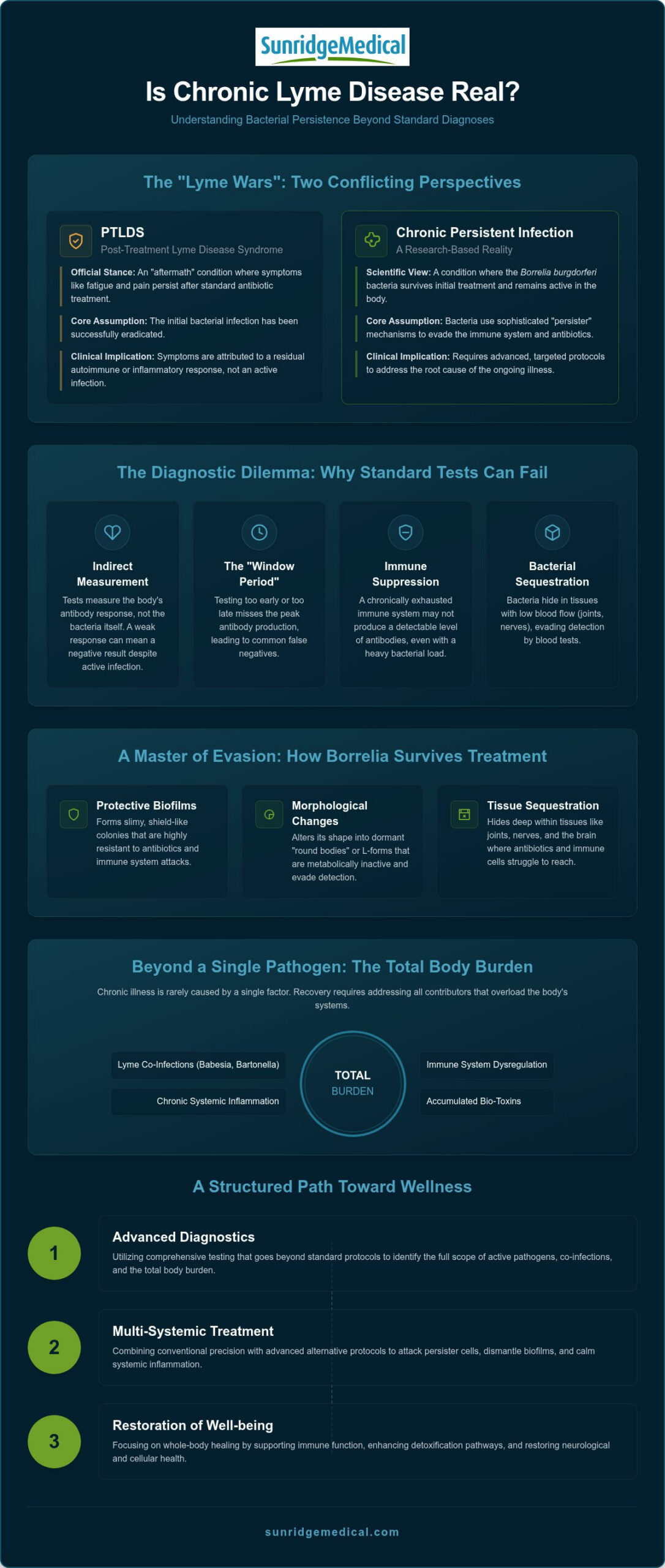
The CDC and other mainstream organizations utilize the term Post-Treatment Lyme Disease Syndrome (PTLDS) to describe patients who experience fatigue, pain, or joint aches lasting more than six months after completing standard antibiotic therapy. This classification relies on the assumption that the initial infection was successfully eradicated and that the remaining symptoms are merely “debris” or an autoimmune malfunction. PTLDS serves as a clinical placeholder for unresolved symptoms when conventional tests no longer show an active infection. However, this definition is often too narrow for clinical practice. It fails to account for the biological complexity of the pathogen and leaves patients without a clear path forward once they have checked the boxes of standard care.
The Argument for Chronic Persistent Infection
A growing body of research suggests that Borrelia burgdorferi, the bacteria responsible for Lyme, possesses sophisticated survival mechanisms that allow it to persist in the body. Emerging studies have demonstrated that these bacteria can survive even aggressive courses of antibiotics by hiding in tissues where blood flow is minimal. Patient advocacy groups have been instrumental in shifting the narrative, pushing for a deeper investigation into how these “persister” cells function. Many lyme disease specialists now view this condition as a multi-systemic, persistent infection that requires more than a one size fits all approach. By recognizing that the pathogen may still be active, we can move toward more advanced, targeted protocols that address the root cause of your continued illness.
Why Standard Diagnostic Tests Often Fail to Detect Persistent Infection
The diagnostic journey for Lyme disease is frequently a source of immense frustration. Standard two-tier testing, which includes the ELISA and Western Blot, is designed to measure the body’s immune response rather than the presence of the bacteria itself. This distinction is critical. If your immune system is suppressed or if the bacteria has sequestered itself in deep tissues, your body may not produce a detectable level of antibodies. Consequently, many individuals are left wondering is chronic lyme disease real when their lab reports indicate a negative result despite a clear clinical picture of physical decline.
The “Window Period” also presents a significant challenge. If testing occurs too early, the body hasn’t had time to mount a detectable response. Conversely, in late-stage cases, antibody depletion can occur as the immune system becomes exhausted or the bacteria shifts into “stealth” modes. A negative test result is not a definitive exclusion of illness; it is simply a snapshot of a specific immune marker at a single point in time. Relying solely on these snapshots often leads to a cycle of misdiagnosis and delayed care.
The Limitations of Antibody-Based Testing
Borrelia burgdorferi is a master of biological evasion. It can downregulate the very immune markers that tests are designed to find, effectively “hiding” from the immune system. Early use of antibiotics can also interfere with the seroconversion process. If treatment was started immediately but was insufficient to fully eradicate the pathogen, it may prevent the development of a robust antibody response. Advanced diagnostic alternatives, such as PCR technology or ELISPOT, offer a more nuanced view by looking for bacterial DNA or cellular immune activity, providing a clearer picture for those seeking comprehensive diagnostic clarity.
Clinical Diagnosis: The Physician’s Role
The CDC acknowledges that Post-Treatment Lyme Disease Syndrome (PTLDS) is characterized by persistent symptoms, yet many practitioners rely exclusively on laboratory confirmation to justify treatment. A skilled physician must prioritize the clinical presentation over a piece of paper. This involves evaluating multi-systemic symptoms such as migratory joint pain, cognitive impairment, and autonomic dysfunction. Physical markers often extend far beyond the classic bullseye rash, which may not appear in up to 30% of cases. Thorough, individualized evaluations are essential to prevent lyme disease long term consequences that can arise from infections that standard tests simply fail to see.
The Science of Survival: How Borrelia Burgdorferi Evades Conventional Treatment
Standard medical guidelines often suggest that a brief course of antibiotics is sufficient to eradicate Borrelia burgdorferi. This perspective overlooks the sophisticated biological reality of the pathogen. Borrelia is a highly evolved organism with a genome far more complex than most other bacteria. Its ability to survive in the host is not an accident; it’s a result of specialized survival mechanisms. When patients ask is chronic lyme disease real, they’re often seeking an explanation for why their bodies haven’t cleared the infection despite following the standard rules. The answer lies in the bacteria’s ability to undergo morphological changes and sequester itself within human cells, such as fibroblasts and endothelial cells, where it remains shielded from the immune system.
The persistence of symptoms is often categorized as Post-Treatment Lyme Disease Syndrome (PTLDS), a term that implies the infection has passed while the damage remains. However, clinical research into “persister” cells reveals a different narrative. By entering a state of metabolic shutdown, these bacteria become invisible to drugs that target active cell wall synthesis. This allows the pathogen to survive in a dormant state for extended periods, hidden in areas where blood flow is minimal and antibiotic concentration is low. This isn’t a failure of the patient’s willpower; it’s a testament to the bacterium’s resilience.
Biofilms and Antibiotic Resistance
Biofilms represent one of the most significant barriers to successful recovery. These complex, extracellular matrices act as a physical shield, encasing bacterial colonies in a protective glue that oral medications struggle to penetrate. Within these colonies, bacteria communicate through biochemical signals to coordinate their survival. Because standard protocols don’t always account for this physical barrier, the infection can remain entrenched in the body’s connective tissues. A multifaceted treatment strategy is required to disrupt these matrices and reach the pathogens hiding within deep tissues. We focus on protocols that address these barriers directly, ensuring that treatment reaches the areas where the bacteria are most protected.
Cyst Forms and Dormancy
When exposed to environmental stressors like changes in pH or the presence of antibiotics, Borrelia burgdorferi can transform from its motile spirochete shape into pleomorphic cyst or “round body” forms. This transformation is a tactical retreat that allows the bacteria to endure harsh conditions that would kill less sophisticated organisms. Once the antibiotic pressure is removed and the physiological environment stabilizes, these pleomorphic cyst forms can revert into motile, pathogenic spirochetes, effectively re-igniting the infection. This cycle of dormancy and reactivation explains why many patients experience a relapse of symptoms shortly after completing a conventional treatment course. Recognizing this “persister” cell phenomenon is essential for designing a clinical path that leads to long-term wellness.
Identifying the Total Body Burden: Why Symptoms Persist After Antibiotics
The persistence of symptoms following standard antibiotic therapy often leads patients to ask is chronic lyme disease real, but the answer requires looking at the “total body burden.” Recovery is rarely hindered by a single pathogen alone. Instead, a complex interplay of co-infections, environmental toxins, and systemic dysfunction creates a state of chronic illness that oral antibiotics cannot resolve. When the body is overwhelmed by multiple stressors, the immune system loses its ability to self-regulate, leading to a cascade of inflammatory responses that linger long after the initial bite.
One of the most overlooked factors is mitochondrial dysfunction. These cellular powerhouses are often damaged by the “cytokine storm” triggered during an infection. When mitochondria fail to produce energy efficiently, the result is the profound, debilitating fatigue that characterizes the chronic state. This isn’t a psychological issue; it’s a measurable physiological breakdown at the cellular level that requires targeted, metabolic support to correct.
The Impact of Tick-Borne Co-infections
Ticks are often “nature’s syringe,” carrying a cocktail of pathogens including Babesia, Bartonella, and Ehrlichia. A “Lyme-only” focus frequently leads to treatment failure because these co-infections require different clinical approaches. For example, Babesia is a parasite that infects red blood cells, while Bartonella targets the vascular endothelium. These pathogens amplify symptoms and suppress the immune system, making it nearly impossible for the body to clear Borrelia on its own. Comprehensive testing for a broad spectrum of pathogens is a non-negotiable step in understanding why you still feel sick. Addressing these hidden layers is essential for reducing the overall burden on your system.
Immune Dysregulation and Autoimmunity
Persistent infection can trigger a “self-attack” mechanism where the immune system, in its attempt to find hidden bacteria, begins to target the body’s own tissues. This is particularly evident in the neurological system, where chronic inflammation leads to brain fog, memory loss, and cognitive decline. By addressing these underlying mechanisms, we can move away from the reductive question of is lyme disease permanent and focus instead on immune restoration. Progress is possible when we provide the specialized support your system needs to heal from within. If you’re ready to look beyond standard care, we invite you to explore our specialized chronic Lyme disease treatment options designed to address your unique clinical needs.
Beyond Standard Protocols: The Sunridge Medical Approach to Chronic Recovery
Standard care often leaves patients in a state of clinical limbo, where symptoms are managed but the underlying cause remains unaddressed. When conventional systems reach their limits, a more sophisticated approach is required to facilitate true healing. For those who have been told their tests are clear yet remain bedbound, the question of is chronic lyme disease real is answered through a more advanced diagnostic lens. Our philosophy at Sunridge Medical is rooted in the belief that persistent illness requires a departure from “packaged” care in favor of individualized, high-impact protocols. We bridge the gap between conventional medical precision and the leading edge of research-based alternative therapies to provide a path forward for those the system has left behind.
A cornerstone of our methodology is the use of specialized IV protocols. These treatments allow for the delivery of targeted agents directly into the bloodstream, bypassing the digestive limitations and malabsorption issues that often plague patients with chronic infections. By delivering high concentrations of therapeutic agents where they are needed most, we can address deep-seated pathogens and systemic inflammation more effectively than oral medications alone. This methodical approach focuses on restoring your internal terrain, creating an environment where the body’s natural defense systems can finally regain control.
Advanced Integrative Therapies
We utilize a multi-faceted array of therapies designed to target the survival mechanisms of Borrelia burgdorferi. This includes oxidative therapies and customized nutritional infusions that support cellular repair and immune function, such as intravenous vitamin C, which achieves near-complete bioavailability by bypassing the digestive system entirely. These protocols are specifically engineered to:
- Disrupt the extracellular matrix of biofilms that shield bacterial colonies.
- Support mitochondrial health to address the root cause of profound chronic fatigue.
- Target persistent pathogens at the cellular level where they often hide.
Our focus remains on the whole person. We don’t just treat a lab value; we address the complex interplay of co-infections and environmental stressors that contribute to your unique clinical picture. This level of customization ensures that every aspect of your “total body burden” is systematically reduced.
Your Path to Clinical Progress
A consultation at Sunridge Medical represents a shift from being a “case number” to being a partner in your own recovery. Our individualized physician evaluations are deep dives into your medical history, environmental exposures, and current physiological state. We act as your scientific guide, providing the steady hand and deep technical knowledge needed to navigate these complex health journeys. It’s time to move beyond the frustration of being overlooked. If you’re ready to start a structured, research-based journey toward wellness, contact Sunridge Medical to discuss your individualized recovery plan and discover the possibility of progress.
Moving Toward a New Standard of Clinical Recovery
The journey through chronic illness is often defined by a search for validation and effective answers. We’ve explored how Borrelia burgdorferi utilizes sophisticated survival mechanisms like biofilms and metabolic dormancy to evade standard treatments. For those who continue to struggle, the question of is chronic lyme disease real finds its answer in the clinical reality of systemic inflammation and the total body burden of co-infections. Understanding these complex biological truths is the first step in moving from a state of being stuck to a path of actual progress.
Sunridge Medical has spent over 20 years refining research-based integrative protocols that address these deep-seated challenges for patients seeking advanced care from across the country. Our approach prioritizes your unique physiological needs over standardized, one size fits all templates. It’s time to work with a dedicated advocate who understands the science of persistence and the mechanics of restoration. Schedule your comprehensive physician evaluation at Sunridge Medical to begin a structured, evidence-based journey toward the quality of life you deserve. Hope is not just a feeling; it’s a clinical outcome we strive for every day.
Frequently Asked Questions
Is chronic Lyme disease a recognized medical condition in 2026?
The recognition of this condition often depends on the clinical terminology employed by specific medical institutions. While mainstream guidelines typically utilize the term Post-Treatment Lyme Disease Syndrome (PTLDS), many pioneering researchers and specialists acknowledge that the symptoms are a tangible physiological reality. For patients asking is chronic lyme disease real, the medical community is increasingly focusing on the biological mechanisms of persistence rather than just the label.
Why did my Lyme test come back negative if I still have symptoms?
Standard diagnostic tests like the ELISA and Western Blot measure your immune system’s response rather than the presence of the bacteria itself. If the pathogen has sequestered in deep tissues or if your immune system is suppressed, your antibody levels may fall below the detectable threshold. This often results in a false negative despite the presence of active, multi-systemic symptoms that require a more sophisticated diagnostic approach.
Can Lyme disease cause long-term neurological damage?
Chronic inflammation triggered by persistent infection can indeed lead to significant neurological complications. Patients often report cognitive decline, memory impairment, and profound brain fog as the pathogen impacts the central nervous system. Addressing these symptoms requires a comprehensive protocol that focuses on reducing the inflammatory burden and supporting neural repair through advanced integrative therapies that target the root cause of the dysfunction.
What is the difference between PTLDS and chronic Lyme disease?
The primary difference lies in the clinical assumption regarding bacterial activity. PTLDS is a term used by mainstream medicine to describe lingering symptoms under the assumption that the initial infection was successfully eradicated. In contrast, the term chronic Lyme typically refers to a state where the bacteria remains active or dormant in the body, requiring targeted interventions to address the persistence of the pathogen itself.
How long does it typically take to recover from chronic Lyme?
Recovery timelines are highly individualized and depend on the complexity of your total body burden. Factors such as the duration of the infection, the presence of co-infections like Bartonella, and the degree of immune dysregulation all influence the pace of progress. A structured, multi-faceted treatment plan focuses on steady, sustainable restoration rather than a quick fix, ensuring that every layer of the illness is addressed over several months.
Are there alternative treatments for Lyme disease that actually work?
Advanced integrative therapies, including oxidative protocols and intravenous vitamin C nutritional infusions, have shown significant clinical utility in managing persistent symptoms. These methods are designed to bypass the digestive system and deliver therapeutic agents directly to the tissues where they are needed most. By combining conventional precision with research-based alternative medicine, it’s possible to address the survival mechanisms that standard oral antibiotics often miss.
What happens if chronic Lyme disease is left untreated?
Leaving a persistent infection unaddressed can lead to the progression of multi-systemic complications. This may include worsening neurological dysfunction, chronic joint degradation, and persistent autonomic issues that significantly diminish your quality of life. Early intervention with a comprehensive evaluation is essential to halt this progression and begin the process of systemic restoration before the damage becomes more entrenched in the body’s tissues.
Why don’t standard antibiotics cure everyone with Lyme disease?
Standard antibiotics primarily target bacteria that are actively dividing and circulating in the bloodstream. Borrelia burgdorferi can evade these drugs by forming protective biofilms, shifting into dormant cyst forms, or hiding within human cells. These survival tactics render conventional short-term antibiotic courses ineffective for many patients, necessitating a more targeted and comprehensive clinical strategy to reach the pathogen in its various forms.