


If you’ve been told that your lingering fatigue and migratory joint pain are simply the new normal, you’re likely facing the heavy question: is lyme disease permanent? It’s a valid concern for the hundreds of thousands of people who find themselves trapped in a cycle of persistent symptoms despite completing standard antibiotic courses. You’ve likely felt the frustration of negative test results that don’t match your physical reality, leaving you feeling overlooked by a medical system that often lacks the tools to address complex, chronic recovery.
The truth is that while the damage can feel lasting, your condition doesn’t have to be a life sentence. This article will help you understand why your body remains in a state of systemic dysregulation and how an advanced, integrative approach can help reverse what feels like a permanent state of illness. We’ll examine the biological mechanisms that keep you stuck, the significance of 2026 diagnostic advancements like the FDA-cleared iDart™ Immunoblot tests, and a clinical roadmap designed to break the cycle of chronic illness and restore your well-being through precision medicine.
Key Takeaways
- Understand why many patients ask is lyme disease permanent and learn the clinical distinction between a simple infection and long-term systemic dysregulation.
- Discover how Borrelia burgdorferi utilizes protective biofilms and pleomorphic forms to evade standard antibiotic treatments and persist in the body.
- Identify the role of the Cell Danger Response and mitochondrial dysfunction in trapping your physiology in a perpetual state of defense.
- Explore why advanced diagnostic testing and systemic detoxification are critical steps for those who have failed to find relief through conventional protocols.
- Gain insight into how a customized, research-based integrative approach can help reverse chronic symptoms and restore your cellular health.
Is Lyme Disease Permanent? Understanding the Clinical Reality
The central question patients bring to our clinic is: is lyme disease permanent? From a clinical perspective, the answer is nuanced. While the infection itself is not inherently a lifelong sentence, the systemic dysregulation it triggers can certainly feel like one. Many individuals find themselves trapped in a state where the initial bacterial threat has been addressed by standard protocols, yet their bodies remain in a state of high alert or “injury.” This distinction is critical because it shifts the focus from simply killing a pathogen to restoring a fractured biological system.
Standard medical diagnostics often complicate this journey. Traditional blood tests, such as the ELISA or Western Blot, are designed to detect the immune system’s response rather than the presence of the bacteria itself. For chronic patients, these tests frequently return negative results because the immune system has become exhausted or the bacteria has migrated into deep tissues. Consequently, many are told they are healthy while their physical reality suggests otherwise. A clinical diagnosis must therefore evaluate whether the condition is an active, persistent infection or a state of physiological aftermath where the body has lost its ability to return to homeostasis.
Active Infection vs. Physiological Aftermath
Clinicians often discuss the “hit and run” hypothesis regarding Lyme disease. This theory suggests that the bacteria can initiate a self-perpetuating immune response that continues to cause damage even after the primary infection has been suppressed. The complexity of the recovery path is usually dictated by the duration of the untreated infection; the longer the bacteria resides in the host, the more intricate the web of systemic complications becomes. When evaluating whether is lyme disease permanent, it’s essential to recognize that “permanent” is often a misnomer for unaddressed systemic damage that requires a more sophisticated intervention than standard care provides.
The Fallacy of the ‘Cured’ Patient
Finishing a 21-day course of doxycycline is frequently touted as a total cure, yet this timeline rarely accounts for the complexity of disseminated disease. When symptoms persist after this window, patients are often labeled with Post-Treatment Lyme Disease Syndrome (PTLDS). This label can be psychologically devastating, as it suggests the symptoms are a mysterious “syndrome” with no clear solution. For those questioning is chronic lyme disease real, the clinical evidence of bacterial persistence and systemic inflammation provides critical validation that these symptoms are not imagined. It’s vital to address the Lyme disease long term consequences through a lens of physiological repair rather than just antimicrobial suppression. Feeling “stuck” is a biological reality, but with an advanced integrative approach, it doesn’t have to be your final destination.
Why Symptoms Persist: The Stealth Mechanisms of Borrelia
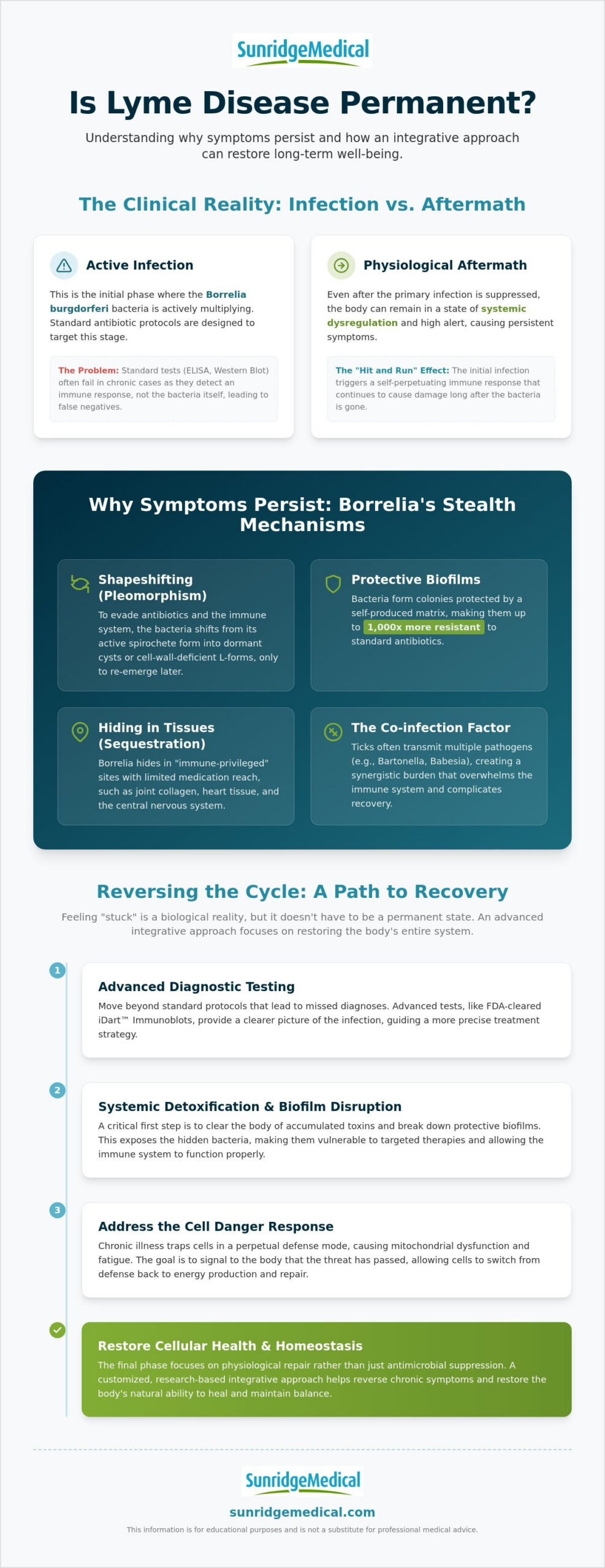
The primary reason patients question if is lyme disease permanent is the sophisticated survival strategy of Borrelia burgdorferi. This pathogen is not a static target; it is highly pleomorphic. When the bacteria senses a hostile environment, such as the introduction of standard antibiotics, it can shift from its active spirochete form into dormant cysts or cell-wall-deficient L-forms. This shapeshifting ability allows the bacteria to evade the immune system and wait out short-term treatment cycles, only to re-emerge when the threat has passed.
Persistence is further complicated by tissue sequestration. Borrelia has a predilection for “immune-privileged” sites where the body’s natural defenses and standard medications have limited reach. It often hides deep within the collagen of joints, the tissues of the heart, and the complex structures of the central nervous system. This deep-seated colonization is frequently exacerbated by the “Co-infection Factor.” Ticks rarely carry only one pathogen. Secondary infections like Bartonella and Babesia create a synergistic burden that overwhelms the immune system, making symptoms feel fixed and immovable.
The Biofilm Challenge
A major barrier to recovery is the role of biofilms. Bacteria often aggregate into complex colonies protected by a self-produced extracellular matrix. These biological shields act as a fortress, making the bacteria up to 1,000 times more resistant to standard antibiotic concentrations than free-floating cells. Standard oral protocols often fail to penetrate these protective layers effectively. To achieve a true clinical breakthrough, a comprehensive protocol must include specific biofilm disruptors designed to strip away these defenses and expose the underlying infection.
Neurologic Sequestration
One of the most distressing experiences for chronic patients is the feeling of cognitive decline. Because Borrelia can cross the blood-brain barrier, it often triggers chronic neuro-inflammation. This manifests as profound brain fog, memory lapses, and mood instability, leading many to fear that their cognitive impairment is a permanent change. Addressing these neurologic complications requires the expertise of Lyme disease specialists who utilize protocols capable of reaching the central nervous system.
While the CDC acknowledges Post-Treatment Lyme Disease Syndrome (PTLDS) as a state of lingering symptoms, this label often fails to account for these active stealth mechanisms. Understanding that your symptoms are driven by biological evasion rather than “permanent damage” is the first step toward a successful recovery. The clinical evidence supporting the science of bacterial persistence makes clear that these stealth mechanisms are real and measurable, not a product of patient imagination. If you feel stuck in your current protocol, it may be time to explore how a more targeted, research-based approach can address these hidden drivers of illness.
The Multi-System Impact: Why Lyme Feels Like a ‘Forever’ Illness
When symptoms persist for months or years, patients naturally begin to wonder: is lyme disease permanent? The feeling of a “forever” illness usually stems from the fact that Borrelia does not just affect one organ; it orchestrates a multi-system breakdown. This transition occurs when the body shifts from fighting an active invader to being trapped in a self-perpetuating loop of dysfunction. Even if the bacterial load is reduced, the biological “machinery” of the host often remains broken, leading to a state of chronic illness that standard medicine struggles to categorize.
A primary driver of this stagnation is the Cell Danger Response (CDR). This is a metabolic state where cells detect a threat and shift their resources away from healing and toward defense. In a healthy body, this response is temporary. In chronic Lyme patients, the “off switch” for the CDR is often stuck. The body continues to act as if it is under siege, prioritize survival over repair, and maintain high levels of systemic inflammation. This results in a “cytokine storm,” a flood of inflammatory proteins that creates a cycle of pain, brain fog, and localized tissue damage that feels impossible to break.
Mitochondrial Exhaustion and Chronic Fatigue
Rest does not fix the fatigue associated with chronic Lyme because the problem is cellular, not behavioral. The bacteria and the resulting inflammation actively drain the body’s cellular energy production. Borrelia can “steal” essential nutrients and lipids required for the production of ATP, the primary energy currency of the cell. This leads to profound mitochondrial dysfunction. Healing stops. Defense begins. Reversing this “permanent” fatigue requires more than just sleep; it necessitates targeted protocols that restore mitochondrial health and provide the specific building blocks needed for cellular repair.
The Immune System’s ‘False Alarm’
The immune system can remain in a state of hyper-arousal long after the initial threat has been addressed. This is often described as Post-Treatment Lyme Disease Syndrome, but the label doesn’t fully capture the underlying mechanism of molecular mimicry. In this state, the immune system begins attacking healthy tissue because the proteins of the bacteria look remarkably similar to the body’s own proteins. The illness has transitioned from a simple infection to a complex inflammatory and autoimmune condition. At this stage, the clinical focus must shift. We move from “killing the pathogen” to “balancing the system.” Success depends on calming the immune response and restoring the body’s natural homeostatic balance.
Reversing the Cycle: A Comprehensive Path to Recovery
When conventional antibiotic cycles fail to provide relief, it’s natural to fear that the damage is final. However, asking is lyme disease permanent often reveals a need for a shift in strategy rather than an admission of defeat. Recovery from chronic, disseminated infection requires a methodical progression that addresses the body’s entire ecosystem. By moving beyond simple antimicrobial suppression, we can begin to dismantle the self-perpetuating loop of inflammation and cellular dysfunction that characterizes long-term illness.
A truly comprehensive recovery path follows a structured clinical roadmap:
- Advanced Diagnostic Testing: We look beyond standard Western Blot limitations. In 2026, utilizing FDA-cleared advancements like the iDart™ Immunoblot tests allows for a more precise identification of the bacterial burden.
- Addressing the Total Toxic Burden: The immune system cannot effectively target pathogens if it’s preoccupied with environmental toxins. Detoxifying the body from heavy metals and mold is essential to lower the systemic load.
- Immune Modulation: Instead of simple suppression, we focus on calming the overactive immune response. This stops the “false alarm” and prevents the body from attacking its own healthy tissues.
- Cellular Repair: As established, mitochondrial health is the engine of recovery. We prioritize restoring ATP production and cellular integrity to pull the body out of the Cell Danger Response.
- Targeted Antimicrobial Support: Using advanced protocols, we can finally reach sequestered bacteria hiding within biofilms and deep tissues.
The Role of Specialized IV Therapies
Intravenous delivery is often a cornerstone for patients who have plateaued on oral medications. IV protocols ensure that high concentrations of therapeutic agents reach the bloodstream and sequestered tissues directly, bypassing the compromised digestive systems of chronic patients. These specialized infusions deliver the precise nutrients required to restore cellular function while simultaneously addressing persistent pathogens. For example, intravenous vitamin C achieves nearly 100 percent bioavailability by bypassing the gut entirely, making it a powerful tool for restoring immune function and reducing systemic inflammation in chronic Lyme patients. This direct approach is frequently what allows a patient to move from “managing” symptoms to achieving a clinical breakthrough. If you are ready to move toward a more targeted solution, explore our Chronic Lyme Disease Treatment protocols.
Restoring the Gut-Brain-Immune Axis
Long-term antibiotic use, while often necessary in early stages, can inadvertently damage the microbiome and hinder long-term recovery. This disruption affects the gut-brain-immune axis, where gut health directly influences the “permanence” of neurologic symptoms like brain fog and mood dysregulation. Repairing the gut lining is vital for reducing systemic inflammation and ensuring the immune system is properly educated. By focusing on this axis, we address the root of neuro-inflammation and provide a foundation for lasting cognitive clarity.
Advanced Integrative Protocols at Sunridge Medical
At Sunridge Medical, we believe that the question of whether is lyme disease permanent is best answered through the lens of clinical results rather than standard labels. Our philosophy is rooted in a fundamental shift: we treat the patient, not just the pathogen. While conventional medicine often remains focused on a standardized antimicrobial approach, we recognize that chronic Lyme is a multi-layered condition that requires a more sophisticated, research-based intervention. Since our founding in 2003, we’ve positioned ourselves as a scientific guide for those who have been told by the traditional system that their symptoms are irreversible.
Our approach combines clinical authority with a deep sense of compassionate optimism. Every person who enters our doors undergoes an individualized physician evaluation that looks far beyond a basic symptom checklist. We examine the whole human experience, including neurologic complications, autoimmune markers, and environmental influences. By blending conventional wisdom with advanced alternative medicine, we create a sanctuary for patients who have felt overlooked or abandoned by the status quo. We don’t accept the idea of “no hope”; instead, we seek the precision required to restore your well-being.
Individualized Patient Care Plans
One-size-fits-all protocols consistently fail in chronic Lyme cases because the disease behaves differently in every host. The way Borrelia interacts with your specific metabolic markers and unique set of co-infections dictates the complexity of your recovery. We customize every protocol to address these variables, ensuring that your treatment is as unique as your biology. This level of customization requires ongoing monitoring and frequent adjustments. As your body begins to heal and the systemic burden shifts, our physicians adapt your care plan to maintain progress and avoid the plateaus so common in standardized care.
A Supportive Path Forward
Empowerment is a vital component of the healing process. We provide every patient with a clear clinical roadmap, replacing the uncertainty of chronic illness with a structured path toward progress. For those seeking a second opinion or a new perspective on their journey, our 1-800 support line serves as a resource for national patients who feel stuck in their current medical trajectory. We’re here to offer the steady hand and specialized attention necessary to navigate these complex health challenges. If you are in the Phoenix area and require immediate, accessible medical assistance at home, YA Medical provides mobile urgent care and house-call doctor services to support you during difficult flare-ups. The fear that is lyme disease permanent doesn’t have to define your future. With the right tools and a multi-faceted strategy, the restoration of your health is a tangible goal.
Schedule a consultation with a Sunridge Medical specialist today to discover how our advanced integrative protocols can help you reclaim your life.
A New Horizon for Chronic Recovery
The persistent cycle of fatigue and pain often leads patients to believe their condition is unchangeable. However, understanding the stealth mechanisms of Borrelia reveals that the question of is lyme disease permanent is more about the limitations of standard care than the reality of your biology. By addressing mitochondrial exhaustion and dismantling protective biofilms, we move beyond simple symptom management toward genuine systemic repair. Our clinical experience shows that even the most complex cases can find a path forward when the focus shifts to restoring cellular energy and balancing the immune response.
Sunridge Medical has spent decades refining this advanced approach. Since our founding in 2003, we’ve provided a sanctuary for patients across the United States who have failed to find relief through conventional systems. We utilize individualized, research-based protocols designed to restore your cellular integrity and calm a hyper-active immune system. You don’t have to navigate this journey alone. We invite you to Request a Personalized Clinical Evaluation for Chronic Lyme Disease and take the first step toward a restorative future. There is always a possibility for progress; your recovery journey starts with a dedicated scientific guide.
Frequently Asked Questions
Can Lyme disease be cured after 10 years of symptoms?
Clinical recovery is possible even after a decade of illness. While the recovery path for long-term patients is more complex, the body’s capacity for restoration remains significant when the focus shifts from simple antimicrobial use to systemic repair. We prioritize addressing mitochondrial dysfunction and immune dysregulation to help patients who have been symptomatic for years find lasting relief.
Does Lyme disease stay in your DNA forever?
No, Lyme disease does not integrate into your genetic code. Borrelia burgdorferi is a bacterium that resides in tissues and fluids rather than a virus that alters DNA. While it can trigger epigenetic changes or persistent immune responses that make you wonder is lyme disease permanent, it does not become a permanent part of your DNA.
Why do I still feel sick after taking 30 days of antibiotics?
Standard 30-day antibiotic courses often fail because they don’t address the bacteria’s ability to hide in biofilms or shift into dormant forms. If symptoms persist, the infection may have sequestered into deep tissues or triggered a chronic state of cellular defense. This requires a more targeted approach to reach the hidden bacteria and calm the resulting systemic inflammation.
Is the damage to my joints and nerves from Lyme disease permanent?
Physical damage is not necessarily final. While chronic inflammation can cause significant wear on joints and nerves, the body possesses remarkable regenerative capabilities. Reversing the “permanent” feeling of neuropathy and joint pain requires a protocol that calms the autoimmune response and provides the specific cellular building blocks needed for tissue repair.
What is the difference between Chronic Lyme and PTLDS?
“Chronic Lyme” generally refers to a persistent, active infection that requires ongoing treatment. The term Post-Treatment Lyme Disease Syndrome (PTLDS) is used by the CDC to describe lingering symptoms after antibiotics where the cause is officially labeled as unknown. Clinically, we view these as a system that hasn’t fully cleared the pathogen or recovered from the multi-system damage it caused.
Can Lyme disease cause permanent brain fog?
Brain fog is typically a functional issue driven by neuro-inflammation and mitochondrial exhaustion rather than structural brain damage. When the underlying inflammation is reduced and cellular energy production is restored, cognitive clarity often returns. This suggests that the cognitive impairment patients experience is a reversible state of dysfunction rather than a permanent loss of capability.
Are there alternative treatments for Lyme when antibiotics fail?
Advanced integrative medicine offers several research-based protocols when standard antibiotics reach their limit. These include specialized IV therapies, biofilm disruptors, and immune-modulating treatments designed to reach sequestered bacteria. Among these, intravenous vitamin C therapy has emerged as a clinically recognized option for reducing treatment-related toxicity and supporting immune function at a cellular level. These methods address the root causes of persistence and the multi-system impact that conventional oral antibiotics often miss.
How do I know if my Lyme infection is still active?
Determining if an infection is active requires looking beyond the limitations of a standard Western Blot. In 2026, we utilize advanced diagnostics like the FDA-cleared iDart™ Immunoblot to detect specific bacterial markers. A comprehensive clinical evaluation of your current symptoms, toxic burden, and immune status provides a much clearer picture of your status than a simple blood test.