


You've finished the antibiotics, yet years later you're still waking up exhausted, dealing with migrating pain, or searching for a word that used to come easily. One clinician says the infection is gone. Another suggests more antibiotics. Meanwhile, your daily life continues to shrink around symptoms no one can clearly explain.
Lyme disease treatment after years requires a more precise question than, “How do I kill the infection again?” The first question is whether there's objective evidence of active Lyme disease, or whether you're experiencing Post-Treatment Lyme Disease Syndrome, tissue injury, reinfection, a coinfection, or another condition that resembles Lyme. That distinction determines whether antibiotics are appropriate, whether a specialist evaluation is needed, and where rehabilitation or symptom-focused care belongs.
Table of Contents
- When Lyme Symptoms Persist for Years
- Active Infection Versus Post-Treatment Syndrome
- Why Extended Antibiotics Often Fail
- The Systematic Reassessment Process
- Multimodal Treatment Strategies That Work
- Managing Specific Persistent Symptoms
- How Sunridge Medical Approaches Persistent Lyme
When Lyme Symptoms Persist for Years
A patient may arrive carrying a thick folder of test results and treatment dates. They may describe fatigue that makes ordinary errands feel like endurance events, joint or muscle pain that changes location, and cognitive difficulty that affects work, conversations, and planning. Often, the most painful part is not only the symptoms. It's being told that normal-looking routine tests mean nothing serious is happening.
Persistent symptoms after Lyme disease are recognized in public health guidance. The CDC's Lyme disease data and clinical information notes that studies found fatigue, pain, and cognitive symptoms remained 5% to 10% more common six months after treatment among people who'd had Lyme disease than among those who had not. Peer-reviewed reviews have also reported prolonged musculoskeletal pain and cognitive symptoms in about 10% of treated patients, while another review found persistent or recurring symptoms in as many as 17% up to 12 months after treatment (NIH-hosted review).
That doesn't mean every person with years of symptoms has PTLDS. It also doesn't mean symptoms should be dismissed as imaginary or automatically attributed to active bacteria. It means the recovery pathway isn't identical for everyone, and a careful clinical framework matters.
The emotional cost of uncertainty
Years of unexplained illness can lead to missed work, reduced activity, disrupted sleep, strained relationships, and loss of confidence in your body. A patient may alternate between pursuing another antimicrobial protocol and abandoning medical care altogether. Neither reaction is irrational. Both can follow from having symptoms that are real but poorly categorized.
The phrase “chronic Lyme disease” is used widely by patients, but it can create confusion because it may imply that viable infection is continuously present. Persistent symptoms don't prove ongoing infection. They also don't prove that nothing can be done.
The useful starting point: Ask what evidence supports active infection, what evidence supports a post-infectious syndrome, and what other diagnoses could account for the current pattern.
The distinction changes treatment. Active infection may call for targeted antimicrobial therapy. PTLDS generally calls for reassessment, rehabilitation, sleep and pain management, and support for cognitive or autonomic symptoms. Tissue damage, autoimmune disease, endocrine problems, medication effects, and other disorders may require entirely different care. A practical overview of possible lasting complications appears in this clinical guide to Lyme disease long-term consequences.
Active Infection Versus Post-Treatment Syndrome
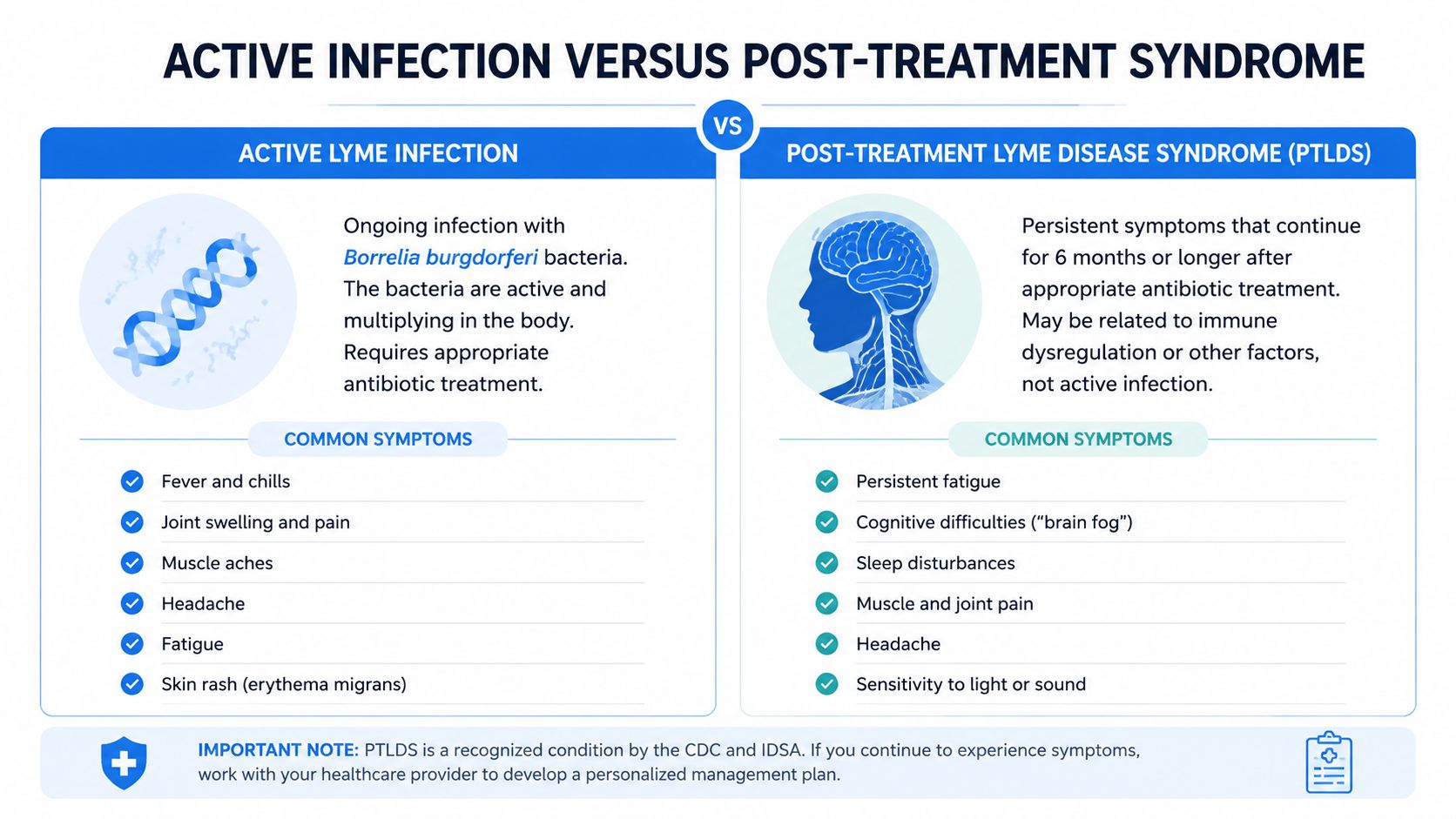
Active Lyme disease and Post-Treatment Lyme Disease Syndrome, or PTLDS, can share symptoms, but they aren't the same clinical situation. Active infection is considered when there are objective findings consistent with ongoing disease, such as Lyme arthritis, meningitis, neuropathy, or another recognized manifestation. In that setting, treatment decisions should be guided by examination, history, appropriate testing, and specialist input rather than symptoms alone.
PTLDS has a more specific framework. A commonly used case definition requires a documented Lyme episode, a recommended antibiotic course, resolution or stabilization of objective Lyme findings, and new nonspecific symptoms such as fatigue, widespread musculoskeletal pain, or cognitive difficulty. Those symptoms begin within 6 months of the Lyme diagnosis and continue for at least 6 months after treatment ends (PTLDS case definition review).
Why symptoms can continue after treatment
Symptoms may persist because the original illness caused injury or dysfunction that takes time to recover. Joint inflammation can affect function after the infection has been treated. Nervous system involvement may leave pain, sensory changes, or cognitive strain. Sleep disruption, deconditioning, autonomic symptoms, immune changes, and another undiagnosed condition can also maintain the illness experience.
The CDC states that people with prolonged symptoms usually improve over time without additional antibiotics, although recovery can take many months. It also reports that carefully conducted studies in the United States and Europe found extended antibiotic treatment was no better than placebo for curing prolonged symptoms (CDC guidance on chronic symptoms).
This is why an ongoing symptom does not automatically equal ongoing infection. The IDSA, AAN, and ACR Lyme disease guideline recommends against additional antibiotics for persistent or recurring nonspecific symptoms unless there's objective evidence of active infection or treatment failure. That recommendation doesn't ask clinicians to ignore patients. It asks them to match treatment intensity to demonstrable disease.
A more detailed discussion of the diagnostic debate is available in this evidence review of chronic Lyme disease and persistence. The practical message is straightforward: persistent symptoms deserve a medical explanation, but the explanation may not be bacterial persistence.
Why Extended Antibiotics Often Fail
The assumption that more antibiotics must produce more recovery is understandable. If symptoms began with an infection, continuing to attack the infection can feel like the safest choice. The problem is that randomized trials haven't shown prolonged antibiotic regimens to improve health-related quality of life more than placebo for persistent symptoms attributed to Lyme disease.
In the 2016 trial, patients received ceftriaxone followed by 12 weeks of doxycycline or clarithromycin-hydroxychloroquine. The prolonged regimens didn't outperform placebo after shorter-term therapy (NEJM randomized trial). Earlier controlled trials likewise found no significant benefit from 90 days of intravenous or oral antibiotics compared with placebo, while physical and mental functioning remained impaired in both groups.
The trade-off clinicians must discuss
Longer treatment isn't a stronger version of standard treatment. It brings additional exposure to medication adverse effects, drug interactions, gastrointestinal complications, allergic reactions, and complications associated with intravenous access. It can also delay investigation of sleep disorders, autoimmune disease, endocrine dysfunction, neurologic injury, pain sensitization, or other contributors.
Treatment duration depends on the Lyme manifestation. The 2020 guideline summary recommends 7 to 14 days for erythema migrans depending on the drug, 14 to 21 days for Lyme carditis and neurologic Lyme disease, and 28 days for late Lyme arthritis (IDSA clinician summary). Those regimens aren't interchangeable with indefinite antibiotics for nonspecific symptoms.
A retrospective cohort involving 607 patients found that 99% remained free of treatment failure at 2 years, whether initial therapy lasted 10 days or longer than 15 days (treatment-duration review). That finding helped support the move toward standardized courses for early disease rather than routine extension.
More treatment isn't automatically more care. If there's no objective evidence of ongoing infection, the central task becomes recovery of function and identification of other causes.
NICE guidance advises specialist discussion when symptoms persist after 2 adequate antibiotic courses. That shift protects patients from endless empiric treatment while preserving a route to expert reassessment when the clinical picture remains concerning.
The Systematic Reassessment Process
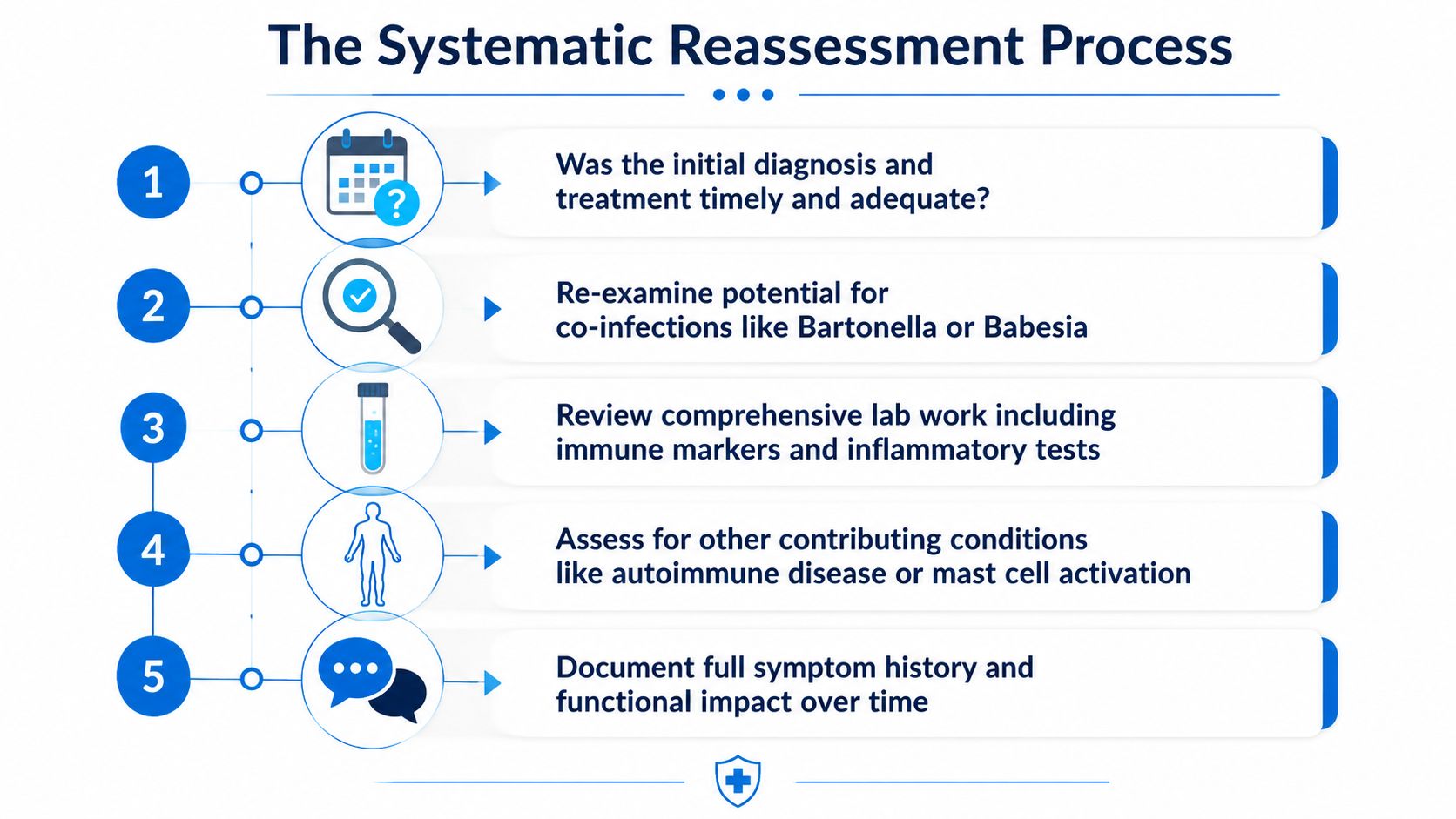
A thorough reevaluation should be structured, not a rapid decision to repeat the last treatment. The clinician needs to reconstruct the original illness, compare it with the current symptom pattern, and look for objective findings that change the diagnosis.
Start with the original episode
Review the initial symptoms, examination findings, test results, treatment dates, medication doses, adherence, and response. Ask whether the original presentation fit Lyme disease, whether the diagnosis was made early or late, and whether objective signs resolved or stabilized after treatment.
The treatment history matters, but it doesn't answer every question. Symptoms that never improved, symptoms that returned after clear improvement, and entirely new symptoms can point toward different possibilities.
Look for a current objective manifestation
The examination should focus on findings that can support active disease or a consequence of prior disease. Depending on the presentation, that may include a swollen joint, focal weakness, sensory loss, reflex changes, meningitis signs, cardiac symptoms, or another neurologic or rheumatologic finding.
A patient with objective arthritis or neuropathy requires a different conversation from a patient with isolated fatigue and brain fog. Testing should answer a clinical question rather than serve as an open-ended search for any abnormal result.
Reconsider reinfection and coinfection
New exposure to ticks can create reinfection, particularly when symptoms change after a period of recovery. Coinfections such as Babesia or Bartonella may also need consideration when the history, exposure pattern, fever pattern, blood findings, neurologic symptoms, or other clinical features make them plausible. Testing should be selected and interpreted by a clinician familiar with its limitations.
Search for overlapping conditions
Fatigue, pain, poor concentration, dizziness, and unrefreshing sleep occur in many medical conditions. A reassessment may need to consider autoimmune disease, thyroid or other endocrine disorders, anemia, nutritional problems, sleep apnea, medication effects, mood disorders, dysautonomia, mast cell activation, migraine, neuropathy, inflammatory disease, and post-viral syndromes.
That doesn't mean every patient needs every test. It means the evaluation should be guided by the history and examination, with laboratory and imaging studies chosen to clarify the most likely alternatives.
Measure function, not only symptoms
Document when symptoms occur, what worsens them, how sleep affects them, and what activities they prevent. A person may report “fatigue,” but the treatment plan differs if the problem is sleepiness, post-exertional worsening, muscle weakness, orthostatic intolerance, pain-related exhaustion, or cognitive overload.
NICE notes that persistent symptoms may take months or years to resolve, may reflect permanent damage, and that no test proves active infection in someone with ongoing symptoms. That uncertainty makes careful clinical reasoning more important, not less.
Multimodal Treatment Strategies That Work
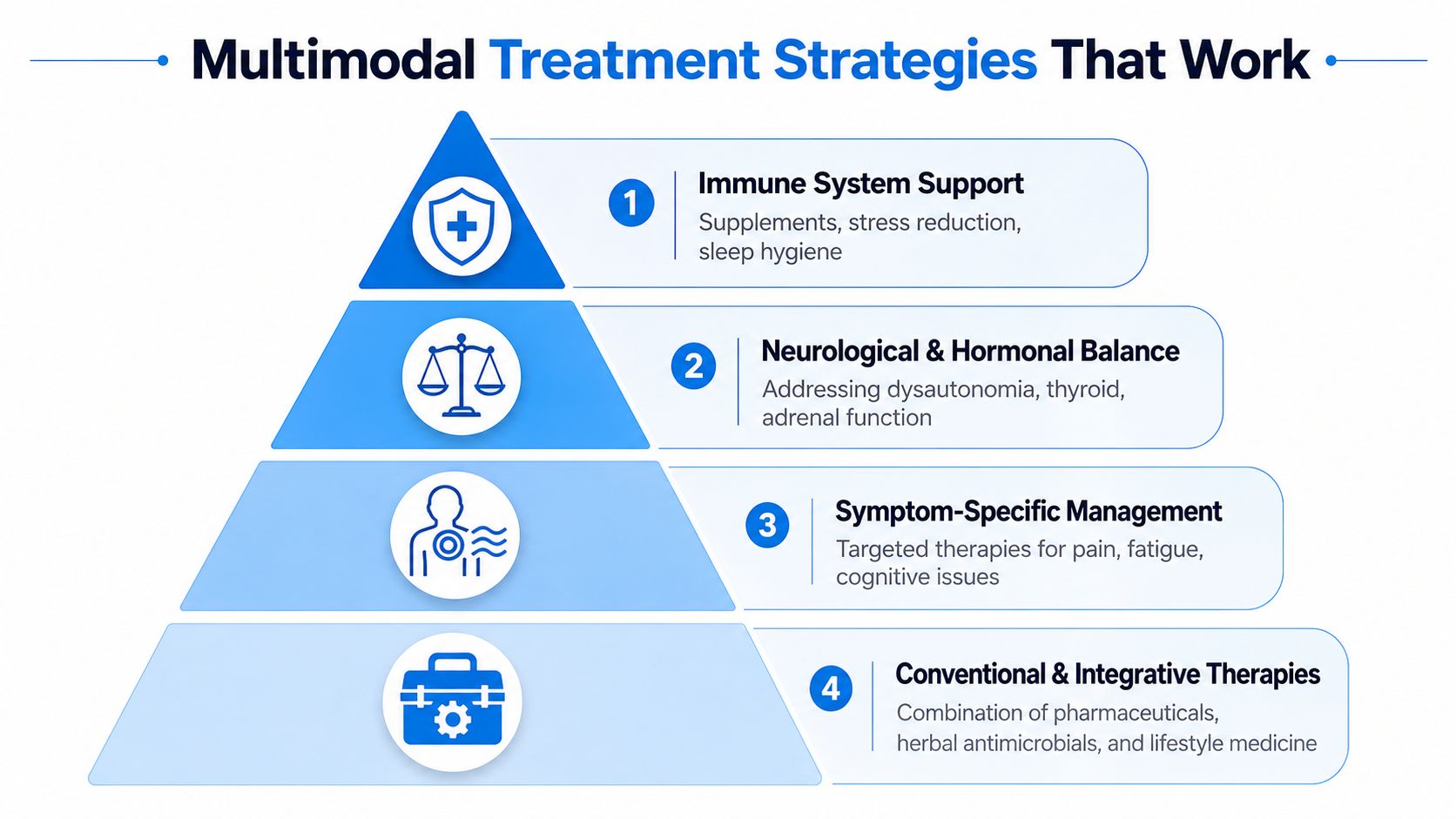
Long-term care works best when it follows the patient's dominant limitations instead of chasing a single theory. The foundation is a conventional medical assessment, medication review, and safety screening. From there, clinicians can add rehabilitation, nutritional support, sleep treatment, pain strategies, and carefully selected complementary therapies when they fit the patient's risks and goals.
Build from the basics
Sleep is not a minor lifestyle detail when poor sleep amplifies pain, worsens attention, and reduces exercise tolerance. A plan may include evaluation for sleep apnea, consistent sleep timing, medication review, treatment of restless legs or pain, and gradual restoration of daytime activity.
Rehabilitation must be paced. Someone with severe post-exertional worsening may need energy conservation and carefully titrated activity rather than a generic exercise prescription. Physical therapy can address joint mechanics, balance, strength, gait, and conditioning when the examination supports those goals.
Add targeted medical and integrative support
Nutritional assessment can identify deficiencies or inadequate intake, but supplements should be selected based on the patient's history, laboratory findings, interactions, and kidney or liver function. IV nutritional support, oxidative medicine, immune-modulating therapies, detoxification protocols, and regenerative approaches vary in evidence and should not be presented as proven cures for PTLDS.
A responsible integrative plan labels each therapy clearly. Established treatment applies to a recognized manifestation such as Lyme arthritis or neurologic disease. Supportive care may target sleep, nutrition, pain, mobility, or function. Emerging or investigational care requires informed consent about uncertainty, cost, risks, and alternatives.
Coordinate rather than compete
A patient may need a neurologist, rheumatologist, sleep clinician, physical therapist, psychologist, and primary care physician. Integrative care should coordinate those perspectives, not replace evaluation for serious disease. The aim is to reduce duplicated testing, identify interactions, and select interventions that can be monitored.
For patients exploring a clinic-based integrative model, this comprehensive guide to holistic Lyme disease treatment describes one framework for combining conventional and supportive approaches. It shouldn't be read as a promise that every modality is appropriate for every patient.
A multimodal plan also needs stopping rules. If a treatment causes a new symptom, worsens function, or offers no meaningful benefit after an agreed review, the clinician should reconsider it instead of layering on another intervention.
Managing Specific Persistent Symptoms
Symptom-focused care isn't the same as dismissing the cause. It means treating the limitation that is keeping you from working, sleeping, moving, thinking, or participating in daily life while the broader evaluation continues.
| Symptom Category | Primary Approaches | Supportive Therapies |
|---|---|---|
| Fatigue and reduced stamina | Assess sleep, anemia, endocrine contributors, medication effects, autonomic symptoms, and post-exertional worsening. Use paced activity and rehabilitation matched to tolerance. | Nutrition review, consistent sleep routines, stress regulation, and gradual functional goals. |
| Joint and muscle pain | Examine for objective arthritis, neuropathy, mechanical problems, inflammatory disease, and centralized pain. Consider physical therapy and appropriate conventional pain treatment. | Heat or cold, mobility work, strength restoration, massage, and clinician-supervised anti-inflammatory strategies. |
| Cognitive dysfunction | Review sleep, medication effects, mood, migraine, autonomic symptoms, and neurologic findings. Consider occupational or cognitive rehabilitation for specific deficits. | External memory aids, task simplification, scheduled breaks, speech-language support, and structured cognitive practice. |
| Sleep disturbance | Identify insomnia, sleep apnea, circadian disruption, restless legs, pain, and nighttime medication effects. | Sleep hygiene, behavioral therapy, relaxation training, and treatment of the identified sleep disorder. |
Match treatment to the pattern
Fatigue with orthostatic symptoms needs a different plan from fatigue caused by fragmented sleep. Joint swelling warrants examination for active inflammatory disease, while widespread pain without swelling may require a rehabilitation and nervous-system strategy. Cognitive fog that appears after poor sleep should not be managed identically to focal memory loss or progressive neurologic change.
Pain medication can help some patients, but it may also cause sedation, constipation, dependence, or cognitive worsening. Supplements and herbal products can interact with prescriptions and may affect bleeding, blood pressure, liver function, or anesthesia planning. “Natural” isn't a safety category.
Track function alongside symptom intensity. Record walking tolerance, work capacity, sleep continuity, concentration time, and recovery after activity. Those measures help determine whether a treatment is actually helping.
The best plan is usually layered and revisable. It may begin with sleep and pacing, add physical or cognitive rehabilitation, and address a confirmed medical contributor when testing identifies one. The objective is not to prove that every symptom has one cause. It's to improve meaningful function without exposing you to avoidable treatment risk.
How Sunridge Medical Approaches Persistent Lyme
Sunridge Medical in Scottsdale evaluates persistent Lyme-related symptoms through an individualized integrative process. That can include reviewing the original diagnosis and treatment, assessing current symptoms and functional limitations, considering conventional laboratory or specialist evaluation, and identifying overlapping contributors such as immune, neurologic, metabolic, sleep, or inflammatory problems.
The clinic may combine conventional care with supportive options such as IV protocols, oxidative medicine, and regenerative approaches when a clinician determines they're appropriate. These therapies require individualized screening and shouldn't be presented as guaranteed treatments for PTLDS or as substitutes for antibiotics when objective active Lyme disease is present.
For patients considering IV-based care, Sunridge Medical's information on IV therapy for chronic Lyme describes the clinic's approach to protocol development. Patients in Scottsdale, Phoenix, Paradise Valley, Tempe, Mesa, Chandler, Gilbert, and the wider Phoenix metropolitan area may seek an evaluation for a second opinion or a coordinated long-term plan. Out-of-town patients can also ask the care team about visit planning and medical record review.
The value of an integrative consultation is not the promise of one hidden cure. It's the opportunity to separate active disease from post-treatment symptoms, evaluate alternatives, and build a monitored plan around your actual recovery goals.
If you're still experiencing fatigue, pain, cognitive difficulty, or other symptoms years after Lyme treatment, Sunridge Medical can review your history and discuss whether an individualized integrative evaluation in Scottsdale is appropriate. Contact the clinic to request a consultation and learn which records, test results, and treatment history to bring.