

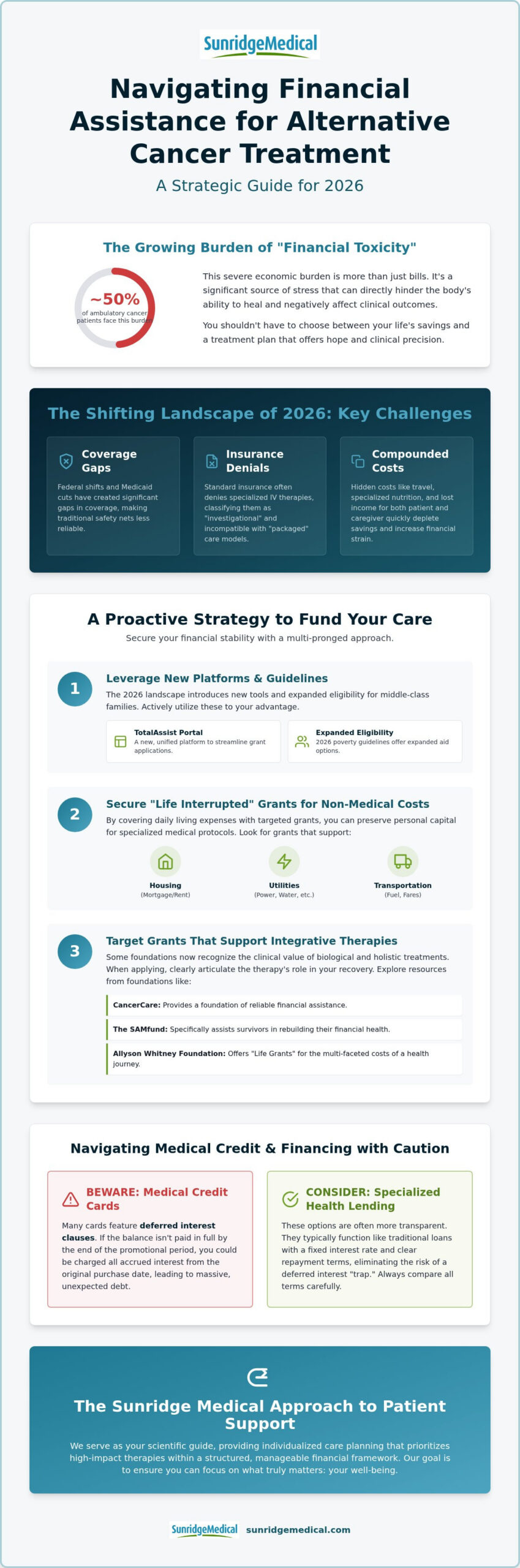
Nearly half of all patients undergoing ambulatory cancer care now experience the severe economic burden known as financial toxicity. When you’re seeking specialized IV therapies or integrative protocols that fall outside the rigid boundaries of standard insurance, this burden often feels insurmountable. You shouldn’t have to choose between your life’s savings and a treatment plan that offers a sense of clinical precision and hope.
By understanding the evolving landscape of financial assistance for alternative cancer treatment 2026, you can reclaim control over your medical journey. We’ll show you how to leverage the newly launched TotalAssist platform and navigate the 2026 federal poverty guidelines, which now offer expanded eligibility for many middle-class families. This guide provides a clear, structured path to funding your care through specialized grants and strategic financial planning. You’ll learn how to secure support for non-medical expenses, freeing up your capital for the advanced protocols you truly need. We’re here to serve as your scientific guide through these complex financial options, ensuring you have the resources to focus on your well-being.
Key Takeaways
- Identify how “financial toxicity” impacts clinical outcomes and why the 2026 landscape requires a proactive strategy to maintain treatment continuity.
- Learn how to navigate the new TotalAssist portal and expanded eligibility criteria to secure financial assistance for alternative cancer treatment 2026.
- Discover strategic “Life Interrupted” grants that cover cost-of-living expenses, allowing you to reserve your capital for specialized clinical protocols.
- Evaluate the risks of deferred interest in medical credit cards and compare them against more transparent specialized health lending options.
- Understand the value of individualized care planning in prioritizing high-impact therapies within a structured, manageable financial framework.
The 2026 Landscape of Financial Toxicity in Oncology
Financial toxicity describes the profound economic burden that patients experience during a serious illness, a burden that directly impacts clinical outcomes. It isn’t just about the bills; it’s about the stress that hinders the body’s ability to heal. In 2026, we face a distinct paradox. While precision medicine has advanced to offer highly targeted, research-based protocols, the payment systems designed to support them have become increasingly fractured. Systemic changes demand action. Recent federal shifts and significant Medicaid cuts have left many individuals with gaps in their coverage, making traditional safety nets less reliable than ever before.
This evolving environment means that seeking financial assistance for alternative cancer treatment 2026 requires a proactive and sophisticated strategy. You can’t wait for the system to catch up to the science. Instead, you must act as your own advocate, identifying private grants and specialized aid to bridge the gap between basic care and advanced clinical options. Success in this landscape depends on your ability to navigate these new economic realities with the same precision applied to your medical protocol.
Why Standard Insurance Often Fails Alternative Care
Insurers typically prioritize standardized, “packaged” care models over the individualized protocols required for complex cases. They often rely on a rigid distinction between established protocols and what they deem “investigational” therapies. This binary view frequently leads to the denial of specialized IV therapies and biological treatments, which are then billed as out-of-network expenses. Standard health insurance billing is often incompatible with the depth and customization of integrative care. Patients are frequently left to navigate these costs independently because the traditional system isn’t built to recognize the value of multi-faceted, targeted methodologies.
The Economic Impact of Complex Chronic Disease
The financial strain is rarely limited to a single diagnosis. When autoimmune or neurologic conditions overlap with a cancer journey, the economic impact compounds. Hidden costs quickly deplete savings, including travel for specialized clinics, advanced nutritional support, and the loss of income for both the patient and their primary caregiver. Integrative oncology serves as a vital bridge between conventional and alternative care, utilizing a comprehensive lens to restore well-being while managing these complex variables. Securing financial assistance for alternative cancer treatment 2026 involves more than just paying for medicine; it’s about protecting your quality of life and ensuring your clinical path remains uninterrupted by economic instability.
Charitable Grants and Non-Medical Financial Support
Strategic funding for integrative oncology requires looking beyond the clinical bill. Many patients find that by securing support for their daily overhead, they can preserve their personal savings for the specialized protocols they need. Organizations like the Pink Fund offer 90-day grants that cover essential cost-of-living expenses such as mortgage payments, utilities, and transportation. This targeted aid acts as a financial buffer, allowing you to focus on your recovery without the immediate pressure of household debt. For young adults, the “Life Interrupted” grants provided by various foundations address the unique economic setbacks that occur when a diagnosis halts a career or education. This proactive approach to budgeting is a cornerstone of securing financial assistance for alternative cancer treatment 2026.
Accessing CancerCare financial assistance and similar resources provides a foundation of reliability. Foundations like the SAMfund specifically assist survivors in rebuilding their financial health, while the Allyson Whitney Foundation offers “Life Grants” that can be used for the multi-faceted costs of a health journey. When seeking aid, it’s vital to categorize your needs clearly. By offloading the burden of non-medical costs onto these charitable structures, you effectively “free up” your own capital to invest in the research-based alternative care that traditional systems often overlook.
Grants That Explicitly Support Integrative Therapies
Some foundations now recognize the clinical value of biological and holistic treatments within a comprehensive plan. When applying, it’s essential to articulate your need for integrative care by focusing on the underlying mechanisms of the therapy and its role in your recovery. In 2026, the launch of TotalAssist, a unified platform merging the Patient Advocate Foundation and the PAN Foundation, has streamlined access to over 130 disease-specific funds. This consolidation makes it easier to track open funds that may support the supportive care components of your protocol, providing a more efficient path to the resources you require.
Need-Based Assistance for Daily Living
Daily living assistance often requires a confirmed oncology diagnosis and verified income documentation. Support for air travel and lodging is particularly crucial for patients seeking national specialists who offer targeted methodologies not available locally. Resources like the Air Charity Network or Hope Lodge provide essential logistical relief. Securing these practical supports ensures that your journey toward well-being isn’t stalled by the logistics of travel or the cost of a hotel room. If you feel overwhelmed by these logistical hurdles, discussing your situation with a specialized guide can help you prioritize the most high-impact treatments first.
Navigating Medical Credit and Specialized Financing
Securing financial assistance for alternative cancer treatment 2026 often requires a multi-layered strategy that includes medical credit and specialized lending. When standard insurance systems fail to recognize the value of integrative protocols, bridge financing becomes a necessary tool to maintain clinical momentum. Medical credit cards provide immediate liquidity. They allow you to start treatment cycles without delay. You must scrutinize the terms of interest-free promotional periods to ensure the balance is cleared before high rates apply. Health Savings Accounts (HSAs) offer another sophisticated avenue for funding. By utilizing pre-tax dollars for treatments prescribed as medically necessary, you can significantly reduce the effective cost of specialized IV therapies and biological medicine.
Specialized health lending differs from standard personal loans by focusing on the specific timelines of medical care. In 2026, the market has shifted toward more transparent patient financing portals. These platforms allow you to compare options without the opaque terms of the past. For instance, while some medical cards carry interest rates as high as 26.99% APR if promotional terms aren’t met, specialized lenders like LightStream offer rates as low as 2.19% for those with strong credit. Choosing a lender for advanced alternative medicine requires a focus on depth and reliability. You need a partner who understands that chronic illness management is a marathon, not a sprint.
Evaluating Medical Credit Options
The criteria for choosing a lender must go beyond simple approval. You must consider the impact of medical debt on your long-term financial health. The 2026 shift toward transparent portals means you can now see the total cost of borrowing upfront. Avoid cards with “deferred interest” clauses. These can lead to high retroactive charges if the balance isn’t paid in full during the promotional window. Instead, look for fixed-rate health loans that offer predictable monthly payments. This clarity allows you to focus on healing rather than fluctuating interest calculations.
The Role of Financial Navigators
A private financial advocate serves as a dedicated ally, distinct from a traditional hospital social worker. These navigators specialize in “stacking” funding sources. They strategically combine charitable grants, bridge loans, and personal assets to cover a comprehensive protocol. This methodical approach ensures that no single financial lever is overextended. By coordinating these resources, a navigator helps you implement a plan that mirrors the precision of your clinical care. For a deeper understanding of how these financial strategies support a broader medical philosophy, you may consult our Alternative Cancer Treatment: A Comprehensive Clinical Guide to Integrative Oncology in 2026. This level of coordination is essential for maintaining the restoration of well-being through a more comprehensive lens than standard practices allow.
Strategic Application Techniques for 2026 Support
Securing financial assistance for alternative cancer treatment 2026 requires a level of organizational precision that matches your clinical protocol. The landscape has shifted significantly this year, particularly with many major funds increasing their income eligibility thresholds to 500% of the Federal Poverty Level (FPL). This change is a pivotal development for middle-class families who previously fell into a coverage gap, being too “wealthy” for traditional aid but unable to sustain the high out-of-pocket costs of specialized IV therapies. To capitalize on these expanded opportunities, you must move beyond passive searching and adopt a methodical, proactive strategy for grant acquisition.
Success often depends on your ability to articulate a compelling personal narrative to foundation boards. When writing your statement, focus on the unique, targeted nature of your chosen methodology. Don’t just list symptoms; instead, describe how your integrative protocol addresses underlying mechanisms that conventional systems have overlooked. This intellectual and empathetic approach helps reviewers understand that your request isn’t for a “standardized” service, but for a premiere level of care designed for the restoration of well-being through a more comprehensive lens.
The Documentation Checklist for Success
The Documentation Checklist is the essential first step for any 2026 grant seeker, serving as the foundation for every application you submit. Having these files ready allows you to respond instantly when funds open, which is critical since many grants are fully allocated within hours. Your digital folder must include:
- Income Verification: Your most recent 1040 tax returns, current pay stubs, or formal letters of support if you’re currently unable to work.
- Clinical Validation: A physician-signed diagnosis form that clearly states your condition and the necessity of your specific treatment plan.
- Medical Records: A concise summary of your diagnostic history and previous treatments, which establishes the clinical logic for seeking alternative protocols.
Leveraging the TotalAssist Hub
On July 1, 2026, the launch of TotalAssist marked a new era in patient advocacy. This unified platform, created through the merger of the Patient Advocate Foundation (PAF) and the PAN Foundation, now serves as the nation’s largest charitable patient assistance portfolio. It provides a streamlined online portal to access over 130 disease-specific funds. You should utilize the “FundFinder” tool within this hub to set up real-time alerts. These notifications ensure you’re the first to know when a funding cycle opens for your specific diagnosis. By maximizing your eligibility through these digital portals, you ensure that your financial health remains as robust as your clinical path. If you need a steady hand to help coordinate these next steps, you can consult with our dedicated advocates to prioritize your high-impact treatments.
The Sunridge Medical Approach to Patient Support
Sunridge Medical operates as a pioneering expert for individuals who feel overlooked or frustrated by traditional medical systems. We prioritize a clinical philosophy that bridges the gap between conventional approaches and research-based alternative care. This multi-faceted methodology is essential when you’re seeking financial assistance for alternative cancer treatment 2026, as it focuses on the restoration of well-being through a highly targeted, precise lens. By conducting comprehensive physician evaluations under the leadership of Medical Director Dr. Steven S. Isaacman, we establish a foundation of medical necessity. This depth of assessment ensures that your treatment path is both clinically sound and resource-efficient, moving beyond the status quo of standardized care.
Our approach is particularly vital for patients managing complex chronic diseases alongside a cancer diagnosis. Conditions such as chronic Lyme disease, autoimmune disorders, or neurologic conditions often compound the physiological and financial stress on the body. We provide a sanctuary where these overlapping health journeys are addressed with calm determination. Our specialists don’t just treat symptoms; they investigate the underlying mechanisms of your condition to create a structured path forward. This level of care reflects a premiere status, suggesting a level of attention that goes beyond ordinary clinical practices.
Individualized Treatment Protocols
Customization is the key to managing the investment in your health. Standardized care models often include “packaged” services that might not be relevant to your specific biological needs. At Sunridge Medical, we ensure you only pay for the therapies that offer the most significant impact for your unique case. Our protocols frequently utilize advanced biological treatments and specialized IV therapy, which are tailored to your cellular requirements. For a detailed look at how these methodologies vary across different phases of care, you can explore our Integrative Cancer Treatment by Stage: A Clinical Reference Guide (2026). This precision prevents the depletion of funds on ineffective, one-size-fits-all options.
Contacting a Patient Advocate
We understand that the search for financial assistance for alternative cancer treatment 2026 is often as complex as the medical journey itself. You don’t have to navigate these choices alone. Our patient advocates serve as your scientific guide, possessing the technical knowledge to explain our methodologies while focusing on your individual human experience. We encourage you to utilize our toll-free 1-800 number for personalized guidance. This consultation mimics a professional clinical review, moving from high-level concepts to practical next steps for your care. Scheduling a comprehensive evaluation is the first step toward a treatment plan that honors your specific needs and provides the specialized attention you deserve.
Securing Your Path to Integrative Recovery
The journey toward healing shouldn’t be stalled by the complexities of the current economic landscape. By leveraging new tools like the TotalAssist platform and understanding the 2026 federal poverty guideline shifts, you can secure the necessary financial assistance for alternative cancer treatment 2026. Success requires a methodical approach to documentation and a proactive stance toward charitable grants that cover daily living expenses. This strategic planning ensures your capital remains dedicated to the advanced clinical protocols that standard systems often overlook.
At Sunridge Medical, we act as your steady hand and scientific guide. Our individualized physician evaluations and advanced research-based alternative protocols are designed to restore well-being through a more comprehensive lens. We offer compassionate clinical guidance to help you prioritize high-impact treatments while navigating these complex choices. You don’t have to face this alone. We invite you to Contact Sunridge Medical at 1-800-928-5575 to discuss your individualized treatment plan. Your progress is possible, and we’re here to provide the specialized attention you deserve.
Frequently Asked Questions
Does health insurance cover alternative cancer treatments in 2026?
Standard health insurance typically excludes specialized alternative protocols because it prioritizes standardized care models. Sunridge Medical doesn’t accept standard health insurance billing. Instead, we provide individualized care plans that allow you to prioritize high-impact treatments. Patients often work with third-party companies to seek potential out-of-network reimbursement, though coverage is never a guarantee in this complex clinical landscape. You must act as your own advocate to bridge these systemic coverage gaps.
What is the TotalAssist program and how does it help cancer patients?
TotalAssist is the nation’s largest charitable patient assistance portfolio, launching in mid-2026 through the merger of the Patient Advocate Foundation and the PAN Foundation. It provides a centralized online portal to access over 130 disease-specific funds. This platform simplifies the application process by allowing you to set up alerts via the FundFinder tool. This proactive monitoring ensures you’re notified the moment funding cycles open for your specific diagnosis, providing a steady hand during financial uncertainty.
Are there specific grants for stage 4 alternative cancer treatment?
Direct grants for purely alternative therapies are rare, but many foundations support integrative oncology for advanced stages. Securing financial assistance for alternative cancer treatment 2026 often requires a strategic approach. You can apply for grants that cover conventional co-pays or home health services to free up your personal funds for specialized IV therapies. This stacking method ensures your clinical path remains uninterrupted while addressing the unique needs of a stage 4 diagnosis.
How do I qualify for financial assistance if I am middle-class?
Middle-class families often qualify for aid in 2026 due to expanded eligibility thresholds that reach up to 500% of the Federal Poverty Level. Many charitable funds now recognize that financial toxicity affects more than just low-income households. To qualify, you must provide comprehensive documentation of your medical expenses versus your household income. This transparency helps foundation boards understand the true economic burden of seeking specialized, research-based care outside the traditional insurance framework.
Can I use a Health Savings Account (HSA) for alternative cancer protocols?
You can utilize Health Savings Account funds for alternative protocols if they’re prescribed as medically necessary by a physician. This requires a formal Letter of Medical Necessity that details the clinical logic of the treatment. Using pre-tax dollars for specialized biological treatments and nutritional infusions provides a significant financial advantage. It allows you to fund your individualized care plan with greater efficiency while maintaining the high standards of a premiere medical journey.
What non-medical expenses can cancer grants cover?
Cancer grants frequently cover essential living costs to help patients preserve their capital for clinical care. These non-medical expenses include mortgage or rent, utilities, car payments, and even childcare during active treatment cycles. Organizations like the Pink Fund and various Life Interrupted grants focus on these overhead costs. By securing support for your daily life, you create a financial sanctuary that allows you to focus entirely on the restoration of your well-being.
How do I find a financial navigator for alternative medicine?
You can find a financial navigator by contacting specialized advocacy groups or integrative clinics that offer personalized support. These professionals are dedicated allies who help you stack various resources. They’re essential for identifying financial assistance for alternative cancer treatment 2026 by coordinating charitable grants, specialized health lending, and personal assets. A navigator acts as your scientific guide through the fracturing payment systems, ensuring you have a clear, structured path toward funding your recovery.
What documentation is needed for a 2026 cancer grant application?
Application requirements usually include a Documentation Checklist to facilitate a methodical review. You’ll need your most recent 1040 tax returns, pay stubs, and a physician-signed diagnosis form. Additionally, some foundations ask for a personal narrative. This statement should explain the multi-faceted nature of your protocol and why these specialized methodologies are necessary for your progress. Having these documents prepared in advance allows you to respond instantly when new funding cycles open.